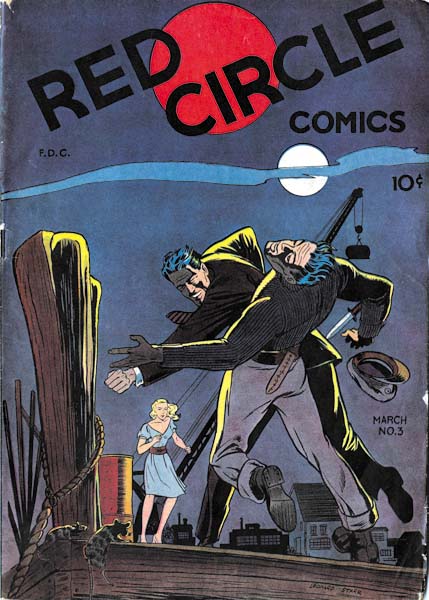
Starr, Leonard


Red Circle #3 (March 1945), art by Leonard Starr

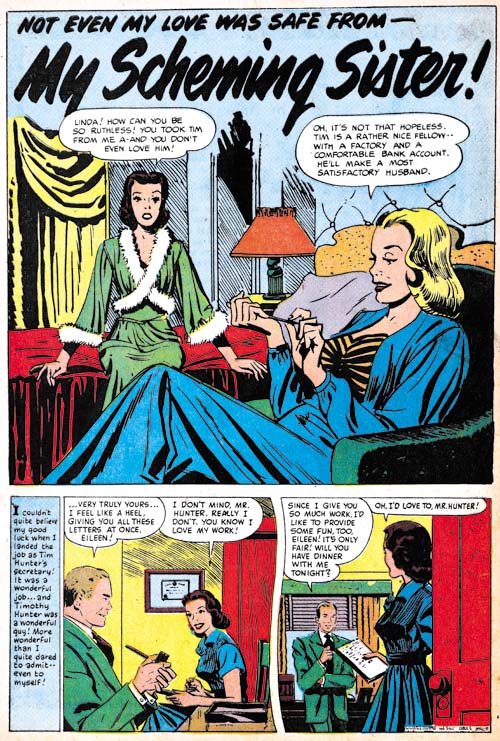
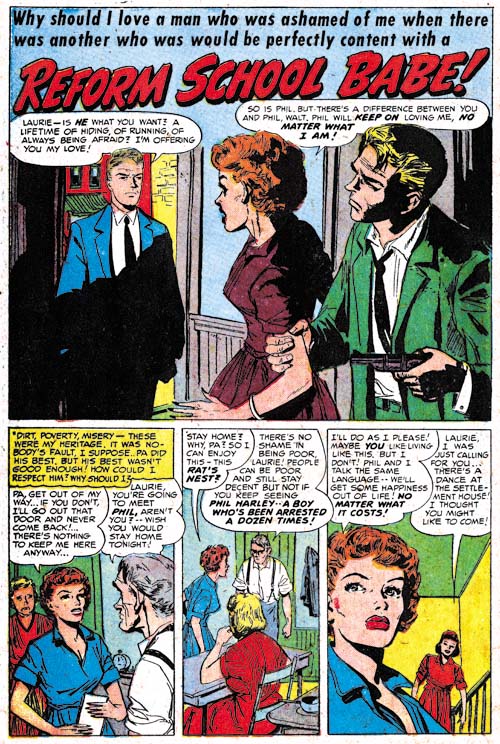
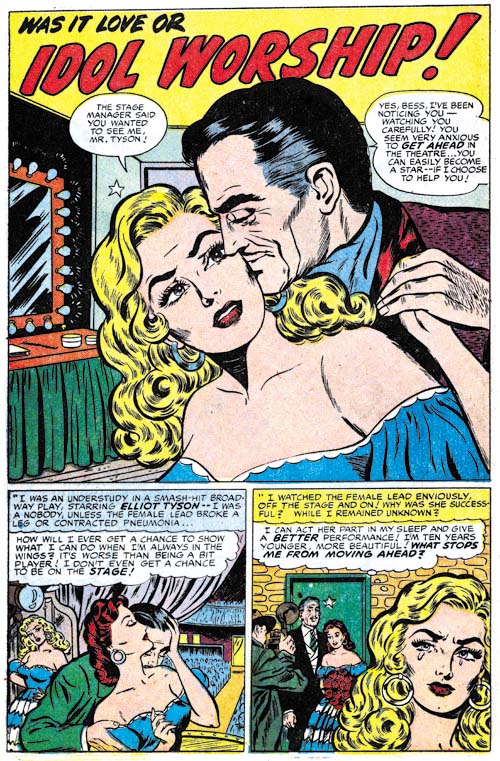
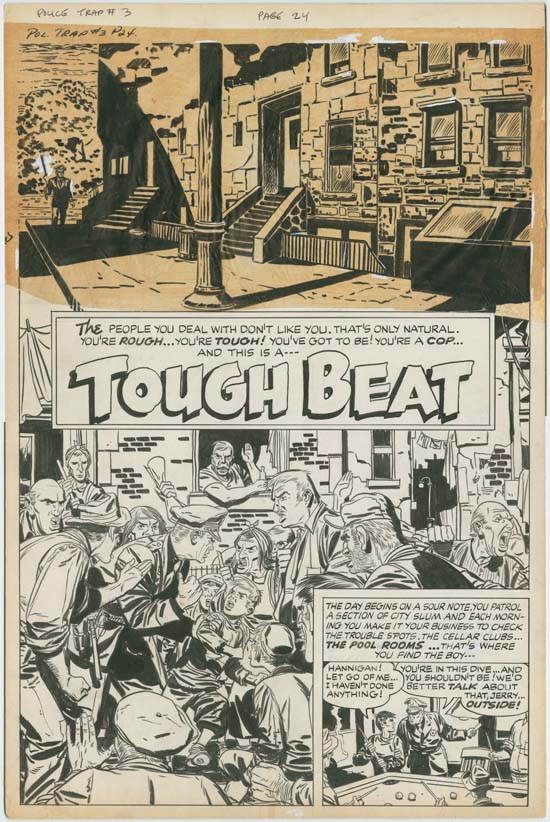
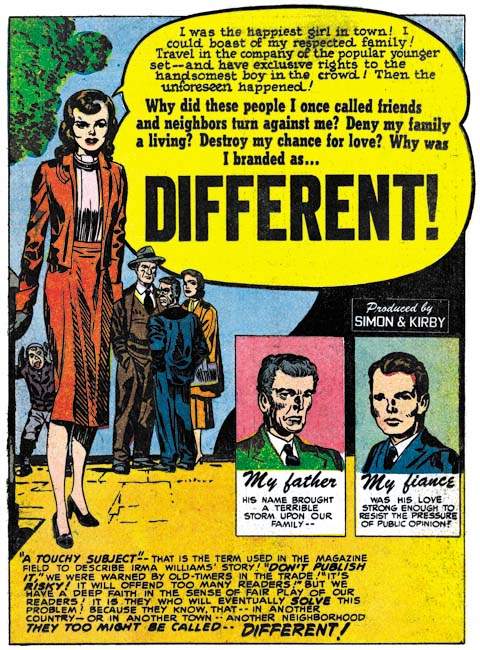
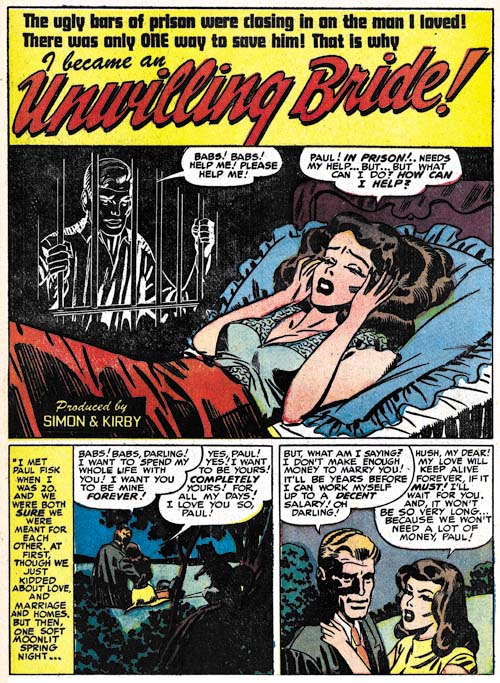
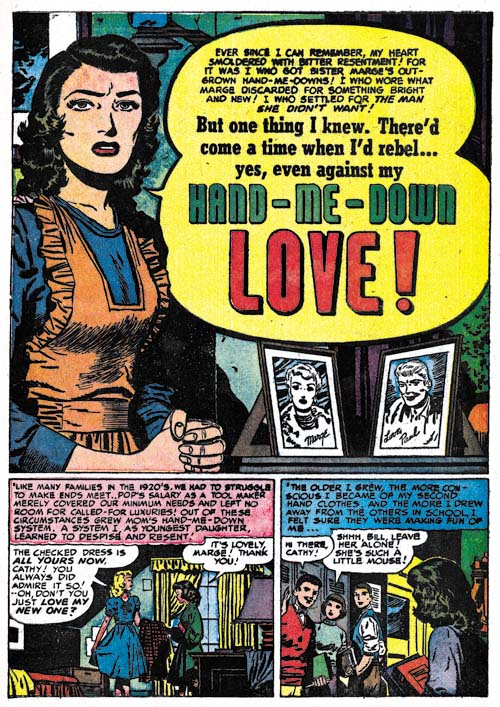
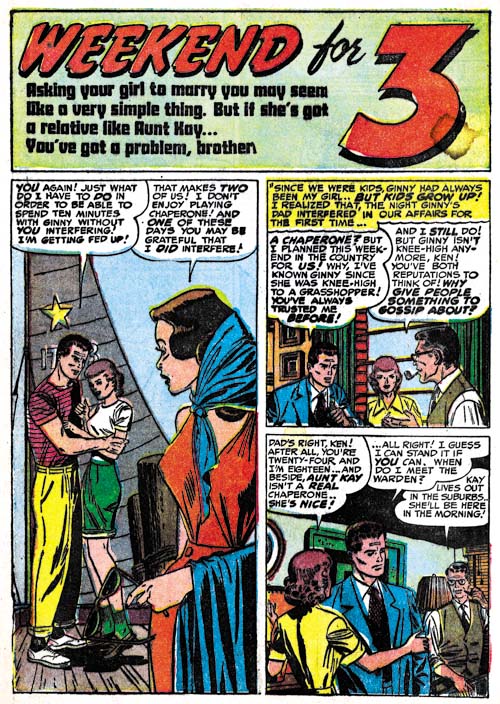
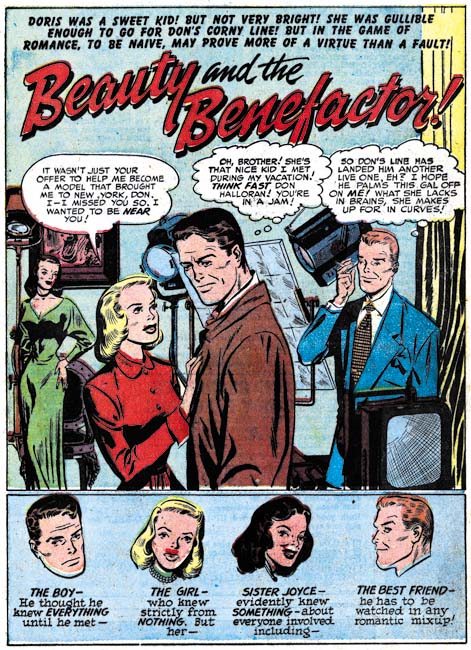
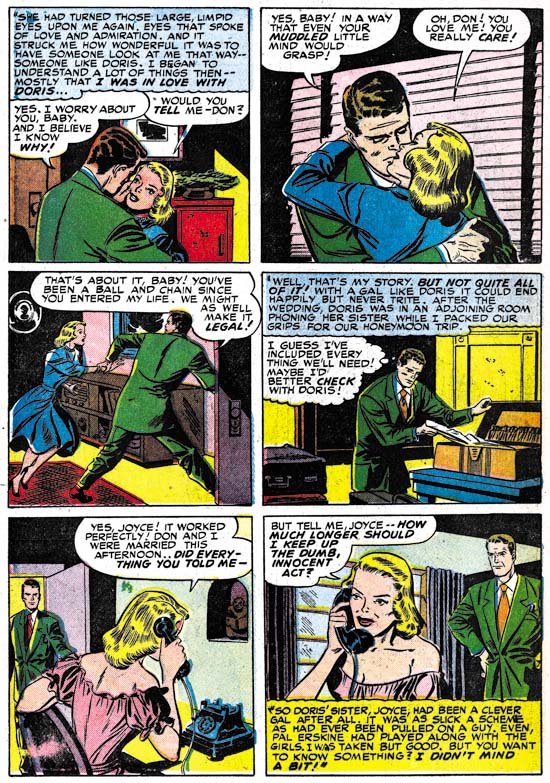
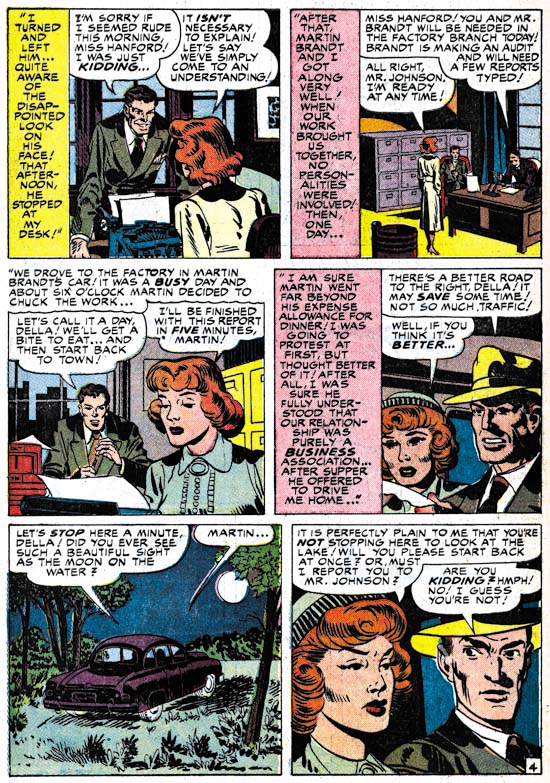
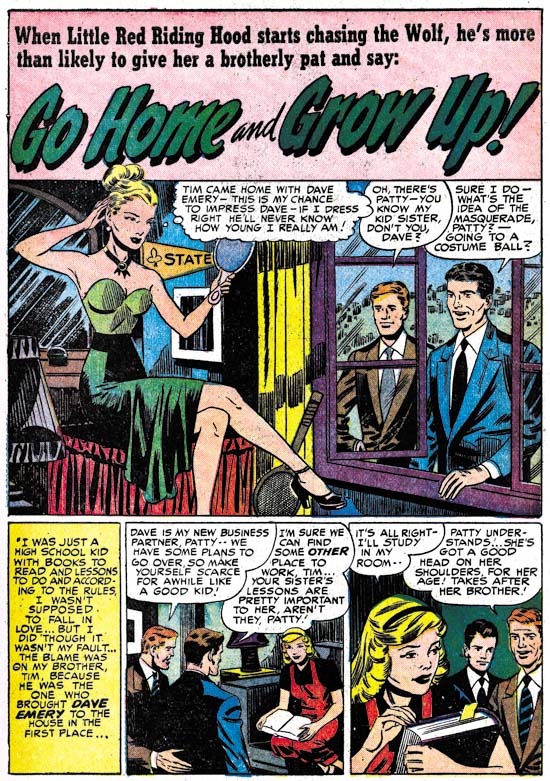
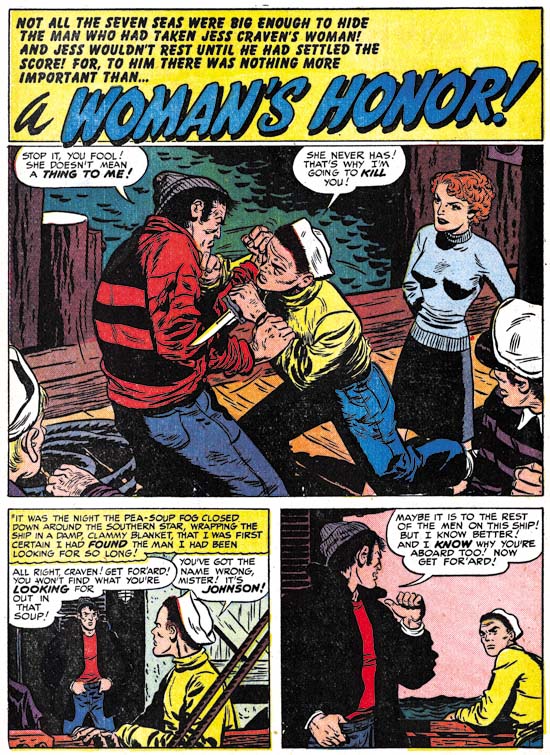
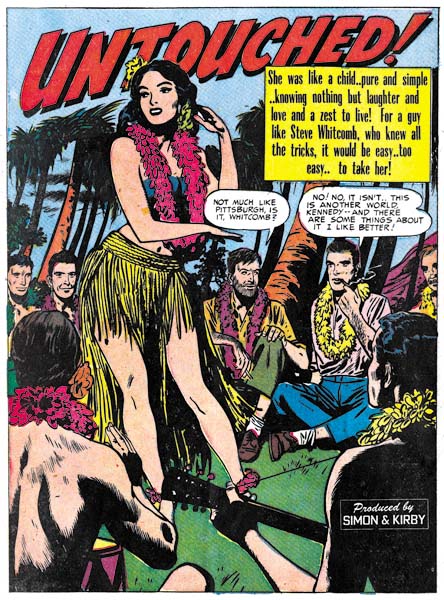
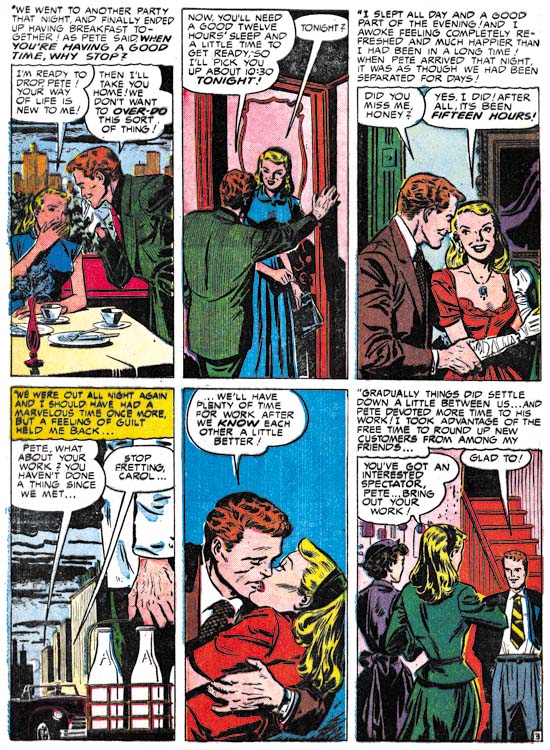
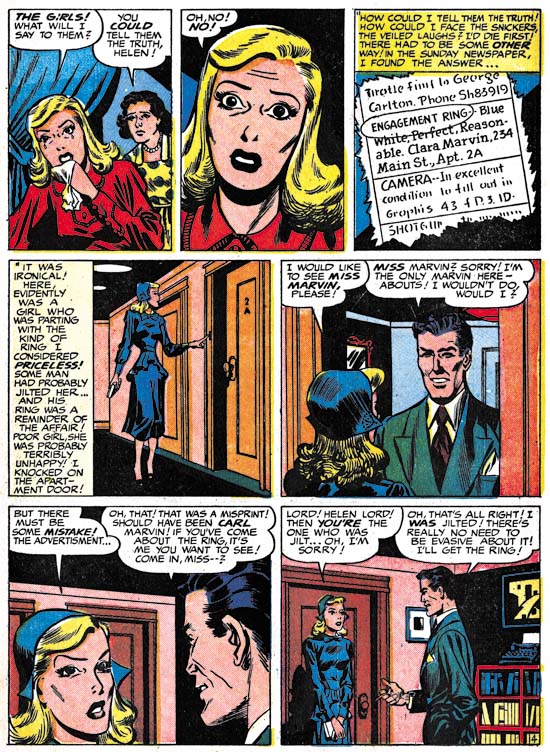
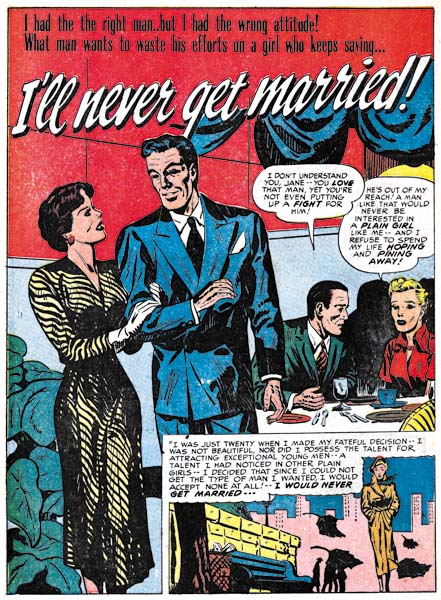
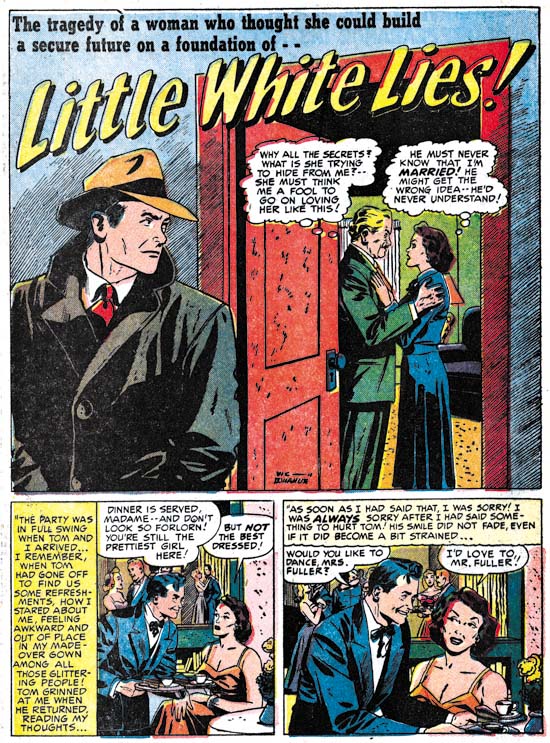
Leonard Starr began his career in 1942 and 1943 doing background art while attending Pratt Art Institute. Afterwards his worked for a variety of comics including Red Circle published by Rural Home Publishing. Red Circle #3 was released in 1945, just four years before Starr’s appearance in Simon and Kirby productions (April 1949). What a difference a few years can make. While I can detect some familiar features in Starr’s earlier art, I doubt I would have identified any of it if the signatures had been absent.

A fight scene dominates the cover for Red Circle #3. A brave man wins with his bare hands against a knife carrying opponent. An exciting cover that is excellently drawn. However in my opinion, a good cover should tell a story. Part of the story is here. The man on the wrong end of the fist had, as indicated by his hat, a maritime profession. This is fitting as the mooring ropes and rats show the locale to be some seedy port. But what is the cause of the conflict? Is it the woman who looks on? She shows an interest but no fear, so a heroic rescue is unlikely.  So what does it all means? The art is well done but the story is confusing. Unfortunately the cover has nothing to do with the contents of the comic, so we will find no answer to the question.


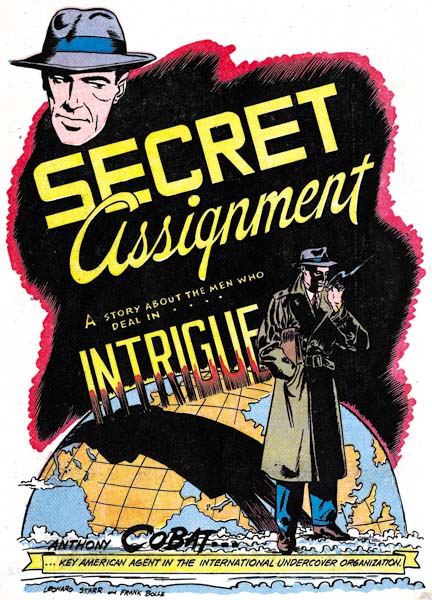
Red Circle #3 (March 1945) “Secret Assignment”, art by Leonard Starr and Frank Bolle

Starr and Bolle provide a better job for the splash of “Secret Assignment”. Anthony Cobat literally casts his shadow over the globe; he is an agent in a fight against international crime. With a briefcase under his arm, a nondescript overcoat and his face shadowed, the image of Cobat is derived from Hollywood; the use of “intrigue” in the title is superfluous.


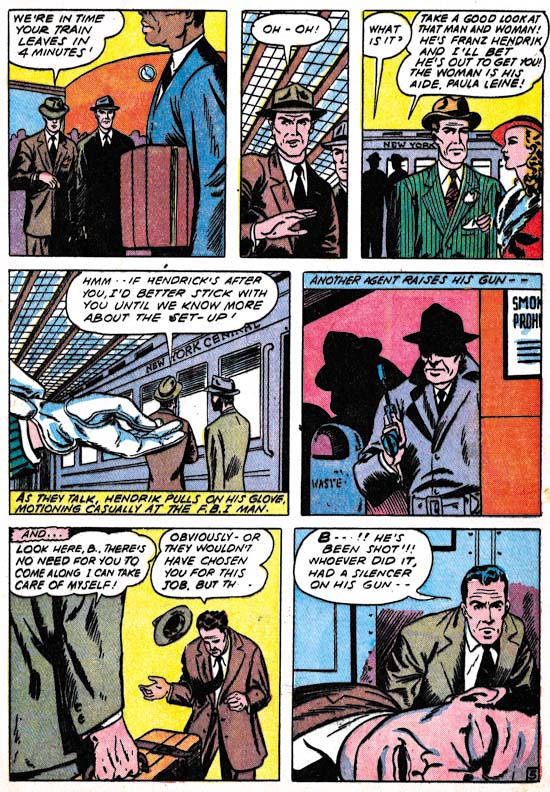
Red Circle #3 (March 1945) “Secret Assignment” page 5, art by Leonard Starr and Frank Bolle

Starr and Bolle also did a great job in the story. Their playing off of fore and backgrounds is well done. For example, the man in the stripped green jacket in the foreground is pointed out as an agent by one of the two men in the background in panel 3. In Panel 4 the foreground is dominated by a pair of gloved hands. These hands could have mistakenly been attributed to some woman except just enough of a sleeve is left to show the same green with stripes. Of course the caption also identifies the owner of the gloves and indicates that there was purpose behind the simple act of putting on gloves. My only complaint to offer about this page can probably be laid at the writer and it is an all too common error. There was really no reason to add the caption “ANOTHER AGENT RAISES HIS GUN” to panel 5, the picture was sufficient and would have been more effective without the caption. Panels without captions or word balloons were rare exceptions during the golden age of comics.

“Secret Assignment” was jointly signed by Leonard Starr and Frank Bolle. Bolle is an artist just a little older then Starr. Like Starr, Bolle’s career has included both comic book and syndication strip work. Since his name follows Leonard’s, Frank may have been the inker. But we have seen that such an interpretation maybe over simplistic for some teams such as Robinson and Meskin, or, for that matter, Simon and Kirby.

For work that Starr did for Simon and Kirby, he showed a preference for a page layout with one or two rows consisting of three, vertically extended, panels. That type of page layout is not found in “Secret Assignment”. However a related layout can be found; one where a panel row is unequally divided into three panels one of which assumes a narrow shape. The effective use of this narrow panel may have made it a forerunner of the vertically extended panels found in Starr’s Simon and Kirby work.


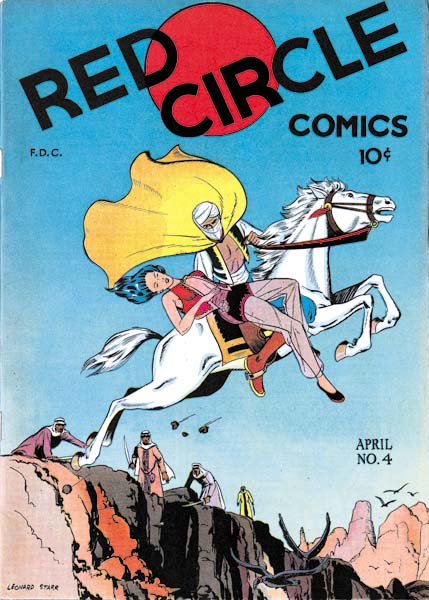
Red Circle #4 (April 1945), art by Leonard Starr

Another nicely drawn cover by Starr with, once again, a confusing story. The woman being carried away seems limp so very likely she has fainted. It is an abduction perhaps from the men in the background who are unable to pursue. A jump over some gorge might be indicated but the vultures flying below suggest a cliff instead. Was the horse magical or was there an unseen but safe landing? Who can tell? Of all the art the woman’s face is the closest to the style Starr would use later for Simon and Kirby.

It would be great to be able to show an image for the story Starr provided inside of Red Circle #4 but I am unable to do so. The interior of my copy is filled with Dorothy Lamour stories. If that was not bad enough, the first one does not even have the splash page. None of this matches what the contents of this issue should be. It looks like a Frankenstein; a combination of the Red Circle #4 cover with an old Dorothy Lamour contents. There is no sign of trimming so I believe this was done years ago. I have heard of publishers who repackaged material for resale, but this seems like an egregious example of that practice. According to the GCD, Fox Comics published a couple of issues of a Dorothy Lamour comic in 1950, but the story titles that GCD provides do not match those in my comic.

(January - April 1950: Young Romance #17 - #20, Young Love #7 - #8)

 
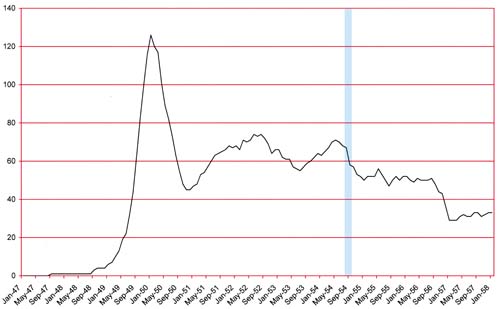
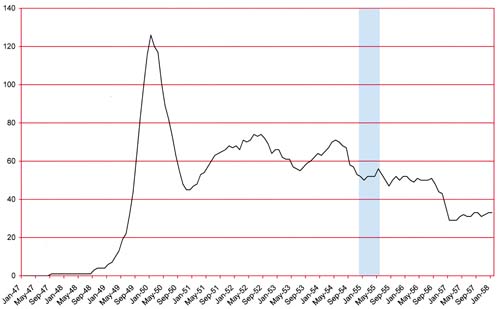
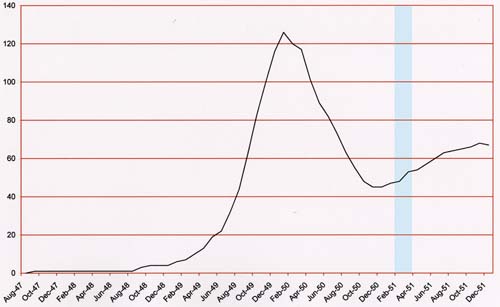
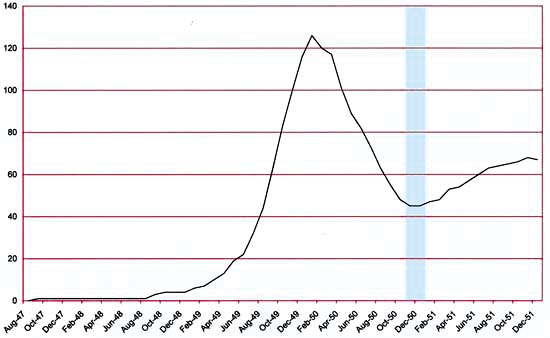
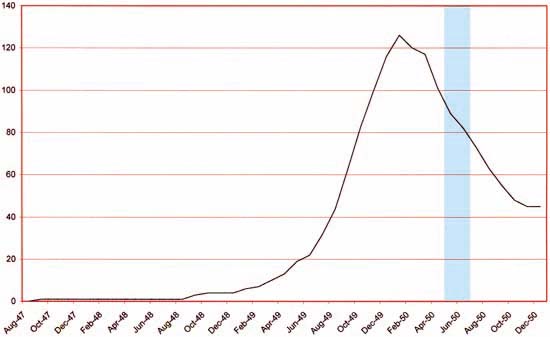
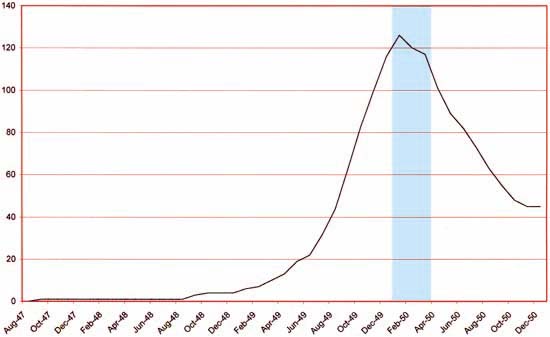
Number of Romance Titles 1947 - 1950 (the period covered in this chapter shaded in blue)

This chapter will cover the period from January to April 1950. This is the height of the love glut and the beginning of the decline in romance titles that followed. For Prize Comics the dropping of titles had not begun since the final issue of Real West Romances would come out in April. Young Romance had been and would remain a monthly. The presumably poor sales experienced by the western romance titles because of the glut was not shared by Prize’s standard love comics as Young Love became a monthly with the April issue. Frankly I am not clear what Simon and Kirby’s status was at this time with the crime titles Headline and Justice Traps the Guilty. At some point Joe and Jack seemed to have passed on the production of those titles to Prize Comics. A better understanding of exactly when that happened will hopefully be achieved as I advance further in my serial post It’s A Crime.

I have no explanation why in the last chapter Jack Kirby’s output dropped so much but now he returned to being the primary artist, at least by page count, with 6 stories and 71 pages (I am excluding illustrations for text features as they are minor works and may include recycled art.) Bill Draut, now again the second most used artist, actually had more stories but fewer pages (8 stories with 53 pages). The discrepancy is caused by the lead stories provided by Kirby have the highest page counts (13 to 15 pages). The two longest stories by artists other then Kirby were 10 and 9 pages while most were 8 pages long. As noted in the previous chapter Kirby would provide the lead story for Young Romance while Bill Draut would have the honor for Young Love. The general rule from now on will be Kirby more or less regularly providing a long lead story to Young Romance and this would be the only real distinction between the contents of Young Romance and Young Love where the lead story was generally done by other artists.

Other artists significantly trailed Kirby and Draut in page counts. The number of artists used in YR and YL drops, and the artists have been seen previously in either the standard or the western romance comics. As was true in the last chapter, Kirby did not supply layouts to any of the artists in this period. This was in contrast to the early issues where some of the less talented artists worked using Kirby layouts.


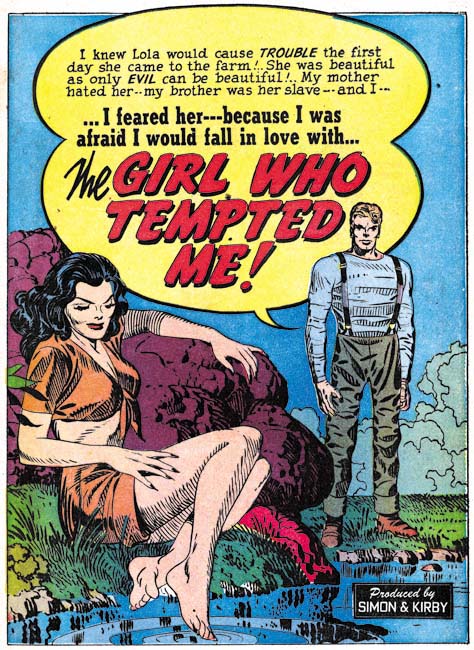
Young Romance #17 (January 1950) “The Girl Who Tempted Me”, art by Jack Kirby

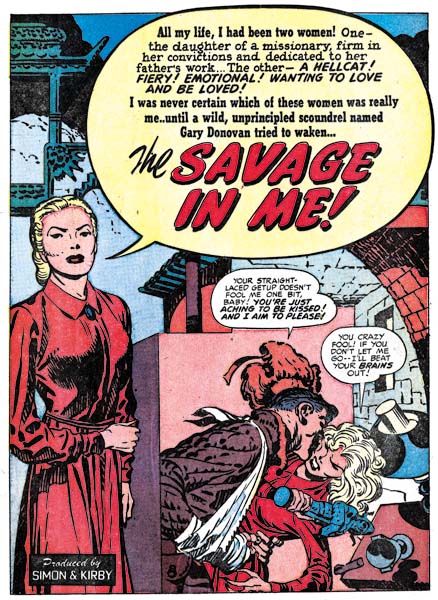
Jack Kirby persists in providing exceptional splashes for his long lead stories. The use of a character introducing the story with the word balloon forming the title has become a trademark of Simon and Kirby romances. (As this splash layout will be repeatedly seen, I am going to refer to it as the soliloquy splash.) The very provocative splashes would be more risque then the actual story. These splashes are often very simple in composition but very effective nonetheless.


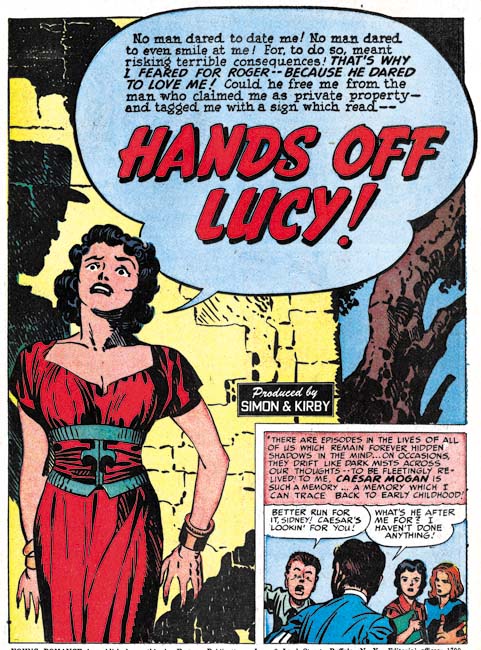
Young Romance #20 (April 1950) “Hands off Lucy”, art by Jack Kirby

Okay maybe I do not have much more to say about Kirby’s splashes, but they are so great (in my opinion) that I cannot resist including an image of another one.


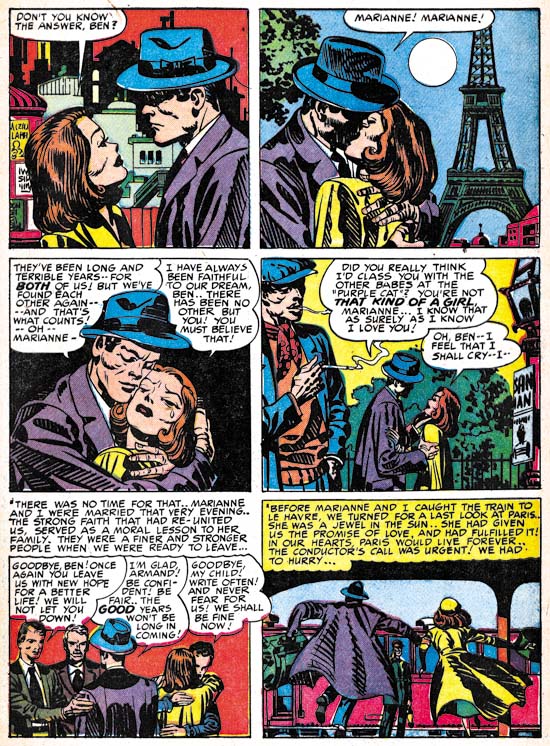
Young Romance #19 (March 1950) “That Kind of Girl” page 13, art by Jack Kirby

Of course comic books are not all about splashes, those were just the devices to entice a reader to buy the comic and read the story. Jack always considered himself as mainly a graphic story teller. Although today Kirby is primarily for his work on superheroes, he was exceptional in pretty much every genre that he worked on. Because of the unique nature of his romance stories, it is clear that Jack was not just illustrating someone else’s script. He must have been an active participant in the plotting and I am sure that he continued the long S&K tradition of changing the script as he saw fit. At this time Jack liked to give a special quality to his romance stories by adding something beyond just romance. I am not sure how the readers of Young Romance and Young Love at that time (overwhelmingly teenage girls) felt about Jack’s romances but I am convinced that if these stories were given a chance many of today’s more adult readers would find them interesting reading.

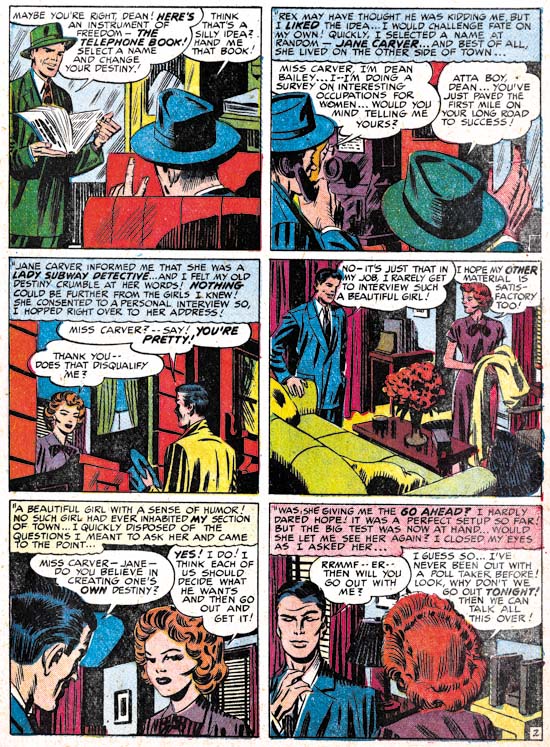
For the most part Jack has adopted a very standard page layout of three rows with two panels in each row. Kirby would occasionally depart from that pattern when the story called for it but that would be the exception. Gone were any uses of circular panels. Figures would not extend beyond a panel’s border although captions or speech balloons might. My description of Kirby’s layouts might make his work sound dry and uninspired but that is certainly not the case. Using a standard panel layout seems to allow Jack to concentrate on depicting the story. Further when the story called for an alteration in the panel layout it was then that much more effective. Kirby was a master of use of changing view points, the addition or removal of background, and even the careful accommodation of speech balloons as the above page amply shows. It was not just melodrama, it was great melodrama! (An honest appraiser would admit that was true of Kirby’s superhero work as well.)


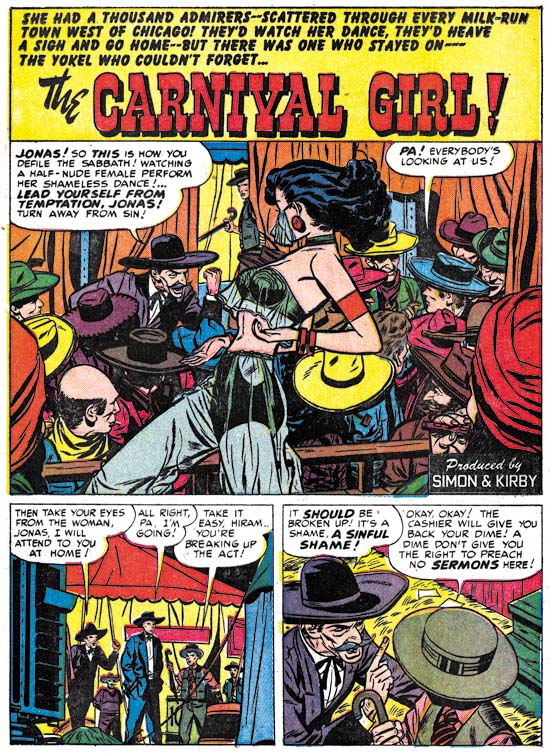
Young Love #7 (February 1950) “The Carnival Girl”, art by Bill Draut

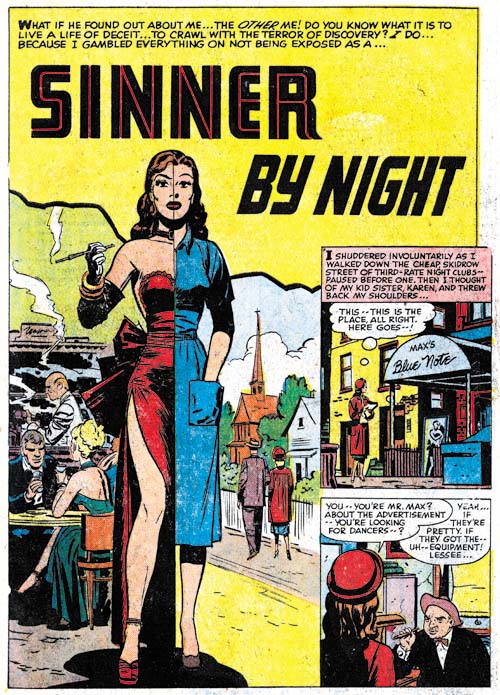
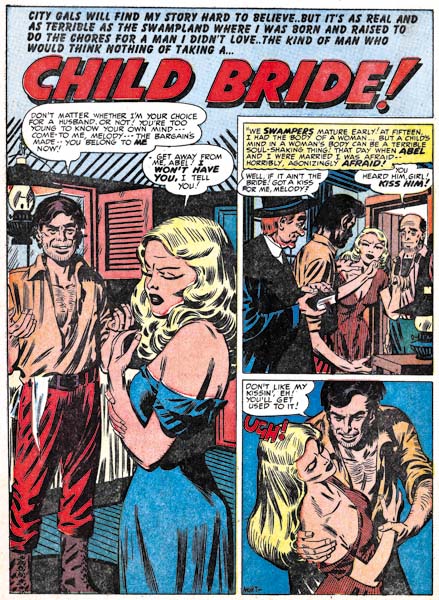
Bill Draut’s position as the number two artist at this time was justified. He could fill a splash panel with a cast of characters each with their own distinctive personalities. Bill was no longer used as an artist in Headline or Justice Traps the Guilty, but this was not due to any problem in handling action since in his romance art he had no problems when action needed to be depicted. Perhaps of even greater importance for love comics, his women, while stylized, are attractive. All of these talents and more are shown in the above splash. Some of Draut’s stories start with a soliloquy splash even though they are not lead stories. Perhaps they were originally intended as lead stories but in the end placed elsewhere in the comic. Although I have seen this happen to Draut, I do not recall a Kirby soliloquy splash that was not the first story.


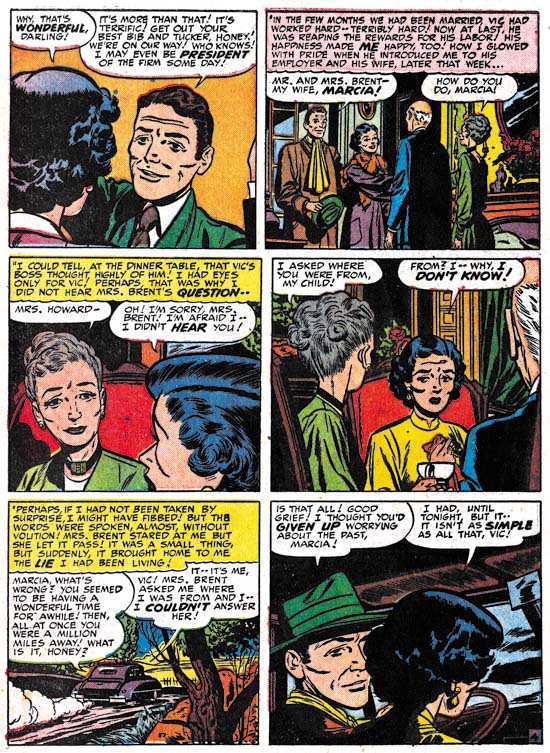
Young Love #8 (April 1950) “Every Man I Meet” page 4, art by Bill Draut

Like Kirby, Bill Draut generally kept to a standard six panel page layout. If anything he adhered to this layout even more then Jack. Bill would vary view points to keep the visuals interesting but he was not as cinematic as some other comic book artists. Draut graphically tells his story in a straight forward and understated manner. While the reader may not always be amazed by Draut’s art he will always find an entertaining and clear story.


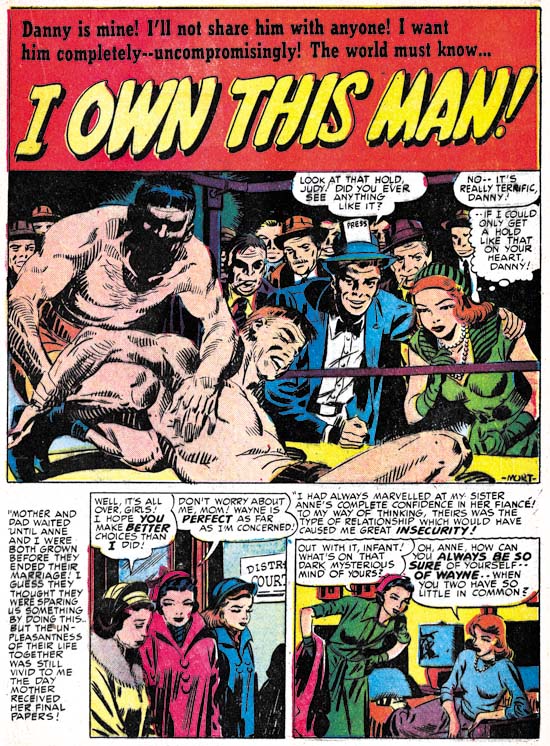
Young Romance #18 (February 1950) “I Own This Man”, art by Mort Meskin

Mort Meskin first solo work for Simon and Kirby appeared in the month before the time covered in this chapter. During this period Mort played no more important a roll then any of the other studio artists (excluding Kirby and Draut). He supplied 4 stories and 2 short features with a total of 32 pages of art. While his presence was not insignificant it was nothing like the prolific output that Mort would achieve in the future. Interestingly Mort was initially used only for the standard and western romance titles, his first crime work would be in the March issue of Headline. Perhaps Meskin’s artist block was not completely overcome by Joe’s strategy of placing random pencils marks so that Mort would not be faced with a blank page.

Meskin’s preference was for a first page; two thirds of which would be used for a splash panel leaving room for a single row of story panels. Most commonly it would have the layout seen in the image above. (Again, these splash page layouts are seen so often that providing them with a name seems a good idea; I will use square splash for those with the story panels arranged horizontally and vertical splash for when the story panels are arranged vertically.) While working in the Simon and Kirby studio Mort did his own inking. Generally this included spotting formed by long parallel, sometimes overlapping, groups of lines. Occasionally, as in “I Own This Man” Meskin would use picket fence crosshatching similar to that found in the Studio style. (For a more complete discussion of Mort Meskin’s inking technique see my post Kirby Inkers, Mort Meskin, for an explanation of the terms I am using to describe inking techniques see the Inking Glossary). My search of Meskin’s work prior to joining Simon and Kirby have so far failed to uncover any examples of the use of picket fence crosshatching so Mort may have adopted it up from Joe and Jack.


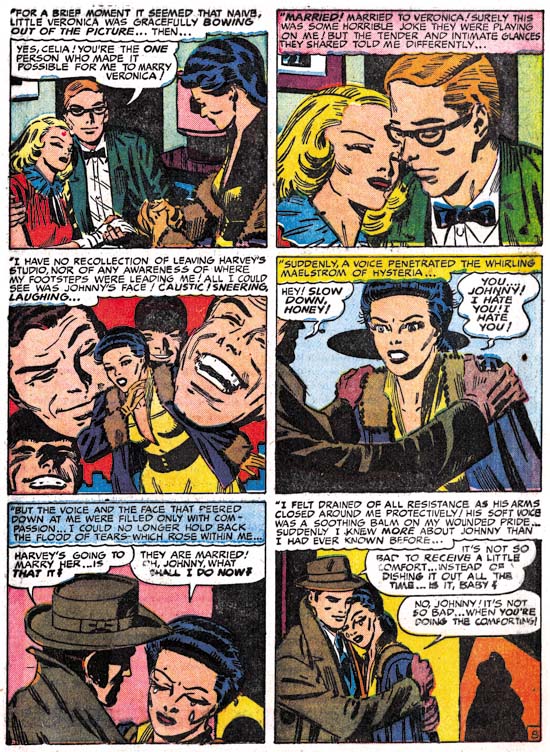
Young Love #8 (April 1950) “Danger, Soft Shoulder” page 8, art by Mort Meskin

Mort Meskin’s art was more subdued compared to his earlier hero genre comic art. Some of the more dramatic compositional devices would largely disappear. Techniques, such as the mass of floating heads used in the third panel of page 8 of “Danger, Soft Shoulder”, would now be the rare exception in Mort’s work. Instead, like Bill Draut, Meskin would concentrate more on graphically telling a story. Few other artists, if any, could do it better. Unfortunately for Mort Meskin’s current reputation, it is all too easy to overlook what he was doing. Also it should be admitted that Meskin’s art was not consistently at the same high level, perhaps a result from his push to achieve a high page production rate (with a corresponding income boost).


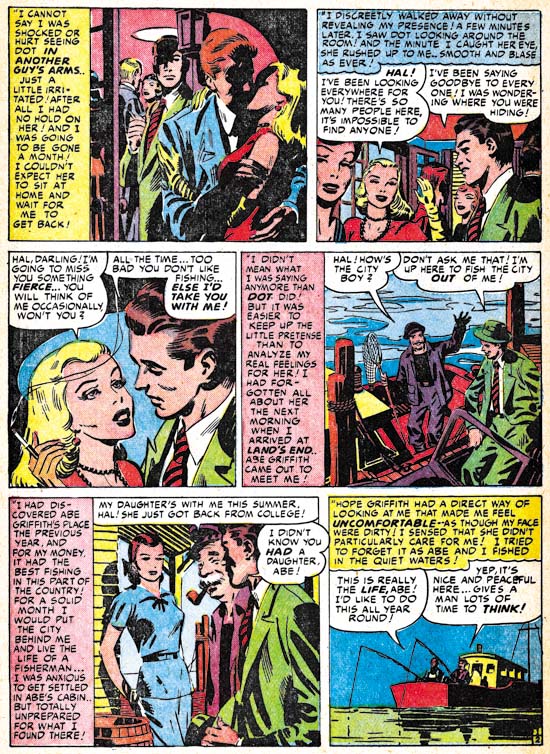
Young Romance #19 (March 1950) “The Fisherman’s Daughter” page 2, art by Mort Meskin

But it would be mistake to say that now Mort was only interested in telling a story. Mort was also a master at his use of blacks. The shadows found in the first panel of the page from “The Fisherman’s Daughter” shown above are very effective. Even when blacks are used in more limited amounts that are carefully placed to provide the most impact as can be seen elsewhere on the page and the fifth panel in particular. In a way though, Meskin’s use of whites and blacks was not separate aspect of his work. It was carefully used as one of Mort’s tools for advancing the story.

At this time Mort was also working primarily in the standard six panel page layout. But he would use other design techniques to add interest. Note the use of vertical caption boxes on the page shown above. Mort sets up a pattern of vertical captions for the left edge of the first and third panel rows, and the center of the second row. This while using horizontal captions in the second part of the first and third rows. It all provides a pattern that helps to pull the page together without being obtrusive.


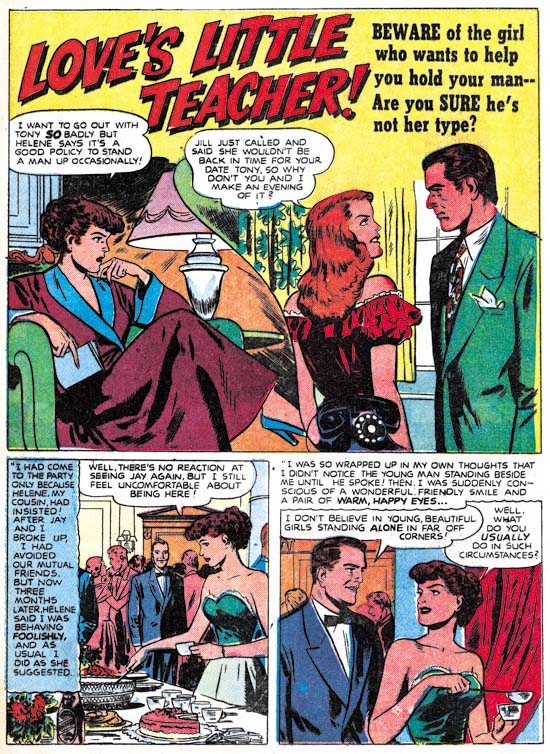
Young Romance #17 (January 1950) “Love’s Little Teacher”, art by Bruno Premiani?

I may not be able to truly show that this artist is Bruno Premiani but he is a great creator nonetheless. The splash here is unusual for him in that he provides a split scene. It is so well integrated that it is easy to overlook two separate views are presented. I have described Premiani’s women as attractive but not striking. But in the end to understand an artist’s style well enough to identify his work requires seeing enough examples. So as I continue with work on this serial post I will include further samples of the more important Simon and Kirby studio artists.


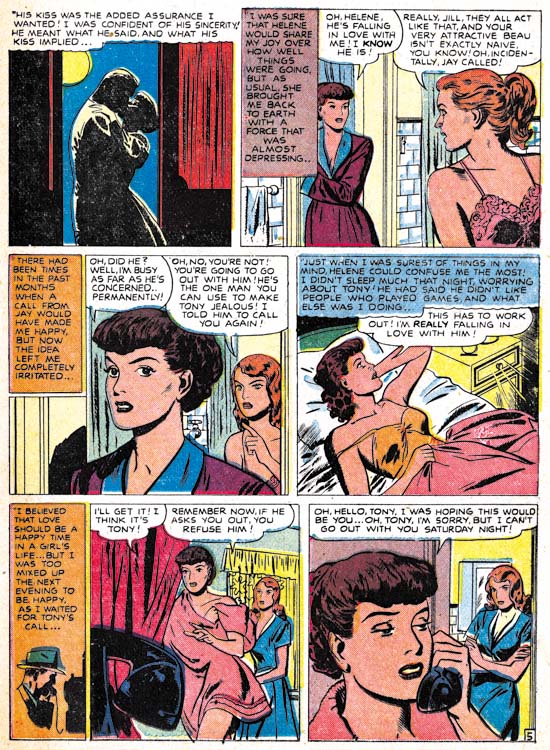
Young Romance #17 (January 1950) “Love’s Little Teacher” page 5, art by Bruno Premiani?

Bruno had an interesting drawing style but he was also, like most of S&K studio artists, adept at graphically telling a story. The page from “Love’s Little Teacher” opens with a couple’s kiss, usually more properly placed as the last panel on a page. But Premiani has other things in mind as he proceeded to show the protagonist following the advice of her cousin.  Premiani indicates to the reader that the cousin is secretly scheming by the pose he provides her in the background of the final panel. Evidentially Bruno is not just following some formula but carefully brackets the cousin’s influence between the love scene in the first panel and the misguided rejection of a date in the last. I particularly like the fifth panel with the man shown calling in the caption box and the close-up of the telephone receiving the call in the actual panel. With Premiani’s careful arrangement of the towel on the leading lady, the depiction really is not very revealing but just seems so.


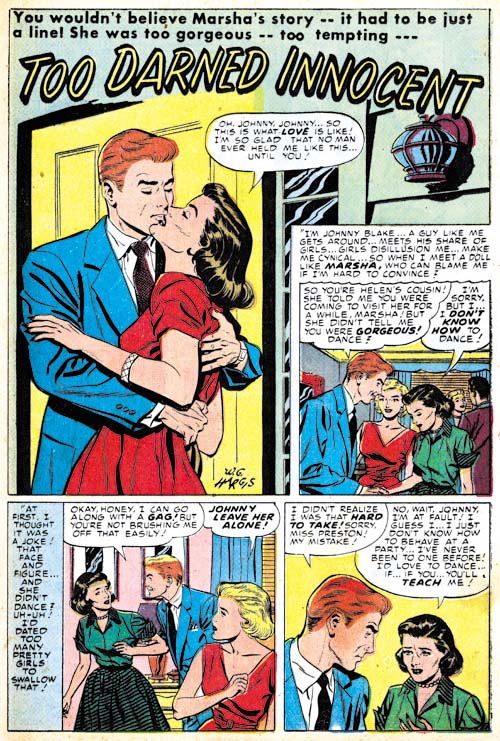
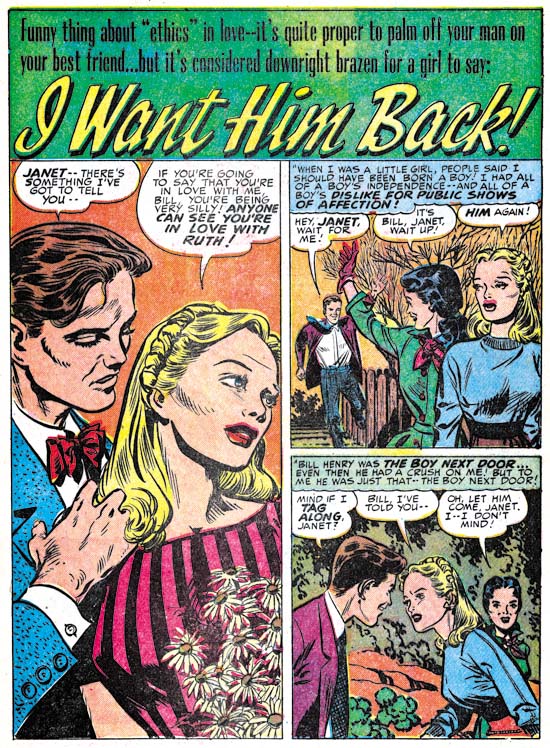
Young Romance #17 (January 1950) “I Want Him Back”, art by Leonard Starr

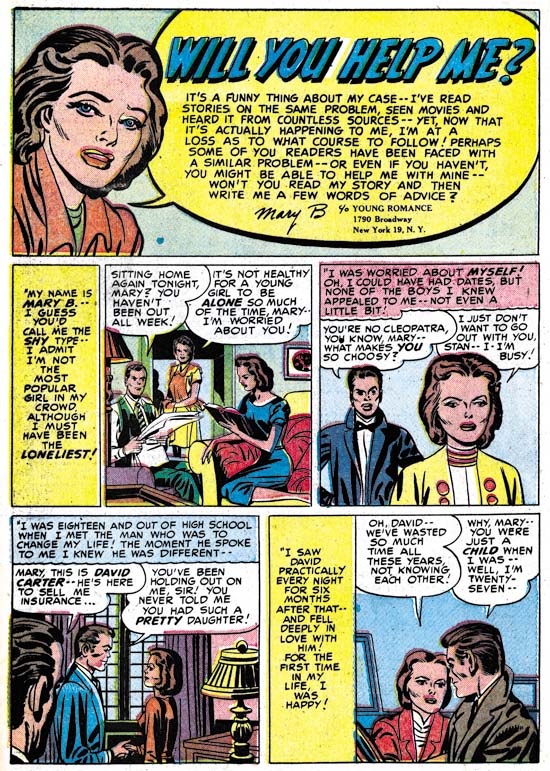
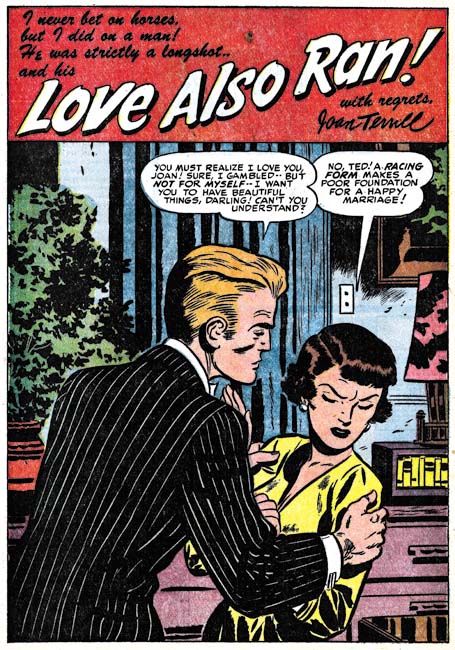
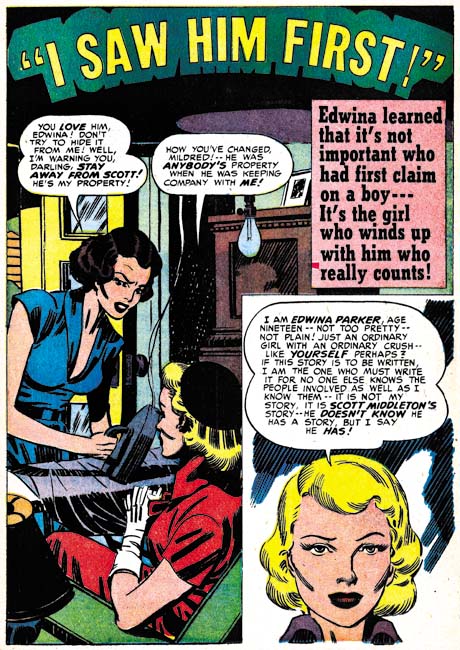
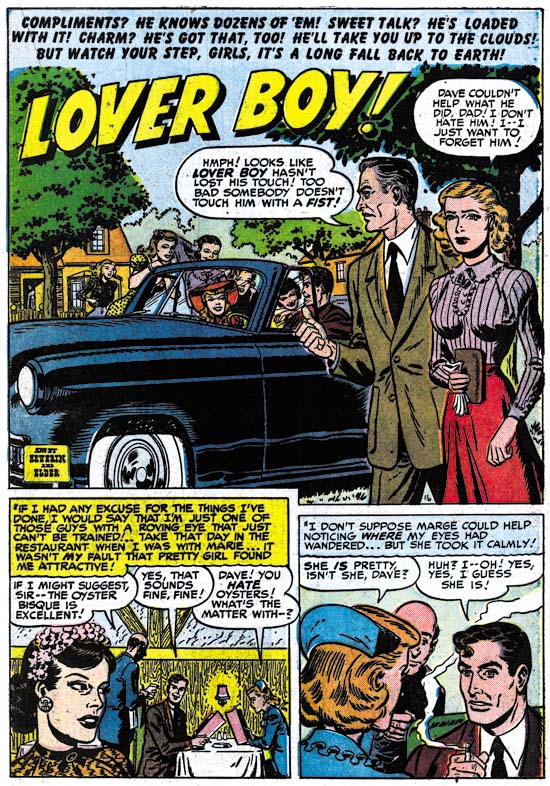
When I first entered the Simon and Kirby productions into my database I was not that familiar with Leonard Starr’s style and so it was largely stories with a signature that ended up attributed to him. Unfortunately this made Starr seem like a minor contributor since, like most Simon and Kirby studio artists, he did not sign all his art. With my current reviews and armed with a better understanding, I have been adding a number of unsigned stories as works that can be credited to Starr. I have long stressed the importance to the studio of three artists (the usual suspects: Draut, Meskin and Prentice) but there is also a second tier of artists who made an important contribution to Simon and Kirby productions but only for shorter periods of time. I would put Starr in this second tier along with artists like Premiani?, Severin, Donahue, Albistur and Brewster.

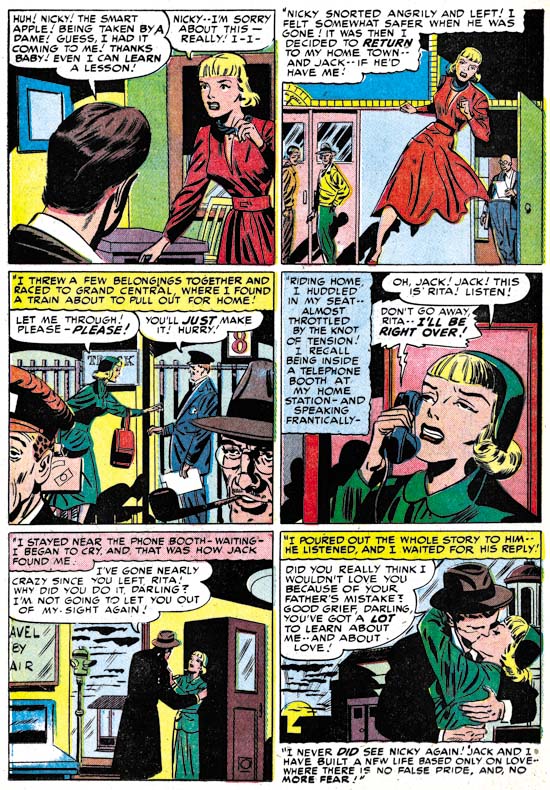
Leonard did 4 stories with 33 pages during this period. All were unsigned but with styles that are in complete agreement with contemporary signed work. Starr’s splashes were either the square or vertical layouts with, perhaps, a preference for the vertical format as seen above in “I Want Him Back”. It is the drawings of woman that I find the greatest help in identifying Starr’s work. They have an appearance that is almost frail with generous foreheads, small mouths, and narrow chins giving them a look I often describe as elfin.


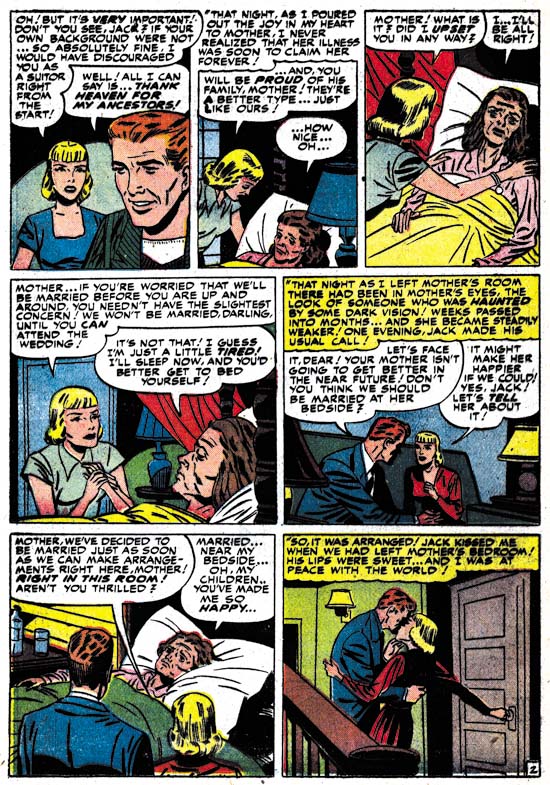
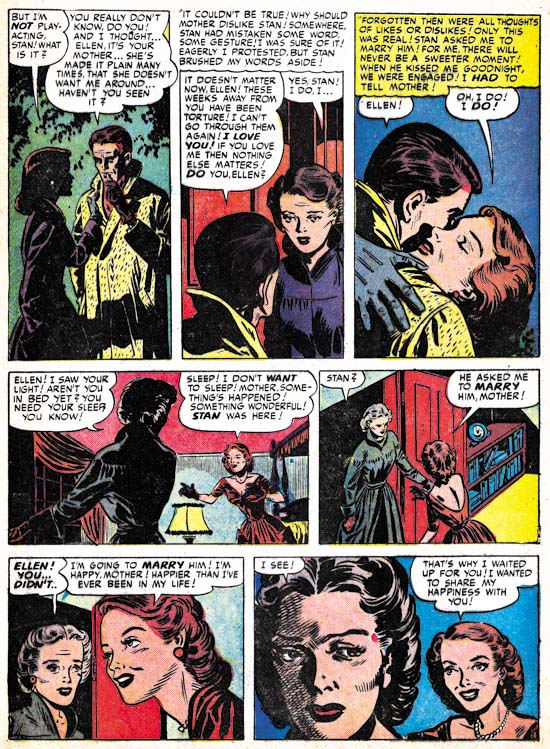
Young Romance #18 (February 1950) “Mother Tags Along” page 4, art by Leonard Starr

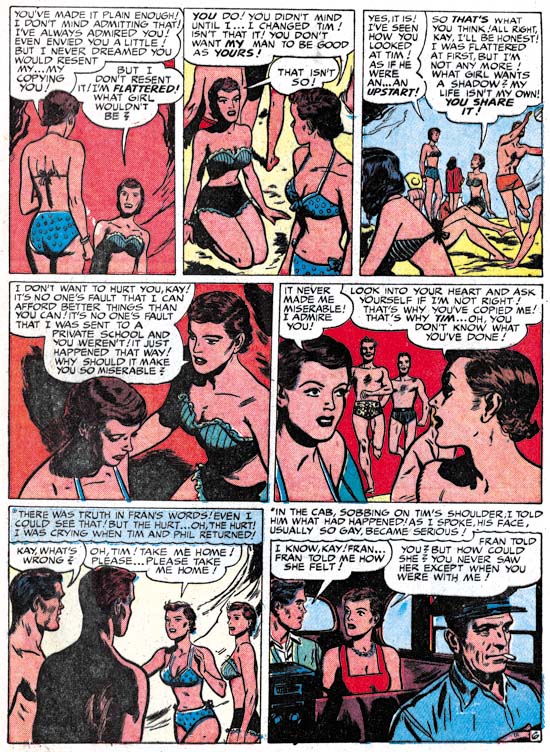
While I would not call Starr’s splashes spectacular they were well done. But it is his story art were Leonard really shines. Like some of the other studio artists, Starr would carefully vary the view point to keep the pages interesting and the story progressing. What makes Starr unique among the S&K studio artists at this time are his panel layouts. More then any of the other artists, Starr would break from the standard page layout of three rows with two panels per row. Instead Leonard preferred to introduced, when possible, a row of three panels with an extended height. Sometimes this was achieved by switching to a page layout of two rows with three panels per row. More frequently the greater height provided for one row would be compensated by decreasing the vertical dimensions of the remaining two rows. These panel layouts did more then provide interesting pages as Starr would use it to aid the story telling. Note how in the page from “Mother Tags Along” Leonard uses the narrow panels for the meeting of the two lovers physically bringing them close together while the more horizontal panels are used the woman’s discussion with her mother allowing the distance that is possible in these panels to suggest the emotional separation between them. No other studio artist at this time made such effective use of panel shapes although Mort Meskin would soon begin to use narrow panels as well.


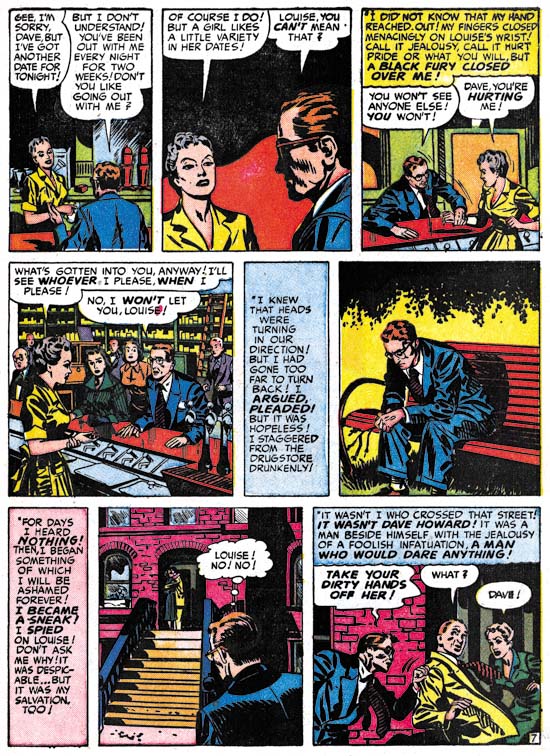
Young Love #7 (February 1950) “A Secret Affair” page 7, art by Vic Donahue

Vic Donahue’s contribution to the standard romances diminished in the previous chapter and this state continues here. There is a difference though; in Chapter 9 Vic work was restricted to the Nancy Hale feature which was 2 or 3 pages long. During this period the Nancy Hale feature was drawn by other artists. Instead Donahue would draw 1 story and 2 short features with a total of 10 pages which was well below artists like Meskin, Premiani? or Starr.

I have included the above story page to show that while Donahue was not as talented as some of the other studio artists; he was more varied in his panel layouts. I feel, however, that the handling of the story leaves a bit to be desired. For instance this page ends with one man’s confrontation with a rival. Since the last panel depicts such a critical moment the reader would expect the next page to show the result of this confrontation, perhaps even a fight. There was a fight of sorts, but at the start of the next page it is all over with the original man already defeated and on the ground! We really do not know anything about the scripts given to studio artists or how carefully they were expected to be followed, so I cannot say whether Donahue or the writer is responsible for this rather poor handling of what should have been a dramatic scene.


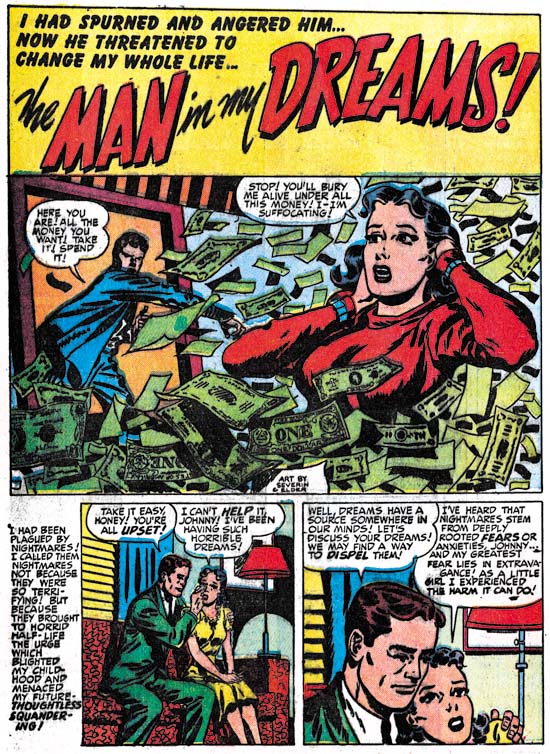
Young Love #8 (April 1950) “The Man in My Dreams”, art by John Severin and Jack Kirby

While Jack Kirby did not supply layouts for any of the artists during this period, there is at least one example of his assuming the roll of art editor. The man in the splash panel of “The Man in My Dreams” is clearly penciled by Kirby, and I believe inked as well. This is the second case of Kirby adding to or altering a splash by John Severin that I have seen (the other was in Chapter 7). If, as I believe, Kirby inked his part of the splash then most likely Kirby was correcting Severin’s finished art.

During this period Severin played a small roll in the standard romance titles. John only did 1 story and 3 features with a total of 8 pages. This is in sharp contrast to the amount of work Severin had done during this same time for the Prize western love titles.

The Art of Romance, Chapter 9, More Romance

The First Romance Comic

(Justice Traps the Guilty #6 - #8, Headline #33 - #34)
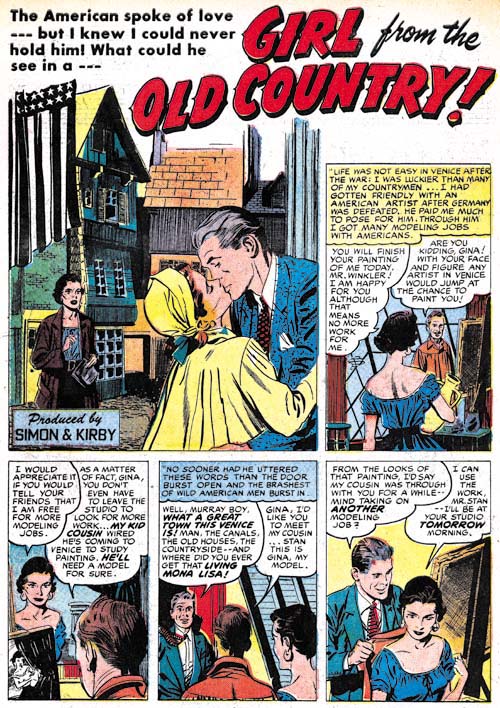
This chapter will cover the Prize crime comics from the period September 1948 until February 1949. Young Romance was also published throughout this period and the first Young Love issue would be cover dated February 1949. Charlie Chan, which featured covers by Jack Kirby and most stories by Carmine Infantino, was also published during this time interval. An important shift seems to have occurred between the material covered here and that from last chapter. Chapter 5 discussed 6 artists with attributions for all the stories. In this chapter there are 10 artists identified but 8 stories remain unattributed so the number of artists was actually higher. The change did not affect Jack Kirby very much, if at all. Jack remains the principal artist; providing all the covers and 6 stories for a total of 77 pages. Kirby supplied all the lead stories and even the illustrations for three text pieces. On the other hand, Bill Draut plays a much more minor roll rendering only 3 stories with 22 pages total. Warren Broderick would do more (4 stories with 30 pages, assuming my attributions are correct). Manny Stallman would tie Draut (3 stories with 22 pages).

There also seems to be a difference between the crime titles and Young Romance during this period. At the same time that Draut’s presence declined in the crime titles he and Kirby were still the main artists for Young Romance. Young Romance #7 (September 1948) to #9 (January 1949) would be drawn by Kirby and Draut alone. Young Romance #10 (March 1949) would also include just one story by artists other then Kirby or Draut (the team of Al Eadeh and John Belfi). This is very different from the multiple artists present in the crime titles. Eventually Simon and Kirby would stop producing crime comics; one of the reasons that I am doing this serial post is to try to determine more precisely when that happened. Simon and Kirby were certainly producing Headline and JTTG during the period covered in this chapter, but the drop of crime stories by Bill Draut may be symptomatic of a change to come.
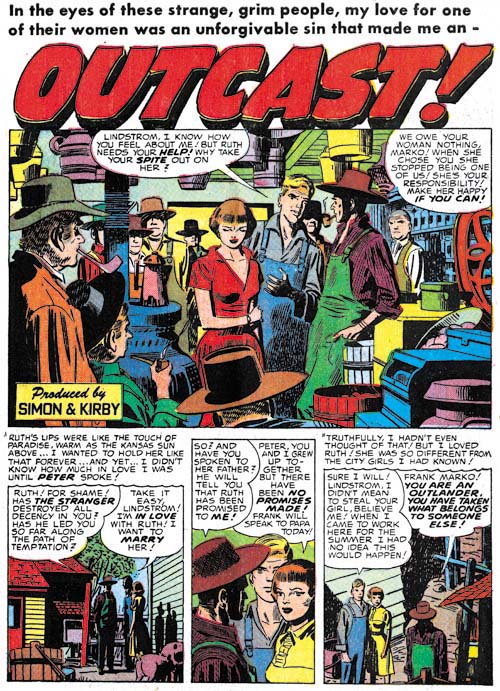
Because of the number of artists, I am going to bypass some. One to be skipped will be Bill Draut. Draut’s work during this period is pretty much the same as seen previously. Another artist that will be neglected here will be A. C. Hollingsworth. “The Amazing 3 Sinister Salesmen” (JTTG #6, September 1948) will be the last signed work that Hollingsworth would do for Simon and Kirby. So far I have not seen an unsigned work by Alvin so I suspect that Hollingsworth total output for Simon and Kirby was an unremarkable four stories. A surprisingly low number for an artist that Joe Simon still remembers. Finally there are 8 stories that I have not determined an attribution. I presently believe that 4 or 5 different artists are present but I will discuss only one of them.


Justice Traps the Guilty #7 (November 1948) “Phony Check Racketeers”, art by Jack Kirby

Most of the lead stories continued to use the motif of a character introducing the story with the speech balloon forming the title. For “Phony Check Racketeers” Simon and Kirby deviated by giving the lead story a splash design they had not previously used for crime comics. The splash actually consists of five vignettes acting as the comic book equivalent of a movie trailer. Four panels ask questions that suggest some of the content of the story while the fifth indicates that the T-Men will find the answers and once again prove that crime does not pay. I do not recall any previous splash that consisted of little more then a series of preview panels but there is some similarity to this splash to one Captain America #9. In any case it is a layout that would rarely be used by Simon and Kirby for their splashes.


Justice Traps the Guilty #6 (September 1948) “The Capture of One-Eye”, splash panel by Jack Kirby, story panels by unidentified artist

I will repeat an observation that I made in my last chapter, Jack Kirby’s crime splashes just no longer have the impact that his early ones had. I find those that Jack was doing at this same time for romance comics much more interesting. However there are occasional exceptions. Kirby certainly provided an interesting splash for “The Capture of One-Eye”. The eye is also by Jack while the story panels, as well as the rest of the story, are by an artist I have not been able to identify. The layout, with its vertical splash and story panel arrangement, is one unusual for Jack. I see no sign of Kirby layouts in this story, so it is possible that the panel layout of the first page was selected by the story artist. But the vertical panel works so well with Jack’s composition that I rather inclined to believe that it was Kirby’s selection despite its otherwise rarity.


Justice Traps the Guilty #8 (January 1949) “Underworld Snob”, art by Jack Kirby and Warren Broderick

One Kirby crime story stands out from the rest of those of this period. The inker was so heavy handed that it is rather easy to overlook this as one of Kirby pencils. It is very similar to “Mother Said No” (Young Romance #7, September 1948 ). Originally I attributed that inking of that piece questionably to Carmine Infantino. In Chapter 5 I changed my mind and now credit Warren Broderick as the inker. I am now attributing the inking of “Underworld Snob” it Broderick as well. However Joe Simon has described inking of Kirby’s work in the Simon and Kirby studio as being like a production line with different artists helping out. I bring this up because I am not convinced that all the inking was all by Warren. The spotting was done in the typical Studio style inking. More typical then Broderick used when inking “A Gangster Dies” (Headline #31, August 1948) a piece where Warren did a good job of mimicking Kirby’s style.


Justice Traps the Guilty #7 (November 1948) “The Man Who Died Twice”, art by Warren Broderick

There are four stories that I here credit to Warren Broderick, this is more then any other artist other then Kirby. But the catch is that I am not complete sure of the identification. The art is simpler then the examples of Broderick from last chapter. Further there is no danger in mistaking any of it for work by Jack Kirby. But the wild eyebrows that Broderick used occur here as well (although not on the example page shown above) and certain facial expressions are found in both groups. Perhaps Broderick is working with another artist; an arrangement that Warren once had with Harry Harrison.


Headline #33 (December 1948) “The Man Who Stole an Ocean Liner”, art by Vic Donahue

“The Mystery of Room 712″ (Headline #32, October 1948) was the first work by Vic Donahue for a Simon and Kirby production. Vic also did “The Man Who Stole an Ocean Liner” which I show above. Donahue uses a style that leans toward realism with some panels looking like they were based on photographs. Inking was done with a combination of brush and a pen. We will encounter Donahue in future chapters as well and Vic has already been discussed in the Art of Romance both for work in the western love comics and the more standard romance. As time went on Vic’s work showed less of the careful drawing and fine inking found in his earlier crime stories.


Justice Traps the Guilty #8 (January 1949) “End of a Blackmailer”, art by Manny Stallman

The biggest treat for me in this chapter is Manny Stallman. Stallman is a good graphic story teller with a style that tended toward caricature (or at least for his Simon and Kirby art). Realism is not necessarily a characteristic I look for in comic book art and I find Stallman’s style very appealing. Atlas Tales has a number of examples of his work, but all from a later period (1952 to 1957) and all unsigned. The style is different then Manny used for Simon and Kirby. So different that based on the Atlas material I doubt that I would have recognized Manny’s S&K work had it all been unsigned. But I gather Manny would often change his style. Mark Evanier has a marvelous obituary on Manny Stallman  which includes comments by Gil Kane. Kane describes Manny’s inking as “very crude but it worked”. I am very impressed by Stallman’s inking. Not for any show of dexterity, but for the impact the inking provided. Particularly well done are his panels dominated by black such as the last one in the image above.


Headline #33 (December 1948) “Underworld Parasite” page 6, art by Manny Stallman

Although he did not seem to use predominately black panels in every story, there are a number of examples I could have selected. Perhaps page 6 “Underworld Parasite” is the best one. The drawing itself is not that exceptional, but the use of blacks makes this nighttime rendezvous very memorable.


Headline #34 (February 1949) “Twenty Second Story Man” page 6, art by John Guinta and Manny Stallman

In my last installment of The Art of Romance I said I only knew of one work by the team of John Guinta and Manny Stallman for the S&K studio (”The Life of the Party”, Young Love #6, December 1949). I must not have checked my database because there was one other, “Twenty Second Story Man” shown above. (This time I double checked, these two are the only work by Guinta and Stallman in my database). I know little about John Guinta and a Google search did not provide much information. John Guinta’s pencils are distinctive; especially the eyebrows of woman, and it should not be hard to recognize unsigned work, if there is any, in the Simon and Kirby productions. It is interesting to compare Stallman’s inking of Guinta with that on his own pencils. Manny’s use of panels dominated by blacks shows up in “Twenty Second Story Man” as well.


Justice Traps the Guilty #7 (November 1948) “Burke and Hare”, art by H. Colben?

I have included “Burke and Hare” because the artist’s signature is found in the last panel of the story. Unfortunately it is hard to make out the name but my best guess is H. Colben. That, however, does not help much because I have been able to find anything about an artist with that name so perhaps I have misread the signature. Colben is not the greatest of artists but he does have some distinctive features to his style and should be easy to determine whether he produced anything else for Simon and Kirby.


Headline #32 (October 1948) “The Clue of The Horoscope”, art by an unidentified artist

As I mentioned earlier, there are a number of stories that I have not been able to provide attributions. But there are a couple of stories, “Joe Slade, Wild West Jekyll And Hyde Desperado” (JTTG #8, January 1949) and “The Clue of the Horoscope”, by an artist I particularly wish I could identify. This artist uses what I would describe as a severe, sometimes even primitive, caricature style. As is seen often in Simon and Kirby productions, the splash panel shows aspects of the Studio style inking while the rest of the story is not. But there are other traits in the splash inking that deviates from the Studio style and agrees with the story inking. Most importantly the way some of the cloth folds are feathered is normally not an attribute of the Studio style. The picket fence crosshatching (see the Inking Glossary for an explanation of my inking terminology) has a hardness in its application that agrees with the inking found throughout the story. The best explanation for all this seems to be that the artist purposely adopted aspects of the Studio style so as to match better with other stories in the comic. It does seem that splash panels often are done in the Studio style.


Headline #34 (February 1949) “The Medium Done Murder Case”, art by Leonard Starr

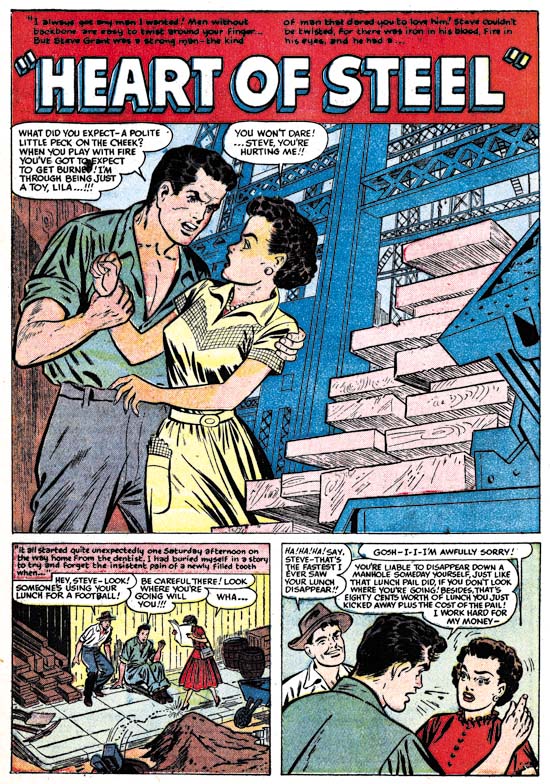
“The Medium Done Murder Case” is the earliest example of work by Leonard Starr for Simon and Kirby productions. It is unsigned but the style closely matches signed work by Starr. The women generally have an elfin look that is characteristic of Starr’s work for Simon and Kirby. Leonard would later produce a good amount of work for the western love titles (covered previously in The Art of Romance, Chapter 7)  and some standard romance as well (The Art of Romance, Chapter 5). Starr signed much of his western love work but nothing in Simon and Kirby’s crime titles bears his signature. It will be interesting to see if further unsigned work can be found.

It’s A Crime, Chapter 6, Forgotten Artists

It’s A Crime, Chapter 8, The Chinese Detective

(Real West Romance #1 - #7, Western Love #1 - #6)


Real Western Romance #6 (February 1950) “I’m Goin’ a’ Cortin’ Ella Mae” page 7, art Leonard Starr

Leonard Starr is most known for his syndication strip Mary Perkins on Stage. He had a long career but I suspect the work that he did in romance comics probably was more important in relationship to his success with the newspaper strip then what he did in any other genre. Starr was an important artist for Real West Romance and Western Love. No single artist dominated these titles but Leonard did more work then any other artist. Not all his work was signed, but I believe he provided 10 out of the 66 stories. Now in my last week’s post I mentioned that Kirby provided significant contributions to 11 stories. I hope to be able to show in my next post what Jack’s contribution was for these stories. For now let me say that most of the stories were not fully the work of Kirby and are dependant greatly on the efforts of other artists. Therefore I give Starr more credit for his efforts in these western love titles then even Jack Kirby.

In my choice of an example of Leonard Starr’s work I decided not to use one that emphasized his talents in romance (but you can see an example of that in Chapter 5). Instead I picked one that gives a good idea of his skill at graphic story telling. In this sequence we see the progression of Marsh’s decision to defy the male members of the Bates family, his arrival ready for action, and the tense confrontation. However in the final panel the action from an unexpected quarter provides a surprise ending for the page. It really is a nice example of Starr’s own graphic story telling. I feel that this page would almost certainly have been handled differently by Jack Kirby. I am sure that Jack would have put more humor in the final sequence by revealing the brooms handler. The point is not that Jack was a better artist (he was) but that I feel that this indicates that Kirby was not involved in laying out this story. This is not a new observation on my part and I am sure that I will repeat in often in the future. I simply have not found evidence to support the contentions of a few individuals that Jack Kirby provided layouts for many of the artists that worked for the Simon and Kirby studio. That is not to say Jack did not do layouts, but I will leave an explanation of what might seem like a contradiction for the next post.

Leonard Starr can present somewhat of a challenge in recognizing his unsigned work. His drawing can vary somewhat from panel to panel. For instance generally his women have a child-like or elfin look. But then in another panel the woman’s face will have a more normal beauty. I am not sure, but I suspect this sort of variation can be explained by Starr’s occasional use of swipes. If Leonard was doing a bit of swiping at this point in his career, and I want to emphasize I do not know this for sure, it was not from Jack Kirby. Starr already seems to have progressed to his own style of comic art and did not seem to fall under Kirby’s spell.

One final comment about Leonard Starr’s work in the Simon and Kirby western romances concerns his panel layouts. The most common page layout among the various studio artists was three rows with two panels per row. Now this was by no means invariable but it did dominate. Leonard Starr would use that panel layout as well but he had a distinct tendency to break the rows into three panels per row. He would sometimes go further and vertically compress two rows so that the other row would have distinctly tall and narrow panels. Starr would at times go even further yet and organize the page, as in the example above, into two rows of three panels per row so that all the panels would have the narrow format. Other studio artists would occasionally use narrow panels, even Kirby, but none of them as frequently as Leonard Starr.


Real Western Romance #1 (April 1949) “Wild Hoses and Ornery Gals”, art by Al Eadeh and John Belfi

I have previously written about the team of Al Eadeh and Jon Belfi in Chapter 5. They had a small but important presence in the early Young Romance and Young Love issues. So far the above story is the only one that I can credit to Eadeh and Belfi in the western romance comics. It is a safe bet because it is signed. Most artists that worked for Simon and Kirby were expected to illustrate any category of story. So the fact that I have attributed 6 stories to Eadeh and Belfi from YR and YL but only one from RWR or WL is suspicious. Either they were exceptions and were predominately assigned standard romance work, or some of the work I have credited to them in YR and YL was incorrect, or there is more work to be found in RWR and WL. There are still a number of cowboy love stories that remain unaccredited but so far I do no find any of them convincing examples of Eadeh and Belfi’s work. As I wrote before, Al and John were, like most artists who worked for Simon and Kirby, talented but were not what I would call exceptional.


Western Love #1 “The Tonto Express” (July 1949), art by George Gregg

George Gregg is one of my newer additions to identified Simon and Kirby artists. In the past I have either overlooked his signature or been unable to correctly read it. To the two works I spotted in Chapter 5 (Young Love #4 and Justice Traps the Guilty #17) I have now been able to add another “Fortune In Furs” from JTTG #19 (October 1950). The newly identified piece is another example of a signature I had previously seen but until recently was not able to correctly read. This last work is important because in it Gregg depicts some of the male characters with more complex eyebrows. Perhaps this reflects an influence from Jack Kirby who frequently provides expressive eyebrows. The manner the eyebrows are drawn in JTTG #19 has a pretty good match in “The Tonto Express” and that is one of the reasons I assigned that unsigned work to George. It is gratifying to be able to attribute more art to Gregg and I suspect I will find even more, but I am getting the impression that he only did a little work for Joe and Jack.


Western Love #5 “Lilly’s Last Stand” (March 1950), art by Mort Meskin

December 1949 marked the return of Mort Meskin in Young Romance #16 and Real West Romance #5. Mort had previously provided some work to Simon and Kirby but as part of a team with Jerry Robinson. Robinson and Meskin really did not do a lot of work for S&K but what they did was at a time that when only a small group of artists were supplying art for Young Romance. With his return as a solo artist, Mort would quickly become one of the essential members of the Simon and Kirby studio, or as I like to think of it as one of the usual suspects. Although I use the term “studio artist” most who produced art for Simon and Kirby did not actually work in the studio. Mort was one of the exceptions. As Joe Simon describes in “The Comic Book Makers”, Meskin initially had trouble executing his assignments. Simon was well aware of how talented Mort really was, so first Joe tried patience and when that was not enough he asked Mort to work in the studio. There Joe realized that Mort had a terror of the blank page, and so Joe would have somebody just marks the pages up. Some have claimed that this meant Jack was doing the layouts for Mort, but Joe insists that is not true; the pencils were nothing more then abstract marks. Having overcome his artist block, Mort went on to become a productive member. So productive, that his output exceeding Jack Kirby’s during some periods. I have long believed that Meskin inked his own work. During a conversation with Joe Simon I was told how inking was done in the studio using an assortment of people, “like a factory”. But then Joe paused, and added “except for Mort Meskin, he did all his own inking”. It is nice to have such confirmation.

What an unusual, but effective, composition Meskin provides for the splash panel of “Lilly’s Last Stand”. It depicts Lilly, acting as the sheriff, breaking up a barroom brawl. Normally a fight would be given center stage, but here Mort has placed the fighters in the background. Well, calling it background is a little misleading as all the characters share a rather narrow depth that Meskin makes look natural by using a high viewpoint. There is no true background as nothing is shown beyond the fighters. One of the fighters has been knocked down to the ground while the other advances on him with menace. Across the empty space stands the second fighter’s true opponent, Sheriff Lilly. Lilly is so much in control of the situation that she casually rests one leg on a fallen barstool. We only see the back of the heads of the on looking crowd, except for one that turns to seemingly comment to another observer but really to the reader. By his statement he is Lilly’s boyfriend and thus Meskin has presented a roll reversal of the sexes, the theme of the story. During his years with S&K Mort had a distinct preference for a two thirds of a page splashes. One reason appears to have been that it allowed him to play off the splash panel with the first couple of story panels. That is true here where the story panel shows Lilly in a very feminine dress in contrast to the sheriff outfit. Interestingly Mort provides another level to the contrast. I describe the dress as feminine but the high collar effectively hides her female anatomy while the plunging neckline of her sheriff outfit neckline reveals them. Was this a suggestion that the feminine roll was actually sexually repressive? Perhaps I am reading too much into it, but that is one of the greatest pleasures reading these stories some 50 plus years later.


Western Love #1 (July 1949) “A Gal, A Guy and a Gelding”, art by Manny Stallman

Another artist we have not encountered before in The Art of Romance is Manny Stallman. Had I been writing about Simon and Kirby’s crime comics, we would have seen Stallman’s work earlier because art signed by him began appearing there starting with Headline #22 (December 1948). The attribution of “A Gal, A Guy and a Gelding” is considered tentative and is based on the general style. The fact that it is the only unsigned work credited to Manny in my database suggests that further investigation should reveal more works by him (most artists working for S&K did not sign everything they did). I would not be surprised if crops up again when this serial post returns to discussing Young Romance and Young Love, but I have not found any more of his works in Real West Romance or Western Love. Currently my database only has 8 works by Stallman with the one in WL #1 being the last.

Despite the western theme, most stories from the western love comics are typical romance stories. There is however a greater emphasis on action found in RWR and WL as compared to YR and YL. “A Gal, A Guy and a Gelding” illustrates that quite well. Stallman shows he can handle the action well enough but he clearly did not learn how to depict a fight from Jack Kirby. Jack discovered quite early in his career that the best way to present a person slugged was to have him project toward the reader; Manny has the man fall away from us. Further the slugger seems to be unnaturally leaning towards us. Still there is no question about what is going on. Since this is first and foremost a romance story it has a typical romantic ending. Panel 5 shows that Manny was better then most of the artists in RWR and WL in providing a romantic image, I wonder why Manny was not used more often in YR or YL? As I previously said, most of these cowboy love stories are really romances and as such they typically end with a kiss. I have to laugh about the ending for “A Gal, A Guy and a Gelding” where instead there is a mutual embrace of a horse. (In all fairness, this was probably determined by the script writer).


Real Western Romance #3 (August 1949) “The Cowgirl and the Sheepherder”, art by John Severin and John Belfi

I left for last another artist not previously encountered in The Art of Romance. John Severin would pencil 10 stories for the Prize cowboy romance comics, the same number as Leonard Starr. I give Starr the credit for being the most prolific of the western romance artists because one of Severin’s pieces was a single page. Still Severin was one of the dominate artists, and he also did work for the crime and standard romances comics as well. Here in “The Cowgirl and the Sheepherder” he is inked by John Belfi. We had previously seen Belfi as teamed up with Al Eadeh. John Belfi was primarily an inker but he did occasionally do pencils. In fact just a couple of months previously he penciled a story for Justice Traps the Guilty. As far as I know this is the only S&K studio story where Belfi inked Severin. I thought it might be interesting to include a sample for comparison with Severin’s normal inker.


Real Western Romance #6 (February 1950) “Six Gun Serenade”, art by John Severin and Will Elder

Although this is my first occasion to discuss Severin in The Art of Romance, I did write about some of his much later work for Joe Simon. Therefore I may as well confess up front that I am not a fan of John Severin; I find his style too dry. However when studying comic art history it is important to separate personal tastes from the study itself. I may not care that much for Severin, but that does not change the fact that he was an important artist. I will also say that Joe Simon does not share my view; Joe greatly admires John Severin. On the occasion of the recent death of Will Elder, Joe commented how talented Severin and Elder were as a team and how each would become great in their own particular art form.

It is with Will Elder that John Severin is most often teamed up with in Simon and Kirby productions. Severin and Elder are an exception among the S&K studio artists in that their work was not evenly distributed among genre. Typically studio artists were expected to be able to work on any type of story. However Severin and Elder did very few standard romance stories while as stated above they did a good number of the western love subgenre. They also did some crime stories, but by this time the Prize crime titles were no longer being produced by Simon and Kirby. It was in western genre that Severin and Elder did the most work. My knowledge of Prize Comics Western (also not produced by S&K) is not adequate, but it does seem that Severin and Elder appeared there before showing up in other Prize titles. Further John and Will became regular artists for Prize Comics Western for a number of years.

Severin’s pencils can most easily be recognized by the very wide and square jaw that he usually gave to men. The reader can see a good example of this in the first panel of the page from “Six Gun Serenade” that I provide above. However I chose this particular page to show that John Severin was not always so dry or limited to serious westerns. Here we get a chance to see a more humorous Severin. His rendition of Phil mimicking Slim’s singing in the third art panel is just marvelous. Even better is Phil’s reaction in the sixth art panel after being slugged by Slim. Unquestionably, Severin had the ability to go beyond his normally dry manner when the occasion called for it. Unfortunately there was one thing that John did not seem very successful at and that is romance. If not for the text in the captions the reader of “Six Gun Serenade” would have no idea the couple in the last panel were in love. John Severin just did not seem to have the romantic touch. That may have been fine for these western love stories, but it may explain why Severin and Elder did so little work for Young Romance and Young Love. Still I must say that although I generally do not care for Severin’s work, there are occasions like “Six Gun Serenade” where he just bowls me over.


Western Love #4 (January 1950) “Six Gun Serenade”, art by John Severin and Will Elder, along with Jack Kirby

With all the comics that Joe Simon and Jack Kirby produced over the years, it is understandable that occasionally a story title would be repeated. Even so it is a bit surprising that “Six Gun Serenade” would be reused as a title within just a month. That is not why I have chosen to include the image above. The real reason is the figure of the wounded Dirk in the splash panel. It is clearly the work of Jack Kirby. The inking of the figure and the surrounding wall also appears to have been done by Jack. The rest of the splash and the two story panels were just as clearly done by John Severin and Will Elder. This is one of those cases of Kirby stepping in as art editor. It may not be too surprising that Severin’s original version was not considered good enough. A comparison of the figure in the splash with the one in the first panel that has just about the same pose suggests what may have been the problem.

There are a number of works in Real West Romance and Western Love that I have not been able to provide an attribution. Some are clearly done by the same artist and so I hope that eventually I should be able to figure who that artist was. There are also some that look like Jack Kirby was involved. These stories and the nature of Jack’s involvement will be discussed in next week’s conclusion to the western romance titles.

The Art of Romance, Chapter 6, Love on the Range
(Real West Romance & Western Love)

The Art of Romance, Chapter 8, Kirby on the Range?
(Real West Romance & Western Love)

(Young Romance #9 - #12, Young Love #1 - #4)

Young Romance #12 (July 1949) “The Man I Kept on a String”, art by Bill Draut
As discussed in the previous chapter, Bill Draut became the most prolific contributor to the Simon and Kirby romance titles within the period from Young Romance #9 (January 1949) through Young Love #4 (August 1949). Bill’s importance is also shown by the fact that for the first time a couple feature stories would be done by someone other then Jack Kirby. However with one exception (”The Plumber and Me” from Young Love #1) Bill’s stories would not be as lengthy as Jack’s would sometimes be. This is true even when it was the featured story which so far Jack had always made the longest in the comic. This was the case with “The Man I Kept on a String” which despite being the feature story is just 8 pages long. Bill’s splash for this feature story continued to use the device of a word balloon for the introduction caption and title. Was Bill just told to do this or was he supplied a layout? I just do not have a good answer to that question. The layout of this splash is unusual in having four story panels in two rows with the splash panel assuming an inverted L shape. Since that arrangement is not found in any other splashes drawn either by Bill or Jack it does not provide any suggestion as to who laid it out. Also not found in other splashes is the use of the diminished statue of the one of the figures as a visual symbol of his status. Although at this time I cannot decide on who should be credited for laying out the splash, I find the rest of these stories, and the others that Bill did during this period, to be told in his own manner and therefore not based on layouts provided by Joe or Jack.


Young Love #1 (February 1949) “Lady Luck”, art by Bill Draut

Since Draut had such an outstanding presence during this period, I though I would include another example of his work. The splash has an interesting design using a card of an ace of spades as a visual link to the title and theme of “Lady Luck”. The background for the splash panel is very unusual and I have to admit I really cannot make out what it is supposed to represent. Most splashes by Draut do not have such an emphasis on design. Again I am undecided in splashes such as “Lady Luck”, where design is so important, whether the layout was supplied to Bill or not. Before leaving this story I would like to point out the way Bill presents the adoring Ruth in the last panel of the page. This particular upward gaze with the head slightly tilted was another of those trademarks of Bill Draut.

This period marks a change in Bill’s art work, although I am not certain what if anything can be made of it. The story “Shadows” (Young Romance #10 from March 1949) would be the last work for Simon and Kirby that Bill would sign. Previous his signatures appeared on a good fraction of his work but it would never again be used for anything else Bill did for S&K productions. I am only familiar with very little of Draut’s work after the Simon and Kirby studio closed but I have never seen a signature on any of it either.


Young Romance #10 (March 1949) “Heart’s Desire”, art by Al Eadeh and John Belfi

Draut’s higher productivity during the period helped to offset Kirby’s declining presence but it was not enough to make up for it entirely. Especially since the team of Jerry Robinson and Mort Meskin were no longer contributing either. New artists, at least new for the Simon and Kirby studio, began to provide romance stories. The most important for this period may have been the team of Al Eadeh and John Belfi. Assuming I am correct in my attributions (only 2 of them were signed) Eadeh and Belfi provided 6 stories. The usual assumption in teams like this is that the first name of the signature is the penciler and the second the inker. It should be kept in mind that the division of labor was not always so complete, as for example with Robinson and Meskin where Meskin’s presence seems more then in just the inking. However Eadeh and Belfi divided up their work the same inking style was used even for the unsigned stories that I credit to them. Eadeh and Belfi’s art is not very distinctive but there are some features that help in identifying their work. Light haired woman have thin lines that do not suggest waves and curls very sensuously; often the lines of hair are almost straight even when doing a curl. The outlines for long hair vary in thickness along its length. Some men have distinctively shaped thick eyebrows.

The splash for “Heart’s Desire” has an interesting high and tilting viewpoint. This is not at all typical of their work for either splashes or the stories. I am not sure why they adopted this tilt in this case. It does allow the title and the woman’s soliloquy to occupy the top of the panel leaving the rest with an unobstructed view. In any case it serves to make the image more interesting. I feel that the artists that did work for Simon and Kirby were usually the better ones in the business and that includes Eadeh and Belfi. They certain provided professionally done work and knew how to graphically tell a story. I do have to admit though that they really are not among my favorite S&K artists. Al Eadeh is probably best known for work he did for Timely/Atlas. John Belfi seemed to have worked for a number of outfits sometimes as penciler and other times as inker. Both Eadeh and Belfi are included in David Hajdu’s lengthy list in “The Ten-Cent Plague” of artists who did not continue working in comics “after the purge of the 1950s”.


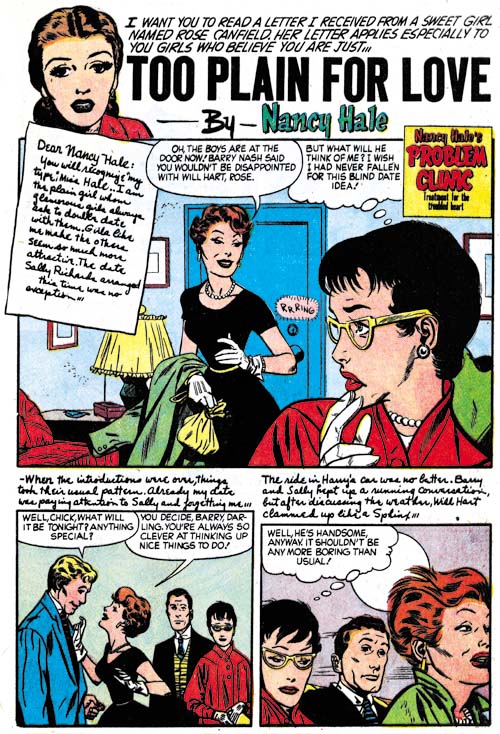
Young Love #2 (April 1949) “Nancy Hale’s Problem Clinic”, art by Vic Donahue

Another new artist for the S&K romance comics was Vic Donahue. During this period Vic would draw four of “Nancy Hale’s Problem Clinic” a short feature, usually 2 or 3 pages long, that appeared in both Young Romance and Young Love. Although Donahue was new to the romance titles his work had previously appeared in S&K crime comics starting with Headline #32 (October 1948). Vic would be associated with Simon and Kirby for a period of about three years but he never seemed to achieve much prominence in their productions. Sometimes Vic signed with his full name with a distinctive long line after the “Vic”, other times he would only use his first name but kept that long line. Donahue can best be recognized by his attractive but not overly beautiful woman. The slight tilt of Nancy Hale’s head in the first panel above shows up from time to time in Donahue’s women. It appears that, like most S&K studio artists, Vic generally did his own inking. Much attention was paid by Donahue in the rendering of hair. At times Vic used a pen to shadow an area with very straight fine lines as can be seen on Nancy Hale’s hand in the first panel of the image above. Donahue also occasionally used picket fence crosshatching or indicate shade by strong simple hatching with a brush. While both of those techniques are typical of the Studio style of inking, Vic did not use any other brush methods from that style.

There is one interesting exception to Vic Donahue as only an artist for the Nancy Hale feature during this period and that is the featured story for Young Love #4, “In Love with a Memory”. Jack Kirby penciled and inked the splash panel while Donahue drew and inked the bottom two panels as well as the rest of the story. The story matches Vic’s Nancy Hale work and does not seem to be based on Kirby layouts.


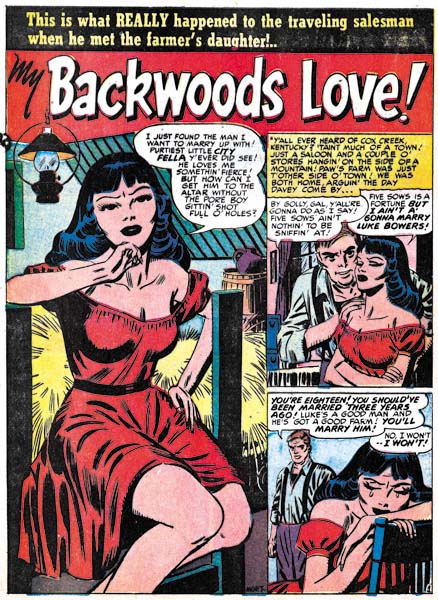
Young Romance #11 (May 1949) “Big City Girl”, art by Leonard Starr

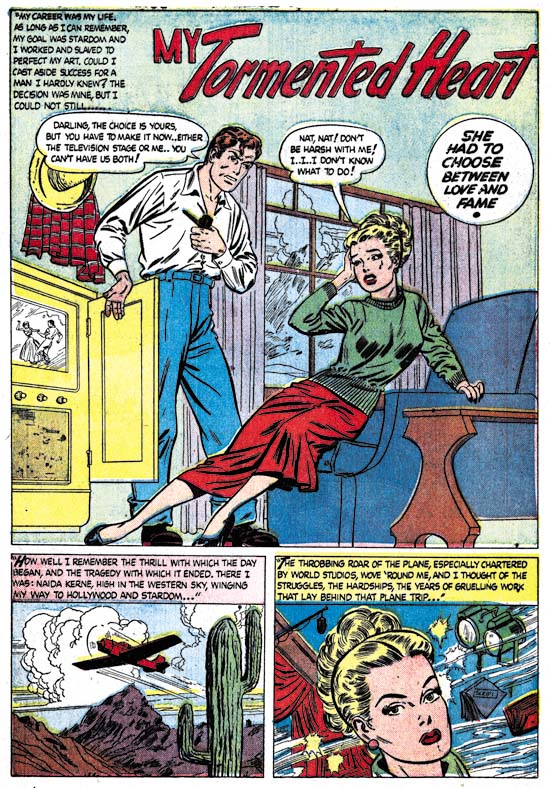
A number of individuals did work for Simon and Kirby who would go on to become famous comic artists. I am not saying Joe and Jack discovered these artists but they did seem to recognized talent even during its early stages of emergence. One of these is certainly Leonard Starr. Leonard only appears in one story for the romance comics that I am covering in this post but was also appearing at this time in the western romances that I will be covering in a separate chapter. The first page for “Big City Girl” is laid out with a vertical splash with two story panels on the right side. This is not a splash page layout that Jack used at this time so once again I do not believe Joe or Jack did layouts for this story. Starr is good with his visual story telling and his woman are attractive but neither compares with what would come later when in 1957 when Starr create his syndication strip On Stage (later called Mary Perkins On Stage). That strip is currently being reprinted.


Young Love #4 (August 1949) “My Strange Fear”, art by George Gregg

An unexpected benefit of preparing for this blog post was the detecting of a signature that I had previously overlooked. There on a book spine of the splash for “My Strange Fear” is the name Gregg. I had already seen a similar signature on a story from Justice Traps the Guilty #17 (August 1950) “Best Seller” but I was never able to make out the correct spelling. The signature in “My Strange Fear” is very clear and I am certain that the artist must be George Gregg. Since this is a very recent discovery for me, I do not yet know how much a part Gregg will have in Simon and Kirby productions but since his other signed work is from a year after “My Strange Fear” there is a good chance more work will be found. Some of the eyebrows are very distinctive in “My Strange Fear” so it should not be hard to recognize George’s work even when a signature is lacking. Gregg is another of those artists found on Hajdu’s list of the ’50s purge victims.


Young Love #4 (August 1949) “Two-Timer”, art by Bruno Premiani?

What can I say, sometimes I make mistakes. I had previously included “Two-Timer” in a post about John Prentice as the first work that he did for Simon and Kirby. At that time I recognized that the style was not typical of Prentice but felt that he had not yet matured into his final style. Later I came to realize that there was a body of work from August 1949 through October 1950 that was pretty consistent and distinct from John Prentice’s work which would not appear in Simon and Kirby productions until April 1951. Unfortunately none of the art by this earlier artist for Simon and Kirby was ever signed. Two stories by this artist were reprinted in “Real Love” where they were credited to Bruno Premiani. I do not know whether this was by Richard Howell, the editor of that book, or either Mark Evanier or Greg Theakston who are credited with supplying information. Nor do I know what formed the basis of that attribution. Because in cases such as this my motto is trust but verify, I have given some cursory examinations of some other comics attributed by Permiani, Tomahawk and Doom Patrol. Frankly nothing I saw convinced me that they were by the same artist. The material for DC is distinctly simpler, with much sparser inking, and the eyebrows of women are more arched. There are artists that adapt their style in relationship to the subject or genre they are working in and perhaps that is the case here. There is an excellent biography of Bruno Permiani which indicates that Bruno, born in Italy but had immigrated to Argentina, was in the U.S. during this time.  For now I will be using the Premiani attribution but with a question mark to indicate my personal uncertainty.

Whether he is was truly Bruno Permiani or not, I have come to admire this studio artist greatly. Premiani only did work for Simon and Kirby for a little over a year but he contributes a fair amount of material (20 stories by my count). Bruno works in an illustrative style similar to that of John Prentice (hence my original confusion). The two can most easily be distinguished by their women; those by Prentice have a sophisticated beauty with slightly longer faces while Permiani’s women, although still attractive, are somewhat plainer with relatively straight eyebrows. Bruno had an ability to truly animate his subjects. Without using excessive poses or melodramatic rendering, Premiani’s people just seem to radiate their emotions.

I have not commented on every individual cover or story in this serial post; however I review everything for the titles belonging to a particular chapter. I try to remark on any of my attributions that might be different from credits supplied by other scholars, particularly the Jack Kirby Checklist. For those who are interested in my attributions of work not included in the serial post itself, I have added checklists for Young Romance and Young Love to the sidebar. I will be expanding these lists as new chapters The Art of Romance appear. I would prefer any comments about my attributions to be placed in the chapters of The Art of Romance where they are less likely to be overlooked.

The Art of Romance, Chapter 4, An Explosion of Romance
(Young Romance #9 - #12, Young Love #1 - #4)

The Art of Romance, Chapter 6, Love on the Range
(Real West Romance & Western Love)

Next Page »