
Please donate!
The Jack Kirby Museum is raising funds to open a "Pop-Up" Museum on the Lower East Side, near where Kirby was born and raised. Learn more here.About this Blog:
© 2006, 2007, 2008, 2009, 2010 & 2011 Harry Mendryk. Unless otherwise marked, all images are my own restorations. Further some of the images have copyrights by Joe Simon and Jack Kirby or Joe Simon alone. I am fortunate that Joe Simon has allowed me to also include some previously unpublished material. Please do not copy from this blog without permission.Pages
Categories
- 9/11 (6)
- Artists (261)
- Albistur, Jo (7)
- Avison, Al (8)
- Belfi, John (4)
- Breifer, Dick (9)
- Brewster, Ann (7)
- Burgos, Carl (1)
- Ditko, Steve (2)
- Donahue, Vic (12)
- Draut, Bill (50)
- Eadeh, Al (16)
- Gregg, George (5)
- Infantino, Carmine (6)
- Kirby, Jack (152)
- McCarty, Bob (9)
- Meskin, Mort (68)
- Morrow, Gray (1)
- Oda, Ben (1)
- Oleck, Jack (2)
- Powell, Bob (1)
- Premiani, Bruno (9)
- Prentice, John (29)
- Riley, Ken (2)
- Robinson, Jerry (10)
- Severin, John (7)
- Simon, Joe (54)
- Stallman, Manny (7)
- Starr, Leonard (13)
- Stein, Marvin (20)
- Walton, Bill (5)
- Checklist (19)
- Albistur, Joe (1)
- Brewster, Ann (1)
- Briefer, Dick (1)
- Donahue, Vic (1)
- Draut, Bill (1)
- Eadeh (1)
- Gregg, George (1)
- Infantino, Carmine (1)
- Kirby, Jack (1)
- McCarty, Bob (1)
- Premiani?, Bruno (1)
- Prentice, John (1)
- Riley, Ken (1)
- Robinson & Meskin (1)
- Severin, John (1)
- Simon, Joe (1)
- Stallman, Manny (1)
- Starr, Leonard (1)
- Stein, Marvin (1)
- Comic Checklists (20)
- All For Love (1)
- Black Magic, DC (1)
- Black Magic, Prize (1)
- Boys' Ranch (1)
- Charlie Chan (1)
- Clue (1)
- Fighting American (1)
- Foxhole (1)
- Headline (1)
- In Love (1)
- Justice Traps the Guilty (1)
- My Date (1)
- Personal Love (1)
- Prize Comics Western (1)
- Real West Romance (1)
- Western Love (1)
- Young Brides (1)
- Young Love (1)
- Young Romance (1)
- Your Dreams (1)
- Ink Checklist (1)
- Kirby, Jack (1)
- Periods (392)
- 1 Early (22)
- 2 Fox (14)
- 3 Timely (44)
- 4 DC (early) (46)
- 5 Studio (135)
- 6 Mainline (68)
- Assorted (10)
- Bullseye (8)
- Fighting American (6)
- Foxhole (13)
- In Love (16)
- Police Trap (7)
- Prize (15)
- 7 Freelance (71)
- Archie (13)
- Atlas Kirby (14)
- DC Kirby (4)
- Harvey (24)
- Prize (17)
- 8 Marvel (12)
- Assorted (6)
- Marvel Kirby (6)
- 9 DC (late) (5)
- Late (3)
- Serial Posts (136)
- Art of J. Simon (1)
- Art of Romance (41)
- Criminal Artists (4)
- Early Jack Kirby (9)
- End of S & K (1)
- It's a Crime (1)
- Kirby Austere Inking (1)
- Kirby Inkers (4)
- Little Shop of Horrors (1)
- Margin Notes (5)
- Replacing S&K (4)
- S&K Colorists (3)
- Start of S&K (12)
- Wide Angle Scream (15)
- Topic (330)
- Alternate Takes (16)
- Anthologies (6)
- Art Editing (4)
- Best of Simon & Kirby (2)
- Captain America (5)
- Comicscope (3)
- Experts (3)
- Featured Work (64)
- First Romance (1)
- Ghosting (7)
- Harvey Covers (24)
- Kirby Inking Kirby (4)
- Kirby Krackle (3)
- Kirby Or Not (28)
- Lettering (13)
- My Two Cents (4)
- Odds & Ends (122)
- Publications (22)
- Quote (4)
- Restoration (3)
- Robots (3)
- S&K Superheroes (2)
- Swiping (8)
- Wertham & Censoring (5)
- Why Comics Declined (1)
- Uncategorized (50)
- z Archive (576)
- 2006/03 (16)
- 2006/04 (14)
- 2006/05 (15)
- 2006/06 (16)
- 2006/07 (10)
- 2006/08 (24)
- 2006/09 (11)
- 2006/10 (19)
- 2006/11 (20)
- 2006/12 (14)
- 2007/01 (16)
- 2007/02 (17)
- 2007/03 (14)
- 2007/04 (10)
- 2007/05 (12)
- 2007/06 (8)
- 2007/07 (7)
- 2007/08 (8)
- 2007/09 (6)
- 2007/10 (10)
- 2007/11 (7)
- 2007/12 (4)
- 2008/01 (4)
- 2008/02 (7)
- 2008/03 (12)
- 2008/04 (8)
- 2008/05 (8)
- 2008/06 (11)
- 2008/07 (6)
- 2008/08 (12)
- 2008/09 (7)
- 2008/10 (8)
- 2008/11 (4)
- 2008/12 (6)
- 2009/01 (10)
- 2009/02 (4)
- 2009/03 (5)
- 2009/04 (8)
- 2009/05 (6)
- 2009/06 (5)
- 2009/07 (8)
- 2009/08 (6)
- 2009/09 (5)
- 2009/10 (6)
- 2009/11 (4)
- 2009/12 (3)
- 2010/01 (6)
- 2010/02 (7)
- 2010/03 (5)
- 2010/04 (4)
- 2010/05 (7)
- 2010/06 (5)
- 2010/07 (8)
- 2010/08 (4)
- 2010/09 (5)
- 2010/10 (9)
- 2010/11 (5)
- 2010/12 (5)
- 2011/01 (4)
- 2011/02 (2)
- 2011/03 (4)
- 2011/04 (6)
- 2011/05 (3)
- 2011/06 (5)
- 2011/07 (7)
- 2011/08 (5)
- 2011/09 (4)
- 2011/10 (10)
- 2011/11 (6)
- 2011/12 (5)
- 2012/01 (3)
Comic related blogs
Groups (membership required)
Web pages
Tag Archives: Jerry
The Eleventh Commandment
“Thou shall not desecrate art”. Okay maybe Moses did not forget to include the eleventh commandment on his tablets when he came down from the mount. And I will admit that most of the other commandments concerned more serious sins. Still alteration of art is truly morally wrong. This restriction may seem odd when it comes to comic books since that art often gets modified on its way through the publication process. However a point is reached when comic art is published (or not) and further modification should no longer be done. Some will say that when a person buys a piece of art he can do anything he wants with it. But the truth is no one really buys art, it is more like an extended lease. While the person may have possession of a piece of art, the expectation should be that someday, somehow, it will pass on to someone else. It is the owner’s duty and self interest to preserve the art for that eventual day.
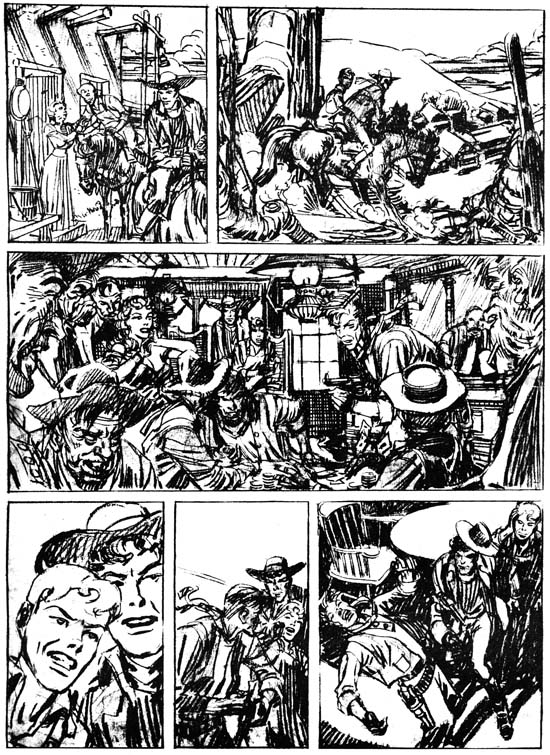
Unpublished page art by Jerry Robinson and Mort Meskin (as published in “History of Comics” volume 1, 1970)
James Steranko’s “History of Comics” is a great resource written by a man who is both a historian and practitioner of comic books. It was published in two tabloid size volumes and is long out of print. However issues appear at conventions and sources like eBay from time to time and are well worth the search. While profusely illustrated most of the images are small in size. There are a limited number of exceptions that take full advantage of the large dimensions of the books. One of the larger illustrations in volume 1 is the source for the image shown above of a page done in pencil by Jerry Robinson and Mort Meskin.
There are good reasons why Steranko gave this image such a prominent treatment. Both artists played important parts in the history of comics. Among the many contributions by Jerry Robinson is the work he did on Batman as a ghost artist for Bob Kane. Unfortunately Mort Meskin’s importance in the history of comics is largely forgotten today but is well understood by Steranko. Hopefully a forthcoming book on Meskin may help to change his current reputation. However Mort is not completely neglected for instance Ger Apeldoorn has provided some recent posts about some of his work (for example Tom Corbett Viewmaster, Real Crime and No Kid Stuff) and there is a list group devoted to him (Mort Meskin List). Besides Robinson and Meskin’s importance to the history there is the rarity of the art. Not a lot of original art for either artist has survived from early in their careers. While they shared a studio for some time they only collaborated for a relatively short period (less then two years) so examples of their joint work would be expected to be rarer still. Original art that was unpublished and left uninked are particularly rare. Last, but certainly not least of the reasons Steranko illustrated this particular page, is the quality of the art itself.
What was this unfinished page originally intended? Meskin did some marvelous work on his creation, the Vigilante, which started as a hero feature and ended up as a western. However Robinson was never associated with the Vigilante and the young man on this page of original art was clearly not the Vigilante’s sidekick Stuff the Chinatown Kid. This page of art can also be found on the Meskin web site where it is suggested it might have originally have been meant for Prize Comics Western. The period that Robinson and Meskin are known to have collaborated was from January 1948 to August 1949 (cover dates). Prize Comics was converted to Prize Comics Western with the May 1948 issue so it certainly was a possible destination for this piece. Robinson and Meskin were doing work for Simon and Kirby during this time and although I do not believe S&K produced Prize Comics Western they may have provided Jerry and Mort a connection to the editor of that title. But Robinson and Meskin’s work never be published in any issue of PCW and the solo Meskin would not appear in the title until 1956 1955. So while nothing rules out Prize Comics as the intended comic, there is little evidence to support that suggestion.
Considering the artists, it is not surprising what a wonderful page this is. The third panel is particularly marvelous. This may be the most complex panel these artists had ever done either together or individually. The panel is framed on each side by the cutoff close-ups of two smokers. A gambling game gone wrong takes up most of the panel with onlookers filling the rest. Every little portion of the panel is filled with interesting details. The only problem is where would the speech balloons go? Actually this seems to be a difficulty with much of the page with only the second and fifth panels seeming to have room for the speech balloons. The fourth panel particularly seems to call for a balloon with no place to put it. This all suggests another possibility for this page, it may have been nothing more then a portfolio piece used to show perspective publishers what the artists were capable of doing. However in the end we are left with little more then informed speculation as to the intended purpose of this unpublished art.

Unpublished page art by Jerry Robinson and Mort Meskin (recent scan)
The image in Steranko’s book is just marvelous. Pencils are difficult to reproduce (which is why art is inked for comic book publication) but the image in “History of Comics” is clear and easy to see. Considering this was done before personal computers and scanners that was quite an accomplishment. Above is a more recent scan of the same art. While it may not be as clear as the Steranko’s image it does show some subtleties that the published image did not. Even here the image has been enhanced as the original pencils are lighter.
I had previously wondered what method Robinson and Meskin used when they collaborated on art since the final result looks like an amalgamation of their two styles. At least some of the inking appeared to have been done by Mort so the simplest explanation would be that Robinson did the pencils and Meskin the inking. But is the simplest explanation actually correct? The best way to answer this question is to examine uninked art such as the page discussed here. Most of the figures on the page look like they were done by Meskin with the exception of the woman in the third panel who looks like she was drawn by Robinson. That assessment is based on the style of the art but notice that the woman is drawn slightly darker then the rest of the figures. Remember this image is an enhanced scan and the difference is even harder to detect on the original art. The panel is so intricate and fully realized that I doubt that Meskin had simply left the woman blank for Jerry to fill in. To me this all suggests that Mort first penciled the entire page and then Jerry came in and altered portions. Robinson may have worked on parts of the art other then the woman but they are now hard to distinguish. I am not suggesting that this was the creation sequence that Robinson and Meskin used in all cases but it does suggest that the reason for their amalgamated style was the passing of the pencils from one artist to the other.
It is interesting how fully developed the drawing is on this page. Not only are all outlines clearly indicated but the required spotting is shown as well. For example the shadows cast by the post sticking out of the top of the house in the first frame and the shadows on the underside of all the hats. Even the cloth folds have the sweeping parallel lines that are characteristic of Meskin’s inking. Previously I felt the inking of the Robinson and Meskin pieces had been done by Mort, but perhaps Jerry also did some inking that is now hard to detect because the inks closely followed the pencils.
By now the reader maybe impatiently proclaiming “but what about the bottom row of panels”? What indeed. Because of the Steranko illustration we know that this row was originally uninked. Did Jerry Robinson, still very much active today, come back and resume working on the page? Or did Mort Meskin return to it before his untimely death? Unhappily neither is the case. A good comparison between the inked version and the one found in the Steranko illustration shows many discrepancies. Hairlines were altered and cloth folds moved. Even the outlines were not closely followed. While it is not completely clear in Steranko’s illustration, the boy on the extreme right of the last panel is cast in shadow with just enough traces of light patches to indicate the shape of the figure. Apparently this was all beyond the questionable talents of the inker who covers it all in solid black. It is true that since the silver age of comics inkers are often expected to add their personal touches, but this particular inker’s alterations have done nothing but deaden the art. Since he did not follow the pencils closely one wonders why the inking was done directly on the original art and not over some copy? Once he had finished the bottom row the contrast between it and the two upper rows must have been painfully obvious even to this inker and he finally halted his destruction before any more damage was done and the page become worthless. The page is now a monument to the wisdom of the Eleventh Commandment. Frankly even if the inker had been more talented he should not have attempted inking the actual pencils. A modern inker has modern sensibilities and his art could not truly recreate the type of inking that would have been done on this page had Robinson and Meskin completed it.
Posted in 2009/02, Artists, Featured Work, Meskin, Mort, Robinson, Jerry, Topic, z Archive
Tagged Jerry, meskin, Mort, Robinson
3 Comments
Jumbo Comics

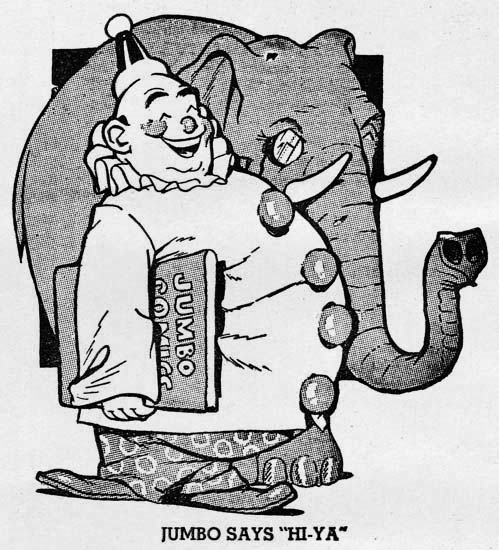
Jumbo Comics #1 (September 1938) Jumbo, the mascot
Will Eisner and Jerry Iger teamed up in 1936 or 1937 to become one of the first studios to provide complete comic book packages to publishers. Previously comic books were largely reprint compilations of newspaper syndication strips. Years later Will Eisner said that he believed there would not be enough syndications material available to meet the rising demand for comic books and so there would be a market for new material created specifically for comic books. That may have been true but one of Eisner and Iger’s packages Jumbo Comics #1 (September 1938) published by Fiction House was actually composed of syndication strips. I have no idea on how many of the strips from Jumbo Comics #1 had previously appeared in newspapers but at least some of them had been printed in the British magazine Wags. Others may have truly been new creations but in a format showed that they were meant for syndication strips.
Jumbo Comics certainly lived up to its name as it was printed in what is called tabloid size (10.5 by 14.25 inches). Except for the cover, no color was used. Perhaps to compensate for the lack of color, the paper used came in two tones; one the normal “white” and the other dyed a pinkish color. (I have removed the page color from all images presented in this post.) All pages followed the same format. There would be a title panel that would normally occupy the entire top of the page although sometimes a single story panel might be included. Below would be three or four rows of panels with three panels per row (occasionally two panels would be combined to form a longer one). While there would be three or four pages provided for each title, all pages would have the same format including the title.

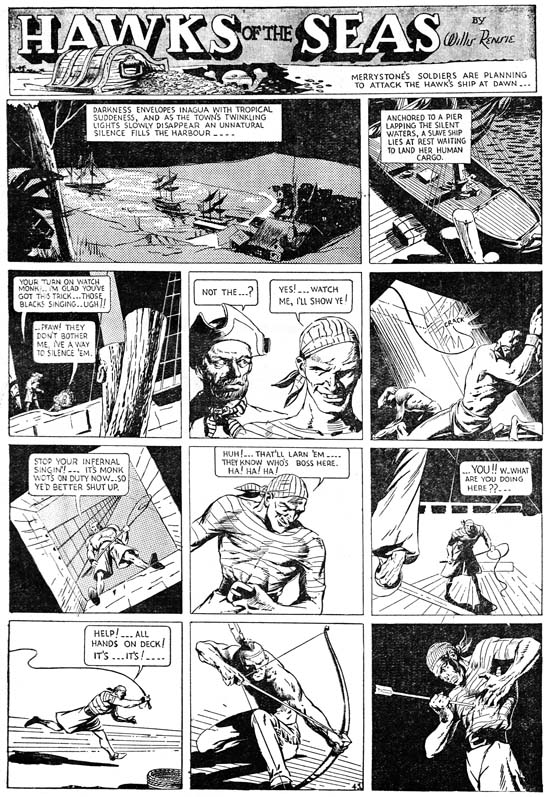
Jumbo Comics #1 (September 1938) “Hawks of the Sea” by Will Eisner
Will Eisner was very conscious about the small size of his operation. While Eisner was involved in many aspects in the making of the strips found in Jumbo Comics but, his name appears on none of them. However, in the title “Hawks of the Sea” is credited to Willis Rensie; Rensie is Eisner spell backwards. This is years before his famous work on the Spirit, but here Eisner is already an accomplished comic artist. Note Eisner’s dramatic use of sifting perspective. As we will see, a number of the artists appearing in Jumbo Comics who would later achieve great fame but none of them supplied art at that time with quite the quality as found in “Hawks of the Sea”.

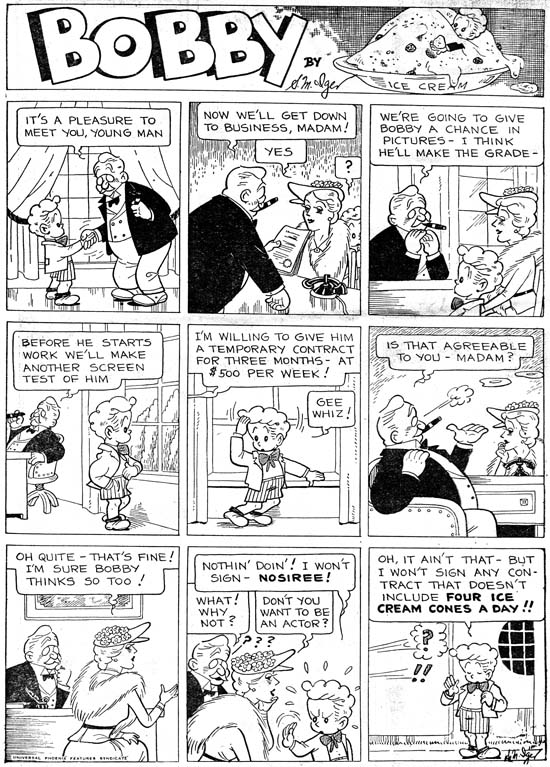
Jumbo Comics #1 (September 1938) “Bobby” by Jerry Iger
“Bobby” is credited to S. M. Iger, but surely that must be an alias for Jerry Iger. Iger was supposed to have been the salesman of the Eisner & Iger partnership, but here he shows how talented artist he was as well. Or it would if we can be sure that this piece was actually done by Jerry. In an interview (The Jack Kirby Collector #16) Eisner said that Iger was not a good artist but he could letter. Was this sour grapes about a former partner or realistic evaluation? I have no way of knowing. It all depends on whether “Bobby” was really done by Iger.

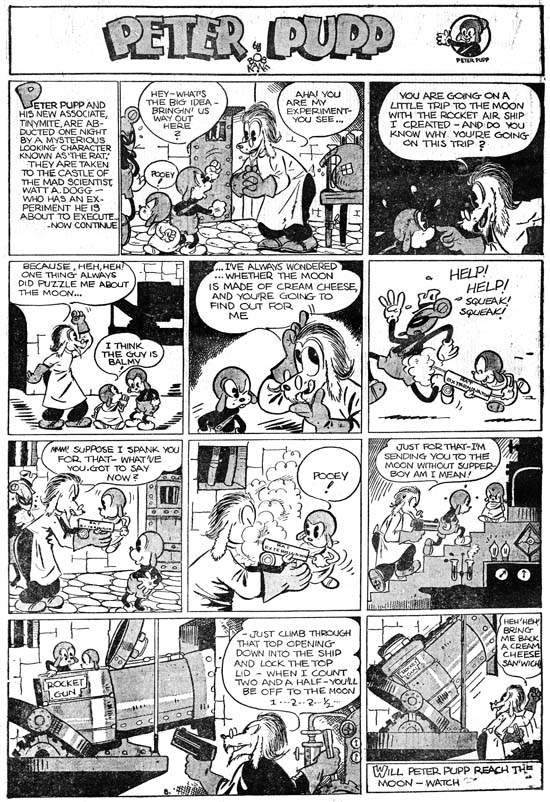
Jumbo Comics #1 (September 1938) “Peter Pupp” by Bob Kane
Bob Kane was a high school friend of Will Eisner, so his presence in Jumbo Comics is not surprising. Batman did not debut until May 1939 so Kane almost certainly did not yet have his studio of ghost artists that he became famous for in later years. I have always found the earliest Batman art, presumably done by Kane, as stiff and rather unappealing. Because of that “Peter Pupp” is quite a surprise. Granted it is of the funny animal and not the hero genre but it shows a suppleness totally absent from Batman. Mickey Mouse would seem to be an obvious inspiration for this strip. I particularly find amusing how the villain’s minion sports Mickey Mouse ears.

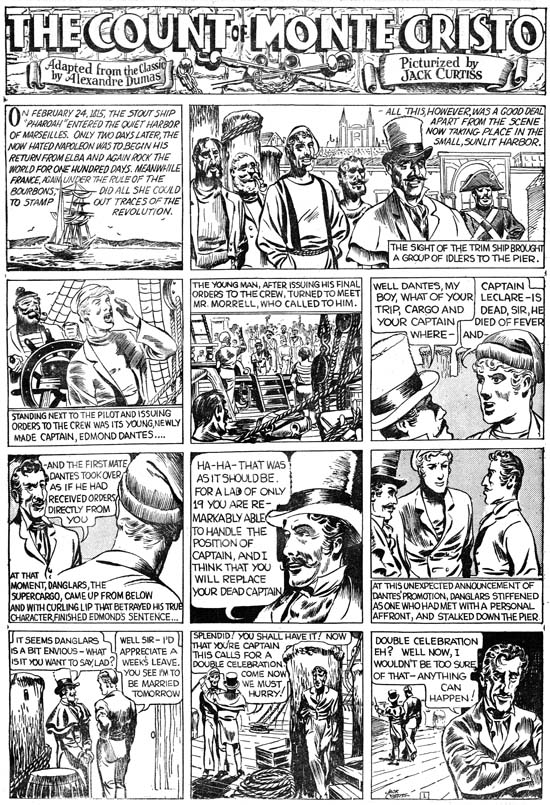
Jumbo Comics #1 (September 1938) “The Count of Monte Cristo” by Jack Kirby
Jack Kirby has said that his first published comic book work be for Wild Boy Magazine, although I do not believe anyone has been able to confirm that. The earliest work that can be confirmed is probably “The Count of Monte Cristo” which appeared in the British magazine Wags in March 1938. These Kirby strips were used again in Jumbo Comics #1. The name Jack Kirby was one he adopted later while his birth name was Jacob Kurtzberg but in this strip he signed his name as Jack Curtiss. By any name this was a far cry from the work Jack would do in just a few years. Even though Kirby’s art would progress much further, his art in Jumbo Comics shows that he already was a very gifted artist, better then most of his peers.

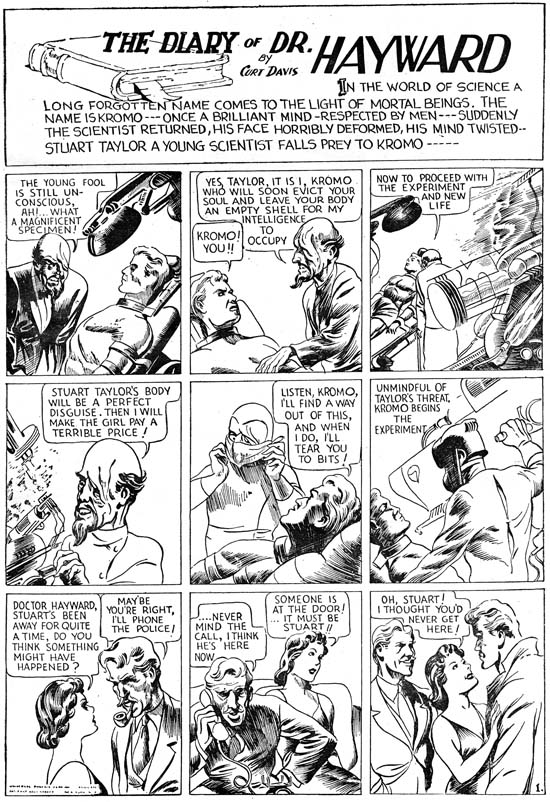
Jumbo Comics #1 (September 1938) “The Diary of Dr. Hayward” by Jack Kirby
Jack also drew “The Diary of Dr. Hayward” this time under the name Curt Davis. While “The Count of Monte Cristo” was based on the book by Alenandre Dumas, the Dr. Hayward strip was all new writing. It is hard to be sure, but the plot seems to be similar to those Jack would write later and so I credit the scripting here to Kirby as well. Without the classic trappings of “The Count of Montet Cristo”, Jack seems quite comfortable both in art and script with the more science fiction story of Dr. Hayward. A handsome hero, a mad scientist and body switching it all provides a setting for a morality tale about good versus evil.

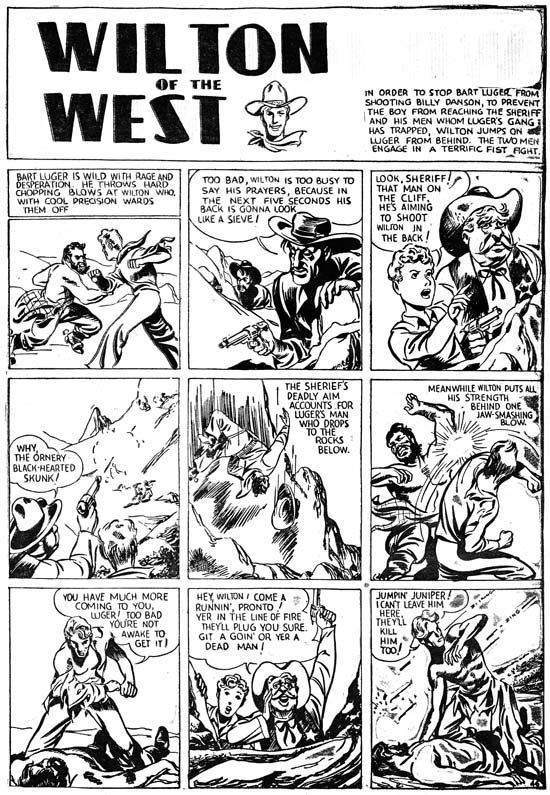
Jumbo Comics #1 (September 1938) “Wilton of the West” by Jack Kirby
It would seem two strips were not enough for the already prolific Kirby as he did a western as well but this time without signing it. It is here that we can see that while Kirby had a way to go before he reached his full potential, he already had developed his predilection for slugfests. The smashing blow depicted in panel 6 is done in a manner far from his signature style but it still embodies Kirby’s enthusiasm. He may not have mastered his use of exaggerated perspective but look how Jack has in panel 7 the hero bend at the torso while thrusting his face forward so that no neck is seen. It is the beginnings of a pose that would become Jack’s trademark.
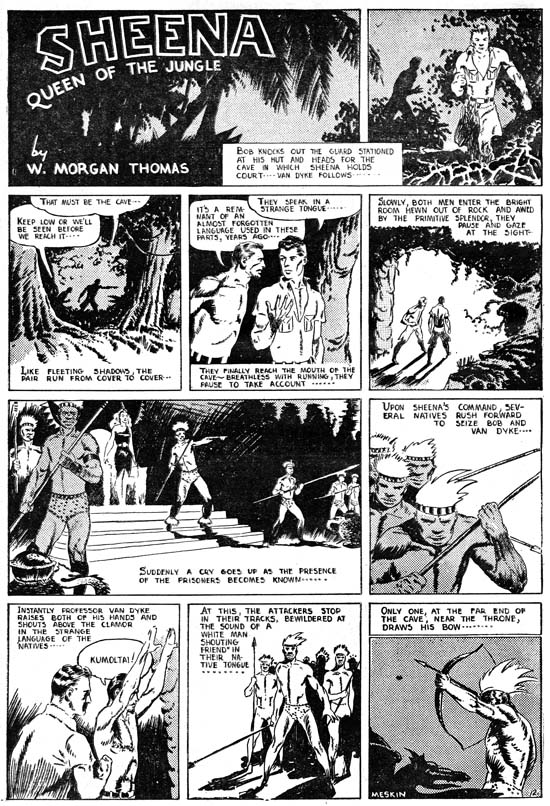
Jumbo Comics #1 (September 1938) “Sheena Queen of the Jungle” by Mort Meskin
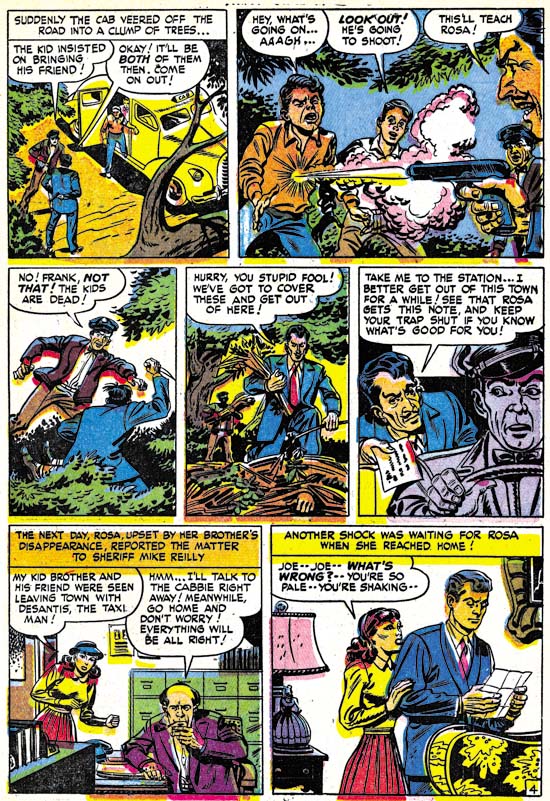
Of all the strips present in Jumbo Comics, the most enduring was “Sheena Queen of the Jungle”. It would eventually dominate the long running Jumbo Comic (1938 to 1953) as well as achieving its own title. Sheena even became a television show (1955) and a movie (1984). The title block credits Sheena to W. Morgan Thomas but this was just one of the pseudonyms adopted by Will Eisner to hide the small size of his studio staff. For the Sheena strips in the Jumbo Comics the artist was Mort Meskin as can be seen by the signature in the final panel. This is the earliest published work by Meskin that I am aware of. While not as polished as Will Eisner or Jack Kirby, Mort’s art already has an energy to it. Look how he composes the figures of the armed natives in panel 6 all on the left side of the panel and on the right in panel 8. Over and over in these strips you can see Meskin’s concerns about how to graphically tell a story. It may be the start of his professional career, but Mort already had his own unique vision.
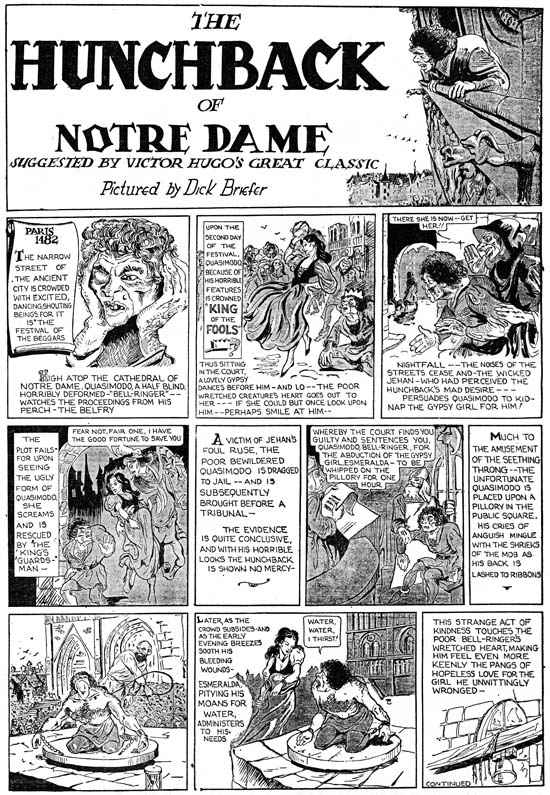
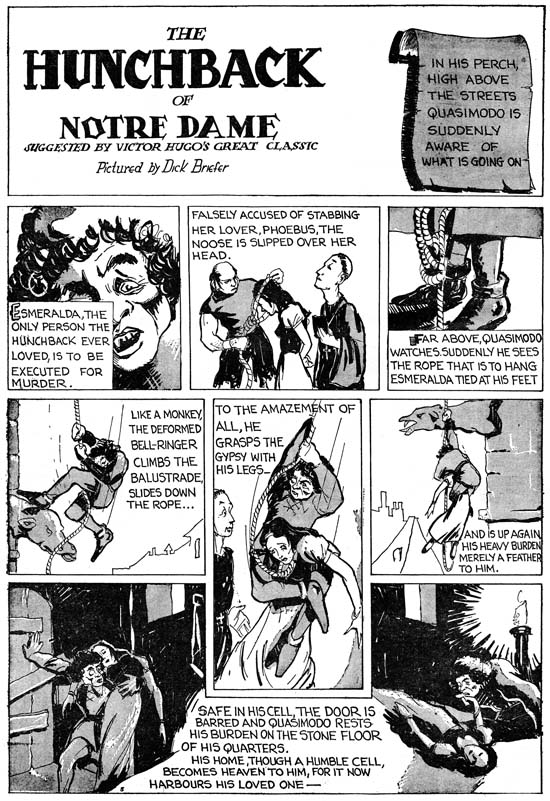
Jumbo Comics #1 (September 1938) “The Hunchback of Notre Dame” by Dick Briefer
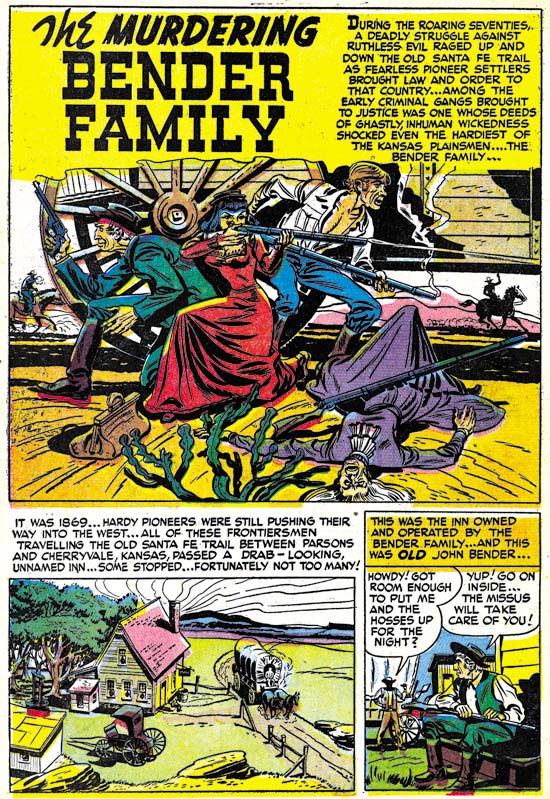
It is hard to recognize some of the artists appearing in Jumbo Comics when you are only familiar with their later work. This is especially true with the first strip of “The Hunchback of Notre Dame” by Dick Briefer. What makes this particular strip so unlike some familiar work by Briefer is mainly the detailed pen work so different from the simpler and more fluid inking found much later in Briefer’s Frankenstein. One thing to note is that while the other artists reviewed in this post had adopted a very grid-like panel layout, Dick’s use of caption boxes and panels breaks from that familiar rigid pattern.

Jumbo Comics #1 (September 1938) “The Hunchback of Notre Dame” by Dick Briefer
The fine inking was abandoned immediately after the first strip and the results make it much easier to recognize Briefer’s participation. I choose to use the fifth strip but in terms of technique it does not differ from the second. But what a great page! While Dick is no longer using the same captions he still deviates from a grid panel layout. Note how the fifth panel was extended vertically down into and how the last panel really is two panels in the same boarder separated by a caption.
There are other strips in Jumbo Comics #1 done by talented artists that are unsigned. Considering the pretenses Eisner maintained of a larger shop there is a good possibility that they some were made by Eisner himself deceptively adopting another style. Or perhaps assigning the finishing or inking to a different artist. I am sure Eisner provided direction to all the artists working for him but I am just as certain that did not include laying out the art. Each of the artists reviewed here had their own unique manner of graphically telling the story which would not have been true if they were working from layouts. It is amazing to see so much talent, albeit in its earliest flowering, in one comic book. Jack Kirby would be also included in Jumbo Comics #2 and #3 for his work on “The Diary of Dr. Hayward” and “Wilton of the West”. Mort Meskin would work on “Sheena Queen of the Jungle” even longer (at least until issue #5). Bob Kane and Dick Briefer would also make further appearances. Eventually Jumbo Comics would abandon its oversize format and adopt a more standard comic book content but for a while it was a most unusual comic book.
Posted in 1 Early, 2008/12, Artists, Breifer, Dick, Kirby, Jack, Meskin, Mort, Odds & Ends, Periods, Topic, z Archive
Tagged bob, Briefer, dick, Eisner, Iger, Jack, Jerry, Jumbo Comics, Kane, Kirby, meskin, Mort, Will
2 Comments
Mort Meskin before Joining Simon and Kirby

Golden Lad #1 (July 1945) “The Heart of Gold”, art by Mort Meskin
Last week I provided some examples of early work by Mort Meskin. Now I would like to do the same for the period from after the war until Mort began working for Simon and Kirby. Actually I am being a little inaccurate by describing this period as post war. The war ended in Europe on May 8, 1945 and in Japan on August 15. The first issue of Golden Lad was cover dated July 1945. Because cover dates were usually advanced a couple of months from the actually released date, this issue probably hit the stands in May. Therefore the war was still ongoing when the art was created (which probably started in February). During most of the war Mort Meskin was doing work solely for National Comics. Mort would continue to provide work to DC while doing Golden Lad for Spark Publications.
Maybe it is just a question of luck as to which issues are available to me, but it seems to me that there was a decline over time in the quality of Meskin’s art for DC. However that decline only affected his DC work. While the Golden Lad character may not have been that great of a creation, the art Mort provided was first rate. The splash is particularly nice. Golden Lad rises dramatically from a cauldron of molten gold. The fire provides the only light for the scene giving the surrounded conquistadors with expressive shadows. But with their modern weaponry, they are not truly conquistadors. The heart of gold that provides Golden Lad with his powers was created during the time of the destruction of the Aztecs but Golden Lad fights modern criminals. The splash is a graphic amalgamation of the two concepts.

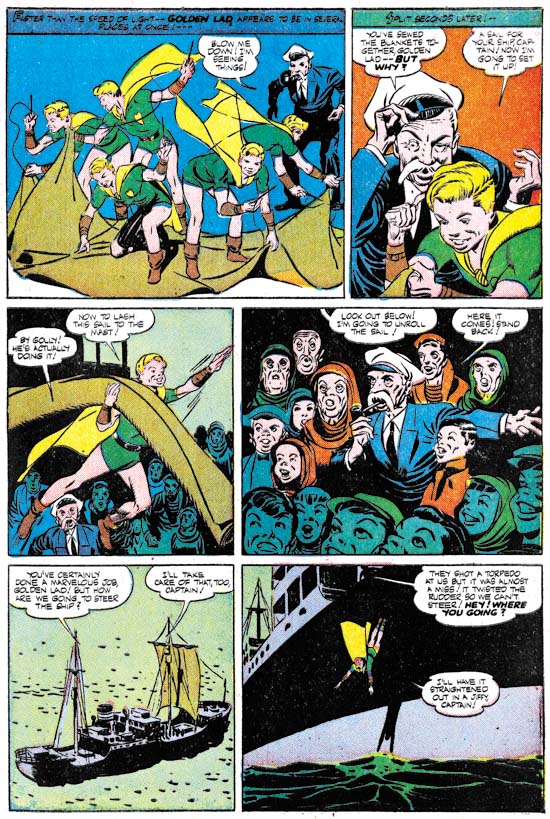
Golden Lad #2 (November 1945) “The Haven for All” page 5, art by Mort Meskin
I really cannot get very enthusiastic about Golden Lad himself. Like Superman, he is just too powerful to provide interesting stories. However Meskin did a good job on graphically depicting the story. The first panel shows the use of multiple images that Mort devised in Johnny Quick for indicating super fast action. The showing the unrolling of the sail might have seem the most obvious choice for panel 5 but Meskin’s depiction of the crowd’s reaction was probably more effective.

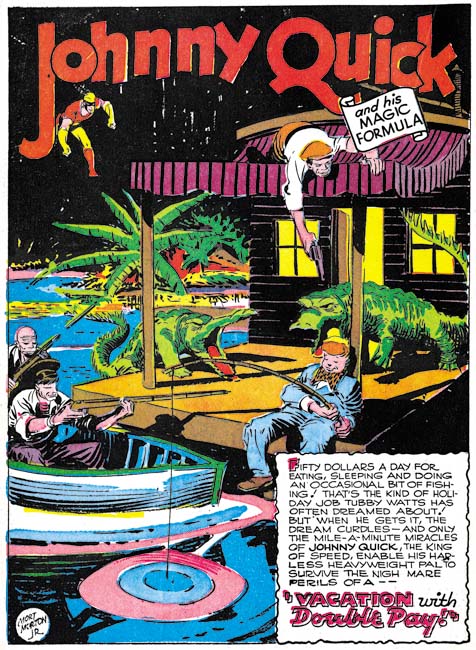
More Fun Comics #107 (January 1946) “Vacation with Double Pay”, art by Mort Meskin
As I said before, Mort’s art for the later DC work is not as impressive as his earlier stuff. This Johnny Quick splash is probably the best of the few I have available from his later DC work. Even here I do not find the approaching alligators truly threatening. What are they going to do, gum the fisherman to death? Some of this decline in quality maybe due to the inkers being used but perhaps Meskin was loosing interest after so many years. That he did such great art for Golden Lad shows that he had not lost his talent.

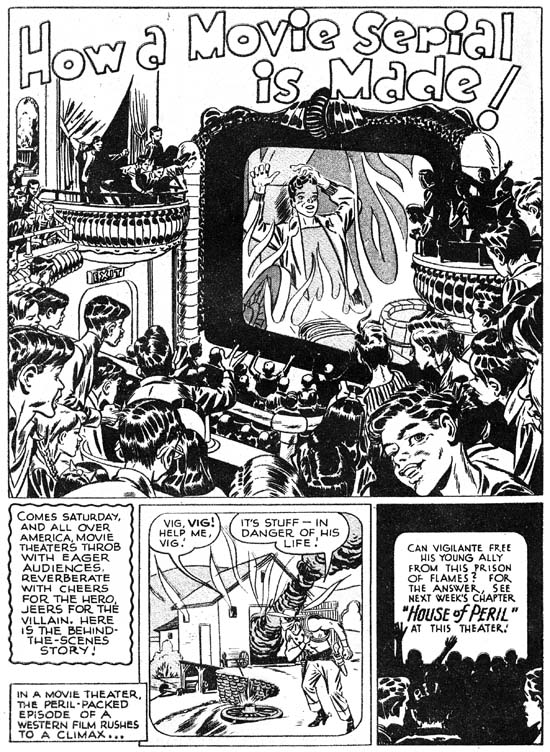
Real Fact Comics #10 (October 1947) “How a Movie Serial Is Made”, art by Mort Meskin
Meskin could do great work for DC as well, if it supplied enough of a new challenge. This scan of “How a Movie Serial Is Made” was provided by Ger Apeldoorn (Those Fabuleous Fifties). It certainly is an oddball feature. Meskin provides examples of how serial movies were created using his own character, the Vigilante. I particularly like the splash. While I am not old enough for movie serials, I do remember weekend matinees where there was a very similar response from the exclusively young audience.
Mort did other work during this period besides what he did for DC and Spark. This was the time that he did a couple pieces for Prize Comics (but this was not for Simon and Kirby). I will not be discussing the Prize stories here as I covered them recently in other posts (Treasure #10 and Treasure #12).

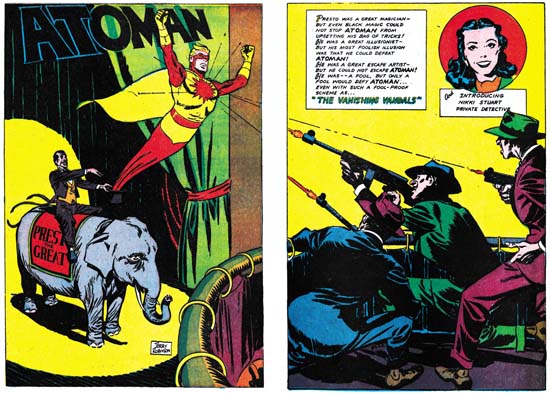
Atoman #2 (April 1946) “The Vanishing Vandals”, art by Jerry Robinson
Larger Image
Mort Meskin would later team up with Jerry Robinson. It would therefore be informative to provide examples of Jerry’s work. Much of what Robinson did previously was on Batman working for Bob Kane. This makes it difficult to come to a clear understanding as to what Robinson’s personal style really was. The one example I can supply was for Atoman, a title from Spark Publications, the same publisher that did Golden Lad. Here Jerry does an ingenious double page splash. The best location for a double page splash was the centerfold. Place one anywhere else and the two pages would have to be printed on separate sheets of paper. With the primitive printing of comics of those days there was little likelihood that the registration would work out properly in the finished comic book. Robinson’s wide splash is at the front of the comic but he avoids the registration problem by purposely including a gutter in the design that would separate the two image halves. He has not simply bisected the image; if you were to bring the two pages together they would not line up properly.

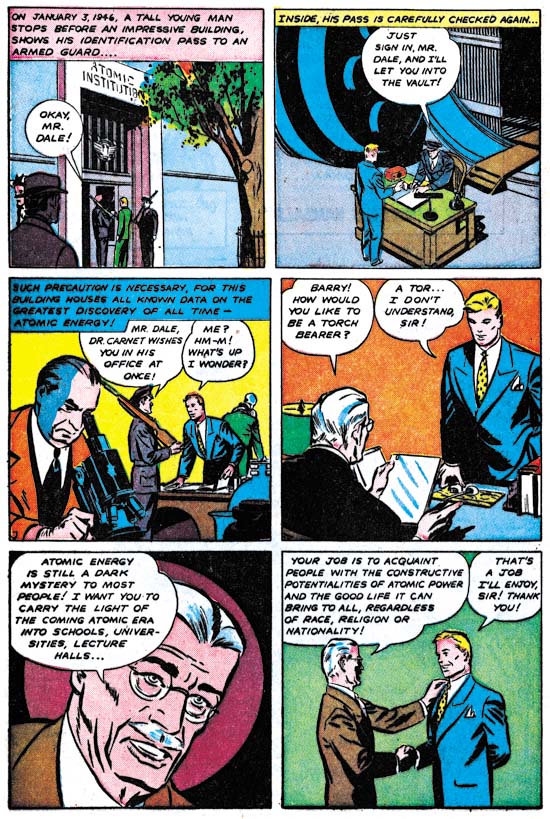
Atoman #2 (April 1946) “The Vanishing Vandals” page 3, art by Jerry Robinson
Here is an example of a story page from Atoman. But note the man in panel 5. He has to my eyes a distinctively Meskin look to him. There are a few other similar Meskin-like portrayals in the story as well. Was Mort giving Jerry a hand? Or was Robinson being influenced by Meskin and adopting some of his style? I do not have an answer but it is something to keep in mind when we examine joint efforts by Robinson and Meskin.

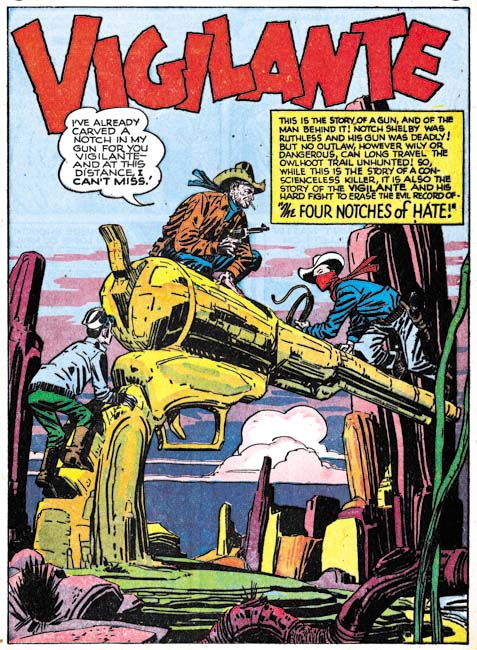
Western Comics #4 (July 1948) “The Four Notches of Hate”, art by Mort Meskin
In 1948 Meskin work for DC would be ending. Did Mort’s emotional problems have something to do with his end at DC? Or was it conflicts from working at National that provoked his emotional problems? The above splash from Western Comics #4 was among these final efforts. I am not sure how, but the Vigilante has somehow made the transition from a costume hero in the modern age to being a western genre hero.

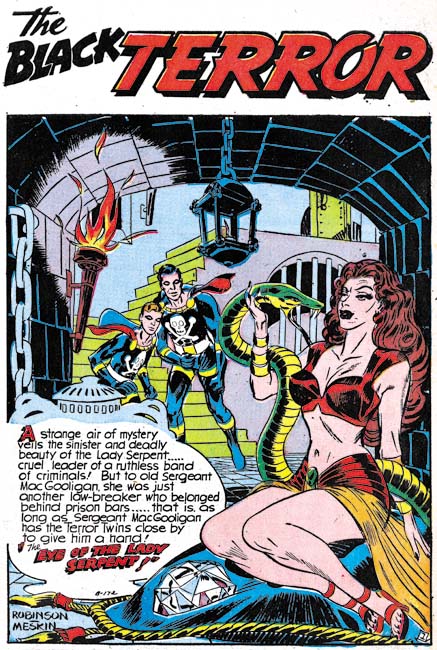
Black Terror #23 (June 1948) “The Eye of the Lady Serpent”, art by Jerry Robinson and Mort Meskin
Robinson and Meskin were only teamed up for a relatively short time, a little over a year. I may not be clear as to exactly what each of the two artists contributed to the joint efforts, but whatever it was it certainly was very successful. I find the art as exciting as Mort’s early work for DC.

Black Terror #23 (June 1948) “The Eye of the Lady Serpent” page 5, art by Jerry Robinson and Mort Meskin
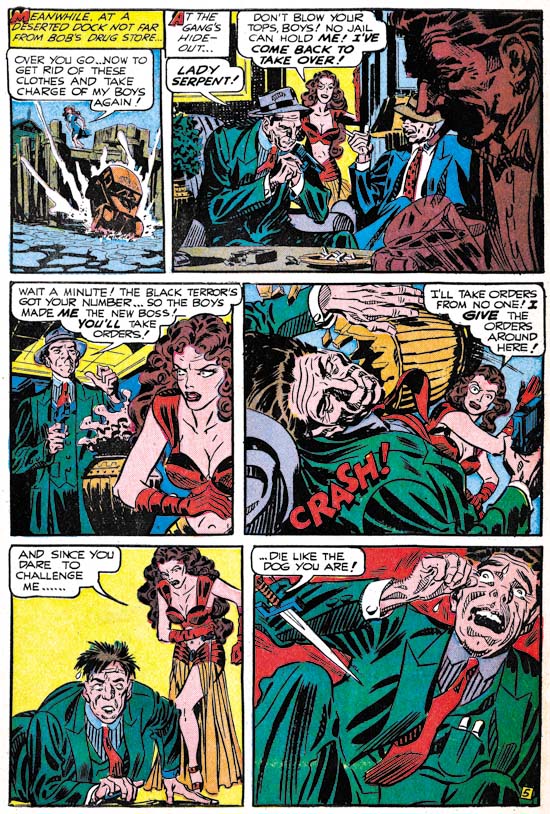
It was not just the splashes that Robinson and Meskin did so well, the story art is also first rate. Note the inking on this page as particularly seen in the last panel. The long sweeping parallel lines would later play an important part of Meskin’s inking style. Even more interesting is the presence of picket fence crosshatching (see the Inking Glossary for explanations of the terms I use to describe spotting techniques). Similar inking can be found for a piece that Jerry and Mort did for Simon and Kirby (Young Romance #5, May 1948). The inking looks like it was done by Meskin, but did he pick up the picket fence technique from Simon and Kirby or is there an earlier Robinson and Meskin example that I have not seen yet?

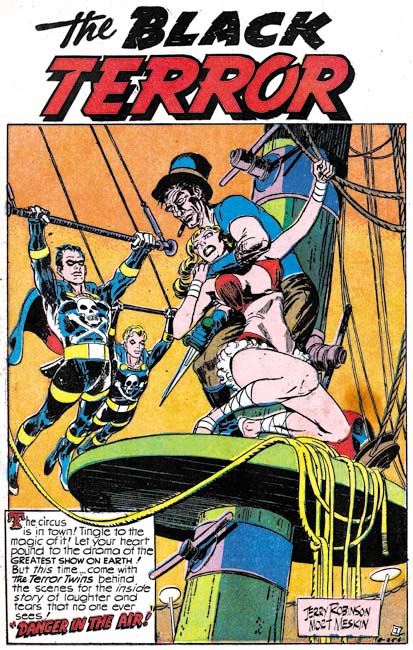
Black Terror #23 (June 1948) “Danger in the Air”, art by Jerry Robinson and Mort Meskin
Another great splash by Jerry Robinson and Mort Meskin. I might not have anything to say about it but how could I resist including it in this post?
I previously used a story page from this work to show the style Mort had adopted for depicting punches.

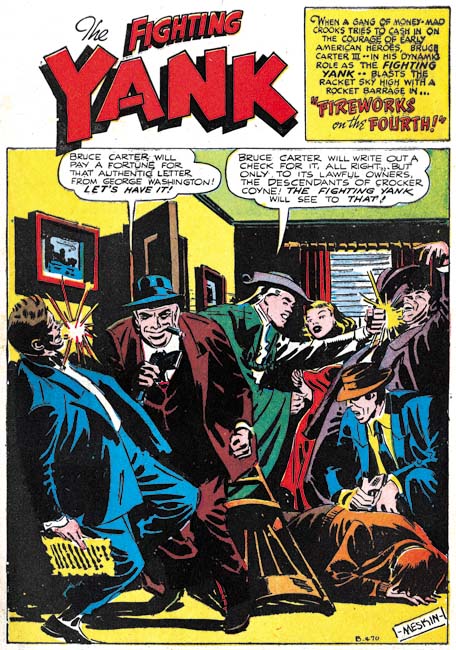
Fighting Yank #29 (August 1949) “Fireworks on the Fourth”, art by Mort Meskin
There may have been a relatively brief period between after the breakup of the Robinson and Meskin team where Mort was doing work by himself again but he had not yet started to work for Simon and Kirby. Fighting Yank #29 is signed by Meskin alone and Robinson does not appear anywhere in the comic. Mort’s first solo work for Simon and Kirby were cover dated December 1949 (Real West Romance #5 and Young Romance #16). Joe Simon has reported in The Comic Book Makers that initially Mort had an artist block. That Meskin was doing some solo work before joining Simon and Kirby may indicate that the artist block did not start until he actually began working for Joe and Jack. Perhaps intimidating presence of Jack Kirby had something to do with Mort’s artistic difficulties.
The “Fireworks on the Fourth” is inked in an interesting spotting technique. The blacks are grouped in a blocky fashion that to my eyes seems to flatten the image while providing it with interesting patterns. This is not the result of a bad printing; other stories by Meskin in the same issue are not inked in this manner.

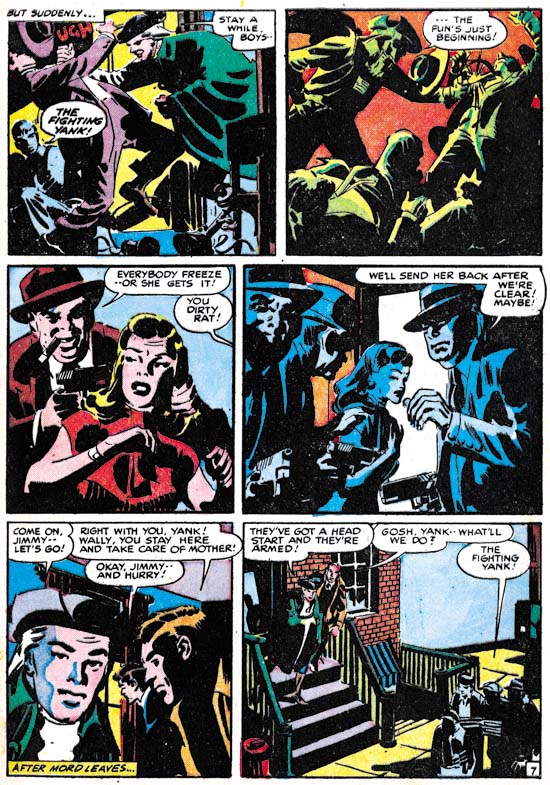
Fighting Yank #29 (August 1949) “Fireworks on the Fourth” page 7, art by Mort Meskin
The effects of this unusual inking can be best be seen in the story itself. While it is possible that this inking was done by another artist, I believe it was Mort’s own work. He would use a similar style of inking for a period later for some Simon and Kirby productions.
In a few months Mort Meskin would begin working for Simon and Kirby. Mort would become an important and prolific artist for Simon and Kirby productions. He did not, however, work exclusively for Joe and Jack. Meskin would also provide work for other Prize comics and occasionally other publishers as well.
Posted in 2008/10, Artists, Meskin, Mort, Robinson, Jerry, z Archive
Tagged Jerry, meskin, Mort, Robinson
11 Comments
Stan Lee Talking About Joe Simon
I mentioned Stan Lee’s statement about Joe Simon when I wrote about the 2008 New York Comic Con but I recently came across a short clip of it.
This was presented by YouTube user AstonishingTale’s. He also has a couple of other videos from the same Living Legends panel. One is a clip with Jerry Robinson and Stan Lee discussing the most creative individuals they ever meet. As much as I liked Lee’s choice, it was who Robinson praised that I really appreciated.
Jerry Robinson at the Jack Kirby Tribute Panel

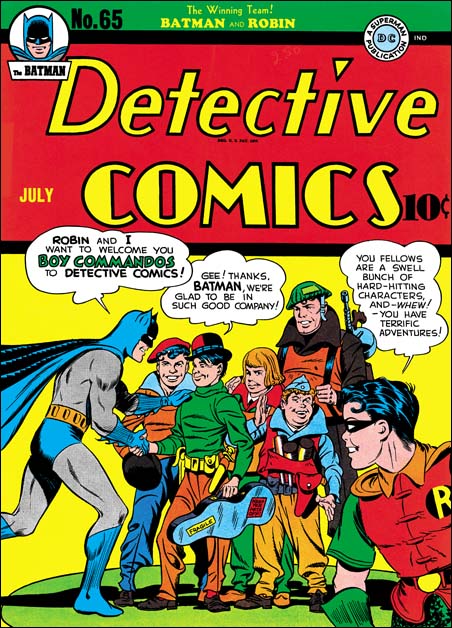
Detective #65 (July 1942), art by Jack Kirby and Jerry Robinson
I mentioned in a previous post a review of the Jack Kirby Tribute Panel that Comic Book Resources has posted (written by Jim MacQuarrie).
At the very end of the article is found:
Jerry Robinson closed the panel by recalling his participation in one of the very few collaborations that Kirby did with anyone but Joe Simon. “The only time Jack collaborated with anyone but Simon on a cover was an issue of “Detective Comics” when the Boy Commandos joined the book. The cover showed Batman and the Boy Commandos shaking hands. I drew Batman and Jack drew the Commandos.”

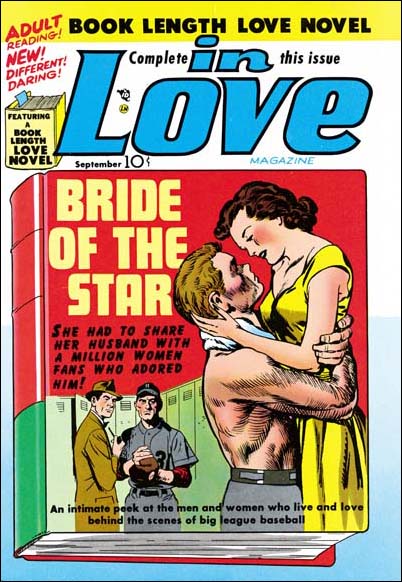
In Love #1 (September 1954), art by Jack Kirby and John Prentice
While of course Jerry is right about his contributions to the cover of Detective #65, he is not correct about being the only artist, other then Joe Simon, to collaborate on a cover with Jack Kirby. John Prentice, one of the usual suspects of the Simon and Kirby studio, also had that honor. Jack did the foreground couple while John did the two background figures.

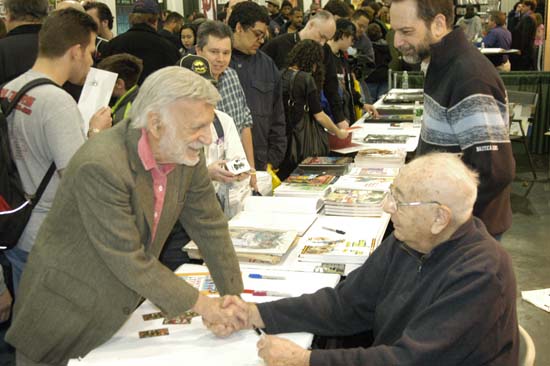
Jerry greeting Joe Simon at the Big Apple Con of 2006

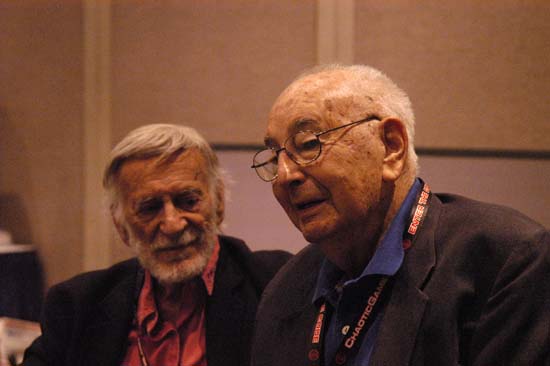
Jerry and Joe at New York ComicCon 2008
Posted in 2008/08, 4 DC (early), 6 Mainline, Artists, In Love, Odds & Ends, Periods, Prentice, John, Robinson, Jerry, Topic, z Archive
Tagged Jack, Jerry, Joe, John, Kirby, Prentice, Robinson, Simon
1 Comment