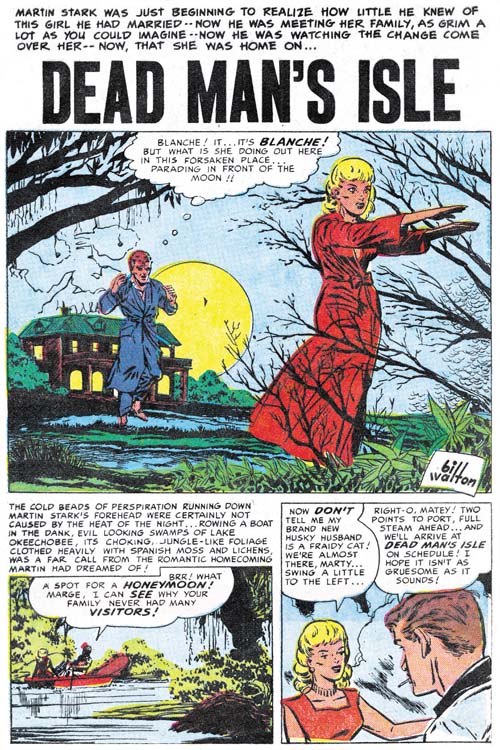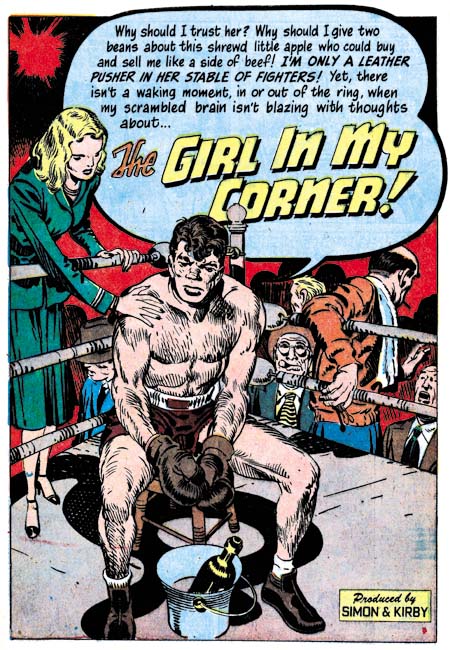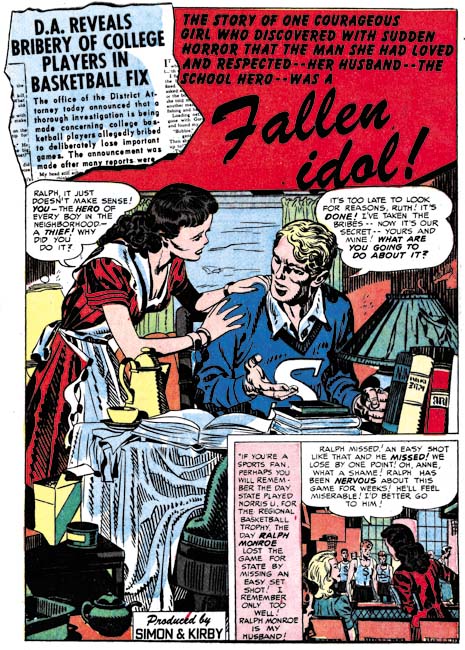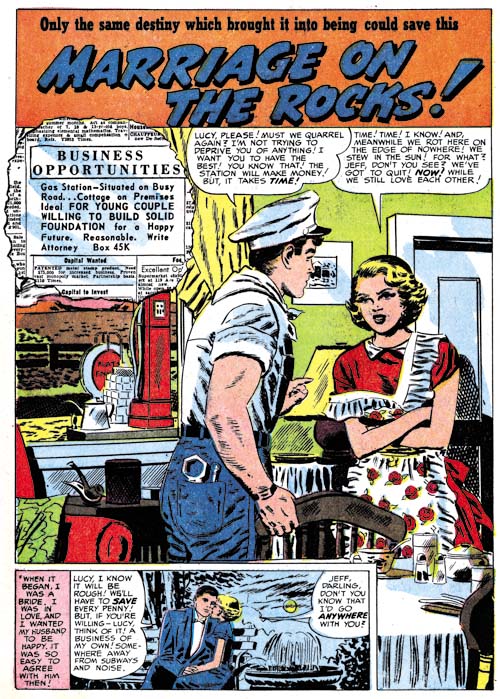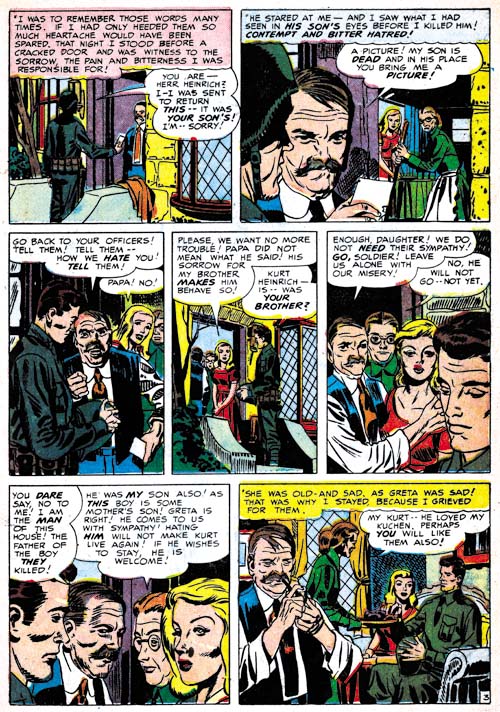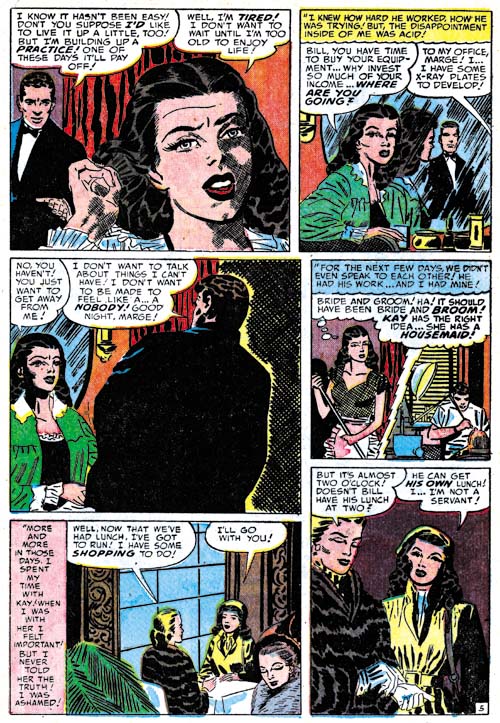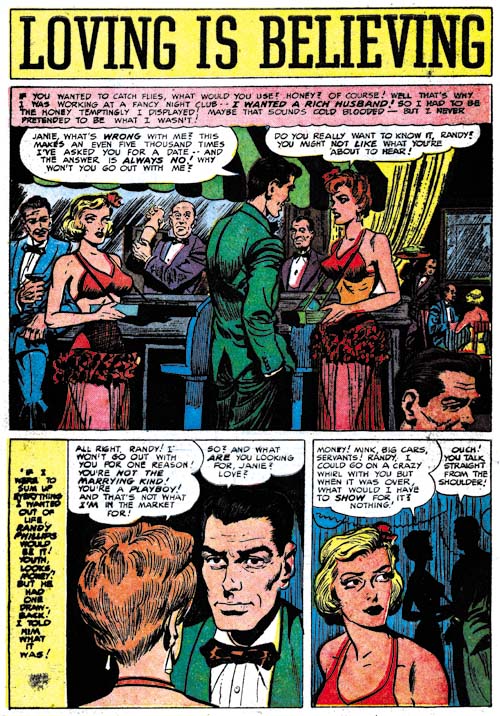

Please donate!
The Jack Kirby Museum is raising funds to open a "Pop-Up" Museum on the Lower East Side, near where Kirby was born and raised. Learn more here.About this Blog:
© 2006, 2007, 2008, 2009, 2010 & 2011 Harry Mendryk. Unless otherwise marked, all images are my own restorations. Further some of the images have copyrights by Joe Simon and Jack Kirby or Joe Simon alone. I am fortunate that Joe Simon has allowed me to also include some previously unpublished material. Please do not copy from this blog without permission.Pages
Categories
- 9/11 (6)
- Artists (268)
- Albistur, Jo (7)
- Avison, Al (8)
- Belfi, John (4)
- Breifer, Dick (9)
- Brewster, Ann (7)
- Burgos, Carl (1)
- Ditko, Steve (2)
- Donahue, Vic (12)
- Draut, Bill (50)
- Eadeh, Al (16)
- Gregg, George (5)
- Infantino, Carmine (6)
- Kirby, Jack (157)
- McCarty, Bob (9)
- Meskin, Mort (69)
- Morrow, Gray (1)
- Oda, Ben (1)
- Oleck, Jack (2)
- Powell, Bob (1)
- Premiani, Bruno (9)
- Prentice, John (29)
- Riley, Ken (2)
- Robinson, Jerry (10)
- Severin, John (7)
- Simon, Joe (57)
- Stallman, Manny (7)
- Starr, Leonard (13)
- Stein, Marvin (20)
- Walton, Bill (5)
- Checklist (19)
- Albistur, Joe (1)
- Brewster, Ann (1)
- Briefer, Dick (1)
- Donahue, Vic (1)
- Draut, Bill (1)
- Eadeh (1)
- Gregg, George (1)
- Infantino, Carmine (1)
- Kirby, Jack (1)
- McCarty, Bob (1)
- Premiani?, Bruno (1)
- Prentice, John (1)
- Riley, Ken (1)
- Robinson & Meskin (1)
- Severin, John (1)
- Simon, Joe (1)
- Stallman, Manny (1)
- Starr, Leonard (1)
- Stein, Marvin (1)
- Comic Checklists (20)
- All For Love (1)
- Black Magic, DC (1)
- Black Magic, Prize (1)
- Boys' Ranch (1)
- Charlie Chan (1)
- Clue (1)
- Fighting American (1)
- Foxhole (1)
- Headline (1)
- In Love (1)
- Justice Traps the Guilty (1)
- My Date (1)
- Personal Love (1)
- Prize Comics Western (1)
- Real West Romance (1)
- Western Love (1)
- Young Brides (1)
- Young Love (1)
- Young Romance (1)
- Your Dreams (1)
- Ink Checklist (1)
- Kirby, Jack (1)
- Periods (396)
- 1 Early (22)
- 2 Fox (14)
- 3 Timely (44)
- 4 DC (early) (46)
- 5 Studio (135)
- 6 Mainline (68)
- Assorted (10)
- Bullseye (8)
- Fighting American (6)
- Foxhole (13)
- In Love (16)
- Police Trap (7)
- Prize (15)
- 7 Freelance (74)
- Archie (13)
- Atlas Kirby (14)
- DC Kirby (4)
- Harvey (27)
- Prize (17)
- 8 Marvel (12)
- Assorted (6)
- Marvel Kirby (6)
- 9 DC (late) (6)
- Late (3)
- Serial Posts (139)
- Art of J. Simon (1)
- Art of Romance (41)
- Criminal Artists (4)
- Early Jack Kirby (9)
- End of S & K (1)
- Harvey Horror (3)
- It's a Crime (1)
- Kirby Austere Inking (1)
- Kirby Inkers (4)
- Little Shop of Horrors (1)
- Margin Notes (5)
- Replacing S&K (4)
- S&K Colorists (3)
- Start of S&K (12)
- Wide Angle Scream (15)
- Topic (341)
- Alternate Takes (16)
- Anthologies (6)
- Art Editing (4)
- Best of Simon & Kirby (2)
- Captain America (5)
- Comicscope (3)
- Experts (3)
- Featured Work (64)
- First Romance (1)
- Ghosting (7)
- Harvey Covers (24)
- Kirby Inking Kirby (4)
- Kirby Krackle (3)
- Kirby Or Not (28)
- Lettering (13)
- My Two Cents (7)
- Odds & Ends (128)
- Publications (24)
- Quote (4)
- Restoration (3)
- Robots (3)
- S&K Superheroes (2)
- Swiping (8)
- Wertham & Censoring (5)
- Why Comics Declined (1)
- Uncategorized (51)
- z Archive (595)
- 2006/03 (16)
- 2006/04 (14)
- 2006/05 (15)
- 2006/06 (16)
- 2006/07 (10)
- 2006/08 (24)
- 2006/09 (11)
- 2006/10 (19)
- 2006/11 (20)
- 2006/12 (14)
- 2007/01 (16)
- 2007/02 (17)
- 2007/03 (14)
- 2007/04 (10)
- 2007/05 (12)
- 2007/06 (8)
- 2007/07 (7)
- 2007/08 (8)
- 2007/09 (6)
- 2007/10 (10)
- 2007/11 (7)
- 2007/12 (4)
- 2008/01 (4)
- 2008/02 (7)
- 2008/03 (12)
- 2008/04 (8)
- 2008/05 (8)
- 2008/06 (11)
- 2008/07 (6)
- 2008/08 (12)
- 2008/09 (7)
- 2008/10 (8)
- 2008/11 (4)
- 2008/12 (6)
- 2009/01 (10)
- 2009/02 (4)
- 2009/03 (5)
- 2009/04 (8)
- 2009/05 (6)
- 2009/06 (5)
- 2009/07 (8)
- 2009/08 (6)
- 2009/09 (5)
- 2009/10 (6)
- 2009/11 (4)
- 2009/12 (3)
- 2010/01 (6)
- 2010/02 (7)
- 2010/03 (7)
- 2010/04 (4)
- 2010/05 (7)
- 2010/06 (5)
- 2010/07 (8)
- 2010/08 (4)
- 2010/09 (6)
- 2010/10 (9)
- 2010/11 (5)
- 2010/12 (5)
- 2011/01 (4)
- 2011/02 (2)
- 2011/03 (5)
- 2011/04 (6)
- 2011/05 (3)
- 2011/06 (5)
- 2011/07 (7)
- 2011/08 (5)
- 2011/09 (4)
- 2011/10 (10)
- 2011/11 (6)
- 2011/12 (5)
- 2012/01 (3)
- 2012/02 (2)
- 2012/03 (8)
- 2012/04 (3)
- 2012/05 (2)
Comic related blogs
Groups (membership required)
Web pages
Tag Archives: Kirby
Simon and Kirby’s Black Owl
Joe Simon and Jack Kirby first began working as a team early in 1940 (on Blue Bolt #2 and Champion #9 both cover dated July 1940). In a few months they would form the core of Timely’s first comic art bullpen. There they worked on the first, and only, Red Raven Comic and created a backup story for Marvel Mystery Comics called the Vision. But their working relationship was forged not just in the Timely bullpen but in the jobs they did outside the company as well. Particularly important was the work they did on the Black Owl for Prize Comics.

Prize Comics #7 (December 1940) “The Black Owl”, pencils by Jack Kirby
The Black Owl was not a Simon and Kirby creation but even at this early stage of their career they would put their distinct stamp on the hero. They did not make any changes to the costume although the Owl’s goggles would reappear years later in the unpublished Night Fighter and the published Fly. It is the story that most clearly shows the Simon and Kirby touch. There is no question they were not from someone else’s script but writing it themselves. With a female detective, an eccentric millionaire, a whistling hit man and King Arthur’s sword Excalibur it was an imaginative story to say the least. A final fight leads to a dramatic ending but the story ends with a caption that asks “Is the Whistler really dead”?

Prize Comics #8 (January 1941) “The Black Owl” page 2, pencils by Jack Kirby
Well it appears the Whistler was not dead as he returns in the next Simon and Kirby story. Since that ended the last story with a hint about Whistler’s survival I presume that Simon and Kirby knew when they did Prize Comics #7 that they would also be doing the next issue as well. The story contains the same cast of characters plus some additional ones. Even more interestingly the plot takers place on the high seas. Once again there is a dramatic fight at the end only this time the closing caption offers no hint of the Whistler’s return.

Prize Comics #9 (February 1941) “The Black Owl” page 3, pencils by Jack Kirby
A conniving reporter and a beautiful villainess, what more can you ask for? Nothing if the story is by Simon and Kirby! Another great effort for what is admittedly a pretty lame hero. Joe and Jack were using someone else’s creation so they cannot be blamed for the rather poor and unimaginative costume. But Simon and Kirby always made good stories even out of seemingly poor material. With the Black Owl Joe and Jack had not reached the creative pitch that would appear next month in Captain America #1 but they were not far from it. The Black Owl was a testing ground for Simon and Kirby on techniques like irregular shaped panels, circular panels and figures that extend beyond panel borders. These effects only make a sparing show in these issues of Prize Comics but they are there. The reader can see another example of unusual panel layouts in a page that I included in Chapter 9 of my serial post Early Jack Kirby.
Usually I choose the images to include in my posts that support the comments that I make. This is not the case for the image of page 3 shown above. It is here because of the final three panels. I find it rather surprising that the reporter would turn out the lights while attempting to capture the Black Owl. Why turn out the lights? The sequence is quite amusing, although not entirely for the reasons Simon and Kirby intended.

Prize Comics #7 (December 1940) “The Black Owl” page 9 panels 1 and 2, art by Jack Kirby
Some have tried to say that the Black Owl stories are solo efforts by Jack Kirby; that is without any input from Joe Simon. For me the problem with such a statement is that Joe’s contribution is often difficult to discern. I believe I see Simon’s inking in some of the Black Owl stories but it is hard to be sure and harder yet to convince others. Fortunately there is another line of evidence and that is the lettering. I credit Howard Ferguson with the lettering for Prize Comics #7 but some changes were made. In the first panel of page 9 shown above the letters for “slowly he forces the Black” are larger than the rest of the caption and the lower edges of the paste up can still be detected. The ‘F’, ‘C’ and especially the ‘W’ are done differently than Ferguson and without doubt they were done by Joe Simon. In the second panel we find larger letters for the portion “figures plunges head”. The letters ‘F’, ‘G’ and ‘S’ are not Ferguson’s but they are done the way Simon does his lettering.

Prize Comics #9 (February 1941) “The Black Owl” page 6 panel 6, pencils by Jack Kirby
Jack Kirby did the lettering for the Black Owl from Prize Comics #8 and so far I have not spotting any final changes (which is not the same thing as there were none). Ferguson was the letterer for Prize Comics #9 but I have spotted at least one alteration on page 6. Observe how the ‘ew’ in ‘newcomer’ is done with slightly thicker lines than the rest of the caption. The ‘E’ does not look like Ferguson’s but I cannot say for sure it was by Simon either. However the ‘W’ is distinctly Simon’s preferred form and so again I have little doubt that that he did the alteration. Now admittedly a few paste ups are not much but it does show Joe Simon’s involvement in Black Owl at some level. At this point in time Simon was the editor at Timely while Kirby was just an artist (although the most important artist in the bullpen). So I doubt that Simon involvement in Black Owl was limited to some final fix ups.
I do not think it is a coincidence that Prize Comics #9 (February 1941) would be Simon and Kirby’s last issue (at least for some years). Captain America #1 came out with a March cover data but I am sure Simon and Kirby knew that it would be a hit. Since they were promised royalties for Captain America, Joe and Jack probably felt that Cap warrant their best efforts and so they cut back on moonlighting. Unfortunately while Captain America was a hit but due to some accounting tricks the royalties was not what would have been expected.
Art of Romance, Chapter 25, More New Faces
(November 1953 – January 1954: Young Romance #63 – #65, Young Love #51 – #53, Young Brides #9 – #11)

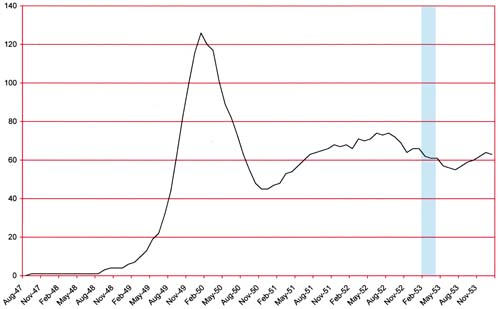
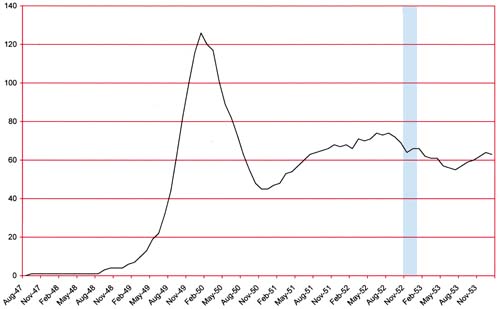
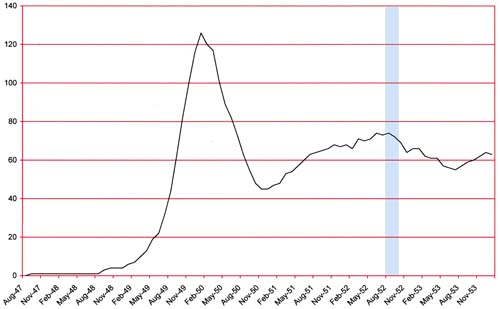
Number of Romance Titles 1947 – 1954 (the period covered in this chapter is shaded in blue)
There have been no significant changes in the romance comics from that reported in the previous two chapters. One variation, or rather the lack thereof, is that almost all the stories are exactly 6 pages long. The only exceptions are some two or single page features, two stories by Jack Kirby (7 and 8 pages long) and one by Al Eadeh (4 pages). Previously the title Young Brides had become a monthly publication and so this chapter covers 9 comics. The line up of contributing artists is Jack Kirby (63 pages), Bill Draut (36 pages), John Prentice (36 pages, Mort Meskin (18 pages), Bob McCarty and an unidentified artist (13 pages each), Mort Laurence and Bill Benulis (12 pages each), Al Eadeh (10 pages), a single story by another unidentified artist (6 pages) and 6 single page features but a probably studio assistant. As can be seen in the list there are some new names among the studio artists.

Young Romance #64 (December 1953) “The Heartbreaker”, art by Jack Kirby
There were no full page splashes but Jack Kirby’s art is still first rate, even compared to his work from other periods. With the reduced size splashes Kirby favored an angular format. Such a panel shape would have been a challenged for most artist but Jack makes good use of it. Observe how the main action of the splash for “The Heartbreaker” occurs in the lower corner making it visually fit in with the second panel. Kirby then uses the helmets of the soldiers ascending a boarding ramp to provide a diagonal from the lower left to the upper right. The second panel hardly seems to intrude at all.

Young Romance #63 (November 1953) “A Matter of Pride” page 3, art by Jack Kirby
While I usually provide examples of the splash pages, it is important to remember that Kirby was primarily a story teller. Once again during this period Jack’s graphical story-telling is first rate. I particularly like the way Kirby drew older men. The craggy face of white haired man in this story perfectly matches his rustic life.

Young Brides #10 (November 1953) “The Stranger in His Heart”, art by Bill Draut
Most romance stories are about, not surprisingly, young love. However stories with other themes would occasionally appear in Simon and Kirby romance titles. “The Stranger in His Heart” is about the entry of the orphaned son of a combat buddy into the life of his young wife. It is the sort of story that Bill Draut is particularly good out, being second only to Jack Kirby among the studio artists.

Young Romance #64 (December 1953) “The Doctor is in Love” page 2, art by John Prentice
One of the formats that John Prentice would use during the period involved the use of tall narrow panels. This type of panel layout had previously been used by artists like Leonard Starr, Mort Meskin and Ross Andru; however at this time Prentice seemed to be the only studio artist that would sometimes use such narrow panels.

Young Love #52 (December 1953) “Loving Sister”, art by Mort Meskin
As I have remarked in the previous couple of chapters, Mort Meskin contributed much less than what would be expected towards Simon and Kirby productions. For a few years Mort had been working almost exclusively for Joe and Jack. However in recent months his work had been appearing in other publishers’ comic books. But it would appear that Meskin’s combined output was much lower then previously. Whatever the reason behind this change, it must have been financially tough times for Meskin.

Young Love #51 (November 1953) “The Will to Love” page 2, art by Al Eadeh
Al Eadeh had not been a major contributor to S&K productions but he had been a regular one for some about a year and a half. Eadeh was not the greatest of the studio artist but he showed some improvements over time. His earlier work for Joe and Jack were rather stiff but in his more recent work he does quite well in graphically telling a story. I love this page of the interaction of the good hearted nurse and a gold-digger. Sure it is a little over the top, but that is what comics are for!

Young Romance #63 (November 1953) “The Two Mrs. McGillicudys”, art by unidentified artist
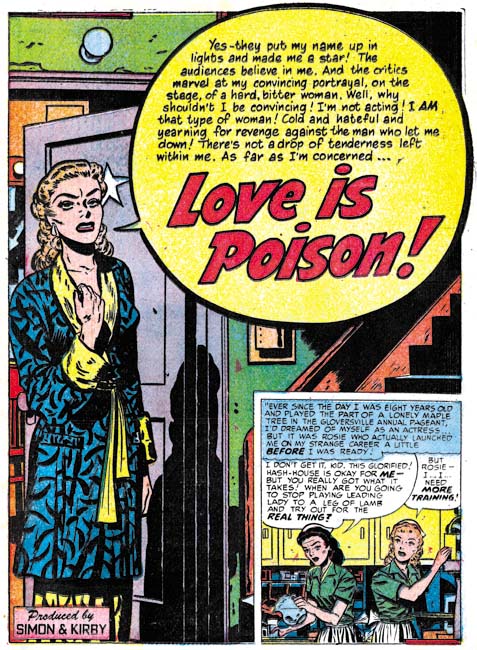
“The Two Mrs. McGillicudys” and “Summer Replacement” are two stories by the same unidentified artist I mentioned in the last chapter. I am quite fond of this mystery artist and I am sure he must have been doing romance art for some other publisher prior to doing this work. In some ways the above page is a good example of the format he liked to start his stories with. The first story panel covers an area a little more then two regular story panels. This makes it not much of a splash although more of one then some other studio artists, such as John Prentice, used. The artist also includes a head in the title box. Only one other artist, Jack Kirby, would include such head shots in the title caption. But in this case the artist increased the size of the head and provided speech balloon. Thus he as effectively turned the title into a second splash. It is almost a soliloquy splash since the woman is introducing the story, but it differs from the classic S&K soliloquy splash in that the title is not part of the speech balloon. True Soliloquy splashes no longer appeared in Simon and Kirby romances and nobody else did anything like this.

Young Love #51 (November 1953) “Speed”, art by Bob McCarty
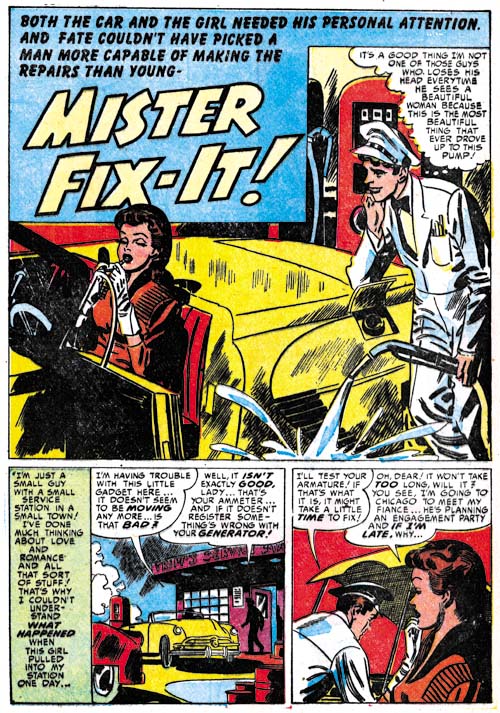
During the review I conducted in preparation for this chapter I found two stories by Bob McCarty that in my database I had previously to another artist. I will discuss this more below. The splash for “Speed” is probably the most typical splash in all the issues covered in this post. The title is not separated into its own box, the splash takes up the full width of the page and vertically it is much greater then the row of story panels. It splash art still adheres to the latest formula of actually being part of the story but otherwise it is a perfectly typical splash.

Young Love #53 (January 1954) “Sweet Talking Man” page 5, art by Bob McCarty
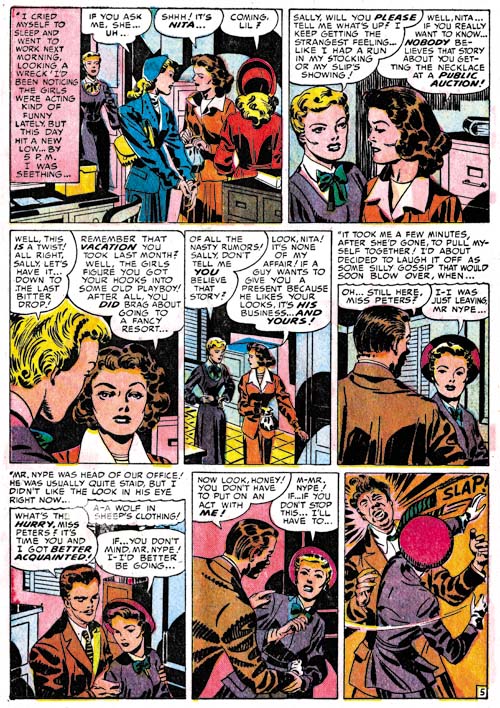
Both of the stories that I am now attributing to McCarty I had previously entered into my database as by John Prentice. My original entries into my database were made as I obtained the comics and depending on when that was would dictate how accurate I was likely to be. That is one of the reasons that I find the reviews that I am now conducting so useful. I find it interesting that the work Bob McCarty resembles the art of John Prentice more now then he did previously or would later. This might be due to influence; not so much Prentice influencing McCarty’s art as much as both of them being influenced by the great syndicate artist Alex Raymond as particularly seen in his Rip Kirby strip. Another possibility is that McCarty and Prentice knew one another and that Prentice may have helped in some on these particular stories.
I purposely choose page 5 from “Sweet Talking Man” because it most clearly shows McCarty’s hand. The doctor in the final panel as eyes that art larger then Prentice would use but typical for McCarty. The woman also lacks Prentice’s more sophisticated beauty. The fact that I have now found three stories by McCarty that I have previously missed makes me suspect that perhaps more will be uncovered as I continue my reviews.

Young Love #52 (December 1953) “Worthless”, art by Mort Lawrence
New to the Simon and Kirby productions, but certainly not new to the comic industry, is Mort Lawrence. The GCD� only lists a single romance work by Lawrence (Love Diary #2, October 1949). I suspect that is just due to the general bias against love comics by most comic book collectors. That said, judging by the work he did for S&K Lawrence really was not that great at the romance genre. But check out the older man in the splash. A similarly downtrodden gentleman appears in the splash of Lawrence’s “Love Me, or Else” (YR #65, January 1953) as well.

Young Love #53 (January 1954) “You’ll Be Sorry”, art by Bill Benulis
Another new artist to start working for Simon and Kirby was Bill Benulis. Benulis was new to comics and his art has a more modern approach. I like some of his techniques but he gives his woman a scratchy look which is very unfortunate thing to do in romance comics. Benulis entry into comics was ill timed and he seems to have been a victim of the crash that would affect the comic industry in a few years.
Chapter 1, A New Genre (YR #1 – #4)
Chapter 2, Early Artists (YR #1 – #4)
Chapter 3, The Field No Longer Their’s Alone (YR #5 – #8)
Chapter 4, An Explosion of Romance (YR #9 – #12, YL #1 – #4)
Chapter 5, New Talent (YR #9 – 12, YL #1 – #4)
Chapter 6, Love on the Range (RWR #1 – #7, WL #1 – #6)
Chapter 7, More Love on the Range (RWR #1 – #7, WL #1 – #6)
Chapter 8, Kirby on the Range? (RWR #1 – #7, WL #1 – #6)
Chapter 9, More Romance (YR #13 – #16, YL #5 – #6)
Chapter 10, The Peak of the Love Glut (YR #17 – #20, YL #7 – #8)
Chapter 11, After the Glut (YR #21 – #23, YL #9 – #10)
Chapter 12, A Smaller Studio (YR #24 – #26, YL #12 – #14)
Chapter 13, Romance Bottoms Out (YR #27 – #29, YL #15 – #17)
Chapter 14, The Third Suspect (YR #30 – #32, YL #18 – #20)
Chapter 15, The Action of Romance (YR #33 – #35, YL #21 – #23)
Chapter 16, Someone Old and Someone New (YR #36 – #38, YL #24 – #26)
Chapter 17, The Assistant (YR #39 – #41, YL #27 – #29)
Chapter 18, Meskin Takes Over (YR #42 – #44, YL #30 – #32)
Chapter 19, More Artists (YR #45 – #47, YL #33 – #35)
Chapter 20, Romance Still Matters (YR #48 – #50, YL #36 – #38, YB #1)
Chapter 21, Roussos Messes Up (YR #51 – #53, YL #39 – #41, YB #2 – 3)
Chapter 22, He’s the Man (YR #54 – #56, YL #42 – #44, YB #4)
Chapter 23, New Ways of Doing Things (YR #57 – #59, YL #45 – #47, YB #5 – #6)
Chapter 24, A New Artist (YR #60 – #62, YL #48 – #50, YB #7 – #8)
Chapter 25, More New Faces (YR #63 – #65, YLe #51 – #53, YB #9 – #11)
Chapter 26, Goodbye Jack (YR #66 – #68, YL #54 – #56, YB #12 – #14)
Chapter 27, The Return of Mort (YR #69 – #71, YL #57 – #59, YB #15 – #17)
Chapter 28, A Glut of Artists (YR #72 – #74, YL #60 – #62, YB #18 & #19, IL #1 & #2)
Chapter 29, Trouble Begins (YR #75 – #77, YL #63 – #65, YB #20 – #22, IL #3 – #5)
Chapter 30, Transition (YR #78 – #80, YL #66 – #68, YBs #23 – #25, IL #6, ILY #7)
Chapter 30, Appendix (YB #23)
Chapter 31, Kirby, Kirby and More Kirby (YR #81 – #82, YL #69 – #70, YB #26 – #27)
Chapter 32, The Kirby Beat Goes On (YR #83 – #84, YL #71 – #72, YB #28 – #29)
Chapter 33, End of an Era (YR #85 – #87, YL #73, YB #30, AFL #1)
Chapter 34, A New Prize Title (YR #88 – #91, AFL #2 – #5, PL #1 – #2)
Chapter 35, Settling In ( YR #92 – #94, AFL #6 – #8, PL #3 – #5)
Appendix, J.O. Is Joe Orlando
Chapter 36, More Kirby (YR #95 – #97, AFL #9 – #11, PL #6 – #8)
Chapter 37, Some Surprises (YR #98 – #100, AFL #12 – #14, PL #9 – #11)
Chapter 38, All Things Must End (YR #101 – #103, AFL #15 – #17, PL #12 – #14)
Posted in 5 Studio, Art of Romance, Artists, Draut, Bill, Eadeh, Al, Kirby, Jack, McCarty, Bob, Meskin, Mort, Periods, Prentice, John, Prize, Serial Posts
Tagged Al, benulis, Bill, bob, Draut, Eadeh, Al, Jack, John, Kirby, lawrence, mccarty, meskin, Mort, Prentice
3 Comments
Art of Romance, Chapter 24, A New Artist
(August 1953 – October 1953: Young Romance #60 – #62, Young Love #48 – #50, Young Brides #7 – #8)

Number of Romance Titles 1947 – 1954 (the period covered in this chapter is shaded in blue)
I had discussed in Chapter 9 of the Little Shop of Horrors that the title Black Magic went to a bi-monthly schedule starting with the September issue (BM #25). This is a certain indication that sales of Black Magic was not doing as well as previously. However with the October release, Young Brides would assume a monthly schedule. This is just as clear a sign that the romance titles were still doing very well. This despite the fact that the number of romance titles published in the industry had reached a local low in August.
This period marked the 50th issue of Young Love. Admittedly this is just a psychological marker but it does serve as a reminder that Simon and Kirby had done quite well over a relatively long time with their romance titles (about the last six years). Since their deal with Prize Comics gave them a share of the profits, Joe and Jack made a lot of money off of romance. Simon and Kirby paid for all the expenses for producing the art however that was recently offset by the fact that Jack had been drawing a significant proportion of the titles. But things would not remain so favorable for Simon and Kirby. A very different state of affairs would exist about a year later.
The story format used during this period pretty much matches that found in the last chapter. Full pages splashes were often found throughout most of the run of the romance titles that is until recently. There is not a single full page splash in the comics from the period covered in this chapter. Before the period that started in the last chapter splashes played a role similar to a movie trailer; they provide a sort of synopsis to entice the viewer to buy the comic and read the story. During this period only three stories used such a standard splash. By far the most common use of the splash, found in 18 stories, was for the splash to actually be part of the story. Less common (6 stories) was the complete elimination of the splash panel. One uncommon format (3 stories) was to include heads in the story title panel. I do not consider this a true splash because the heads occupy a very small portion of the panel. There is also a single example of what I call a theme title that I will discuss below.
Once again during this period Jack Kirby was the most prolific of the romance artists having penciled 79 pages. The next most prolific artist was Bill Draut (44 pages), followed by John Prentice (32 pages), Mort Meskin (16 pages), an unidentified artist (10 pages). Two artists (Bob McCarty and Al Eadeh) each supplied only a single story. Another unidentified artist did two single pages pieces. As discussed in the last chapter, I find Mort Meskin’s much diminished contribution rather surprising. As I mentioned in Chapter 9 of the Little Shop of Horrors, Meskin had begun to produce art for other publishers during at this time; Harvey (July), DC (August), Standard (August) and Marvel (September).

Young Romance #62 (October 1953) “The Mystery Blonde of Lover’s Lane”, art by Jack Kirby
The Prize romance comics may have been running for some time but Simon and Kirby still managed to provide good stories with just a suggestion of the risque. The start of “The Mystery Blonde of Lover’s Lane” can accurately be described as an attempted rape. One wonders whether the man would have given up even after the woman left the car had that hobo did not happen to be on the scene. By the way, this is a good example of splash that is actually the start of the story.

Young Brides #7 (September 1953) “A Husband for Tracy”, art by Jack Kirby
For “A Husband for Tracy” Kirby tackles the subject of love an overweight woman. I remember this theme was used before but in that story the lady in question lost her weight to become popular. That is not the approach of this story where except for a change of attitude, the protagonist is unaltered throughout the story. This is an example of a standard splash. As I said earlier there were only 3 standard splashes and all of them were done by Kirby.

Young Love #48 (September 1953) “The Marrying Kind”, art by Jack Kirby
In the previous chapter I discussed a story by Bill Draut (“The Hard Guy”) where Bill added some drawing to the title box to provide a sort of a theme. I did not consider this a splash because the title dominated the box and the art did not depict anything specific about the story. At the time I wrote that none of the other artist picked up the technique. Well now Kirby has with “The Marrying Kind”. Jack has increased the amount of art so the panel is now more splash-like. However the art still lacks specificity normally supplied by a splash. Since little more then a cruise ship is depicted the question is was this really drawn by Kirby? I think it was because the brushwork found in the inking of the foreground trees look like Jack’s hand to me.

Young Love #49 (September 1953) “Highway of Dreams”, art by Bill Draut
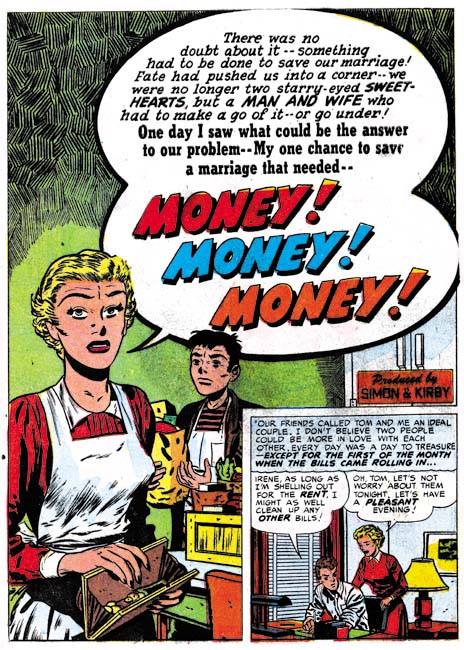
Although I have classified “Highway of Dreams” as a story splash the panel is nothing more then two standard story panels combined. While Bill, like the rest of the studio artist, does a good job with this new format one wonders what was behind this new approach.

Young Romance #61 (September 1953) “Tried and Untrue”, art by John Prentice
All the romance work that John Prentice did during this period was in the form of splash-less stories. While the new formats seem to have been a direction to the studio artists (almost certainly from Simon and Kirby) there seems to have been some variation on the precise approach adopted by the different creators.

Young Brides #7 (September 1953) “Mind Your Own Marriage”, art by Mort Meskin
As discussed about, Mort Meskin was only a minor contributor. At least some of the work he did pencil was inked by some other artist. “Mind Your Own Marriage” does not look like it was inked by either Mort or his frequent inker at this time, George Roussos. I am not sure who the inker is but he does a nice job.

Young Romance #60 (August 1953) “First Kiss”, art by Al Eadeh
While Al Eadeh has been doing little work for Simon and Kirby, his occasional pieces still keep showing up.

Young Love #50 (October 1953) “Miss Puritan” page 5, art by Bob McCarty
Up till now Bob McCarty mostly did horror stories for Simon and Kirby and very little romance work. His last romance piece appeared some months ago (YL #41, January 1953). His last Simon and Kirby piece was Black Magic #21 (February 1953). I do not know why he has been absent from the S&K productions and he will not appear regularly again until late 1954. “Miss Puritan” marks a mid-way place between the earlier art he did for Simon and Kirby and the later material. Previously I had noted some differences between the two and I was not certain they were done by the same artist. In “Miss Puritan” McCarty has largely stopped depicting over-sized eyes but retains enough of his older style to be recognized. Thus I am now confident that all this work was done by McCarty and I have stopped adding the question mark to his attributions.

Young Love #49 (September 1953) “The Doormat” page 3, art by unidentified artist
The unidentified artists who worked for Simon and Kirby in the more recent few years have all been artists of lesser talent that were only assigned very short pieces. With “The Doormat” however, there is an artist of exceptional talent. The example page I provide above shows that he was more than comfortable with romance, he excelled at it. I do not know who he is but I examination of work by other publishers from this period might identify him.

Young Love #50 (October 1953) “Two Kisses For Your Anniversary” page 4, art by unidentified artist
Another example from the same mystery artist. Both of the stories he did start with his own version of the story splash. The splash was formed by vertically joining two panels. So while the stories adhere to some sort of direction from Simon and Kirby that direction did not seem to be in the form of a layout. More likely it was a direction from the script. Page 4 of “Two Kisses for Your Anniversary” not only shows a similarly vertical panel but also an unusual borderless panel of talking heads that spans the width of the page. No other Simon and Kirby studio artists used such a device. This is further evidence that this artist was not working from Kirby layouts.
Chapter 1, A New Genre (YR #1 – #4)
Chapter 2, Early Artists (YR #1 – #4)
Chapter 3, The Field No Longer Their’s Alone (YR #5 – #8)
Chapter 4, An Explosion of Romance (YR #9 – #12, YL #1 – #4)
Chapter 5, New Talent (YR #9 – 12, YL #1 – #4)
Chapter 6, Love on the Range (RWR #1 – #7, WL #1 – #6)
Chapter 7, More Love on the Range (RWR #1 – #7, WL #1 – #6)
Chapter 8, Kirby on the Range? (RWR #1 – #7, WL #1 – #6)
Chapter 9, More Romance (YR #13 – #16, YL #5 – #6)
Chapter 10, The Peak of the Love Glut (YR #17 – #20, YL #7 – #8)
Chapter 11, After the Glut (YR #21 – #23, YL #9 – #10)
Chapter 12, A Smaller Studio (YR #24 – #26, YL #12 – #14)
Chapter 13, Romance Bottoms Out (YR #27 – #29, YL #15 – #17)
Chapter 14, The Third Suspect (YR #30 – #32, YL #18 – #20)
Chapter 15, The Action of Romance (YR #33 – #35, YL #21 – #23)
Chapter 16, Someone Old and Someone New (YR #36 – #38, YL #24 – #26)
Chapter 17, The Assistant (YR #39 – #41, YL #27 – #29)
Chapter 18, Meskin Takes Over (YR #42 – #44, YL #30 – #32)
Chapter 19, More Artists (YR #45 – #47, YL #33 – #35)
Chapter 20, Romance Still Matters (YR #48 – #50, YL #36 – #38, YB #1)
Chapter 21, Roussos Messes Up (YR #51 – #53, YL #39 – #41, YB #2 – 3)
Chapter 22, He’s the Man (YR #54 – #56, YL #42 – #44, YB #4)
Chapter 23, New Ways of Doing Things (YR #57 – #59, YL #45 – #47, YB #5 – #6)
Chapter 24, A New Artist (YR #60 – #62, YL #48 – #50, YB #7 – #8)
Chapter 25, More New Faces (YR #63 – #65, YLe #51 – #53, YB #9 – #11)
Chapter 26, Goodbye Jack (YR #66 – #68, YL #54 – #56, YB #12 – #14)
Chapter 27, The Return of Mort (YR #69 – #71, YL #57 – #59, YB #15 – #17)
Chapter 28, A Glut of Artists (YR #72 – #74, YL #60 – #62, YB #18 & #19, IL #1 & #2)
Chapter 29, Trouble Begins (YR #75 – #77, YL #63 – #65, YB #20 – #22, IL #3 – #5)
Chapter 30, Transition (YR #78 – #80, YL #66 – #68, YBs #23 – #25, IL #6, ILY #7)
Chapter 30, Appendix (YB #23)
Chapter 31, Kirby, Kirby and More Kirby (YR #81 – #82, YL #69 – #70, YB #26 – #27)
Chapter 32, The Kirby Beat Goes On (YR #83 – #84, YL #71 – #72, YB #28 – #29)
Chapter 33, End of an Era (YR #85 – #87, YL #73, YB #30, AFL #1)
Chapter 34, A New Prize Title (YR #88 – #91, AFL #2 – #5, PL #1 – #2)
Chapter 35, Settling In ( YR #92 – #94, AFL #6 – #8, PL #3 – #5)
Appendix, J.O. Is Joe Orlando
Chapter 36, More Kirby (YR #95 – #97, AFL #9 – #11, PL #6 – #8)
Chapter 37, Some Surprises (YR #98 – #100, AFL #12 – #14, PL #9 – #11)
Chapter 38, All Things Must End (YR #101 – #103, AFL #15 – #17, PL #12 – #14)
Posted in 2009/11, 5 Studio, Art of Romance, Artists, Draut, Bill, Eadeh, Al, Kirby, Jack, McCarty, Bob, Meskin, Mort, Periods, Prentice, John, Prize, Serial Posts, z Archive
Tagged Al, Bill, bob, Draut, Eadeh, Al, Jack, John, Kirby, mccarty, meskin, Mort, Prentice
4 Comments
Little Shop of Horrors, Chapter 9, The Party’s Over
(May 1953 – September 1953, Black Magic #24 – #26)
Simon and Kirby had been on a winning streak ever since they made their deal with Prize Comics in 1947. With the sole exception of Strange World of Your Dreams the titles that they did for Prize were all very successful. Every title except for the more recent Young Brides had gone from monthly to bimonthly; a sure sign that they were selling well. However now the reverse had happened; Black Magic returned to a bi-monthly schedule; an equally sure sign that sales had fallen. It had stayed a monthly for over a year and it would continue to be a bi-monthly for some time so Black Magic could hardly be called a failure. Because of the new schedule, I will be doing these chapters in six month increments. This chapter covers the same period as Chapter 23 and the yet to be written Chapter 24 of the Art of Romance.
As was the case with the romance titles during this period, the primary artist for Black Magic was Jack Kirby who at 42 pages did more then twice as much as any other artist. Surprisingly the second place artist was Al Eadeh (17 pages). This is surprising because Eadeh was the least used of the artists working on the romance titles. Bill Draut and George Roussos both did a single, six page story. An unidentified artist drew 5 single page features.
Mort Meskin is completely absent. Meskin’s contribution to the romance titles had also dramatically declined at this time. Perhaps as a result Mort would start appearing in the titles by other publishers; Harvey (July), DC (August), Standard (August) and Marvel (September). Since Meskin would continue to provide work to Simon and Kirby I do not believe this was due to some sort of break between the parties. A better explanation may be that this was when Mort set up his own studio, perhaps in partnership with George Roussos. With Meskin no longer in the S&K studio, Kirby would pick up the work that did not get assigned to other artists.

Black Magic #24 (May 1953), “After I’m Gone”, art by Jack Kirby
Jack Kirby was not only producing in quantity but with quality as well. Unfortunately his splashes from this period are all half-page affairs but Kirby could still make great use of the limited space. Perhaps Jack’s most important attribute when it came to the horror genre was not his ability to depict monsters and demons (although he was quite good at that) but instead it was his skill at depicting fear.

Black Magic #26 (September 1953), “Demon Wind”, art by Jack Kirby
Sometimes things are perfectly understandable when graphically presented but actually illogical when rationally examined. Kirby’s splash for “Demon Wind” obviously shows a native encountering someone or something wearing a frightening mask. Since the front of the mask is shown this is not a depiction as seen by the wearer of the mask. But then why would images of the victim appear in both eyes? They would not unless they were mirrors in the eyes in which case how could the wearer see anything? Logic may fail, but Kirby certainly has not; despite or perhaps because of its simplicity this is a great splash.
In the more recent period double images such as seen in the “Demon Wind” splash would be created by drawing one and making a stat or xerox from that to create the second version. However xeroxes had not been invented yet and apparently the Simon and Kirby studio did not include a stat camera. It therefore was quicker and more cost effective to just draw two images. Even a casual comparison shows that these are not truly identical images.

Black Magic #24 (May 1953), “The Lady Is a Ghost”, art by Bill Draut
The only full page splash in these issues of Black Magic was by Bill Draut. The scene is very appropriate for the story but with a text change such a splash could just as easily been used in one of the romance comic books. This story was Bill’s only contribution to Black Magic at this time. That Draut was so underused in Black Magic is not too surprising because at this time he was doing more then his usually amount of romance work.

Black Magic #24 (May 1953), “As Real as Life”, art by Al Eadeh
During this period Al Eadeh was not just working for Simon and Kirby but also Atlas. Unfortunately I do not have any examples of his Atlas work to show but you can find some in Atlas Tales. Although the work really does look like it was done by the same artist there was a difference in the style used for the two different companies. Work for Simon and Kirby was more realistic and perhaps a little drier while for Atlas Eadeh would use more exaggerated characters.

Black Magic #24 (May 1953), “The Changeling”, art by George Roussos
My database indicates that this is the last piece that Roussos did for Simon and Kirby. However my recent reviews of these comics sometimes reveal attributions that I missed in the past. We shall see if he turns up in any future chapters.

Black Magic #25 (July 1953), “Human Bloodhound”, art by unidentified artist
Single page features had always been used in Black Magic but there seems to be an increase of their use in these particular issues. I cannot identify the artist but I have to say he really is not that good of one. While Jim Infantino was a studio assistant he did some single page pieces for the romance titles, so perhaps this artist was an assistant as well.
The Little Shop of Horrors, Chapter 1 (#1 – 3), Expanding Their Fields
The Little Shop of Horrors, Chapter 2 (#4 – 6), Up and Running
The Little Shop of Horrors, Chapter 3 (#7 – 8), The Same Old Gang
The Little Shop of Horrors, Chapter 4 (#9 – 11), Another Hit
The Little Shop of Horrors, Chapter 5 (#12 – 14), New Faces
The Little Shop of Horrors, Chapter 6 (#15 – 17), Mix Bag
The Little Shop of Horrors, Chapter 7 (#18 – 20), Kirby Returns
The Little Shop of Horrors, Chapter 8 (#21 – 23), The Gang’s All Here
The Little Shop of Horrors, Chapter 10 (#27 – 29), A Special Visitor
The Little Shop of Horrors, Chapter 11 (#30 – 33), The End
Art of Romance, Chapter 23, New Ways of Doing Things
(May 1953 – July 1953: Young Romance #57 – #59, Young Love #45 – #47, Young Brides #5 – #6)

Number of Romance Titles 1947 – 1954 (the period covered in this chapter is shaded in blue)
The artists who contributed to the romance titles during this period were the same as those covered in the last chapter; Jack Kirby, Bill Draut, Mort Meskin, John Prentice and Al Eadeh. Kirby was by far the most prolific having penciled 97 pages of art. Second place went to Draut (41 pages), followed by Prentice (21 pages), Meskin (18 pages) and then Eadeh (12 pages). The only other artist involved only produced two single page features both in the same issue (YR #57) and was likely a studio assistant. Still missing were some other artists that not so long ago had been doing a share of the work; Bob McCarty(?), Bill Walton and George Roussos.
Over a period of about half a year there has been a dramatic shift in the amount of art produced by Mort Meskin and Jack Kirby. Prior to this shift Meskin was producing a lot of romance art while Kirby was doing much less. Now the rolls were reverse with Jack being quite productive and Mort doing relatively little work. I do not think this reversal was coincidental. It would appear that Kirby was doing the work that had previously been going to Meskin. It is not at all clear whether this was because Meskin for some reason could no longer produce the same amount of work or whether Simon and Kirby decided to give him much less work to do. There is no sign that Mort made up for this loss of work by doing more in the titles he appeared in that were not produced by Simon and Kirby (Headline, Justice Traps the Guilty and Prize Comics Western). Nor had Meskin at this time begun working for other comic book publishers. Whatever the explanation, Mort’s had suffered a rather drastic drop in income.

Young Romance #59 (July 1953) “A Family Affair”, pencils and inking by Jack Kirby
There were some significant format changes that fully developed during the period covered by this chapter. One of the most noticeable is the almost complete abandonment of full page splashes. The splash for “A Family Affair” is the only full page splash in any of the 8 issues. The move away from the larger splash was obviously not due to any flagging talent on Kirby’s part as this splash is full of Kirby punch (pun intended). I am not sure what the teen-age girl purchasers of the day felt about such action in a romance comic, but it sure makes a dramatic splash for a modern reader. Jack makes great use of the often awkward space left over from the inclusion of the single story panel. Kirby creates a powerful diagonal that starts at the lower left and ascends to the upper right corner. Almost all the parts of the composition takes part in that diagonal except for the female protagonist who balances out the story panel where she also appears.
The first story panel for “A Family Affair” is an example of another of the format changes that occurred during this period. It is not a true story panel but rather a soliloquy panel where the protagonists introduce the story. Previously we have seen the frequent use of what I have described as a soliloquy splash where a characters also introduces the story and where the speech balloon forms the title of the story. Soliloquy splashes still are used although perhaps not quite as commonly as before (there are four). I do not want to over emphasize the use of soliloquy story panels; there are only four features that use them.
Jack may have been producing a lot more art than he had for some time but this did not affect the quality of what art he did create. If anything his work is stronger then ever. I think this maybe due to Kirby doing a greater percentage of the inking then he has been. Certainly the spotting in the splash for “A Family Affair” looks like Kirby’s brushwork.

Young Romance #57 (May 1953) “Peeping Tom”, art by Jack Kirby
A more significant format change that became common during this period concerns the use of the splash panel. Previously Simon and Kirby productions, and in fact almost all comics by any publisher, used the splash as the comic book equivalent of the movie trailer. That is the splash would provide a sort of synopsis of the story to entice the reader. Now some of the Simon and Kirby productions would have a splash that was actually the first panel of the story. “Peeping Tom” is a good example. Carefully done, as in “Peeping Tom”, the splash still entices the reader but it is also an essential start to the story. Remove it and the following panels are difficult to understand.

Young Romance #59 (July 1953) “You Stole My Girl”, art by Mort Meskin
Some stories have gone even further then making the splash into the first panel of the story, in them the splash panel is eliminated entirely. This would even be done in the first, or lead, story of a comic. The “produced by Simon and Kirby” cartouche would still appear but it would seem a bit oversized and out of place in the first panel.
Young Romance #58 (June 1953) “Love That Landlady”, art by Bill Draut
For some pieces two of the new story formats would be combined. In “Love That Landlady” the splash panel has been eliminated and the first panel provides a soliloquy by the male protagonists. Most of the soliloquy story panels were used in features without splashes.

Young Love #46 (June 1953) “The Hard Guy”, art by Bill Draut
One consequence of using the splash as the first story panel or eliminating it entirely was that the title ended up isolated in a band at the top of the page. Frankly this resulted in a visually un-integrated and rather uninteresting title caption box. Only one artist appeared to address this deficiency and that was Bill Draut in “The Hard Guy”. The art work in the title caption would never be mistaken for a splash and it certainly was not the start of the story. All it provided was an ambiance of a run down waterfront to the title. Not much but in my opinion very effective. However none of the other artists seem to have picked up this approach and Draut did not repeat it, at least for the titles covered in this chapter.

Young Love #47 (July 1953) “The Web We Weave”, art by John Prentice
Except for the unidentified artists of two single page features, all the artists did stories with the new formats. I provide above an example of a splashless story by John Prentice.

Young Brides #5 (May 1953) “Stepchild”, art by John Prentice
Not all the stories used the new formats; some were pretty much indistinguishable from those of earlier issues. I have a fondness for the borderless splashes that John Prentice occasionally uses and so I provide an image from “Stepchild”. Perhaps this is not the best example of an older format because the first story panel is a soliloquy introduction.

Young Romance #59 (July 1953) “Love Me, Don’t Laugh at Me”, art by Bill Draut
Simon and Kirby productions could still provide strong story lines. “Love Me, Don’t Laugh at Me” begins (in the splash) with an attempted suicide. Pretty strong stuff but of course the protagonist does not die in the end. In a way this is another example of soliloquy as the lady proceeds to tell her life story to explain how see arrived at such an emotional state.

Young Romance #57 (May 1953) “Little Flirt”, art by Al Eadeh
Al Eadeh only did two stories for this period. I could have chosen “The Perfect Setup” as a further example of the use of the new formats (in this case without a splash) but “Little Flirt” is probably the best drawn romance story that Eadeh has provided Simon and Kirby. It is in a more standard format.
I have finally settled my mind about attributing these works to Al Eadeh. I had previously visited the Atlas Tales site but had then concentrated on the females because Eadeh does them in such a distinctive manner. Unfortunately there were few examples in Atlas Tales that provided examples of women. This time I returned but concentrated on the men. Sure enough there are some signed works that clearly were done by the same artist that was working for Simon and Kirby.
Splashes that are actually the start of the story, splashless stories and stories with soliloquy introductions are pretty recent and sudden developments. Actually Chapter 21 included “Loving is Believing” by Bob McCarty with a splash that was the beginning of the story. Not all stories used the new formats, actually there still were 13 standard and 4 soliloquy splash with 5 story splashes and 8 no splashes. While Kirby did 3 story splashes he did not do any features without a splash. If we remove Kirby from the statistics we get 4 standard splashes, 1 soliloquy splash, 2 story splashes and 8 no splashes. What was behind this shift? It could be just the use of a new script writer. However since Simon and Kirby always placed much importance on the splash I rather expect that this was a directive from one of them. Since Kirby did not participate in the new format as much as the other artists I suspect therefore this was largely Simon’s doing.
Chapter 1, A New Genre (YR #1 – #4)
Chapter 2, Early Artists (YR #1 – #4)
Chapter 3, The Field No Longer Their’s Alone (YR #5 – #8)
Chapter 4, An Explosion of Romance (YR #9 – #12, YL #1 – #4)
Chapter 5, New Talent (YR #9 – 12, YL #1 – #4)
Chapter 6, Love on the Range (RWR #1 – #7, WL #1 – #6)
Chapter 7, More Love on the Range (RWR #1 – #7, WL #1 – #6)
Chapter 8, Kirby on the Range? (RWR #1 – #7, WL #1 – #6)
Chapter 9, More Romance (YR #13 – #16, YL #5 – #6)
Chapter 10, The Peak of the Love Glut (YR #17 – #20, YL #7 – #8)
Chapter 11, After the Glut (YR #21 – #23, YL #9 – #10)
Chapter 12, A Smaller Studio (YR #24 – #26, YL #12 – #14)
Chapter 13, Romance Bottoms Out (YR #27 – #29, YL #15 – #17)
Chapter 14, The Third Suspect (YR #30 – #32, YL #18 – #20)
Chapter 15, The Action of Romance (YR #33 – #35, YL #21 – #23)
Chapter 16, Someone Old and Someone New (YR #36 – #38, YL #24 – #26)
Chapter 17, The Assistant (YR #39 – #41, YL #27 – #29)
Chapter 18, Meskin Takes Over (YR #42 – #44, YL #30 – #32)
Chapter 19, More Artists (YR #45 – #47, YL #33 – #35)
Chapter 20, Romance Still Matters (YR #48 – #50, YL #36 – #38, YB #1)
Chapter 21, Roussos Messes Up (YR #51 – #53, YL #39 – #41, YB #2 – 3)
Chapter 22, He’s the Man (YR #54 – #56, YL #42 – #44, YB #4)
Chapter 23, New Ways of Doing Things (YR #57 – #59, YL #45 – #47, YB #5 – #6)
Chapter 24, A New Artist (YR #60 – #62, YL #48 – #50, YB #7 – #8)
Chapter 25, More New Faces (YR #63 – #65, YLe #51 – #53, YB #9 – #11)
Chapter 26, Goodbye Jack (YR #66 – #68, YL #54 – #56, YB #12 – #14)
Chapter 27, The Return of Mort (YR #69 – #71, YL #57 – #59, YB #15 – #17)
Chapter 28, A Glut of Artists (YR #72 – #74, YL #60 – #62, YB #18 & #19, IL #1 & #2)
Chapter 29, Trouble Begins (YR #75 – #77, YL #63 – #65, YB #20 – #22, IL #3 – #5)
Chapter 30, Transition (YR #78 – #80, YL #66 – #68, YBs #23 – #25, IL #6, ILY #7)
Chapter 30, Appendix (YB #23)
Chapter 31, Kirby, Kirby and More Kirby (YR #81 – #82, YL #69 – #70, YB #26 – #27)
Chapter 32, The Kirby Beat Goes On (YR #83 – #84, YL #71 – #72, YB #28 – #29)
Chapter 33, End of an Era (YR #85 – #87, YL #73, YB #30, AFL #1)
Chapter 34, A New Prize Title (YR #88 – #91, AFL #2 – #5, PL #1 – #2)
Chapter 35, Settling In ( YR #92 – #94, AFL #6 – #8, PL #3 – #5)
Appendix, J.O. Is Joe Orlando
Chapter 36, More Kirby (YR #95 – #97, AFL #9 – #11, PL #6 – #8)
Chapter 37, Some Surprises (YR #98 – #100, AFL #12 – #14, PL #9 – #11)
Chapter 38, All Things Must End (YR #101 – #103, AFL #15 – #17, PL #12 – #14)
Posted in 2009/11, 5 Studio, Art of Romance, Artists, Draut, Bill, Eadeh, Al, Kirby, Jack, Meskin, Mort, Periods, Prentice, John, Prize, Serial Posts, z Archive
Tagged Al, Bill, Draut, Eadeh, Al, Jack, John, Kirby, meskin, Mort, Prentice
Leave a comment