(August 1952 – October 1952: Young Romance #48 – #50, Young Love #36 – #38, Young Brides #1)

Number of Romance Titles 1947 – 1954 (the period covered in this chapter is shaded in blue)
Simon and Kirby not only created the romance genre of comics, they also made quite a bit of money from it quite well. Their agreement with Prize Comics gave Joe and Jack a share in profits but it also required them to cover all the costs of producing the art. If sales for the love comics were not sufficient, Simon and Kirby could actually loose money. However there are two indications from the period covered in this chapter that indicate that the Prize romance titles were doing quite well. One is that Young Romance reached its 50th issue. Of course there is nothing really special about the number 50 (as compared to 49 or 51) but it does make a convenient benchmark for how successful the title Young Romance was. Most of the titles created and produced by Simon and Kirby did not last past 7 issues. Young Romance, Young Love and Black Magic are among the exceptions. Justice Traps the Guilty was another title created by Joe and Jack but they did not actual produce it over most of the title’s run.
There is a second indication on how successful the Prize romance comics were. Simon and Kirby titles were typically started as bimonthlies. You can tell if a title was doing well because either it would become a monthly or a spin-off title would be made. Apparently the S&K love comics were doing well but Young Romance and Young Love were both monthly so the only option was to introduce another title, Young Brides. Young Brides would also follow Simon and Kirby’s modus operandi and begin as a bimonthly. As far as I can tell there was no difference between the contents of any of the three love comics except that Kirby would appear more often in the flagship title, Young Romance (although during the period covered in this chapter Kirby would not appear in Young Romance at all). By the way, Young Brides is another of those successful titles that would last well beyond 7 issues.
As the reader can see on the chart shown above, the new title Young Brides was released at a relative peak in the number of romance titles published. I use the tracking of the number of romance titles over time as a means of deducing the popularity of romance comics and even as an indicator for comics in general (The Real Reason for the Decline of Comics). I still do not have an adequate explanation for this relative peak and the decline that followed. Was it similar to the romance glut where publishers grew overconfident and ended up with more romance titles than the market could bear? Or was there some external factor such as the rise in criticism of comic books in some sectors of the public? Like I said, I really do not know but it does not appear that starting a new love title at this time was a poor business decision because Young Brides would go monthly a year later which is a sure sign that sales where very good even with three romance titles.
Surprisingly the most prolific artist for these seven issues was Bill Draut (59 pages). Bill is a consistent presence in Simon and Kirby productions but he is generally overshadowed by either Jack Kirby or Mort Meskin in terms of quantity. Meskin was still prolific supplying 51 pages. Other artist provided significantly less; John Prentice (29 pages), Al Eadeh(?) (24 pages), and a surprising fifth place for Jack Kirby (23 pages). Other artists (Bill Walton, Bob McCarty(?) and George Roussos would supply only single stories.
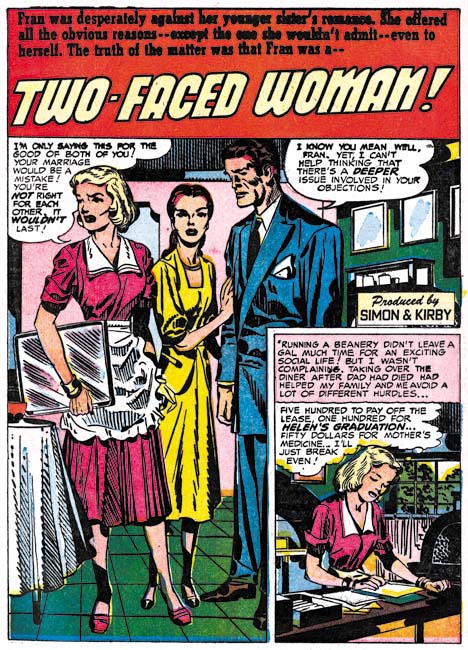
Young Love #36 (August 1952) “Two-Faced Woman”, pencils by Jack Kirby
Another indication about the more reduced roll that Jack Kirby has been taking in the romance titles is that he only did one of the seven lead stories. The lead story typically starts with a confessional splash; one where one of the characters introduces the story to the reader and their speech balloon becomes the title. The confessional splash was very effective and it seems strange that Kirby did not go with it for the splash used in “Two-Faced Woman”. Frankly this splash while technically well executed just does not have much impact. The verbal exchange just does not seem to match the splash well. However the inking was by Kirby and is quite superb.
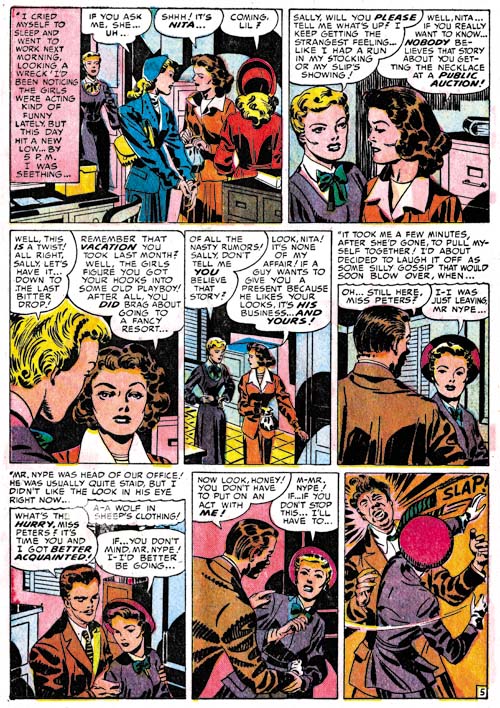
Young Brides #1 (September 1952) “Surprise, Surprise” page 5, pencils by Jack Kirby
More than any of the other studio artists, Kirby always liked to add a little action to his romances. Slaps did not play a big part in Simon and Kirby productions but check out that last panel. In movies the man slapped would often hardly flinch, but this lady certainly put some muscle behind it.
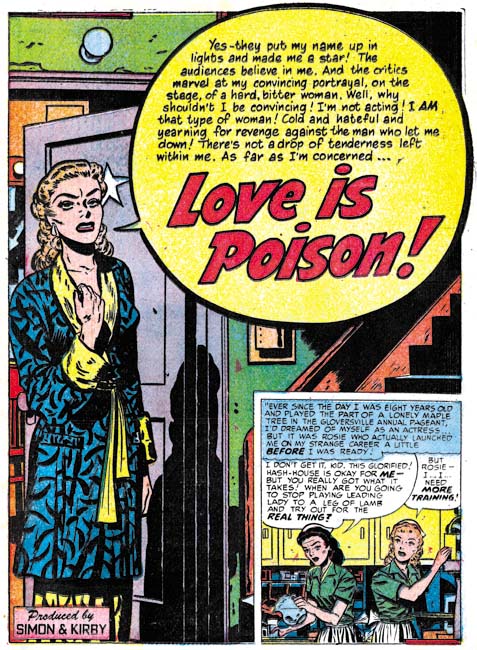
Young Romance #48 (August 1952) “Love Is Poison”, art by Bill Draut
Kirby may not have used the confessional splash but it would appear with other artists. Bill Draut made some particularly good use of that splash format. In “Love is Poison” even without reading her speech we can tell she is a bitter woman. The star on the door behind her shows she is an actress but the peeling paint above her indicates that she is not appearing in a big time movie or Broadway show. Draut was second only to Kirby among the studio artists in providing such emotional portrayals.
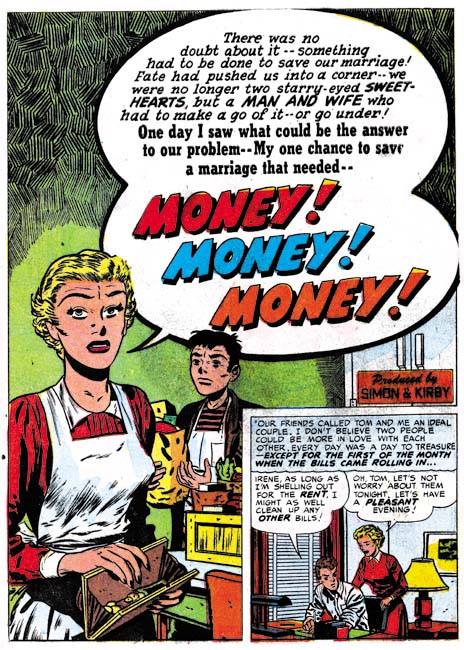
Young Romance #50 (October 1952) “Money, Money, Money”, art by Bill Draut
Draut did four of the seven lead stories and some of his splashes are so good that I wanted to include another example. The splash for “Money, Money, Money” may not have quite the impact of “Love Is Poison” but I love his portrayal of the grocery boy waiting to be paid (somehow I do not think he will get much of a tip). The inking of the upper part of the page is rather unusual for Bill.
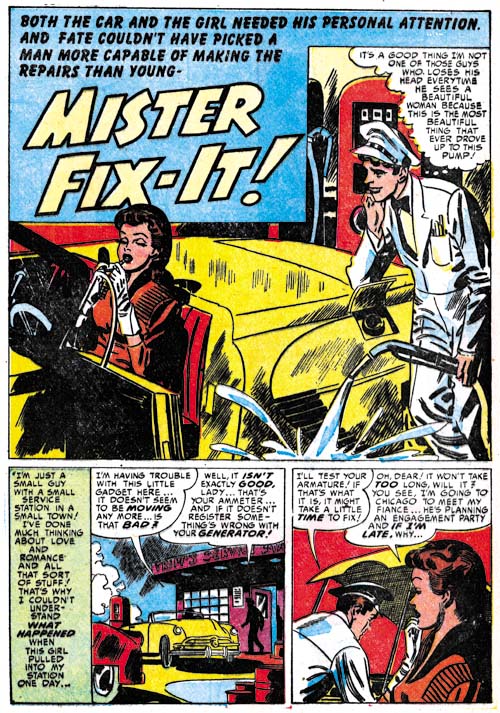
Young Love #36 (August 1952) “Mister Fix-It”, art by Mort Meskin
Mort Meskin may not have drawn splashes with the emotional impact found in those by Kirby or Draut, but he was great at humor. The gas station attendant feels that he is calm and collected while he unknowingly misses the gas cap and pours the fuel on the ground. Mort did these humorous splashes so well it is small wonder that he seem to do more of them than any other studio artist.
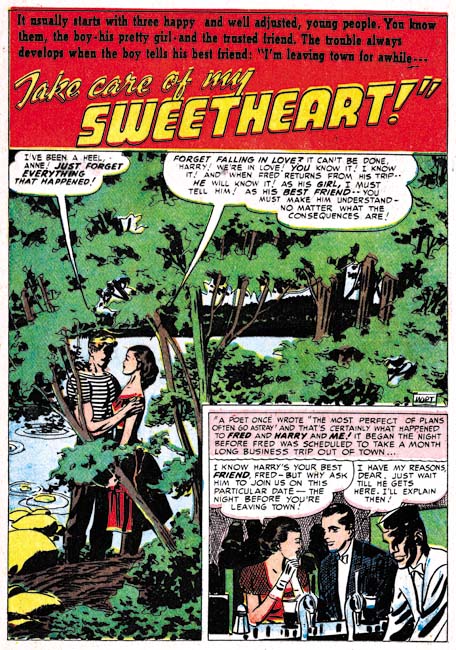
Young Love #38 (October 1952) “Take Care of My Sweetheart”, pencils by Mort Meskin, inks by George Roussos?
Although I generally do not make a point of it, Mort Meskin did his own inking while working for Simon and Kirby. I say this based on an examination of the work itself and it was verified recently by a comment that Joe Simon made to me. Meskin was very productive and sometimes I feel that some of his worked suffered because of that. However some of the work in this period seems particularly poorly inked, as for example “Take Care of My Sweetheart”. This is unfortunate because the composition for the splash is rather nice. But the inking does seem rushed and the end results rather crude.
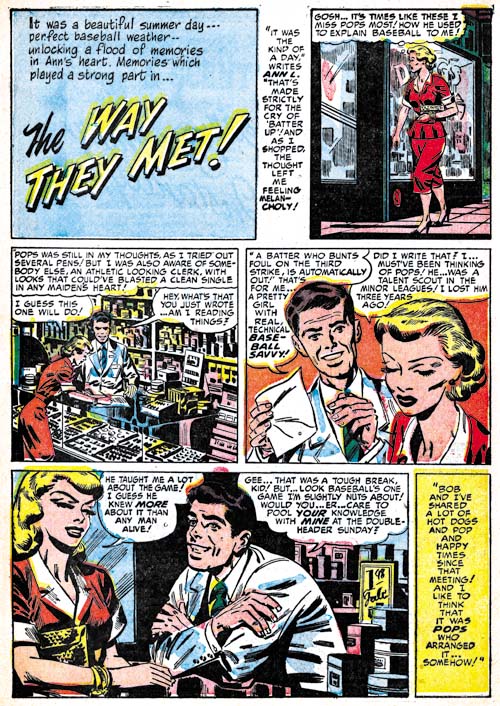
Young Romance #49 (September 1952) “The Way They Met”, pencils by Mort Meskin, inks by George Roussos?
“The Way They Met” from YR #49 is another example of uncharacteristically poor inking on a work penciled by Mort. Normally the cloth folds made from a series of narrow parallel lines are an indication that Meskin did the inking so I might attribute it all to a particularly rushed job. However while the faces have Meskin’s classic grin they also have a resemblance to those drawn by George Roussos. So I suspect what is going on is that Roussos is helping with the inking. Unlike Kirby, Meskin at least sometimes indicated the spotting in his pencils (The Eleventh Commandment) which may explain why Roussos adopted some inking techniques not found when inking his own pencils.
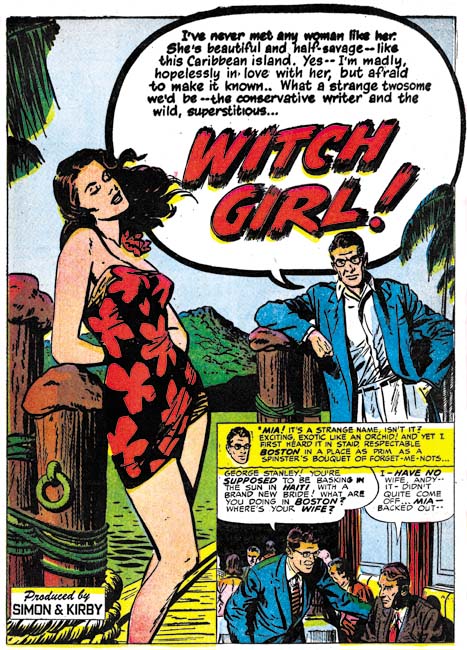
Young Romance #49 (September 1952) “Witch Girl”, art by John Prentice
The two lead features not drawn by either Draut or Kirby were done by Prentice. This is a clear sign that Simon and Kirby valued his contribution and I think with good reason. While I like the art that Kirby, Draut and Meskin were providing I think Prentice was just what was needed to provide the titles with a healthy mix of styles. “Witch Girl” uses the almost standard confessional format (John’s other lead feature, “Jay’s Protege”, does not). While Prentice might not quite have Kirby’s or Draut’s talent for the portraying of emotions, he certainly could draw beautiful women. Prentice was greatly influenced by Alex Raymond and the male character looks like Rip Kirby. This is ironic because Prentice would take over the strip after Raymond’s untimely death in 1956.
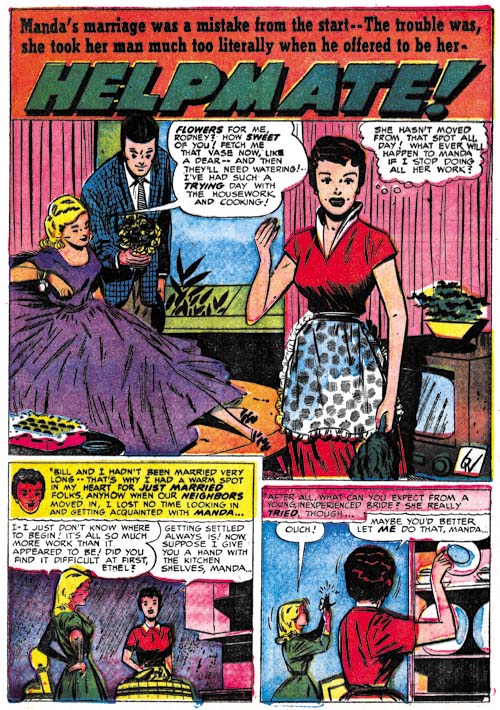
Young Love #37 (September 1952) “Helpmate”, art by Bill Walton
There is a single story, “Helpmate” signed with just initials. Even if the art style was not clue enough, a comparison of those initials with Bill Walton’s signature in stories like “Say the Magic Words” (Black Magic #12, Chapter 5 of the Little Shop of Horrors) show them to be identical. Walton did work for a number of different comic publishers at the same time. He would not play a big part in Simon and Kirby productions but he would appear on and off for a couple of years.
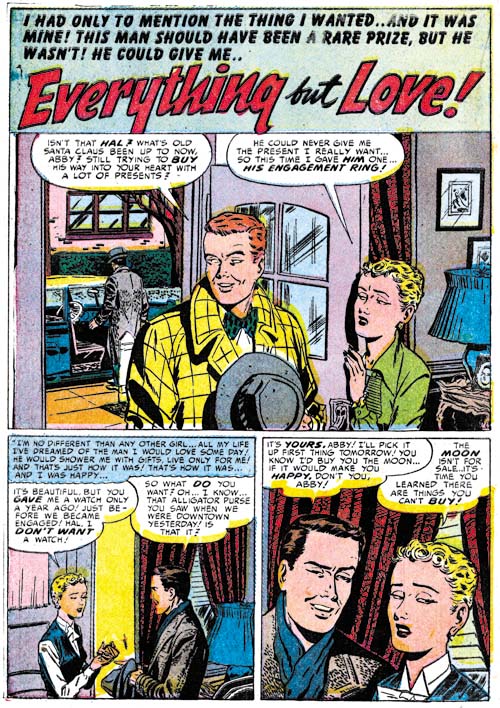
Young Romance #48 (August 1952) “Everything but Love”, art by Al Eadeh(?)
I provide another example of work that I questionably attribute to Al Eadeh. The way the artists draws eyes, particularly for women, is so distinctive that it should be relatively easy to determine if this work really was done by Eadeh once I have managed to compare it with signed work for another publisher from this period.
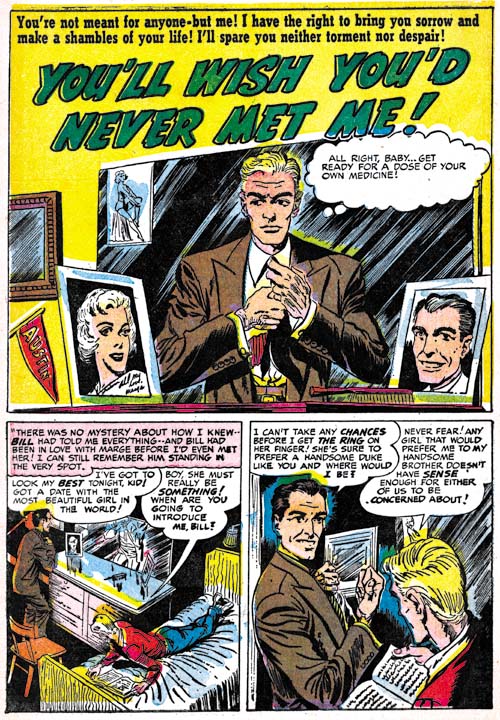
Young Romance #49 (September 1952) “You’ll Wish You’d Never Met Me”, art by Bob McCarty(?)
My problem with resolving the attribution of this work to Bob McCarty (or not) is different than with the case of Al Eadeh(?). There is some work for Foxhole that can safely be attributed to McCarty. It is just a matter of seeing whether traits that make this work like distinct from the Foxhole work change with time or remain constant. The most distinctive difference is the large eyes used in these earlier pieces as can be seen in the above page.
Chapter 1, A New Genre (YR #1 – #4)
Chapter 2, Early Artists (YR #1 – #4)
Chapter 3, The Field No Longer Their’s Alone (YR #5 – #8)
Chapter 4, An Explosion of Romance (YR #9 – #12, YL #1 – #4)
Chapter 5, New Talent (YR #9 – 12, YL #1 – #4)
Chapter 6, Love on the Range (RWR #1 – #7, WL #1 – #6)
Chapter 7, More Love on the Range (RWR #1 – #7, WL #1 – #6)
Chapter 8, Kirby on the Range? (RWR #1 – #7, WL #1 – #6)
Chapter 9, More Romance (YR #13 – #16, YL #5 – #6)
Chapter 10, The Peak of the Love Glut (YR #17 – #20, YL #7 – #8)
Chapter 11, After the Glut (YR #21 – #23, YL #9 – #10)
Chapter 12, A Smaller Studio (YR #24 – #26, YL #12 – #14)
Chapter 13, Romance Bottoms Out (YR #27 – #29, YL #15 – #17)
Chapter 14, The Third Suspect (YR #30 – #32, YL #18 – #20)
Chapter 15, The Action of Romance (YR #33 – #35, YL #21 – #23)
Chapter 16, Someone Old and Someone New (YR #36 – #38, YL #24 – #26)
Chapter 17, The Assistant (YR #39 – #41, YL #27 – #29)
Chapter 18, Meskin Takes Over (YR #42 – #44, YL #30 – #32)
Chapter 19, More Artists (YR #45 – #47, YL #33 – #35)
Chapter 20, Romance Still Matters (YR #48 – #50, YL #36 – #38, YB #1)
Chapter 21, Roussos Messes Up (YR #51 – #53, YL #39 – #41, YB #2 – 3)
Chapter 22, He’s the Man (YR #54 – #56, YL #42 – #44, YB #4)
Chapter 23, New Ways of Doing Things (YR #57 – #59, YL #45 – #47, YB #5 – #6)
Chapter 24, A New Artist (YR #60 – #62, YL #48 – #50, YB #7 – #8)
Chapter 25, More New Faces (YR #63 – #65, YLe #51 – #53, YB #9 – #11)
Chapter 26, Goodbye Jack (YR #66 – #68, YL #54 – #56, YB #12 – #14)
Chapter 27, The Return of Mort (YR #69 – #71, YL #57 – #59, YB #15 – #17)
Chapter 28, A Glut of Artists (YR #72 – #74, YL #60 – #62, YB #18 & #19, IL #1 & #2)
Chapter 29, Trouble Begins (YR #75 – #77, YL #63 – #65, YB #20 – #22, IL #3 – #5)
Chapter 30, Transition (YR #78 – #80, YL #66 – #68, YBs #23 – #25, IL #6, ILY #7)
Chapter 30, Appendix (YB #23)
Chapter 31, Kirby, Kirby and More Kirby (YR #81 – #82, YL #69 – #70, YB #26 – #27)
Chapter 32, The Kirby Beat Goes On (YR #83 – #84, YL #71 – #72, YB #28 – #29)
Chapter 33, End of an Era (YR #85 – #87, YL #73, YB #30, AFL #1)
Chapter 34, A New Prize Title (YR #88 – #91, AFL #2 – #5, PL #1 – #2)
Chapter 35, Settling In ( YR #92 – #94, AFL #6 – #8, PL #3 – #5)
Appendix, J.O. Is Joe Orlando
Chapter 36, More Kirby (YR #95 – #97, AFL #9 – #11, PL #6 – #8)
Chapter 37, Some Surprises (YR #98 – #100, AFL #12 – #14, PL #9 – #11)
Chapter 38, All Things Must End (YR #101 – #103, AFL #15 – #17, PL #12 – #14)