
Wide Angle Scream


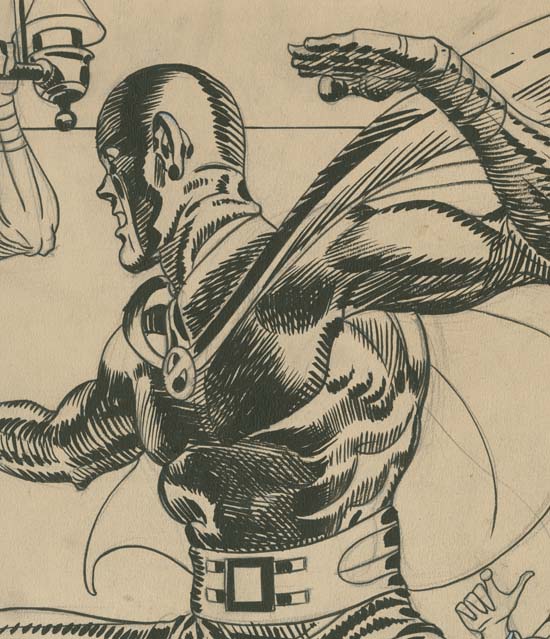
Sometime after the demise of Mainline, Simon and Kirby’s attempt at becoming publishers, Joe and Jack’s partnership broke up. Jack returned to being a freelance artist but whenever Joe had some comic to produce Jack would always give a hand, at least for the initial issues. In 1959 Archie Comics asked Joe Simon to produce a couple of superhero comic titles for them. For one of the new titles Joe decided to resurrect an old proposal. Years before Simon along with the artist C. C. Beck and the writer Jack Oleck had created Silver Spider. Oleck wrote some scripts and Beck drew the origin story and it was proposed to Harvey Comics but was then rejected. Joe retrieved the original art and at least one script (which he still has) from Harvey but decided, probably because of the previous rejection, the hero should be changed from the Silver Spider into the Fly. Simon asked his former partner, Jack Kirby, to draw the art for the first issue using the C. C. Beck art as the basis for the origin story. (What happened to the C. C. Beck art is a tale that I will not repeat here, suffice it to say that through no fault of Jack’s the Beck art was never returned to Joe. All Simon has now are large photocopies of the original art. You can see some images of the Silver Spider in Chapter 10 of The End of Simon and Kirby) Kirby was also apt to turn to old ideas and so he based the Fly’s costume on an unused Simon and Kirby creation, the Night Fighter. (It is not pertinent to the theme of this post, but this was not the end of the recycling of the Silver Spider as years later it played a part in the creation of Marvel’s Spider-Man.)


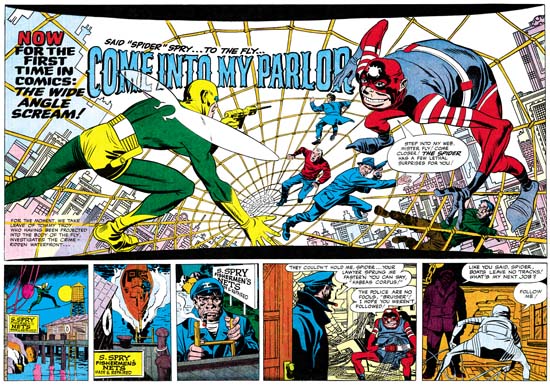
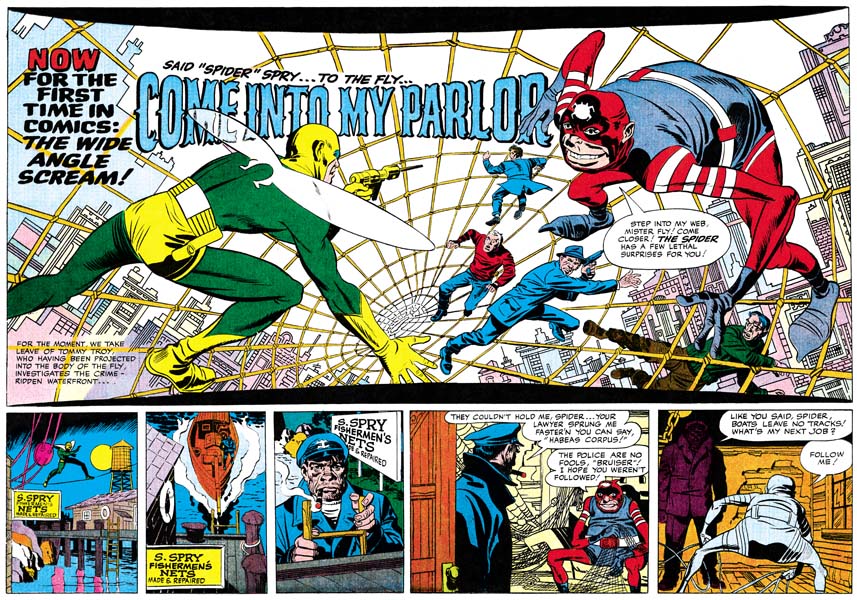
Adventures of the Fly #1 (August 1959) “Come Into My Parlor”, art by Jack Kirby
Enlarged view

The centerfold of the first issue of The Adventures of the Fly featured a double page splash with the declaration:

NOW FOR THE FIRST TIME IN COMICS: THE WIDE ANGLE SCREAM

This is of course where I have derived the name for this serial post about the Simon and Kirby wide splashes. Since Joe and Jack have been using double page spreads since Captain America #6 (September 1941), this issue of the Fly was hardly the first time for the use of this dramatic opening for a story. But in 1959 comic book readers were young and unlikely to know about the earlier comics.

The Fly splash pages are divided into two sections, the splash proper and the start of the story. At the top and bottom of the splash are two parabolic shaped borders making the image wider at the sides then in the center. The background buildings on the two sides of the splash tilt in different directions. All of this was to give the feeling of a wide angle presentation. But this was all just suggestive as a true wide angle lens would not distort the scene in these manners.

The two adversaries face off from opposites sides of the splash. The Fly seems quite at home on the Spider Spry’s web while it is the criminal cohorts of the Spider that seem to be most encumbered. The scale of the figures makes no literal sense. No realistic perspective would cause the rest of the criminals to be so much smaller then either the Fly or the Spider. The size difference is not due to any problem Kirby had with rendering perspective; he was the master of the illusion of space. Rather Jack has reverted to a pre-Renaissance technique, actually common to a great number of art cultures, were size indicates importance.

Not Jack’s best splash but still superior then most artists of the day could have produced. Some have said this was inked by Kirby but I cannot see Jack’s hand in any of the inking of these Archie comics. I doubt Joe Simon did the inking on the splash either.

Adventures of the Fly #1
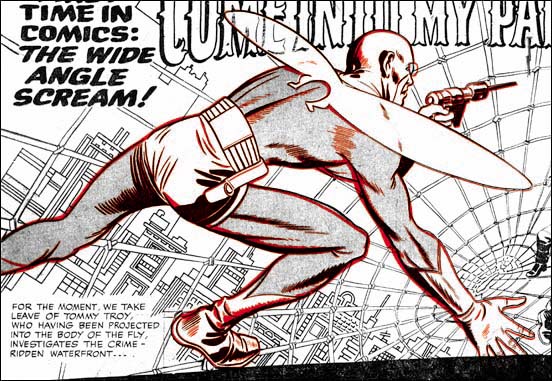
Overlay of the figure of the Fly from the cover (red) and the splash (black)

The cover for the first issue of the Fly is basically the same scene as this splash with the composition altered for the vertically oriented space. As I have shown previously, the cover is based on the splash and not the other way around. (See The Fly, A Case Study of Swiping, for further details.)  First a stat was made of the splash and then cutup and reorganized for the cover. Then someone, most likely Simon, touched up some of the inking. It was all well done because cover is every bit as good a designed as the splash.


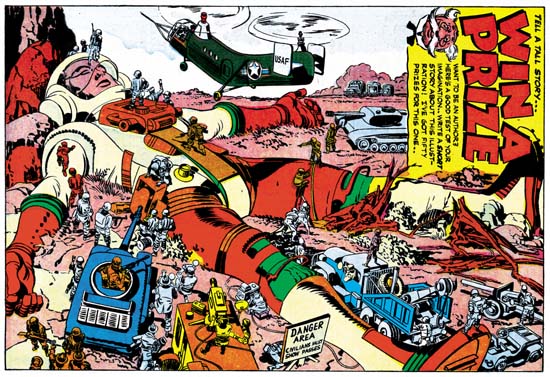
Win A Prize #1 (February 1955) pinup, art by Jack Kirby
Enlarged view

Pinups, both single and double paged, played an important part of Boys’ Ranch (October 1950 to August 1951) but they did not appear at all in Black Magic which also started in October 1950. Nor did they appear in either Strange World of Your Dreams (August 1952 to March 1953) or Fighting American (April 1954 to April 1955). Pinups did play a marginal roll in some other titles. A single page pinup, “Desk Sergeant”, appeared in Police Trap #2 (November 1954) and a double page spread was used in Bullseye (discussed below). There is also the pinup from Win A Prize #1. While printed on a single page, its horizontal format leaves little doubt that originally the Win A Prize splash was meant to be a double page centerfold. Joe Simon has said that initially this pinup was to have been used in Captain America #11 but Joe and Jack’s sudden exit meant that issue was done by other artists. If Joe’s story is true, this pinup underwent modification before it was finally used. Of course Captain America would have had to have been removed. Sikorsky was just beginning their efforts in building helicopters while Simon and Kirby were working on Captain America and helicopters would not play a significant part in the military until after World War II. The helicopter in this pinup has a USAF marking, but the Air Force was not an independent military unit until after the war. At the bottom center of the splash is what looks very much like a television camera crew. While televisions were created before the war they did not really come into use until the late’40s.

The pinup’s theme of a modern day Gulliver is an interesting twist, particularly in using a futuristic spaceman as the giant. There are a score of little soldiers and civilians scattered about each involved in the individual tasks. The image presents a number of questions. Since no nearby rocket or flying saucer is shown, where did the spaceman come from? Although lying prone with eyes closed, the spaceman appears uninjured. With all the tanks and guns aimed at him the suggestion is that he still is alive. If that is so why are all the soldiers crawling over the spaceman even though he is not tied down or restrained in any way? There does not appear to be much in the way of ropes or cable, so what is the soldiers’ intention? Of course such unanswered question was the whole point as Uncle Giveaway is offering prizes for short stories based on this pinup. I wonder if it is too late to enter?


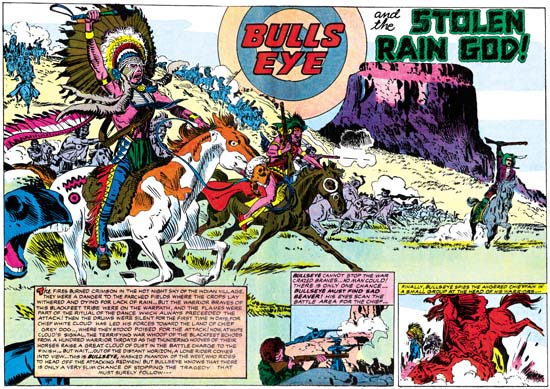
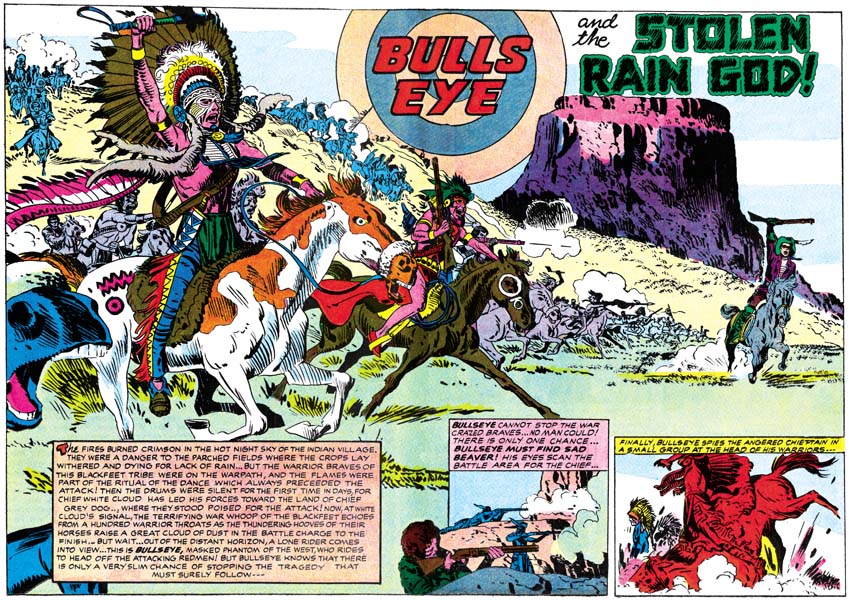
Bullseye #7 (August 1955) “The Stolen Rain God”, art by Jack Kirby
Enlarged view

During the final period of the Simon and Kirby studio, the only double page splash to actually get printed as such appeared in Bullseye. Oddly it was in the final issue published by Charlton. It is hard to believe that Joe and Jack thought this splash would help save the title. Having Charlton’s print the former Mainline comics looks more an attempt to get some money for art that Joe and Jack could no longer afford to publish themselves due to problems with their distributor. Charlton was notorious for their low pay so I am sure they did not offer much to Simon and Kirby, but it was better then nothing. If by some miracle they sold well enough to warrant continuation, so much the better. But for the most part Charlton used up the final art and cancelled the titles. Foxhole was extended for a single issue produced by Charlton artists with Joe and Jack probably having nothing to do with it. The postal permit for In Love was transferred to Charlton’s new romance title I Love You, which, although having a Kirby drawn cover for its initial issue, was again filled with story art probably created by Charlton artists. I suspect that careful investigation of other Charlton comics will reveal the transfer of the postal permit from the other former Mainline titles Police Trap and Bullseye as well. The only Simon and Kirby title that Charlton ran with for a few issues was not a Mainline title at all. It was Charlie Chan, a title previously licensed to Prize some years before. It was more of a Joe Simon production with Jack Kirby only providing the cover art for the first Charlton issue (#6 June 1955). Joe would help put it together for Charlton until it too was cancelled with issue #9 (December 1955). So I believe the wide splash in Bullseye #7 came too late to be considered a serious attempt to bolster sales of the Bullseye title. I cannot help but wonder if when the breakup of the Simon and Kirby studio was clearly possible, if it had not happened already, whether the presence of this splash was brought on by a nostalgic memory of Simon and Kirby’s use of the centerfold splash in their first big hit, Captain America.

Jack has drawn a good splash. It is just that after so many marvelous double page spreads in the past it is hard for me to get too enthusiastic about this one. It is a well balanced composition with the prominent Indian chief on our left offset by the plateau and title on the right. The chief certainly presents an impressive figure what with his large headdress (could that really be expected to stay on during the charge?) and ornate apparel. The horse cut off on our left showing only a mouth and knee makes the viewer really feel that he is at the head of the line of charging warriors. The colorist wisely blocked out the smaller figures in simple colors otherwise the foreground figures would have been lost among a patchwork of colors. This allowed the small figure of Bullseye on our right to still stand out. The most unusually aspect of this splash, unique among Simon and Kirby wide angle screams, was that it is actually an oversize story panel. We find Bullseye racing in front of the attacking Indians as he tries to prevent the unfolding tragedy that the war will certainly bring. It is a very risking thing for Bullseye to do since his racing across Indian line could easily make him the victim of friendly fire. The two smaller panels on the bottom provide an explanation on Bullseye’s objective.

The splash for “The Stolen Rain God” was the last double page art for a Simon and Kirby production. Even though the studio and their partnership was over, Kirby always seemed willing to give Simon a hand whenever Joe tried to launch new comics. One such effort included the wide angle screams that will be the subject of the next chapter of my serial post.

Boys’ Ranch #4
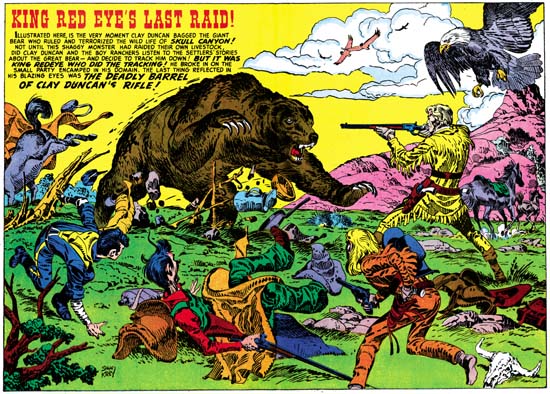
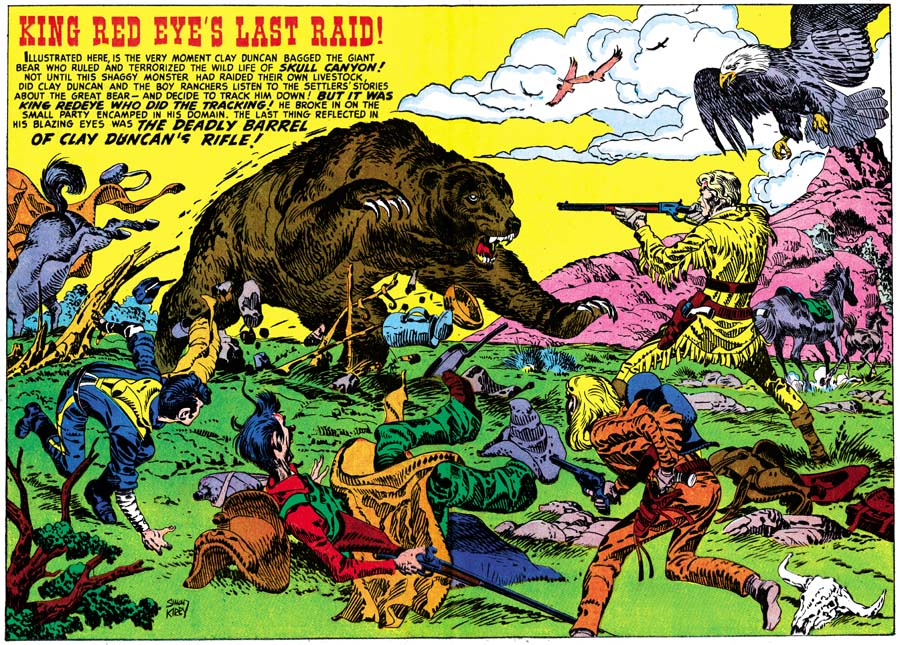
Boys’ Ranch #4 (April 1951) “King Red Eye’s Last Raid” art by Jack Kirby
Larger image

A rampaging grizzly bear, escaping horses, a kicking mule, and the scrambling youngsters of Boys’ Ranch make this image one of chaos. That is except for the firm figure of Clay Duncan as he calmly aims his rifle to make the most of his shot, probably the only one that he will manage to get off. Although the scene is supposed to be chaotic, the composition is anything but that. The mule, boys and Duncan form a broad ‘U’ shape with the bear occupying the center. Each element that forms that ‘U’ directs our attention toward the grizzly. The bald eagle might seem out of place in the portrayed scene. We would not expect the eagle to have been sleeping among the crew and there certainly would seem to be enough Americana in the picture without it. But its does serve the purpose of balancing off the caption on the opposite side of the splash. All in all a carefully composed image not at all like the true chaos found in last month’s splash “Social Night In Town”  but every bit as great a piece of art.

Before I continue, I would like to offer a little digression. In 1972 I lived for a short time in Denver. One weekend I went out into the front range of the Rockies to collect fossils. The weather was dry and my original plans were to roll out the sleeping bag and spend the night under the stars. However the area I was in was cattle country and there were absolutely no trees. I found that the cattle liked to visit my car so that they could use it to rub against. I did not relish the possibility of one of them stepping on me while I slept, so I spent the night in the backseat of the car. When I returned to Denver I heard on the radio that a bear had killed some cattle only a few miles from where I was. I felt that I was pretty lucky since the cattle congregating around my car could have easily attracted the bear and had I been outside he may have found me a much easier prey. After a few weeks of killing cattle the bear was finally shot, he was the largest bear killed in Colorado in over 25 years.

Boys’ Ranch #5
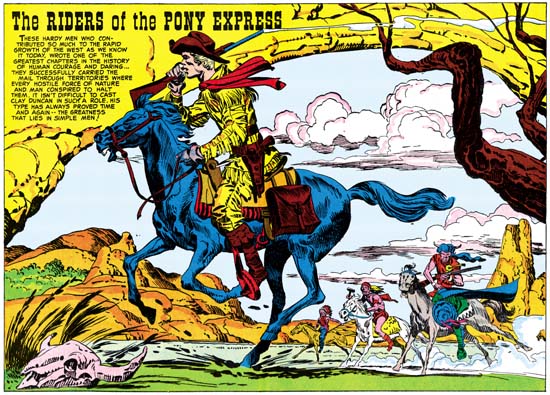
Boys’ Ranch #5 (June 1951) “The Riders of the Pony Express” art by Jack Kirby
Larger image

The Pony Express rider runs his horse at full speed as he tries to escape some attacking Indians. The horse seems frantic but the rider appears almost casual with his rifle held over his shoulder. A trail of smoke exits from the gun barrel showing that the rider has already fired it once and will surely do so again if necessary. There is no question about the unpleasant intent of the Indians but the Pony Express rider seems in control of the situation. The Indians are not trailing behind the rider so they appear to have been trying to cut him off. It makes for an interesting composition with the farthest Indian almost at the center with nearer natives placed increasingly towards our right with the Pony Express rider bring the movement back towards the left. That is not the only way the eye is directed, an overhanging rock formation and some tree branches form an oval with all the riders. The caption rests comfortably on the right portion of the rocky arch. It is truly amazing the variations that are found in these wide pinups, each have their unique composition.

Boys’ Ranch #6
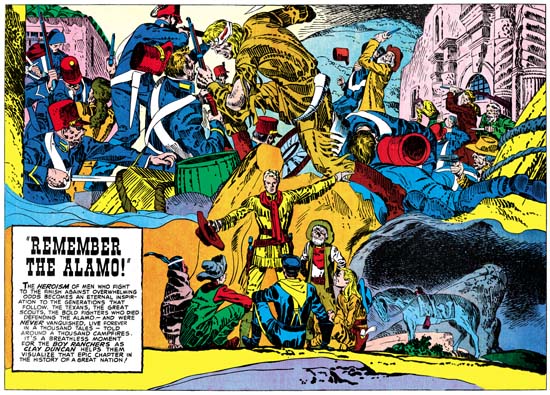
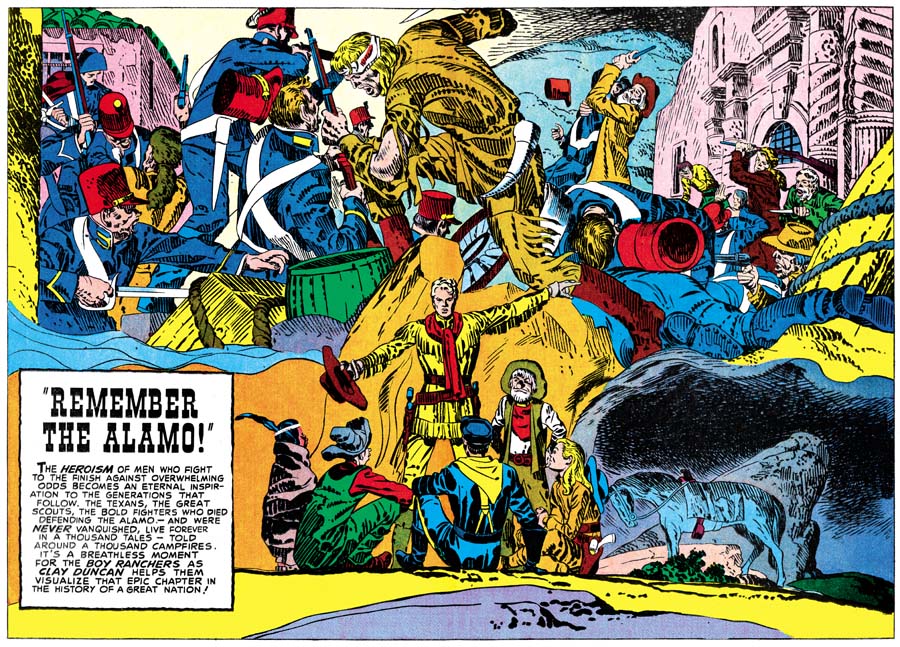
Boys’ Ranch #6 (August 1951) “Remember the Alamo” art by Jack Kirby
Larger image

Clay Duncan enthralls his friends while spending the night out in the prairie with tales of the heroics of the defenders of the Alamo. The lower half of the splash depicts the cast of the Boys’ Ranch while the upper half portrays a dramatic battle. What a battle it is, fully in the Kirby tradition. Gun play takes a decidedly second place to hand to hand combat. This is not an all-over composition like we saw in “Social Night in Town”. A large figure occupies the center separating a left portion of large, mostly Mexican, figures from a right field where the large fallen Mexican figures reveal smaller fighters and a building behind. It would almost seem that the Texans were winning the battle! The only Texan that appears to be in immediate trouble is one in the right background who holds his hands to his face. Of course the Texan success could only be true for a relatively short time before they would succumb to the overwhelming numbers of their opponents. The hard struggle they have had up to this point is suggested by the head bandage and torn costume of our central fighter. He, and two others, one on each side, are obviously frontiersmen. I am tempted to identify the center figure as Jim Bowie because of the large knife he welds, mostly out of the frame. Also tempting would be to identify the wearer of a coon-skin hat as Davy Crockett except that there are two of them. Note how the one on the right brandishes his rifle in the same matter that Crockett does on the cover to Western Tales #32 (March 1956).  The central figure’s outfit visually links him to the similarly garbed Clay Duncan below but more importantly suggests a common heroic nature. What a shift from the drama above to the quiet scene below. The members of the Boys’ Ranch are bunched up in the center with backdrops of rock formations and night sky. A lone horse is seen on our right compositionally balancing the caption that appears on the opposite side of the splash. The horse should be unsaddled for the night but a shoe horn and stirrups can be seen but not the rest of the saddle. It is the sort of thing I would expect from Jack, but not from Joe who rode a horse in the Coast Guard. It is however a minor and easy to overlook flaw.

Often the inspiration for Simon and Kirby creations can be found in cinema of the period. Jack and Joe were both of the age that they likely saw the movie “Heroes of the Alamo” but that was released in 1937 and thus does not explain the appearance of the Alamo theme at this particular time. Alamo movies and TV shows became more popular a few years later starting with “The Man from the Alamo” (1953), then “The Last Command” (1955), “Davy Crockett at the Alamo” (1955), “The First Texan” (1956) and pretty much ending with “The Spirit of the Alamo” (1960). The “Davy Crockett at the Alamo” is particularly important as it was part of the made for TV series that Disney produced about Davy Crockett that started a craze among young boys. Afterwards the Alamo largely disappeared from popular culture. At least part of this can be blamed on a shift in social attitudes; one of the freedoms the Texan’s were fighting for was the right to own slaves. Another attempt at the theme was done in 2004 with the film “The Alamo” but it did not achieve much success.

It would not be possible for me to overemphasize what a successful piece of art I think “Remember the Alamo” is. The combination of the action and quiet scenes was done so well it is easy to overlook how unnatural it really should have been. It is arguably the best of the double page pinups from the Boys’ Ranch titles and one of Simon and Kirby’s greatest creations. With the end of the Boys’ Ranch title wide pinups or splashes would disappear from S&K publications for the next few years. For Simon and Kirby it was a relatively quiet period with only one new title, Strange World of Your Dreams in 1952. This was followed by a flurry of new comics starting with Captain 3D (December 1953). The wide format’s small part of the activity will be covered in the next chapter.

Towards the end of 1950 Simon and Kirby had some hit titles all published by Prize. For the crime genre there were Headline and Justice Traps the Guilty. Having two titles in the same genre is always a sign of a success. More important would be the Young Romance and Young Love titles for the romance genre that Joe and Jack started. However Simon and Kirby were not ones to just sit back and milk past achievements, they were always trying to produce new titles. October of 1950 would see the release of two new S&K productions. For Prize again they would release their first in the horror genre, Black Magic. That title would run for about five years and would be joined in 1952 by Strange World of Your Dreams, again an indication of success. Simon and Kirby would also release in October Boys’ Ranch, only it would be published by Harvey Comics. Boys’ Ranch is considered by many fans as one of Simon and Kirby’s greatest creations. Unfortunately it was not so well received at the time and the title only lasted six issues.

Boys’ Ranch may not have been as big a success as Joe and Jack had hoped, but it was not for lack of trying. S&K used in Boys’ Ranch some things that they had never tried before, among which were pinups. I am not sure where the idea for the pinups came but Simon and Kirby put it to good use. Each issue of Boys’ Ranch contained both introductory and centerfold pinups. Pinups are unlike splash pages since without any attachment to a story a pinup can be a self sufficient entity. In this respect they are much more like cover art except the image need not be crowded by a prominent title. As stand-alone pieces of art, The Boys’ Ranch pinups represent some of the finest work that Simon and Kirby did. With the expanse that the double page provides, the centerfold pinups are particularly effective.

Boys’ Ranch #1
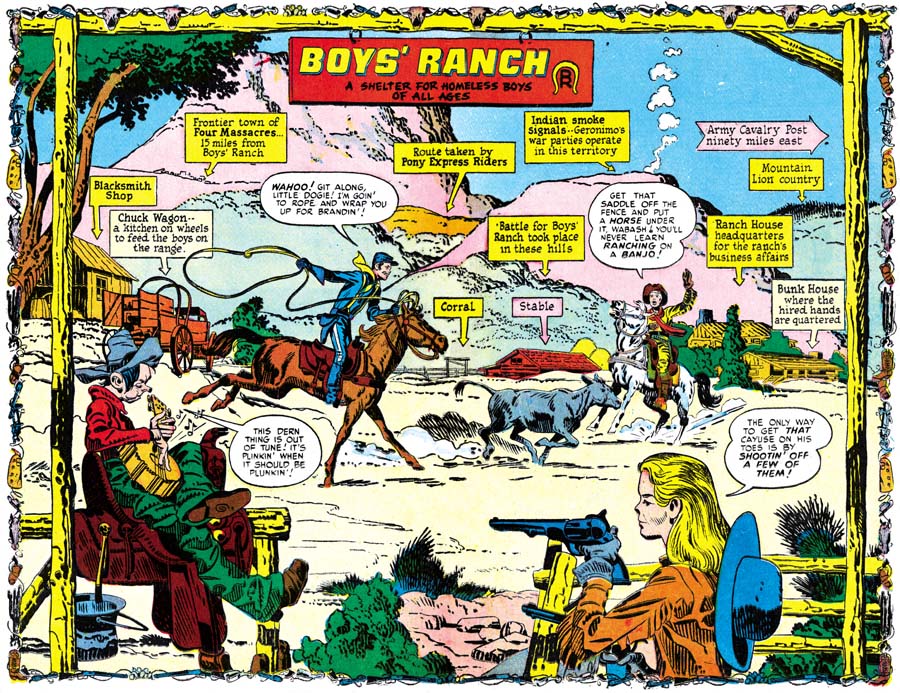
Boys’ Ranch #1 (October 1950) “Boys’ Ranch”, art by Jack Kirby
Larger image

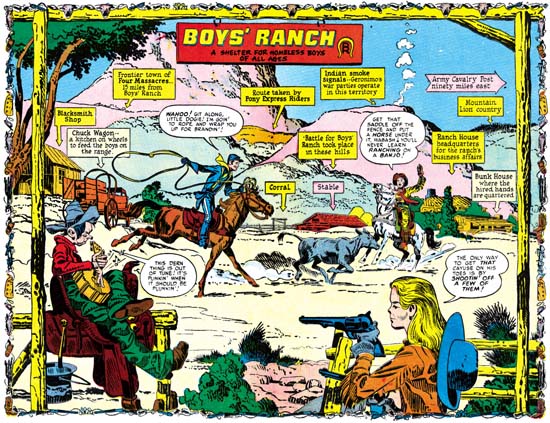
The centerfold for the first issue introduces the cast and the locale. We find Tommy learning how to lasso cattle while Wabash loafs with his guitar. Angel threatens to use his marksmanship to get Wabash moving. Three sides of the image are framed with rough timber with the title hanging from the top post. The complete circumference is edged with cattle skulls, pistols and other western paraphernalia reminiscent of the bottom edge of the wide splash from Captain America #8 (November 1941). This emphasis on design, unusual in the Boys’ Ranch splashes, does not save this particular centerfold. The more distant view used is not Jack Kirby’s forte for he generally does better when he thrusts his cast into the foreground. There are lots of assorted details provided, many requiring explanations from captions, but just not enough interest to hold our attention long. This is a rare example, in my opinion, of a Kirby double page piece of art that does not come up to his usual high standards.

Boys’ Ranch #2
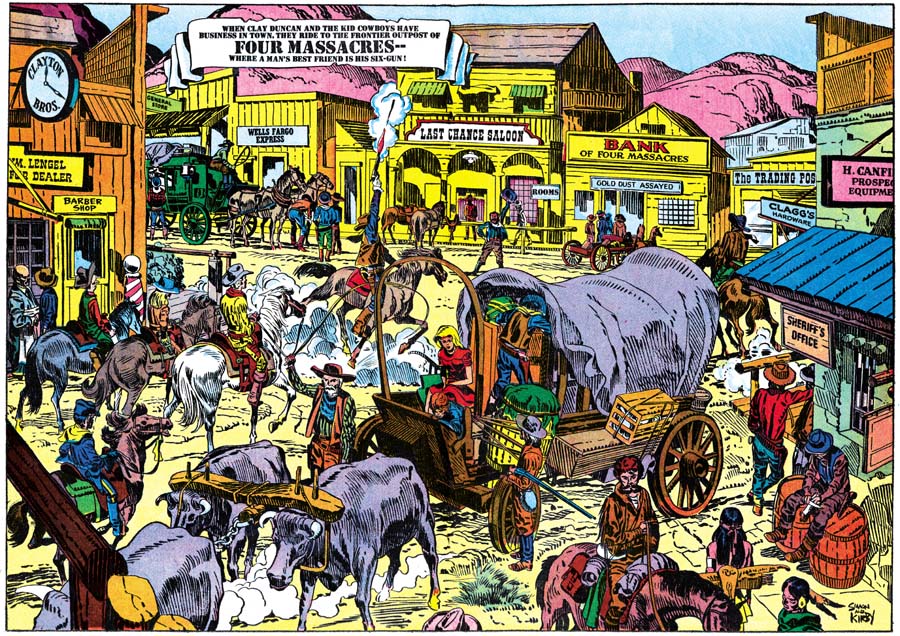
Boys’ Ranch #2 (December 1950) “Four Massacres”, art by Jack Kirby
Larger image

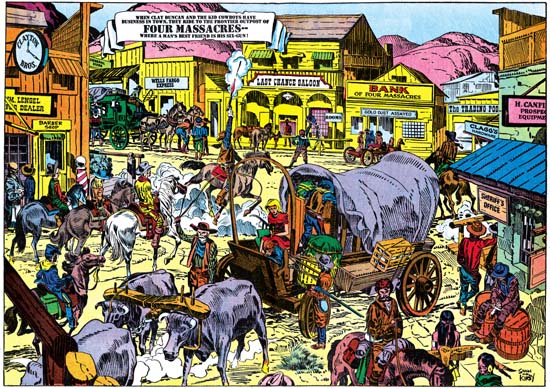
Another more distant view but this time Kirby makes it more interesting by providing more to look at. It is a crowded image but because this is in a comic book and a reader would tend to view it from left to right there should have been no difficulty in finding the Boys’ Ranch characters on the far left as they enter the town. I will leave it up to my readers to ferret out all the details. This splash is filled with individuals and groups all telling their own little stories, no need for captions to explain it all. Whatever the reasons for the short comings of the wide pinup from Boys’ Ranch #1, Jack is now clearly getting into the control of this new format.

Boys’ Ranch #3
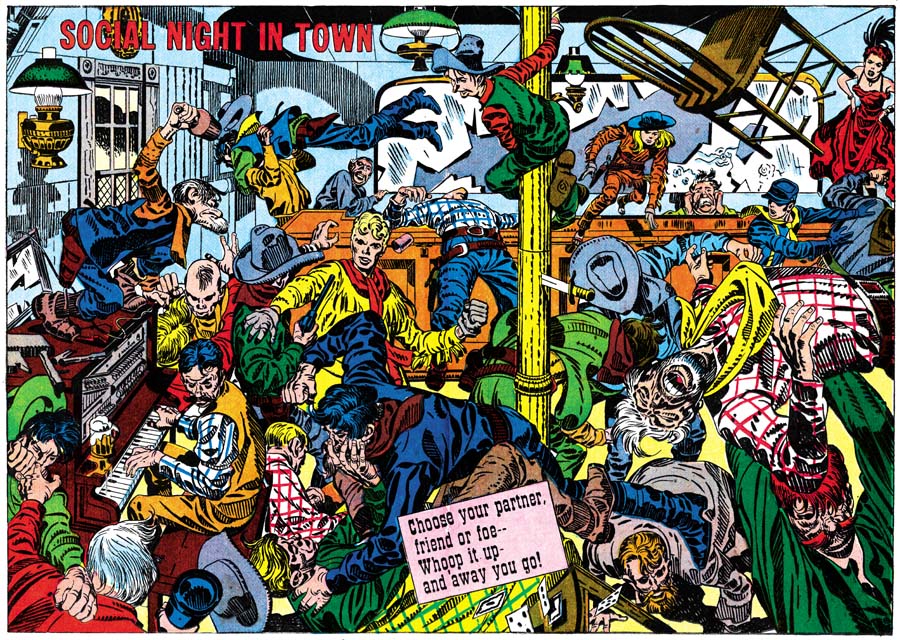
Boys’ Ranch #3 (February 1951) “Social Night in Town”, art by Jack Kirby
Larger image

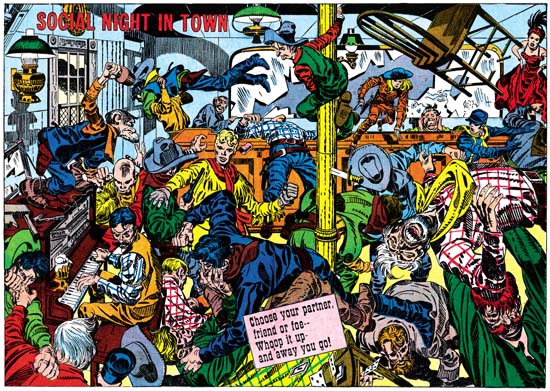
With “Social Night in Town” Jack Kirby is in top form; this is certainly one of his classic drawings. This is Kirby at his best, a slugfest up close and personal. I like to think of this sort of composition as Kirby’s comic book equivalent of Jackson Pollock. There is no true focus to the image as it is an all over drawing with every portion as important as any other. Jack’s mastery of exaggerated perspective allows him to make this look easy but I honestly cannot think of another comic artist who could come close to providing such an exciting fight scene. Kirby has done this sort of thing before in for example “The Villain from Valhalla” in Adventure Comics #75 (June 1942) but the wide format allows a treatment just not possible on a single page. It would sound much too dry to describe all the details but I cannot help point out Wabash clinging in relative safety high on the near center post enjoying watching all the proceedings. Relative is the operative word because note the knife sticking in the post below him and the chair flying high on the right. The theme of cowboy’s letting off steam in a bar fight may not have been a cliche in 1950 but it soon would be. Comic books could do it in a way that television or movies simple could not match no matter how hard they tried. Not that their directors would likely have noticed Kirby’s work in 1950, but they should have.

As wonderful as “Social Night in Town” is, the best was yet to come. Unfortunately that will have to be covered in the next chapter.

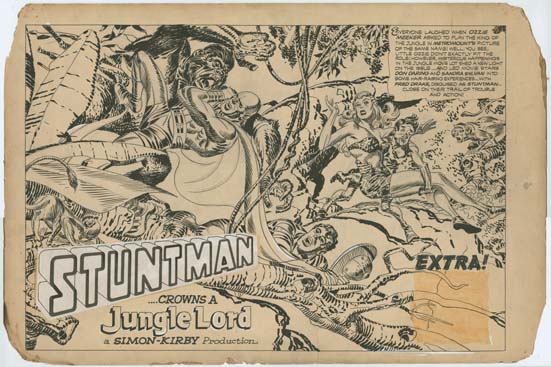
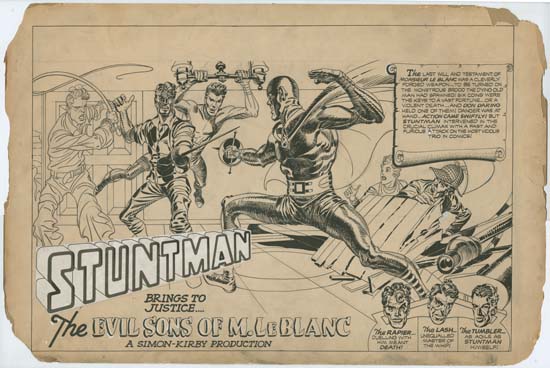
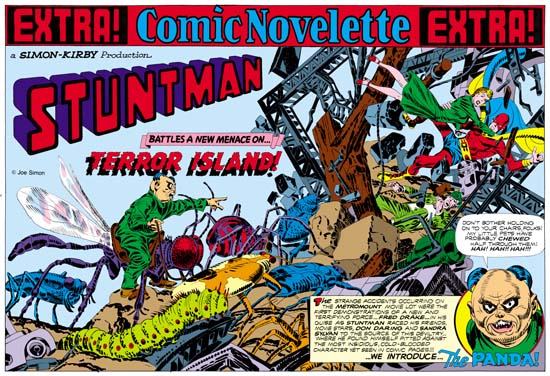
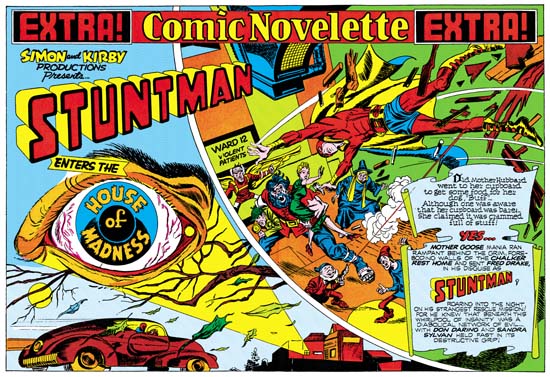
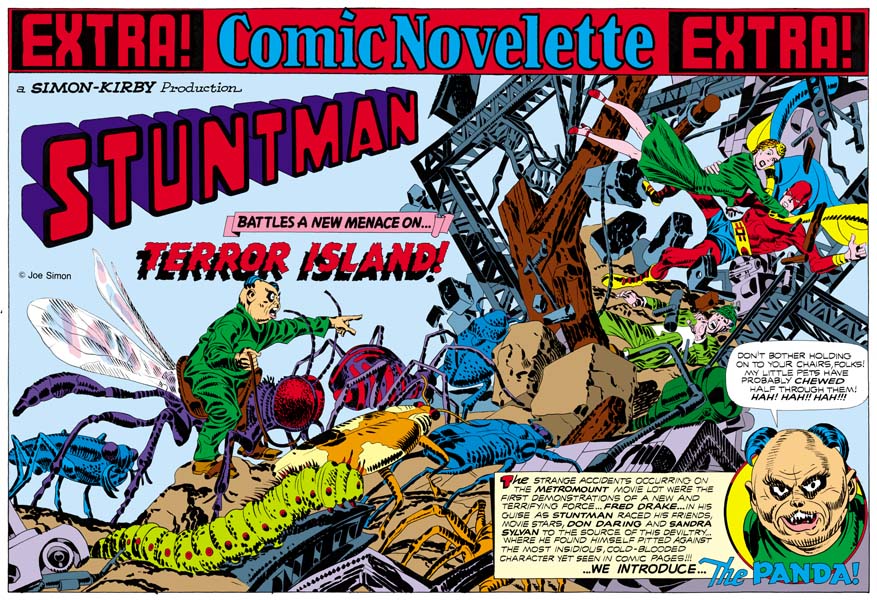
With the early demise of the Stuntman and Boy Explorer titles, Simon and Kirby’s next important project would be crime anthologies. Perhaps mindful that during the comic book glut it was previously existing titles that made it into the newsstand racks, Prize Comic’s Headline would be converted into a crime genre comic with issue #23 (March 1947). All the art for Headline issues #23 and #24 would be penciled by Jack Kirby, a feat that would not be repeated again until late in 1955. Most likely Simon and Kirby followed the same procedure that Joe reported as being used when launching romance comics; that is preparing the initial issues ahead of time before striking a deal with a publisher. The other thing unique about these first two crime issues of Headline was they both included double page splashes.

Headline #23
Headline #23 (March 1947) “Burned at the Stake”, art by Jack Kirby
Larger Image

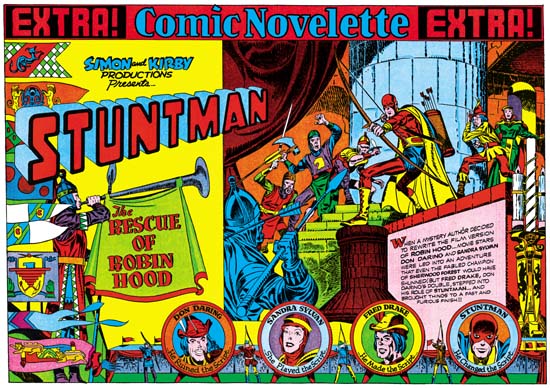
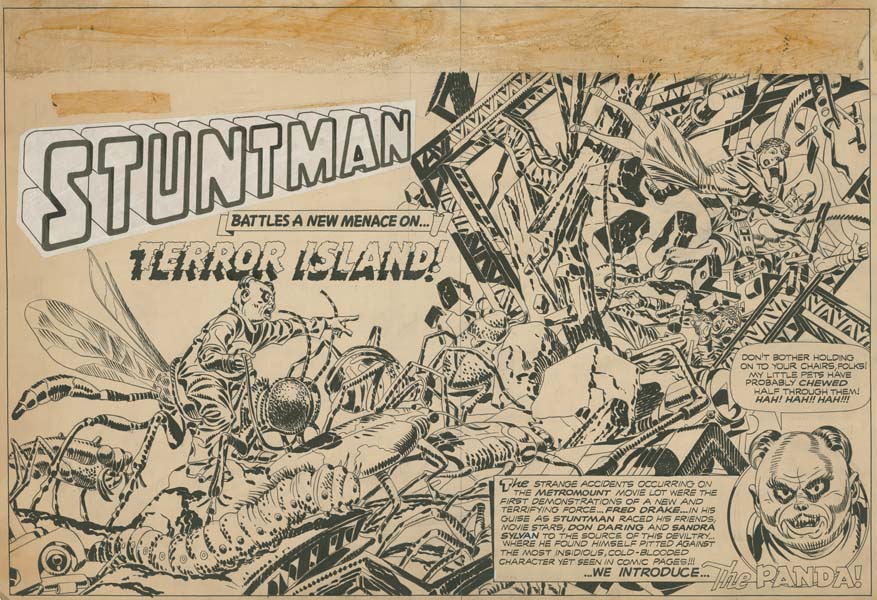
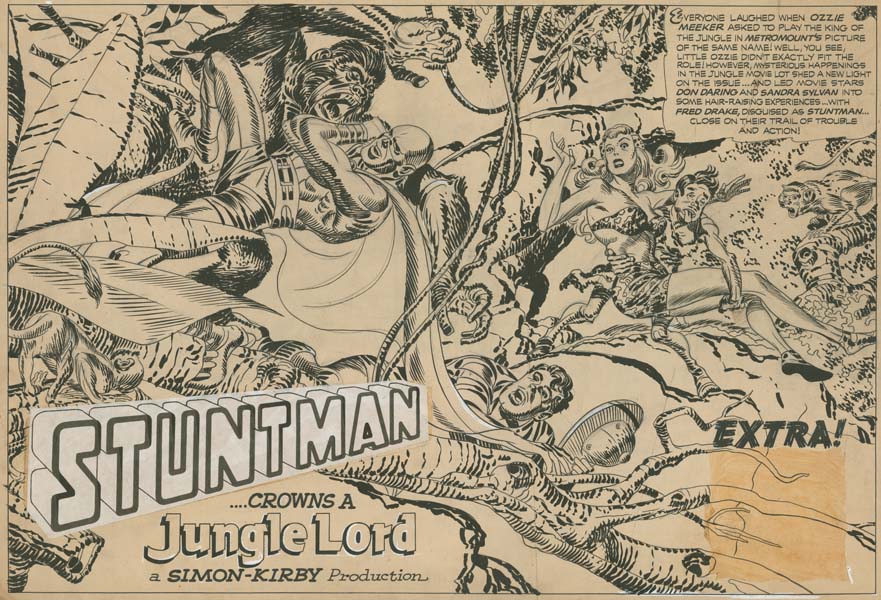
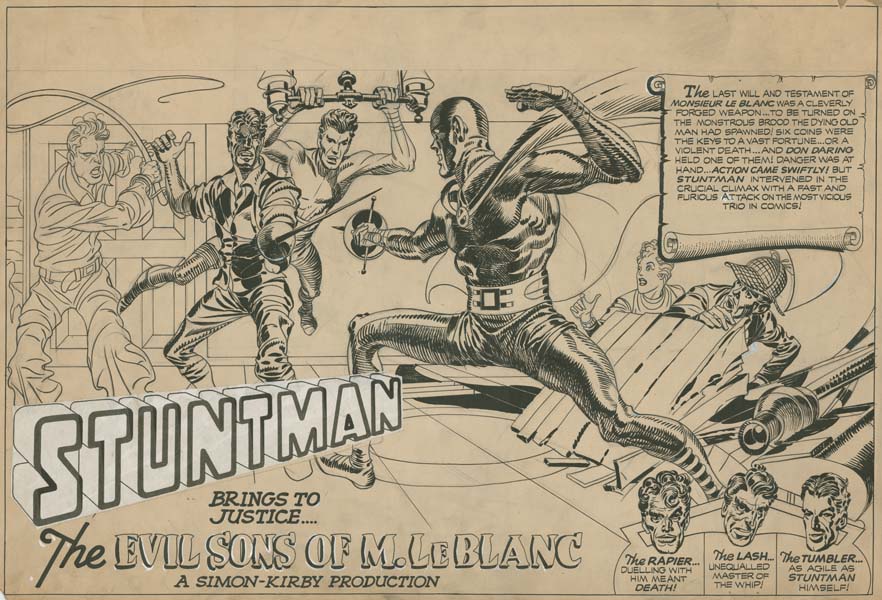
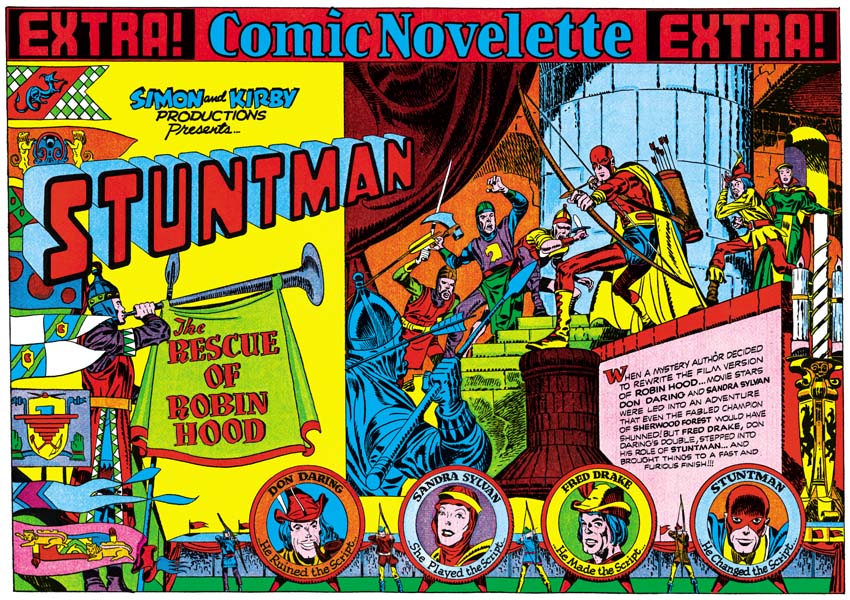
Although the last published double page splashes by Simon and Kirby were designed with two or more sections, we previously saw that enactment section had taken over in three unpublished Stuntman wide splashes. This approach was continued here in “Burned at the Stake”. There is a heading across the top, the story title, an introductory caption and a round panel portrait, but these sections are all subservient to the enactment. We find four armored and armed soldiers approaching a single individual at the top of some stairs. This composition is not just happenstance. Like other Western languages, English is read from left to right and readers have become accustomed to viewing even illustrations in this direction. Placing something higher on the page also provides it with prominence. Thus in this case the eye follows the advancing soldiers from down on the left, upwards and toward the right, until it reaches the main character of the story, Guy Fawkes. Essentially the same composition was found in the enactment section for “The Rescue of Robin Hood“.  Only in this case the center of attention was not a hero as Stuntman was. Did the man mean to set off the explosives and if so would the soldiers be in time to prevent him? The double page splash was not meant to answer those questions. Quite the contrary, leaving them unanswered would hopefully entice the viewer to buy the comic book.

Headline #24
Headline #24 (May 1947) “A Phantom Pulls the Trigger”, art by Jack Kirby
Larger Image

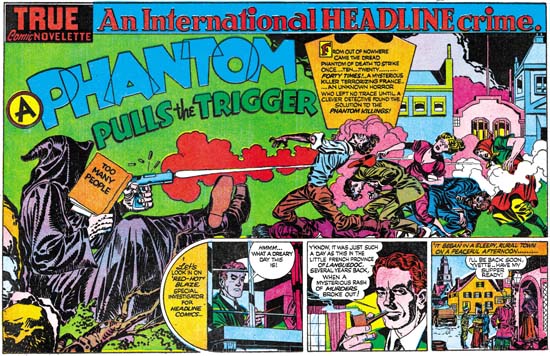
“A Phantom Pulls the Trigger” might mistakenly be considered to be composed contrary to the normal left to right reading. It is true that the primary focus would seem to be the hooded figure on the left, the opposite of the expected location. In this case however the viewer’s progress from left to right is meant to indicate the progress of time, from the action of the firing of the pistol on the left to the affect of the killing of the people on the right. Kirby has countered the diminishing affect of placing the most important figure on the left by increasing his visual size. It is unclear whether the hooded figure is truly meant to be larger then his victims or if he is just closer to the viewer.

A section devoted to the start of the story makes a come back after last being used for the double page splash in Captain America #10 (January 1942). That this strip of panels is not an afterthought can be clearly seen by the way the hooded figure props his feet up on story panels and how the victims are firmly standing or lying upon it.

Simon and Kirby would discontinue using double page splashes in their crime genre comics. In my opinion this was not because crime did not lend itself to exciting wide splashes. I find the double page splashes from Headline #23 and #24 to be very effective and Kirby would pencil a number of single page splashes that could have benefited from a wider format. The problem I believe was due to an inherent weakness in use of the double page splash. For proper printing a wide splash must be placed as the centerfold page. With such a location the splash might be overlooked by a potential customer and thus loose its importance for inducing the purchase of the comic. But that was nothing new; it was a problem from when it was first introduced. What may have been more important was how the double page splashed affected the organization of the comic. Having a wide splash meant that a story had to start at on a particular page in the middle of the comic. This also placed restrictions on the page length for preceding stories as well. Organization of a comic book was simply easier without the wide splash. Now that Simon and Kirby was busy producing Headline and would soon be starting Young Romance, the double page splash may have been considered more trouble then it was worth. It would be a number of years before S&K would return to the wide splash, which is a shame because they did it better then anyone else. However in a few years Joe and Jack would put the centerfold to another good use. But that is a story for the next chapter.

Next Page »