Please donate!
The Jack Kirby Museum is raising funds to open a "Pop-Up" Museum on the Lower East Side, near where Kirby was born and raised. Learn more here.About this Blog:
© 2006, 2007, 2008, 2009, 2010 & 2011 Harry Mendryk. Unless otherwise marked, all images are my own restorations. Further some of the images have copyrights by Joe Simon and Jack Kirby or Joe Simon alone. I am fortunate that Joe Simon has allowed me to also include some previously unpublished material. Please do not copy from this blog without permission.Pages
Categories
- 9/11 (6)
- Artists (268)
- Albistur, Jo (7)
- Avison, Al (8)
- Belfi, John (4)
- Breifer, Dick (9)
- Brewster, Ann (7)
- Burgos, Carl (1)
- Ditko, Steve (2)
- Donahue, Vic (12)
- Draut, Bill (50)
- Eadeh, Al (16)
- Gregg, George (5)
- Infantino, Carmine (6)
- Kirby, Jack (157)
- McCarty, Bob (9)
- Meskin, Mort (69)
- Morrow, Gray (1)
- Oda, Ben (1)
- Oleck, Jack (2)
- Powell, Bob (1)
- Premiani, Bruno (9)
- Prentice, John (29)
- Riley, Ken (2)
- Robinson, Jerry (10)
- Severin, John (7)
- Simon, Joe (57)
- Stallman, Manny (7)
- Starr, Leonard (13)
- Stein, Marvin (20)
- Walton, Bill (5)
- Checklist (19)
- Albistur, Joe (1)
- Brewster, Ann (1)
- Briefer, Dick (1)
- Donahue, Vic (1)
- Draut, Bill (1)
- Eadeh (1)
- Gregg, George (1)
- Infantino, Carmine (1)
- Kirby, Jack (1)
- McCarty, Bob (1)
- Premiani?, Bruno (1)
- Prentice, John (1)
- Riley, Ken (1)
- Robinson & Meskin (1)
- Severin, John (1)
- Simon, Joe (1)
- Stallman, Manny (1)
- Starr, Leonard (1)
- Stein, Marvin (1)
- Comic Checklists (20)
- All For Love (1)
- Black Magic, DC (1)
- Black Magic, Prize (1)
- Boys' Ranch (1)
- Charlie Chan (1)
- Clue (1)
- Fighting American (1)
- Foxhole (1)
- Headline (1)
- In Love (1)
- Justice Traps the Guilty (1)
- My Date (1)
- Personal Love (1)
- Prize Comics Western (1)
- Real West Romance (1)
- Western Love (1)
- Young Brides (1)
- Young Love (1)
- Young Romance (1)
- Your Dreams (1)
- Ink Checklist (1)
- Kirby, Jack (1)
- Periods (396)
- 1 Early (22)
- 2 Fox (14)
- 3 Timely (44)
- 4 DC (early) (46)
- 5 Studio (135)
- 6 Mainline (68)
- Assorted (10)
- Bullseye (8)
- Fighting American (6)
- Foxhole (13)
- In Love (16)
- Police Trap (7)
- Prize (15)
- 7 Freelance (74)
- Archie (13)
- Atlas Kirby (14)
- DC Kirby (4)
- Harvey (27)
- Prize (17)
- 8 Marvel (12)
- Assorted (6)
- Marvel Kirby (6)
- 9 DC (late) (6)
- Late (3)
- Serial Posts (139)
- Art of J. Simon (1)
- Art of Romance (41)
- Criminal Artists (4)
- Early Jack Kirby (9)
- End of S & K (1)
- Harvey Horror (3)
- It's a Crime (1)
- Kirby Austere Inking (1)
- Kirby Inkers (4)
- Little Shop of Horrors (1)
- Margin Notes (5)
- Replacing S&K (4)
- S&K Colorists (3)
- Start of S&K (12)
- Wide Angle Scream (15)
- Topic (341)
- Alternate Takes (16)
- Anthologies (6)
- Art Editing (4)
- Best of Simon & Kirby (2)
- Captain America (5)
- Comicscope (3)
- Experts (3)
- Featured Work (64)
- First Romance (1)
- Ghosting (7)
- Harvey Covers (24)
- Kirby Inking Kirby (4)
- Kirby Krackle (3)
- Kirby Or Not (28)
- Lettering (13)
- My Two Cents (7)
- Odds & Ends (128)
- Publications (24)
- Quote (4)
- Restoration (3)
- Robots (3)
- S&K Superheroes (2)
- Swiping (8)
- Wertham & Censoring (5)
- Why Comics Declined (1)
- Uncategorized (51)
- z Archive (595)
- 2006/03 (16)
- 2006/04 (14)
- 2006/05 (15)
- 2006/06 (16)
- 2006/07 (10)
- 2006/08 (24)
- 2006/09 (11)
- 2006/10 (19)
- 2006/11 (20)
- 2006/12 (14)
- 2007/01 (16)
- 2007/02 (17)
- 2007/03 (14)
- 2007/04 (10)
- 2007/05 (12)
- 2007/06 (8)
- 2007/07 (7)
- 2007/08 (8)
- 2007/09 (6)
- 2007/10 (10)
- 2007/11 (7)
- 2007/12 (4)
- 2008/01 (4)
- 2008/02 (7)
- 2008/03 (12)
- 2008/04 (8)
- 2008/05 (8)
- 2008/06 (11)
- 2008/07 (6)
- 2008/08 (12)
- 2008/09 (7)
- 2008/10 (8)
- 2008/11 (4)
- 2008/12 (6)
- 2009/01 (10)
- 2009/02 (4)
- 2009/03 (5)
- 2009/04 (8)
- 2009/05 (6)
- 2009/06 (5)
- 2009/07 (8)
- 2009/08 (6)
- 2009/09 (5)
- 2009/10 (6)
- 2009/11 (4)
- 2009/12 (3)
- 2010/01 (6)
- 2010/02 (7)
- 2010/03 (7)
- 2010/04 (4)
- 2010/05 (7)
- 2010/06 (5)
- 2010/07 (8)
- 2010/08 (4)
- 2010/09 (6)
- 2010/10 (9)
- 2010/11 (5)
- 2010/12 (5)
- 2011/01 (4)
- 2011/02 (2)
- 2011/03 (5)
- 2011/04 (6)
- 2011/05 (3)
- 2011/06 (5)
- 2011/07 (7)
- 2011/08 (5)
- 2011/09 (4)
- 2011/10 (10)
- 2011/11 (6)
- 2011/12 (5)
- 2012/01 (3)
- 2012/02 (2)
- 2012/03 (8)
- 2012/04 (3)
- 2012/05 (2)
Comic related blogs
Groups (membership required)
Web pages
Category Archives: Serial Posts
In the Beginning, Chapter 10, Captain Marvel and Others

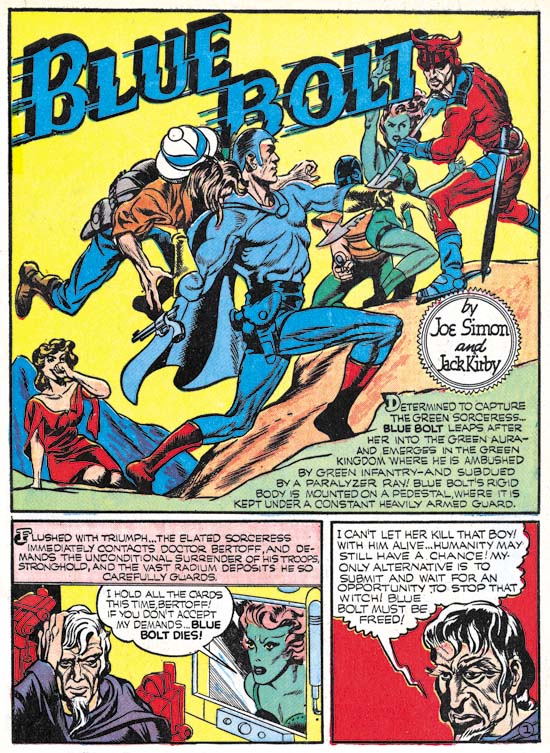
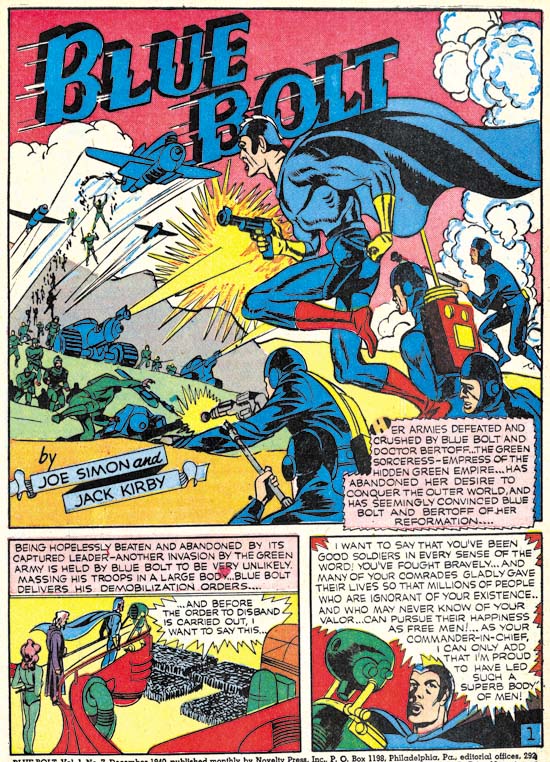
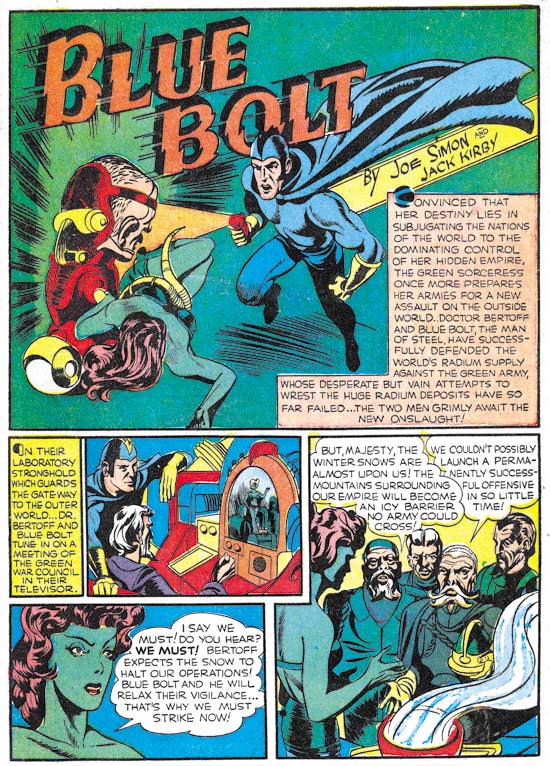
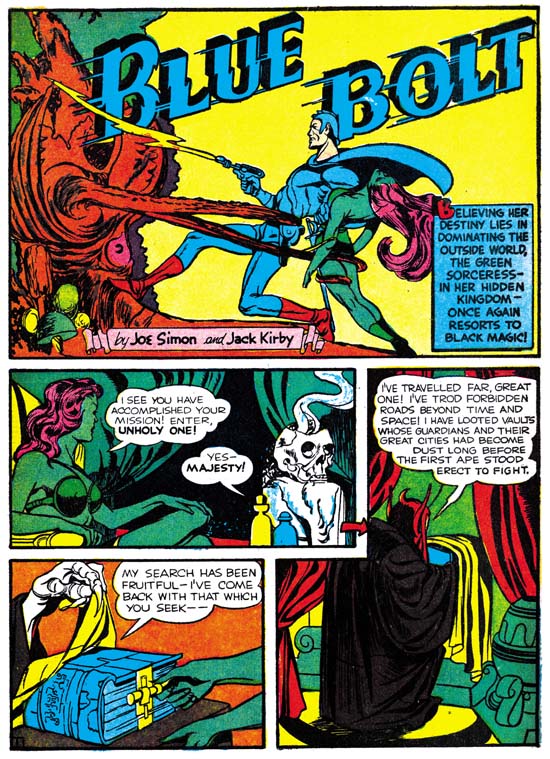
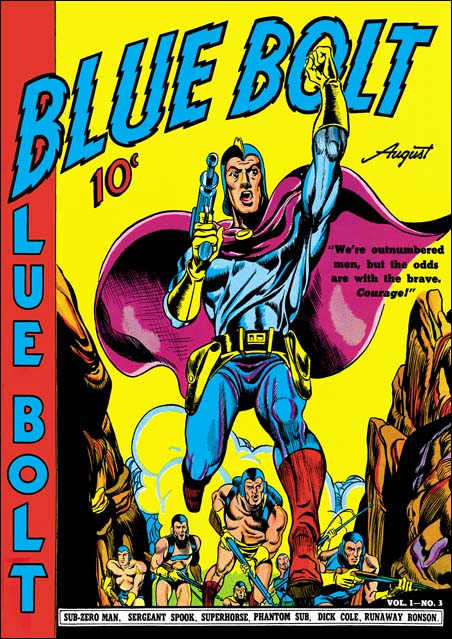
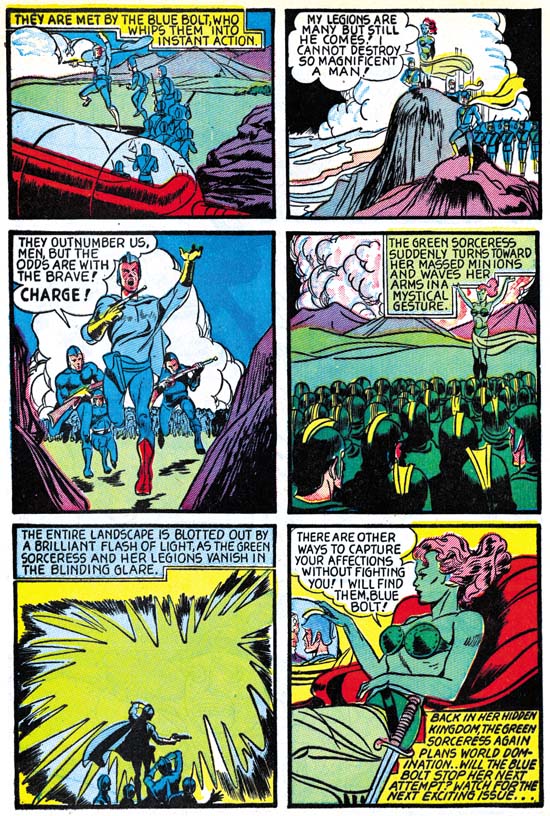
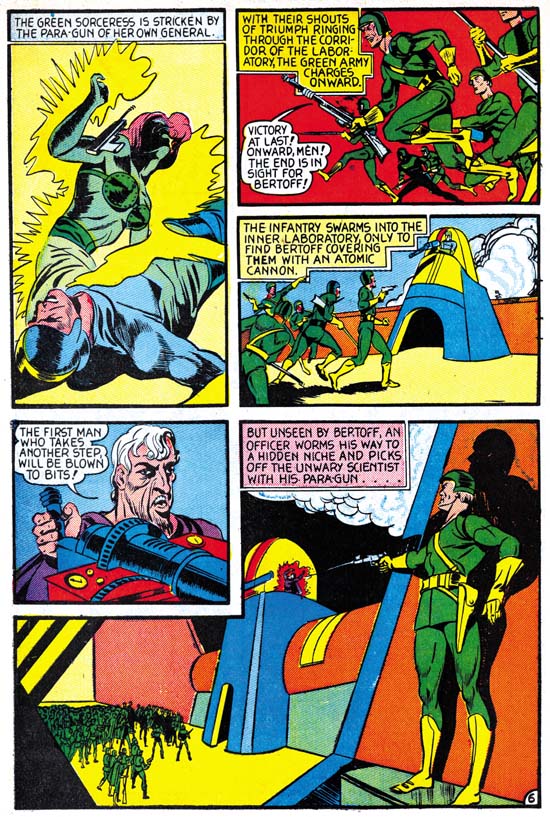
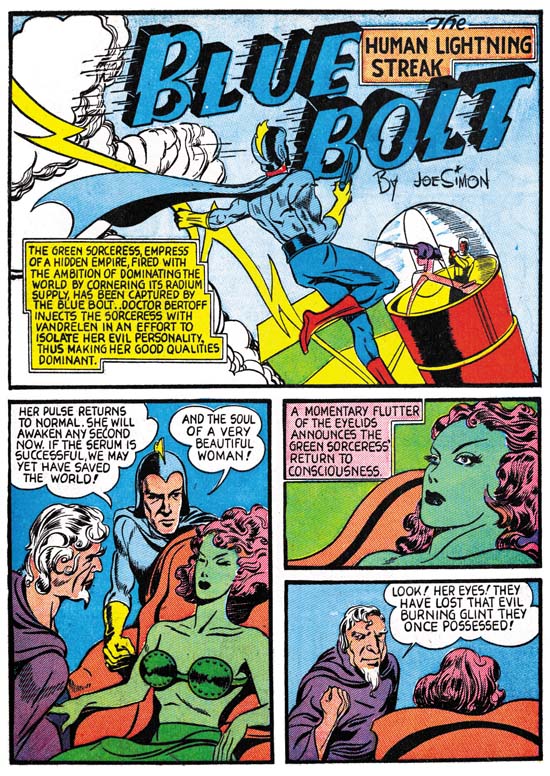
Blue Bolt #8 (January 1941) Blue Bold, pencils and splash inks by Jack Kirby, letters by Howard Ferguson
Blue Bolt #8 initiates a working methodology that Simon and Kirby would use often in years to come. Kirby would ink his own splash panel while leaving the rest of the story to be inked by other artists (besides Joe Simon). Kirby’s inking tops off an already spectacular splash. While in later years Jack’s primary interest was the story art, during his collaboration with Joe much emphasis was placed on covers and splashes. Great stories may have built the Simon and Kirby reputation but covers and splashes are what drew attention and persuaded comic book readers to spend their money. Of course having all the story inked by either Kirby or Simon would be preferable but if that was not possible the next best thing was for Jack to ink the splash.
It has been said that Kirby pencils could withstand even poor inkers. Well the story art to Blue Bolt #8 certainly puts that claim to the test. As I mentioned previously, I will not try to identified the inkers other than either Kirby or Simon but one or more of the assistants from the Timely bullpen were likely candidates for this work. Al Avison, Al Gabriel and Syd Shores were very young and just learning their trade.

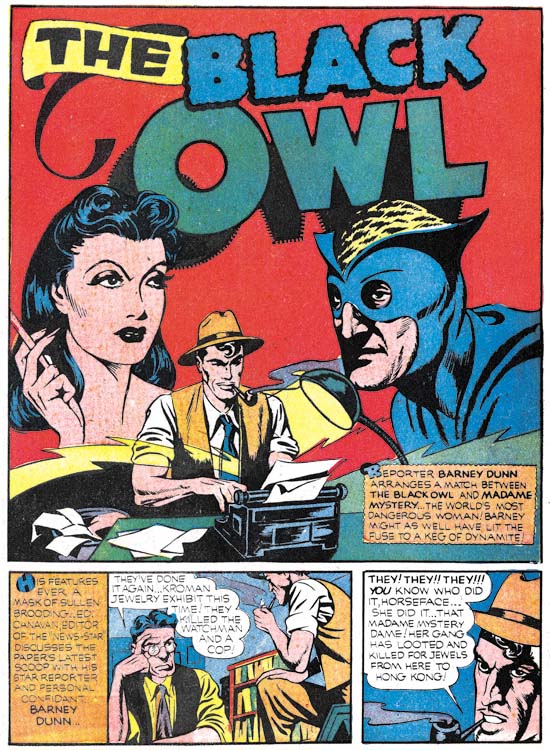
Prize Comics #8 (January 1941) Black Owl, pencils and letters by Jack Kirby, inks by Joe Simon
Blue Bolt was a serialized comic feature. Not quite like in the movie serials as Blue Bolt did not have “cliff hangers” endings. Instead each story would be complete but with an ending that left open the question of where the tale would go from there. The Black Owl feature from Prize Comics #7 leads to PC #8 in the same manner. However the ending in PC #8 does not suggest further development of the story in the next issue. This issue was included in a previous post (Simon and Kirby’s Black Owl).

Prize Comics #8 (January 1941) Black Owl, letters by Jack Kirby
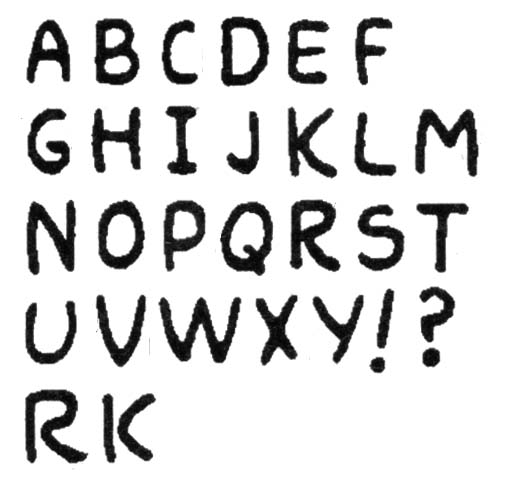
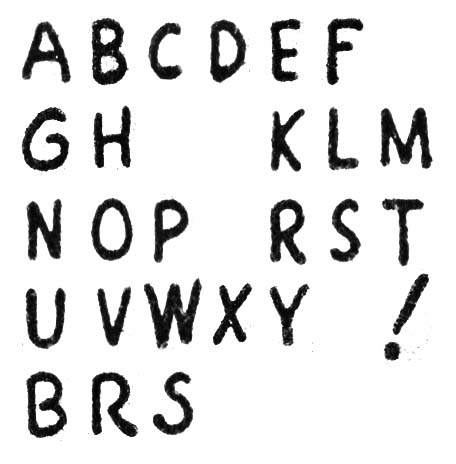
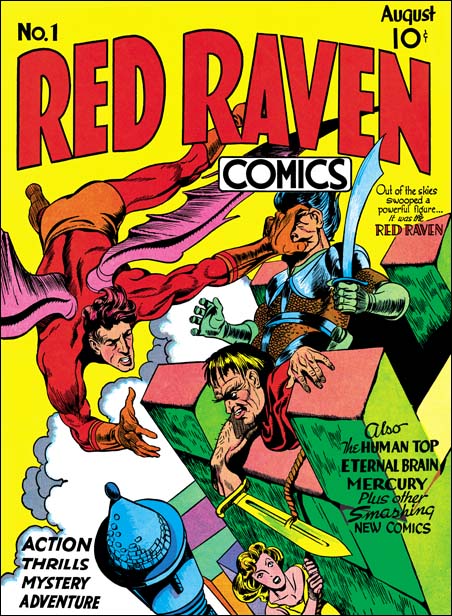
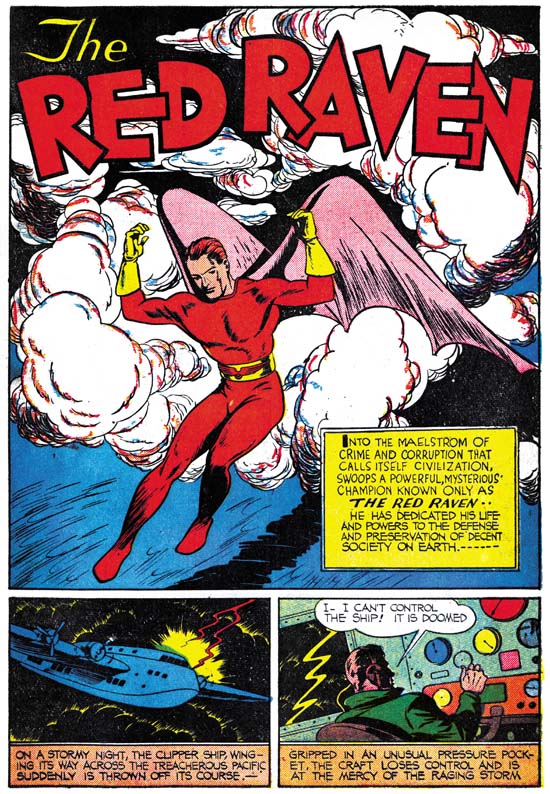
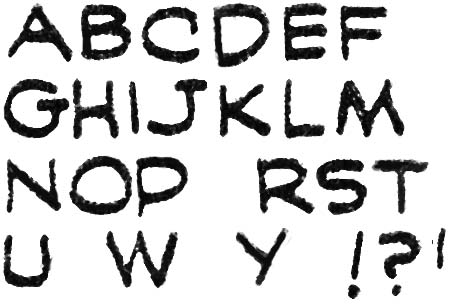
Kirby provided the lettering for PC #8 and since I have prepared samples for a previous post (Jack Kirby as a Letterer) I will repeat them here. But truth be told Kirby’s lettering really has not changed from the previous sample that I provided (Red Raven #1, August 1940, shown in Chapter 5).

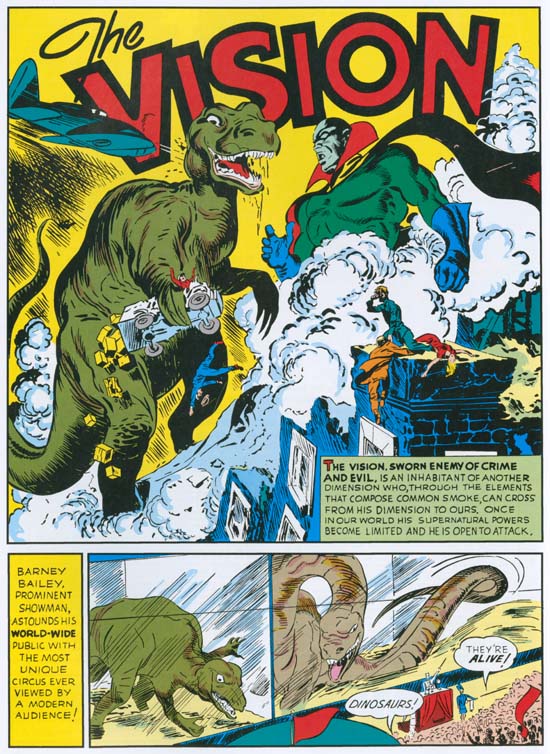
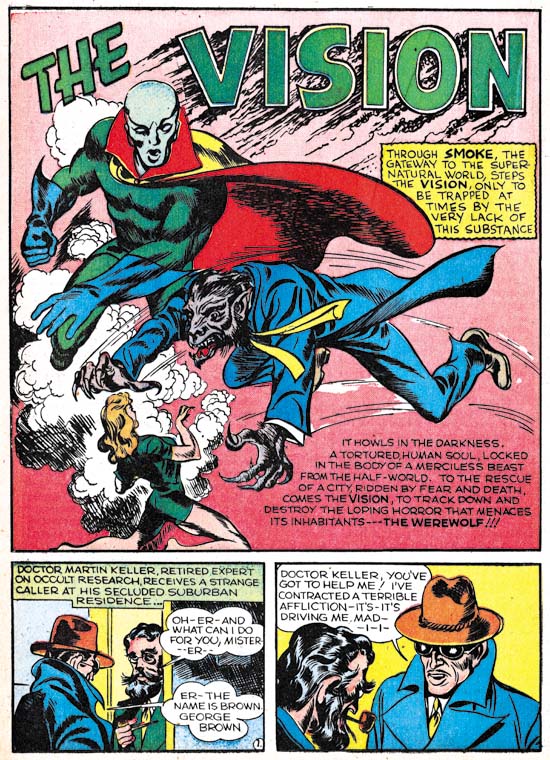
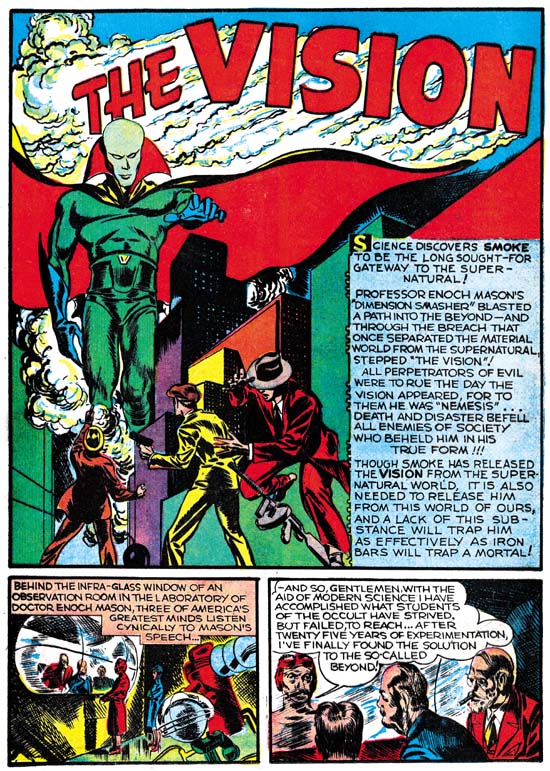
Marvel Mystery #15 (January 1941) Vision, pencils, inks and letters by Jack Kirby (from Marvel’s Golden Age Masterpieces reprint)
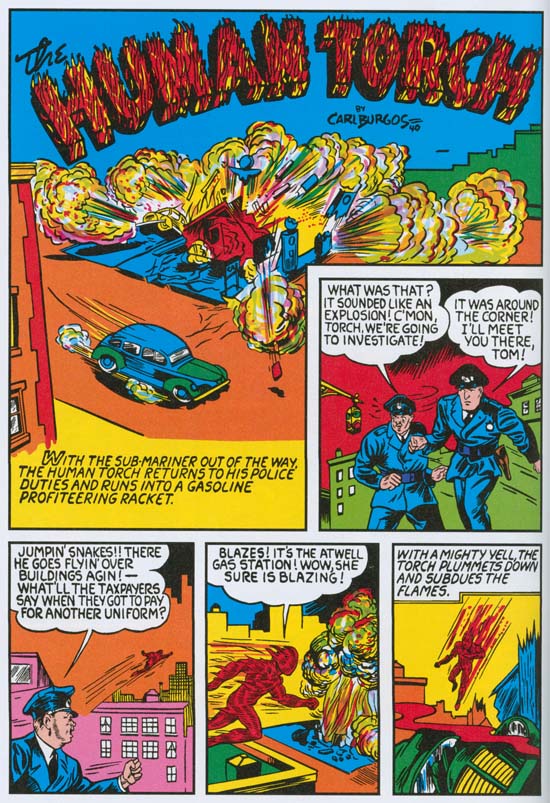
As with Marvel Mystery #13 and #14, Kirby seemingly does it all, or at least all the visuals, for the Vision story in MM #15 (January 1941). Of course Simon might have had something to do with this feature, he was after all the editor.
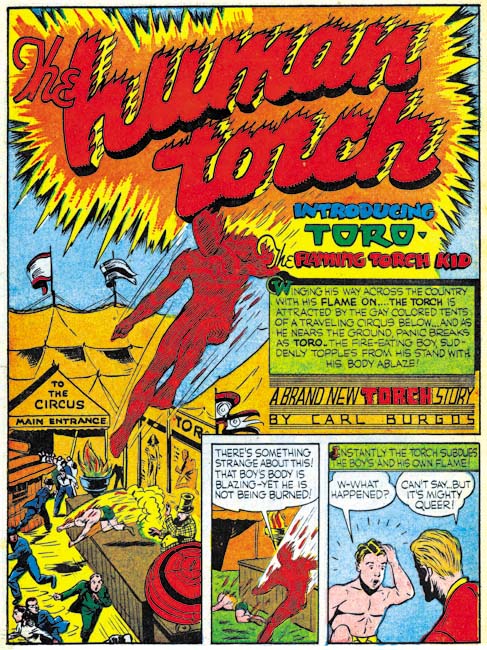
Ferguson provided the lettering in Marvel Mystery #15 for the Human Torch and Terry Vance features.

Captain Marvel Adventures #1, Pencils by Jack Kirby (from a bleached page)
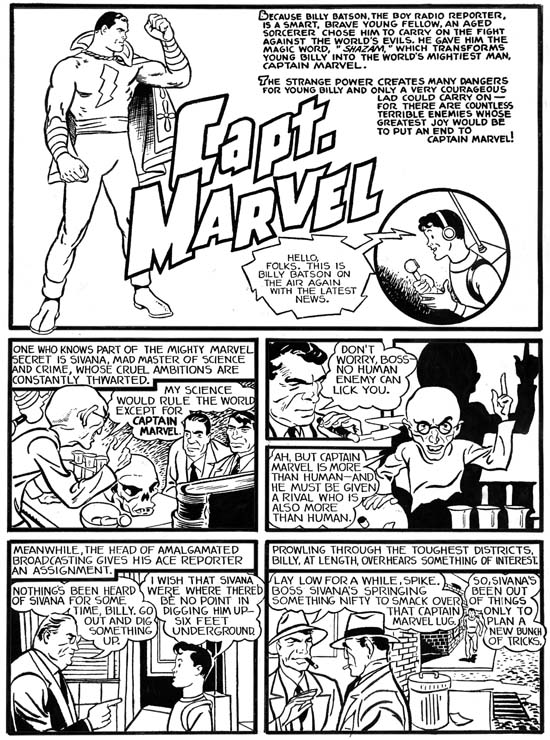
I have chosen this chapter to include some moonlighting work that Simon and Kirby did for Fawcett. Unfortunately the dating of this work for is uncertain as the comic books lack dates on the covers or in the indices. One of the works was Captain Marvel Adventures #1. This was the first comic book dedicated to Fawcett’s new hit Captain Marvel. It must have seemed a rather troublesome assignment. Not only did the art have to look like the work that C. C. Beck had previously done on the character, but also Simon and Kirby were not allowed to alter the scripts (Joe Simon’s Fawcett Testimony). The pencils had to be returned to Fawcett for lettering and then picked up again for inking. Yet despite all this the final art is rather nice. Kirby was never very good at imitating other artists and despite the simple lines of the artwork Kirby style keeps showing up. Beck might not have been pleased but in my opinion Simon and Kirby’s version was much more interesting. I have no idea who the inker was but it certainly was not Kirby, Simon or any of the assistants from the Timely bullpen. Whoever it was they did a marvelous job.

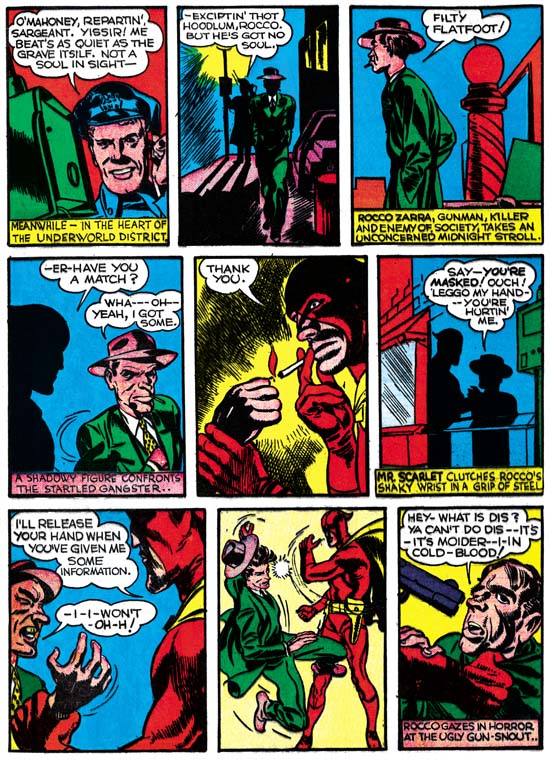
Wow Comics #1, Mister Scarlet, Pencils and inks by Jack Kirby, letters by Jack Kirby and Joe Simon
It is uncertain whether this work was done before or after Captain Marvel. In the Fawcett testimony Simon said it came later however that testimony was given some eight years later and therefore might not be accurate.
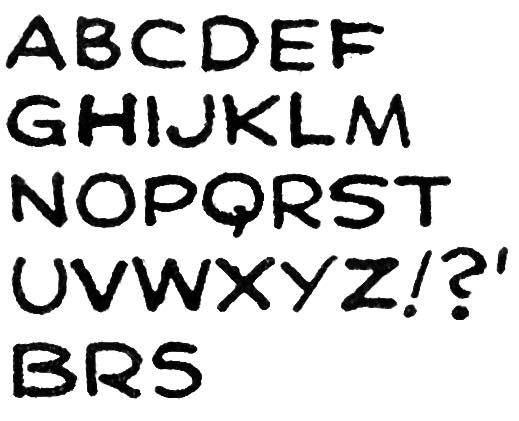
Mister Scarlet appears to largely be the work of Jack Kirby but Joe Simon’s presence is revealed in some of lettering. His distinctive ‘W’, ‘M’ and other letters make their appearance in some of the text as for instance in the captions in panels 1, 4 and 6 from page 2 shown above. All the Simon letter that I have spotted so far comes from captions and not the word balloons. This suggests that Joe was trying to make an existing story clearer. This feature is also a good reminder about the problems of identifying Joe’s contributions in Simon and Kirby productions. Had this story been lettered by someone other than Kirby and Simon, Joe’s additions would have gone unnoticed.
Posted in 2011/11, 3 Timely, Artists, Assorted, Kirby, Jack, Lettering, Periods, Serial Posts, Start of S&K, Topic, z Archive
Tagged howard ferguson, jack kriby, Joe Simon
Leave a comment
In the Beginning, Chapter 9, More Moonlighting

Blue Bolt #7 (December 1940) Blue Bolt, pencils by Jack Kirby, inks by Joe Simon, letters by Howard Ferguson
Blue Bolt #7 continues the Simon and Kirby collaboration in its purist form, that is with Jack doing the pencils and Joe providing the inks. The only other feature from December that showed such a degree of collaboration was the Black Owl from Prize Comics #7 which I will discuss below. Both of these features were done while moonlighting. As we will see below the features created for their regular gig at Timely were not quite the same joint effort.
The enlarging World War II, romance, betrayal, spies and assassins are just some of the elements of this engaging story. Simon and Kirby were not satisfied with telling a simple confrontation between a hero and a villain they had to put in as much as possible. Ten pages hardly seemed enough to fit all that they included. It does not seem that Blue Bolt had any significant impact on the rest of the comic book industry of the day but it should have.

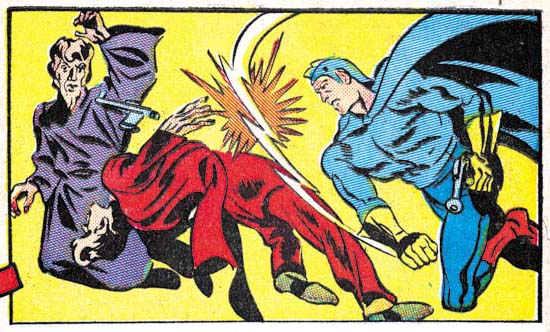
Blue Bolt #7 (December 1940) Blue Bolt page 8 panel 1, pencils by Jack Kirby, inks by Joe Simon, letters by Howard Ferguson (horizontally flipped image)
Sure Blue Bolt was science fiction but that did not mean that the hero always used a ray gun. Previously Kirby had a penchant for dramatic slugfests but now he began to take that art to a new level.
I present the above image in reverse…

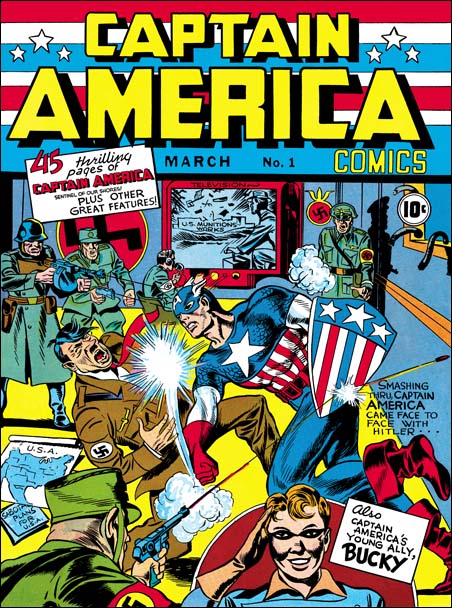
Captain America #1 (March 1941), pencils by Jack Kirby
as I want to highlight that roll Blue Bolt played in laying the groundwork for a future hit. Captain America would appear on newsstands just three months later.

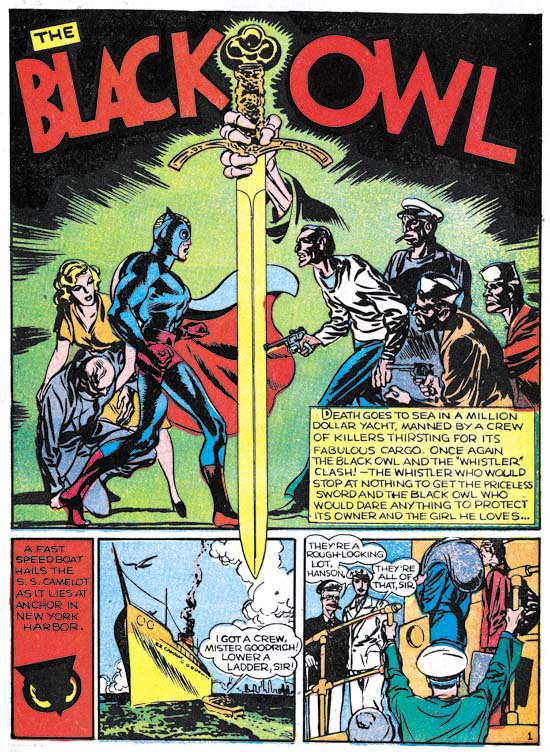
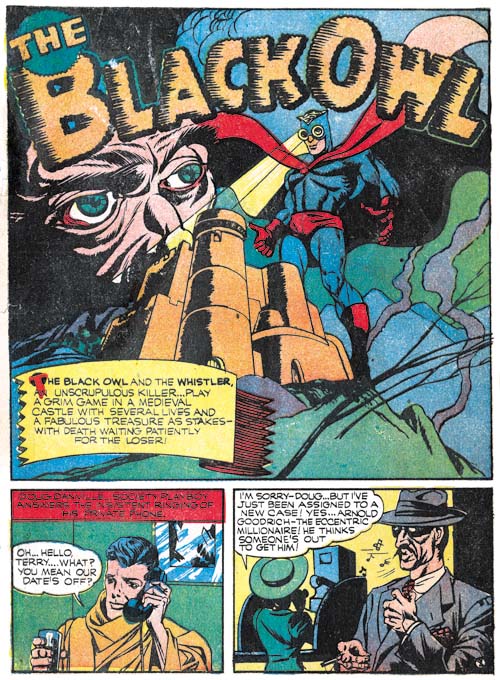
Prize Comics #7 (December 1940) The Black Owl, pencils by Jack Kirby, inks by Joe Simon?, letters by Howard Ferguson
Blue Bolt was not the only moonlighting job that Simon and Kirby produced for December they also did Black Owl for Prize Comics #7. Joe and Jack would end up doing a Black Owl story for three issues which I discussed previously (Simon and Kirby’s Black Owl). All three stories were reprinted in Titan’s “Simon and Kirby Library: Superheroes” (shameless plug). The Black Owl was not a Simon and Kirby creation and I really do not know much about previous appearances of the character. But of course Simon and Kirby added their distinct touch if in nothing more than the story and art.

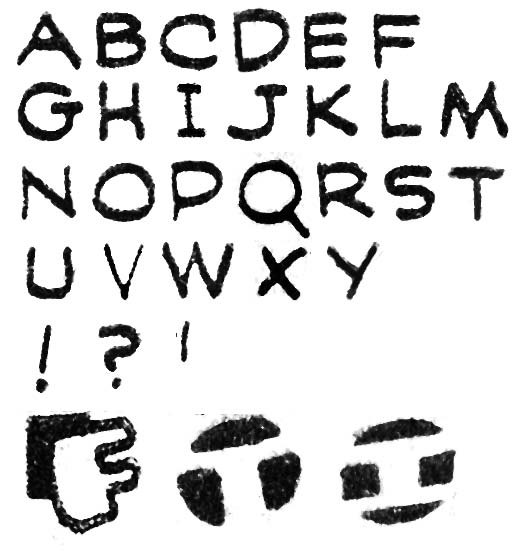
Prize Comics #7 (December 1940) The Black Owl, letters by Howard Ferguson
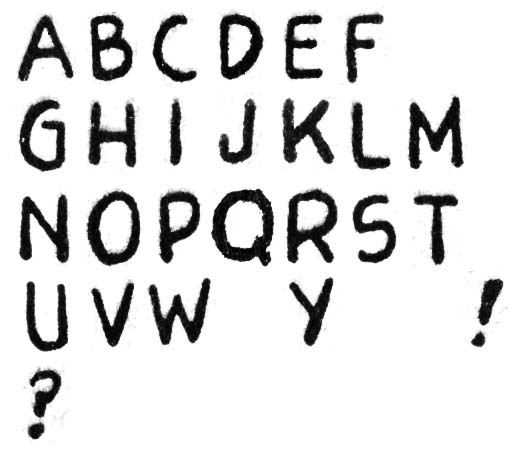
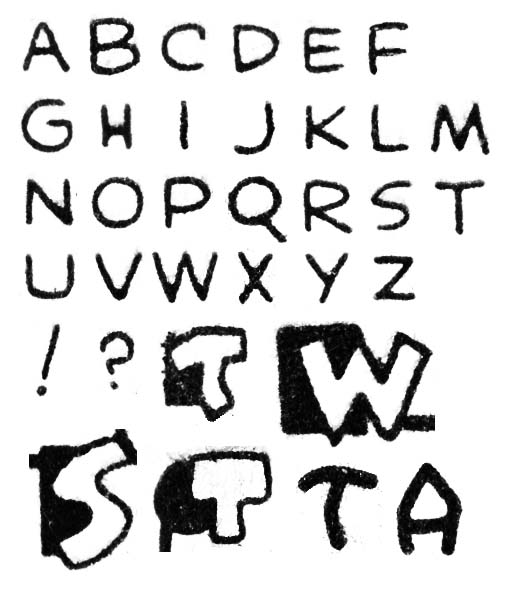
Howard Ferguson provided the lettering for the Black Owl story. I have previously provided the lettering samples for Ferguson’s Prize Comics #7 but I have since made a correction and some additions to it. A recap of the more useful features would seem in order. The most useful trait for identifying Ferguson lettering is the little vertical stroke attached to the upper end of the letter ‘C’. Another useful trait is the very shallow hook for the letter ‘J’ but unfortunately that is not a common letter. Some other traits are less useful but still should be noted particularly the way the upper portions of the letters ‘P’ and ‘R’ predominate over the lower portion. The letter ‘S’ is similarly often affected by a predominate upper portion but there is some variation in this feature. Another trait is found in some but not all ‘N’ is the manner that the left vertical stroke is sometimes tilted downward to the left somewhat. Perhaps not as useful than the letter ‘C’ but certainly easier spot is Ferguson’s special handling of the first letter in captions (examples are provided above). I believe all these traits (except the special ‘N’) were retained by Ferguson the rest of his career. I plan to review his entire career after I finish this serial post.
In is at this time that in my opinion Ferguson’s lettering has gone from good to great. This is not due to form of his letters which has changed only a little from previous work. Rather it steady and firm hand used and the spacing and legibility of the final results. Ferguson’s work is not mechanical but neither is it overly variable.
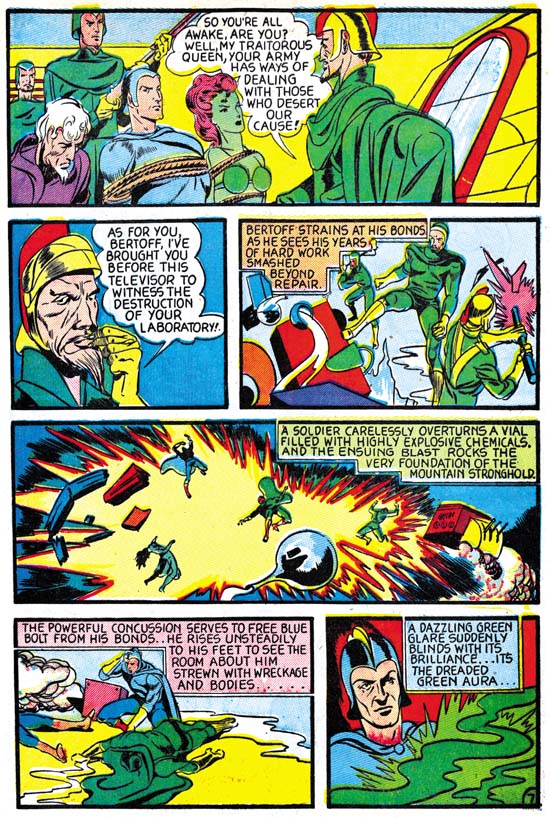
Besides an improvement in quality, the lettering differs from what was done not that long ago for Blue Bolt #5 (October 1940) by three changes.
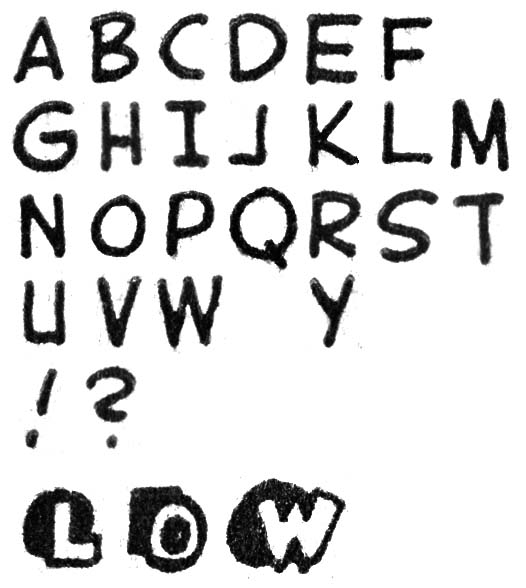
I have previously pointed out the special handling of the first letter in captions. Such enlarged and specially formed letters are similar to the first letter of chapters often found in older books. The analogy is not perfect but it is close enough that I have decided to adopt the name given to them, drop capitals (or drop caps for short). Drop caps were used by other comic book letterers but Ferguson began using a special version where the letter is created a negative space in a black field such as the two final examples in the image above. I shall refer to these as negative drop caps. It was the introduction of negative drop caps that is one of the things that distinguish Prize #7 from Blue Bolt #5. But there appears to be two flavors of negative drop caps. The first that appeared in Blue Bolt #6 and the Terry Vance feature from Marvel Mystery #13 (both November 1940) had vertically oriented letters. Later in Blue Bolt #7, Prize Comics #7 and the Human Torch and the Terry Vance features from Marvel Mystery #14 (all December 1940) Ferguson introduced negative spot caps that were tilted.
The second change in Ferguson lettering concerns the letter ‘G’. In Blue Bolt #6 (November 1940) and earlier Howard constructed the ‘G’ with a small horizontal element on the left side of the bottom of the character and does not extend to the right. In Prize Comics #7 and the Human Torch story from Marvel Mystery #14 (both December 1940) Ferguson extends the small horizontal so that it appears on both the left and the right side. Interestingly Blue Bolt #7 (December 1940) uses the old form of ‘G’ for most of the first page of the story while otherwise using the new ‘G’. The old ‘G’ is used in BB #5 (October), BB #6 (November) and the Terry Vance stories from MM #13 and #14 (November and December). As mentioned both forms of ‘G’ appear in BB #7 (December). Only the newer ‘G’ appears in the Human Torch of MM #14 (December).
The third change involves the form of the letters ‘I’ and ‘J’. Ferguson’s older form for these letters excluded any horizontal elements while the newer form did. While the letter ‘I’ is common enough, horizontal strokes are not supposed to be added when the letter is used with others to form a word. Unfortunately the isolated use of ‘I’ and the use of ‘J’ are not too common. The old form of ‘I’ and ‘J’ appear in BB #5 (October), BB #6, Terry Vance from MM #13 (November) and BB #7 (December) with the new forms used in PC #7 and the Terry Vance feature of MM #14 (both December).
With these three changes in Ferguson’s lettering it would seem possible to sort out the relative order that Ferguson lettered the work appearing in the months from October to December. Regrettably it turns out that no ordering is possible that will satisfy all three criteria for all cases. The few cases of lettering by Ferguson from later periods suggest that perhaps he was not consistent in his use of ‘G’. Hopefully this question will be answered as my review progresses.

Marvel Mystery #14 (December 1940) The Vision, pencils, inks and letters by Jack Kirby,
The Vision became a regular Marvel Mystery Comics features with his second appearance in MM #14 (December 1940). As in the previous issue, Kirby would provide pencils, inks and letters for the Vision story. Even today the Simon and Kirby Vision is a largely neglected feature and at that time it was very much overshadowed by the Human Torch and the Sub-Mariner. (This story was reprinted in “The Best of Simon and Kirby”, another shameless plug).
Lettering by Howard Ferguson also appeared in Marvel Mystery #14 in the Human Torch and the Terry Vance features.

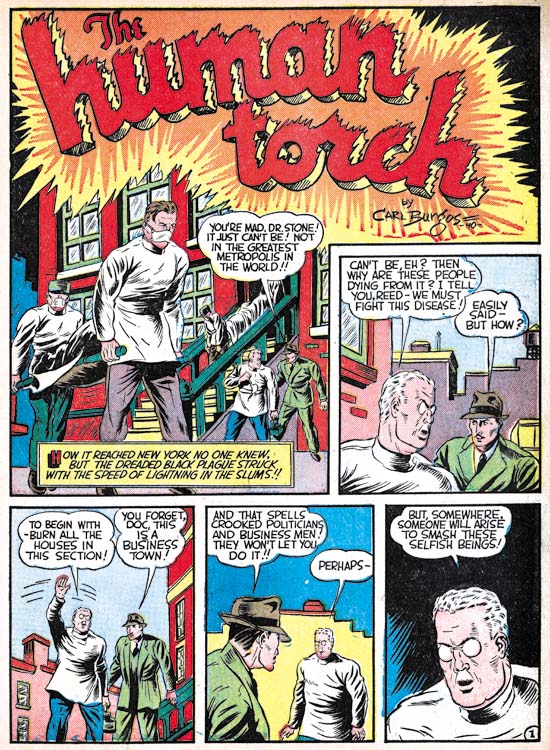
Human Torch #2(1) (Fall 1940) the Human Torch “Introducing Toro”, pencils by Carl Burgos, lettering by Howard Ferguson
As mentioned in the previous chapter, Timely did not release a Red Raven #2 issue. Instead that titles mailing license was used instead for a new title, Human Torch Comics #2. That the first issue was numbered 2 has brought about confusion to the numbering of the title even back when it was released. I have added “(1)” to the issue number to indicate it is actually the first issue. The cover is dated as Fall 1940 which means there might be some question as to what month to assign it. However Marvel Mystery #13 (November 1940) and #14 (December 1940) have house advertisement for the Human Torch #2(1). The MM ads provides a release date of September 25. Normally comics are cover dated about two months after their release so it is seems appropriate to assign HT #2(1) to December.
This issue has been reprinted in the Golden Age Masterwork series. Unfortunately Marvel did a horrendous job re-creating it. I have discussed this previously (The Human Torch #2) but I feel I need to emphasize here that the reprint volume is useless for anything beyond a casual reading. It is simply not possible to use this reprint book to examine the art or lettering. Luckily I will be using scans from the original comic in my discussions here.

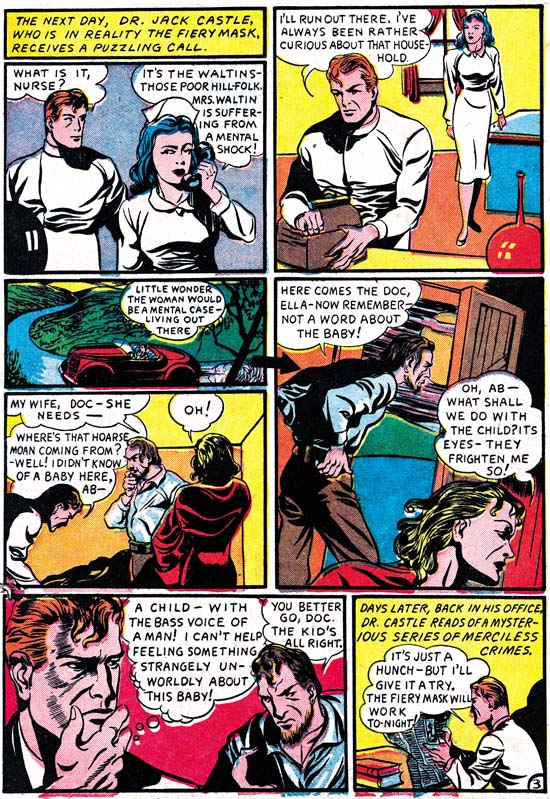
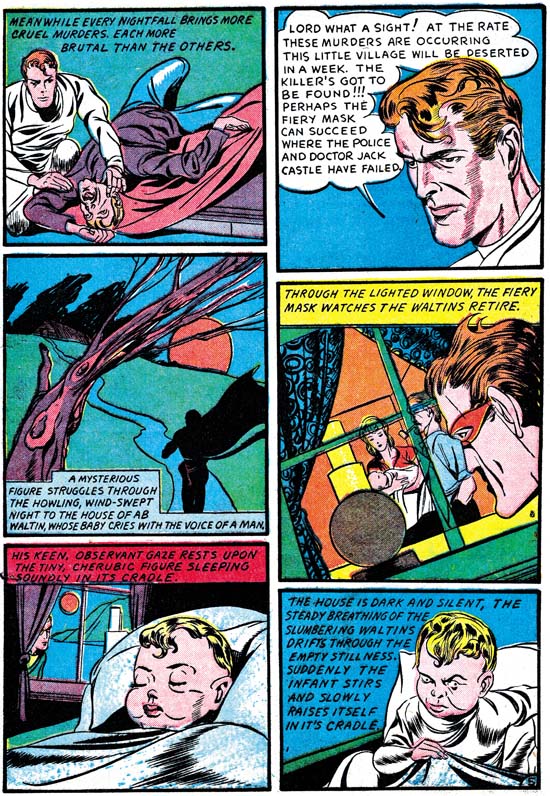
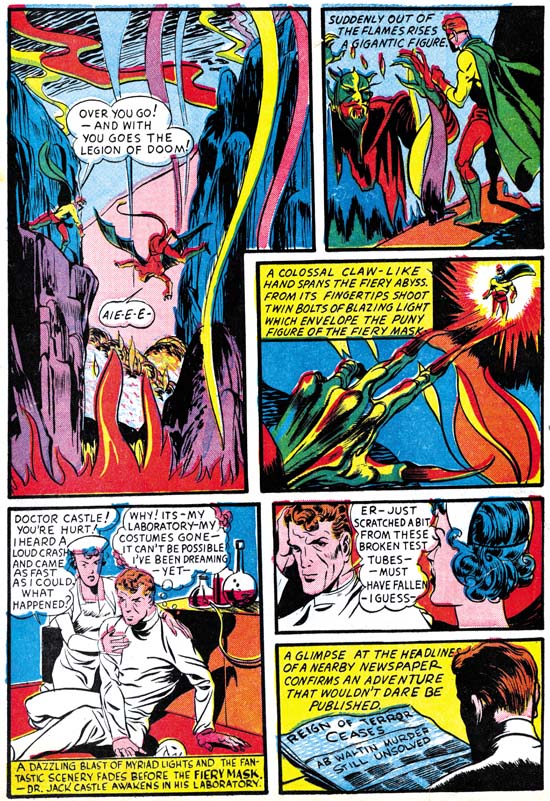
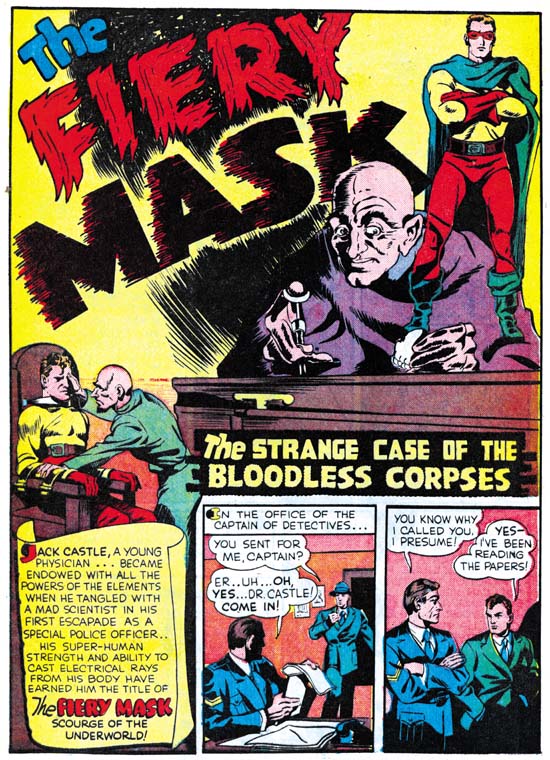
Human Torch #2(1) (Fall 1940) the Fiery Mask “The Strange Case of the Bloodless Corpses”, pencils and inks by Joe Simon, letters by Howard Ferguson
The Fiery Mask was one of Simon’s earliest creations having first appeared in Daring Mystery #1 (January 1940, Daring Mystery and Joe Simon BK (Before Kirby)). Another artist drew the character for Daring Mystery #5 (June 1940) but Simon returned with Kirby’s help to provide the Fiery Mask for Daring Mystery #6 (September 1940). Simon worked on the Fiery Mask one last time for Human Torch #2(1) (Fall 1940). I periodically get asked, but I really feel this was a solo effort because I cannot find any sign that Kirby had anything to do with this Fiery Mask story, “The Strange Case of the Bloodless Corpses”. Simon’s comic book art improved rapidly so that even though only a short period had past the art style for HT #2(1) Fiery Mask story shows it was definitely drawn when Simon became editor at Timely and was not some older inventoried story from when he first started working in comics. Still it would be nice to provide a more accurate date for the story as it theoretically have been done a few months earlier and inventoried or it could have been drawn later specifically for the HT #2(1) issue.
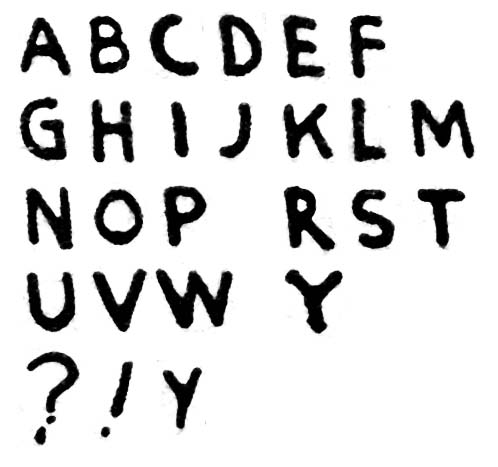
Fortunately the lettering Howard Ferguson did for the story may provide a clue. As mentioned before Ferguson’s work had been undergoing development during this period. The Fiery Mask story lacks negative drop caps and uses the older form of the letters ‘G’, ‘I’ and ‘J’. Therefore I believe it must have been done no later than the work for Blue Bolt #5 (October 1940). It likely was originally intended for Daring Mystery #7 which possibly was meant to be released in October or November but that publication of that issue was delayed until April 1941. Or alternatively it might have been meant for Red Raven Comics #2 which should have come out in October but that title got cancelled. But in any case the Fiery Mask story was done earlier than the Human Torch story in the same issue as that story was lettered by Ferguson but with the tilted negative drop caps, the new ‘I’ and ‘J’ and mostly using the new ‘G’ all of which suggests a December date.
Posted in 2011/11, 3 Timely, Artists, Assorted, Kirby, Jack, Lettering, Periods, Serial Posts, Simon, Joe, Start of S&K, Topic, z Archive
Tagged howard ferguson, Jack Kirby, Joe Simon
Leave a comment
In the Beginning, Chapter 8, A New Title

Blue Bolt #6 (November 1940), pencils by Jack Kirby, inks by Joe Simon, letters by Howard Ferguson and Joe Simon
Blue Bolt #6 is the second feature to include Simon and Kirby credits. Once again Kirby provides the pencils while Simon does the inking. Although it is not known who wrote the script, the story has the special Simon and Kirby quality that already was very different from the standard comic book fare of the day. Now the green sorceress is joined by Marto, a man with enlarged head and an atrophied body who uses a special mechanical device to overcome his physical limitations.

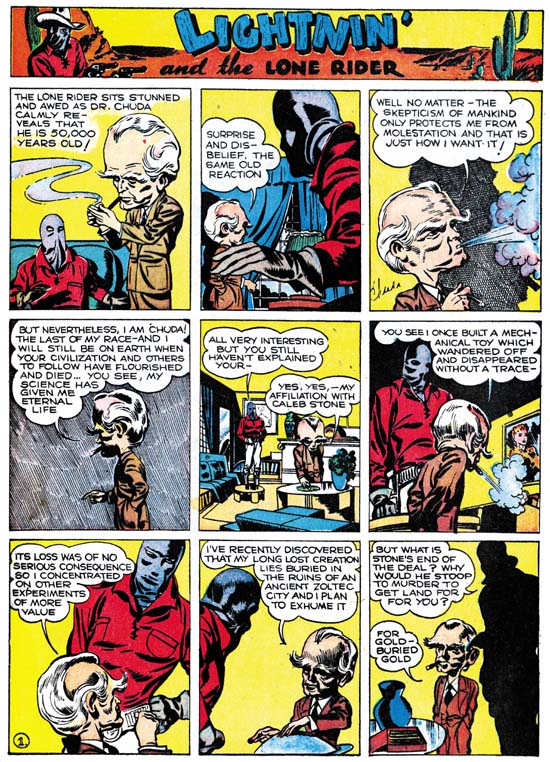
Famous Funnies #76 (November 1940) Lightnin’ and the Lone Rider, pencils, inks and letters by Jack Kirby
Kirby seemed to have a fascination with advanced beings with large heads. The earliest prototype appeared in a western feature that Jack work on called Lightnin’ and the Lone Rider. Actually this feature had been appearing in Famous Funnies at the same time as Blue Bolt #6. The Lone Rider was initially developed as a syndication strip back in late 1938 to early 1939 (Early Jack Kirby, Chapter 1, Lighting and the Lone Ranger). However it appears Kirby returned to the feature sometime later. Exactly when is uncertain but I believe it was while Kirby was still working for Fox Comics (Early Jack Kirby, Chapter 3, Moonlighting). However based on the art style I believe it was done before Kirby started working with Joe Simon and therefore outside the current discussion. However the recent appearance of the large headed adversary in Famous Funnies may have inspired Kirby to create an updated version for Blue Bolt.

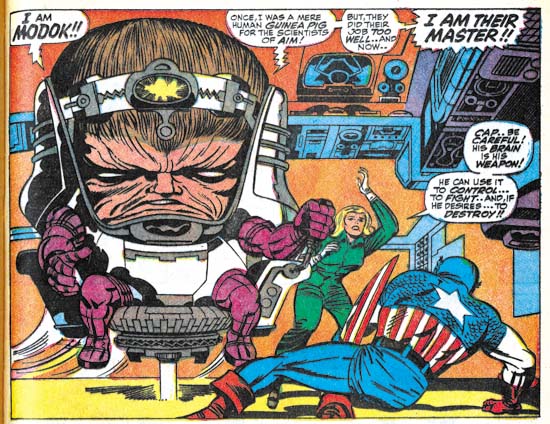
Tales of Suspense #94 (October 1967) pencils by Jack Kirby, inks by Joe Sinnott, letters by Sam Rosen
It is surprising how some ideas seem to lay dormant for years before Kirby would return to them. If there was another appearance of the Marto character I do not recall it. But in 1967 Kirby returned to the theme when he created Modok. While the background stories were very different, the similarity between Marto and Modok is too great to be require much discussion.

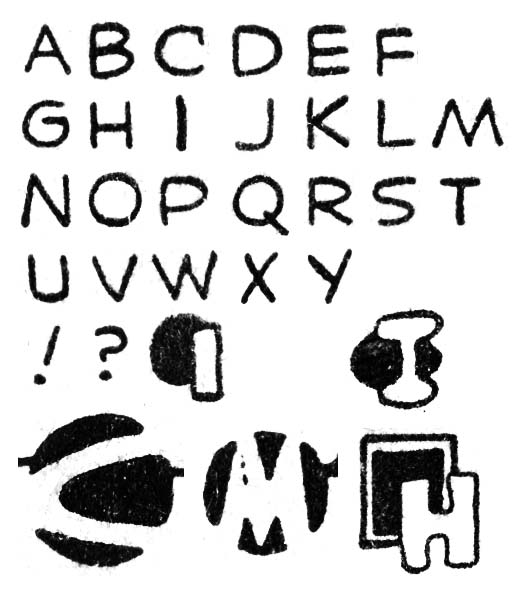
Blue Bolt #6 (November 1940), letters by Howard Ferguson
The first six pages of the Blue Bolt feature were lettered by Howard Ferguson. The seventh page has some lettering by Ferguson but most of the page was lettered by Joe Simon. The style of the letters has not change at all from examples from the previous month. The use of circular or square shapes attached to the first letter of captions is also the same as what has been seen earlier. One new feature in Ferguson’s repertoire is the use of other abstract shapes with the first caption letter such as the oval and double square show above. The most interesting addition is the rendering of the letter as a negative space on a circular black field such as the ‘C’ and ‘M’ shown above. This simple but elegant design was the most effective design that Ferguson adopted. Unfortunately Ferguson had no control on how the colorist would handle it. When a separate color was added the letter would stand out. But without that special color addition the design becomes more abstract and harder to read as a letter. Unfortunately the colorist failed to apply a separate color to many of these negative letters in Blue Bolt #6.

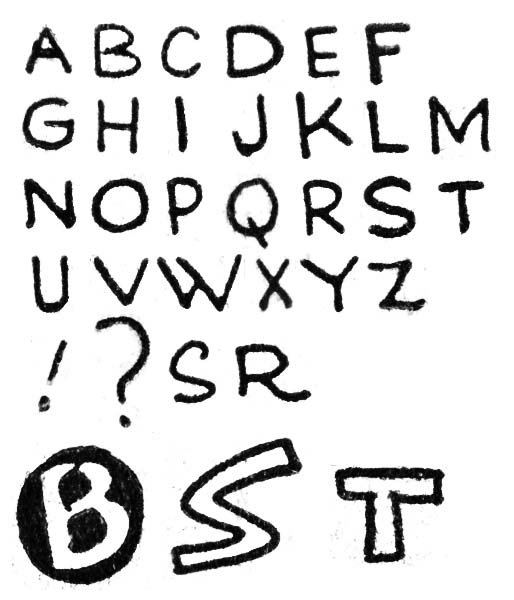
Blue Bolt #6 (November 1940), letters by Joe Simon
Joe Simon did the lettering for most of page 7 and all of pages 8 to 10. Here Simon does a more careful job at lettering but the basic form of the letters remains the same. As mention previously the ‘W’ that Simon used is very helpful in spotting his work and while not quite as distinct his ‘M’ is useful as well. There still are occasional little elaborations that Simon uses like the ‘S’ and ‘R’ shown above. The lettering for page 9 seems particularly well done. Also found on that page are special first caption letters, something Simon normally did not do. While unusual for Simon, the use of open letters (which allow the addition of a color) was also done by other letterers. However Joe places one ‘B’ as a negative letter on a black circular field. This must have been a response to what Ferguson was doing in the same story. Simon’s design is not as abstract as Ferguson’s but it still an effective device.

Marvel Mystery #13 (November 1940) The Vision, pencils, inks and letters by Jack Kirby
In the previous chapter I mentioned the unusual lack of Kirby art in the Timely comics for October. The one explanation I provided was that Kirby might have done some art for Red Raven #2 only it was never published due to the abrupt cancellation of that title. Here I will suggest another (but not necessarily conflicting) explanation. Kirby might have been busy creating a new feature as in this month Marvel Mystery #13 debuted “The Vision”. The pencils, inks and letters were all done by Kirby. The only thing that suggests that Simon was involved (other than as the editor) was the motif of the Vision being able to appear from smoke of any kind. This is similar to the power of the Flame, a Fox comics feature, who could transport using fire as a portal. While Kirby had worked for Fox Comics he had nothing to do with the Flame. Simon on the other hand was not only the editor for the comics that included the Flame but had also drew the character on some of the covers.
As I mentioned Jack did the lettering for the Vision story. Kirby’s lettering was unchanged from the last time we saw it (Red Raven #1, August 1940 see In the Beginning, Chapter 5). Ferguson provided lettering for the Terry Vance feature from MM #13 in a style that matches his work in Blue Bolt #6.
Posted in 2011/11, 3 Timely, Artists, Assorted, Kirby, Jack, Lettering, Periods, Serial Posts, Simon, Joe, Start of S&K, Topic, z Archive
Tagged blue bolt, howard ferguson, Jack Kirby, Joe Simon
Leave a comment
In the Beginning, Chapter 7, Blue Bolt #5

Blue Bolt #5 (October 1940), pencils by Jack Kirby, inking by Joe Simon, lettering by Howard Ferguson
Blue Bolt #5 has the distinction of being the first time that the Simon and Kirby collaboration was credited in print. BB #4 was every bit a Simon and Kirby production but in the splash it was credited to Joe Simon alone. It is little more than speculation, but perhaps when Joe saw the final results of BB #4 he realized that Kirby’s contribution had gone well beyond being just an assist and that Jack deserved a greater recognition. Since BB #5 was penciled by Jack and inked by Joe, why did Simon get top billing? The simple answer was that Blue Bolt was a Joe Simon creation. While this is very understandable, once this particular order appeared in print from then on it would Simon and Kirby, not Kirby and Simon.
Blue Bolt #5, like issue #4, is a great piece. Simon and Kirby full of action and visually exciting art. Blue Bolt may not have been a top selling comic book, but anyone paying attention should have realize that the Simon and Kirby were producing something unlike what anyone else was doing.

Red Raven #1 (August 1940) “Comet Pierce” page 6 panel 7, pencils, inking and lettering by Jack Kirby
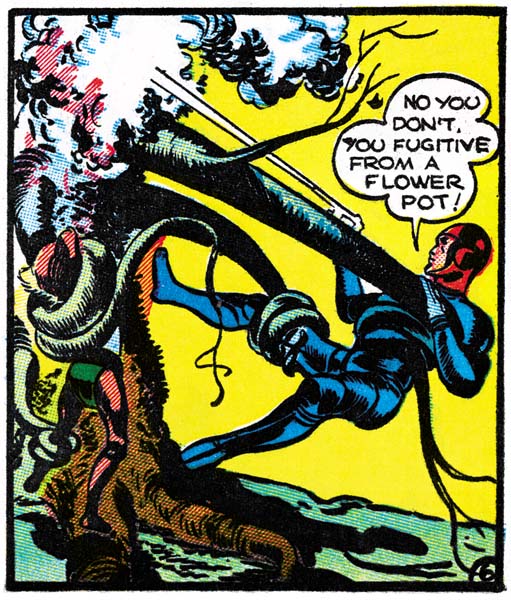
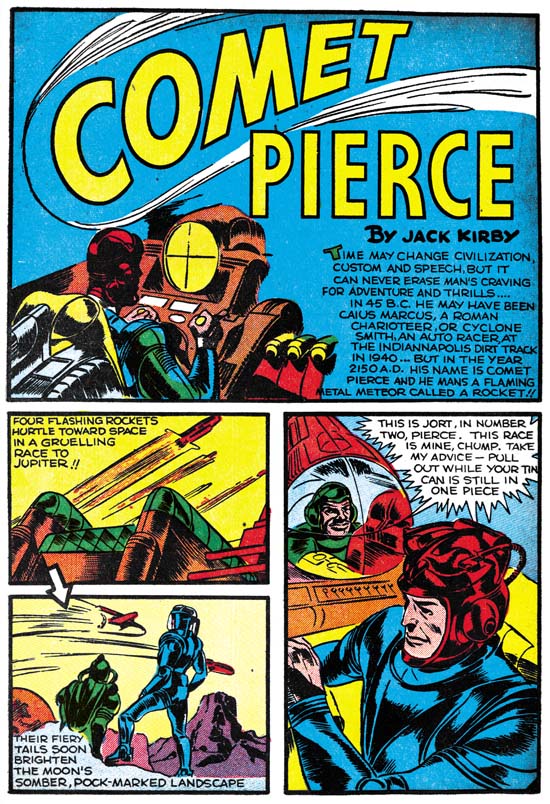
Was Blue Bolt written by Simon and Kirby as well? In the future Simon and Kirby would generally employ writers to develop scripts. However Joe and Jack normally supplied the plot and just as often re-write the returned scripts. We may not know whether Simon and Kirby were working from a script or not for BB #5, but they clearly were involved in the plotting. A man-eating plant appears in the Comet Pierce” story from Red Raven #1 a couple months earlier. The Comet Pierce story seems to be a largely Kirby effort but since Simon was the editor to Timely he may have had input to the story.

Blue Bolt #5 (October 1940), lettering by Howard Ferguson
Howard Ferguson did the lettering for Blue Bolt #5. The form of the general letters has not changed at all from Daring Mystery #6 (September 1940). The special first letters of captions continue to have attached circular or square black shapes. However now these special first letters have migrated to the caption border so that small parts of them may actually extend outside of the caption box. Another addition to the Ferguson repertoire is that some of the captions have first letters that are slightly larger and oddly angled. This angularity sometimes appears in the letters with square or round backgrounds as well.

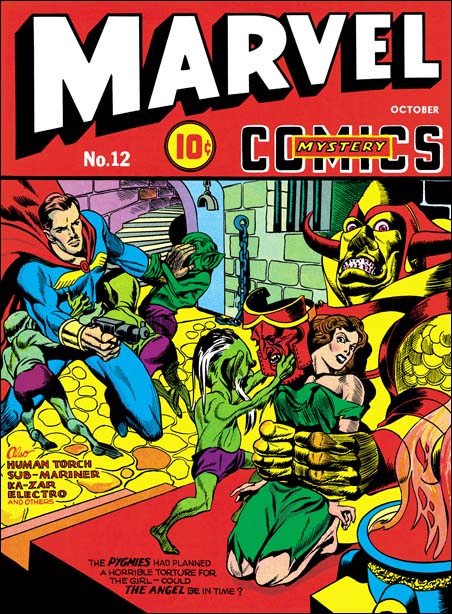
Marvel Mystery #12 (October 1940), pencils and lettering by Jack Kirby, inking by Joe Simon
In October Simon and Kirby also provided the cover art for Marvel Mystery #12. Featured on it was the Angel. It would be the last appearance of the Angel on a cover of Marvel Mystery Comics as the Human Torch or the Sub-Mariner would dominate all future covers. Kirby did the pencils for MM #12 with Simon adding the inks. The lettering on the cover was done by Kirby (note the horseshoe shaped ‘U’). More time and energy was expended on covers as compared to lettering the story. So it is not surprising that Kirby, who like Simon was normally a rather unprofessional letterer, could provide a real nice job lettering the cover.
At this point I am reminded of a passage from the Sherlock Holmes story “Silver Blaze”:
“Is there any point to which you would wish to draw my attention?”
“To the curious incident of the dog in the night-time.”
“The dog did nothing in the night-time.”
“That was the curious incident,” remarked Sherlock Holmes.
I too have a “curious incident” to draw attention to. While Simon and Kirby created a number of pages for Timely comics for August and September the MM #12 cover was the only art they provided for October. Now I have to admit there was one Fiery Mask story that could have been done at this time period but I have good reason to assign that work to November and will cover it in the next chapter. But even if it was done in October it was drawn and inked by Simon, what happened to Kirby? One possible explanation was there was such art but it was created for Red Raven #2 which should have appeared in October. However the Red Raven title was abruptly cancelled well before any indication of how well Red Raven #1 sold. Timely owner Goodman apparently had come to realize the popularity of the Human Torch and the Sub-Mariner and decided to launch titles dedicated to them. Licensing fees could be saved by canceling Red Raven Comics and using that license for the Human Torch Comics which is why that new title started with issue number 2. There is also another explanation for this deficit of Kirby art but that will also be discussed in the next chapter of “In the Beginning”.
Posted in 2011/10, 3 Timely, Artists, Assorted, Kirby, Jack, Lettering, Periods, Serial Posts, Start of S&K, Topic, z Archive
Leave a comment
In the Beginning, Chapter 6, Blue Bolt #4

Blue Bolt #4 (September 1940), pencils by Jack Kirby, inking by Joe Simon
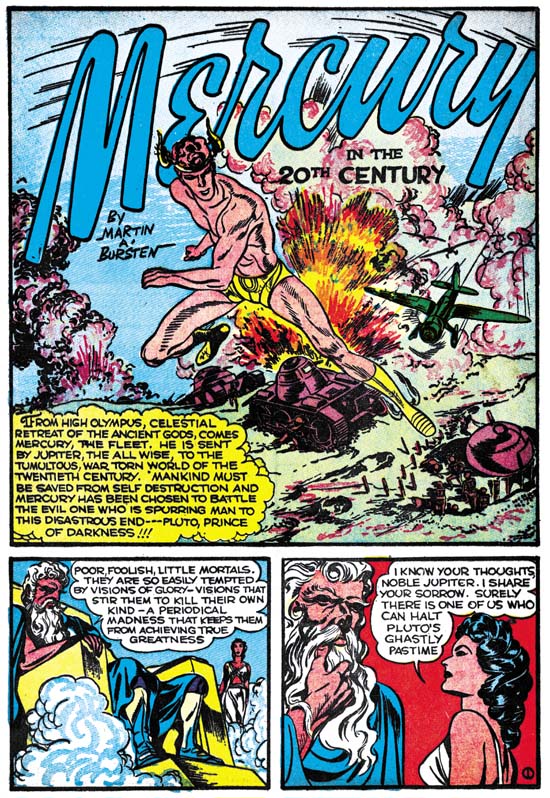
Blue Bolt #4 was the first story created in the definitive Simon and Kirby manner with all the pencils done by Jack and the inking by Joe. While previous Blue Bolt installments were quite nice, it is with BB #4 that the Simon and Kirby magic really unfolds. Exciting visuals, unusual perspectives and a great story. Both Joe and Jack had done their own individual work before this but it lacked the special qualities found in BB #4. Even the work they had done together in Blue Bolt #2 and #3 or Daring Mystery #6 is not quite as good. Only Kirby’s “Mercury in the 20th Century” for Red Raven #1 matches BB #4. The Blue Bolt story may have been signed by Joe Simon alone, but it was certainly a Simon and Kirby creation.
The Kirby Checklist states that Simon got assists in the inking from Avison and Gabriele. While I cannot prove this to be incorrect I also cannot find any evidence of it. The inking looks like the hand of one artist and that was Simon. Joe had made great strides in his inking and much of that can probably be credited to his working with Jack. In fact the inking of the robot and some of the other devices was done in the manner that Kirby had already been doing for his science fiction stories. While Kirby was and would remain a better inker, Simon’s inking talent far exceeded the abilities at that time of Avison or Gabriele.
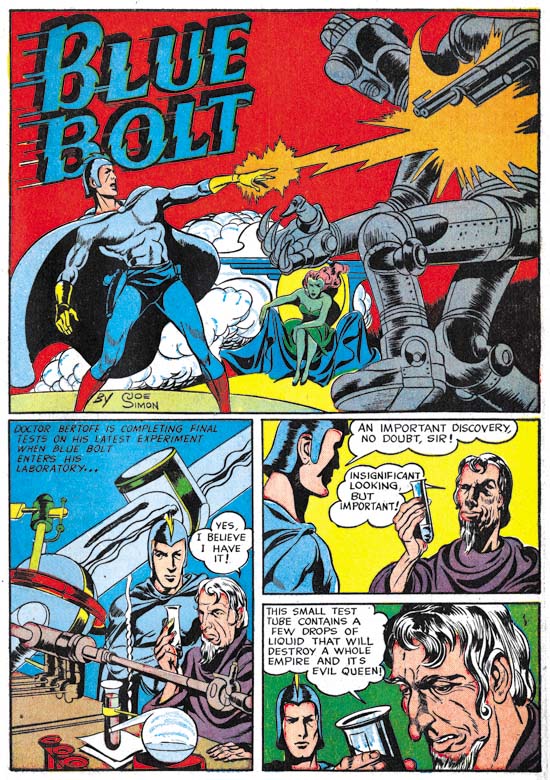
One of the star attractions of the Blue Bolt #4 story was the formidable robot. The splash panel shows a exciting confrontation between Blue Bolt and the mechanical foe. The story takes a different, but still dramatic, turn. The robot’s murderous rampage is handled with what would be typical Simon and Kirby restraint. A restraint that would not diminish but actually enhance the effect. Close-ups, silhouettes and shadows would provide the substance while leaving it to the reader’s imagination to fill in the rest.

Marvel Stories v2 n2 (November 1940) “A Dictator for all Time”, art by Jack Kirby
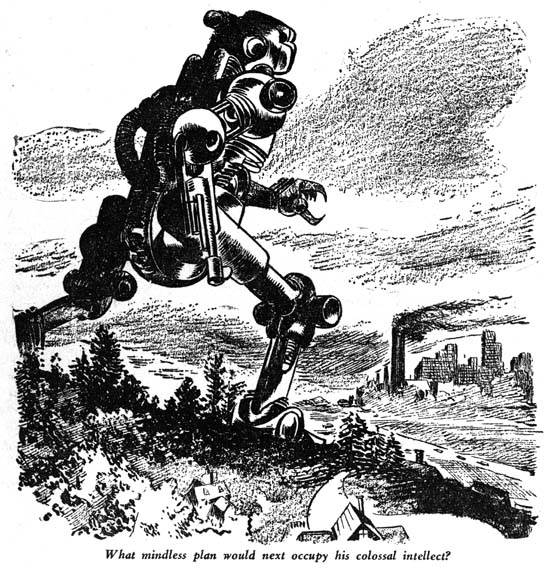
Both Simon and Kirby would do more than just comic books while working at Timely. They would also supply art for some of the pulps that the company produced. The pulp art was created under different circumstances and with unique techniques. As far as I can tell illustrations were not joint efforts but were individually executed instead. The pencils and inks that were used to create comic book art were replaced with the use of a special textured paper that would translate pencils into dots suitable for printing. While the pulp art may not shed much light on the beginnings of the Simon and Kirby partnership they sometimes are not completely independent of the comic book art. The horrific robot from Blue Bolt #4 makes a reappearance in Marvel Stories volume 2 number 2 a couple of months later. The details may differ but both share one clawed hand with the other arm transformed into a gun. While the robot drawn for the pulp story “A Dictator for all Time” might have been impressive it really had nothing to do with the story. There we find a rather benign machine more of an immense computer than a terrifying weapon.

Blue Bolt #4 (September 1940), letters by unidentified letterer
Another unidentified letter was used for Blue Bolt #4. This letter differed from the one used for BB #3 in the form of the letters used for ‘G’, ‘J’, ‘K’, ‘M’ and ‘W’. It may seem surprising that so many different letterers would work on Blue Bolt but Joe’s position as editor for first Fox then Timely probably provided a lot of resources to turn to. The letterer for Blue Bolt #4 did the most professional work to appear in Blue Bolt to date. One of his interesting contributions was to do caption lettering with a slight slant upward to the right while keeping balloon text as vertical.

Marvel Mystery #11 (September 1940) “The Human Torch”, letters by Howard Ferguson
The letterer for BB #4 used some larger and specially formed first letters in the captions. A similar approach was used by Howard Ferguson at this time but his first caption letters are even more special. While the BB #4 letterer provided one of this first caption letter with a 3-D effect shadow he never provides the sort of abstract black shapes that Ferguson used. The difference between the two letterers also shows up in their letters ‘G’ and ‘J’.

Blue Bolt #4 (September 1940), page 9 letters by unidentified letterer
Actually not all of Blue Bolt #4 was lettered by the individual discussed above. One page, page 9, was lettered by yet another artist. This page lacks the slanted lettering to the captions as well as any special effects to the first caption letter. The letters ‘G’ and ‘Y’ are distinct between the two. The second letterer also had a tendency to fail to properly connect the lines in ‘B’ and ‘R’ as shown in the bottom line of lettering examples above. His letter ‘S’ is somewhat variable but often has a bottom that is proportionally larger than the top.
As if it was not enough that there were two letterers to work on Blue Bolt #4, one caption (panel 6 on page 9) was lettered by Joe Simon. It has his very distinctive ‘W’ and recognizable ‘M’.
When Simon and Kirby first started working together for story art it was Jack helping out on a few pages for Blue Bolt #2 (July 1940) and #3 (August 1940). In August and September work was also done for Timely. Some of this later work (Blue Bolt #4) was done in what would be the classic Simon and Kirby manner, that is Jack providing the pencils with Joe doing the inking. But other work seems to have been mostly done by Kirby with little, if any, help from Simon (“Cosmic Carson”, Red Raven #1). Other distribution of working efforts were also done. Even greater variation is found in the lettering. Sometimes Simon or Kirby would do the lettering. Otherwise a number of different letterers were employed. Some more professional than others. One of these was Howard Ferguson who in the future would play an important roll as the definitive Simon and Kirby letterer. However initially Ferguson did more lettering for features not created by Simon and Kirby. What we have seen so far is not the sudden teaming up of Simon and Kirby but rather Joe putting together comic books using a variety of resources in a variety of ways.
Posted in 2011/10, 3 Timely, Artists, Assorted, Kirby, Jack, Lettering, Periods, Serial Posts, Simon, Joe, Start of S&K, Topic, z Archive
Tagged howard ferguson, Jack Kirby, Joe Simon
Leave a comment