
Please donate!
The Jack Kirby Museum is raising funds to open a "Pop-Up" Museum on the Lower East Side, near where Kirby was born and raised. Learn more here.About this Blog:
© 2006, 2007, 2008, 2009, 2010 & 2011 Harry Mendryk. Unless otherwise marked, all images are my own restorations. Further some of the images have copyrights by Joe Simon and Jack Kirby or Joe Simon alone. I am fortunate that Joe Simon has allowed me to also include some previously unpublished material. Please do not copy from this blog without permission.Pages
Categories
- 9/11 (6)
- Artists (268)
- Albistur, Jo (7)
- Avison, Al (8)
- Belfi, John (4)
- Breifer, Dick (9)
- Brewster, Ann (7)
- Burgos, Carl (1)
- Ditko, Steve (2)
- Donahue, Vic (12)
- Draut, Bill (50)
- Eadeh, Al (16)
- Gregg, George (5)
- Infantino, Carmine (6)
- Kirby, Jack (157)
- McCarty, Bob (9)
- Meskin, Mort (69)
- Morrow, Gray (1)
- Oda, Ben (1)
- Oleck, Jack (2)
- Powell, Bob (1)
- Premiani, Bruno (9)
- Prentice, John (29)
- Riley, Ken (2)
- Robinson, Jerry (10)
- Severin, John (7)
- Simon, Joe (57)
- Stallman, Manny (7)
- Starr, Leonard (13)
- Stein, Marvin (20)
- Walton, Bill (5)
- Checklist (19)
- Albistur, Joe (1)
- Brewster, Ann (1)
- Briefer, Dick (1)
- Donahue, Vic (1)
- Draut, Bill (1)
- Eadeh (1)
- Gregg, George (1)
- Infantino, Carmine (1)
- Kirby, Jack (1)
- McCarty, Bob (1)
- Premiani?, Bruno (1)
- Prentice, John (1)
- Riley, Ken (1)
- Robinson & Meskin (1)
- Severin, John (1)
- Simon, Joe (1)
- Stallman, Manny (1)
- Starr, Leonard (1)
- Stein, Marvin (1)
- Comic Checklists (20)
- All For Love (1)
- Black Magic, DC (1)
- Black Magic, Prize (1)
- Boys' Ranch (1)
- Charlie Chan (1)
- Clue (1)
- Fighting American (1)
- Foxhole (1)
- Headline (1)
- In Love (1)
- Justice Traps the Guilty (1)
- My Date (1)
- Personal Love (1)
- Prize Comics Western (1)
- Real West Romance (1)
- Western Love (1)
- Young Brides (1)
- Young Love (1)
- Young Romance (1)
- Your Dreams (1)
- Ink Checklist (1)
- Kirby, Jack (1)
- Periods (396)
- 1 Early (22)
- 2 Fox (14)
- 3 Timely (44)
- 4 DC (early) (46)
- 5 Studio (135)
- 6 Mainline (68)
- Assorted (10)
- Bullseye (8)
- Fighting American (6)
- Foxhole (13)
- In Love (16)
- Police Trap (7)
- Prize (15)
- 7 Freelance (74)
- Archie (13)
- Atlas Kirby (14)
- DC Kirby (4)
- Harvey (27)
- Prize (17)
- 8 Marvel (12)
- Assorted (6)
- Marvel Kirby (6)
- 9 DC (late) (6)
- Late (3)
- Serial Posts (139)
- Art of J. Simon (1)
- Art of Romance (41)
- Criminal Artists (4)
- Early Jack Kirby (9)
- End of S & K (1)
- Harvey Horror (3)
- It's a Crime (1)
- Kirby Austere Inking (1)
- Kirby Inkers (4)
- Little Shop of Horrors (1)
- Margin Notes (5)
- Replacing S&K (4)
- S&K Colorists (3)
- Start of S&K (12)
- Wide Angle Scream (15)
- Topic (341)
- Alternate Takes (16)
- Anthologies (6)
- Art Editing (4)
- Best of Simon & Kirby (2)
- Captain America (5)
- Comicscope (3)
- Experts (3)
- Featured Work (64)
- First Romance (1)
- Ghosting (7)
- Harvey Covers (24)
- Kirby Inking Kirby (4)
- Kirby Krackle (3)
- Kirby Or Not (28)
- Lettering (13)
- My Two Cents (7)
- Odds & Ends (128)
- Publications (24)
- Quote (4)
- Restoration (3)
- Robots (3)
- S&K Superheroes (2)
- Swiping (8)
- Wertham & Censoring (5)
- Why Comics Declined (1)
- Uncategorized (51)
- z Archive (595)
- 2006/03 (16)
- 2006/04 (14)
- 2006/05 (15)
- 2006/06 (16)
- 2006/07 (10)
- 2006/08 (24)
- 2006/09 (11)
- 2006/10 (19)
- 2006/11 (20)
- 2006/12 (14)
- 2007/01 (16)
- 2007/02 (17)
- 2007/03 (14)
- 2007/04 (10)
- 2007/05 (12)
- 2007/06 (8)
- 2007/07 (7)
- 2007/08 (8)
- 2007/09 (6)
- 2007/10 (10)
- 2007/11 (7)
- 2007/12 (4)
- 2008/01 (4)
- 2008/02 (7)
- 2008/03 (12)
- 2008/04 (8)
- 2008/05 (8)
- 2008/06 (11)
- 2008/07 (6)
- 2008/08 (12)
- 2008/09 (7)
- 2008/10 (8)
- 2008/11 (4)
- 2008/12 (6)
- 2009/01 (10)
- 2009/02 (4)
- 2009/03 (5)
- 2009/04 (8)
- 2009/05 (6)
- 2009/06 (5)
- 2009/07 (8)
- 2009/08 (6)
- 2009/09 (5)
- 2009/10 (6)
- 2009/11 (4)
- 2009/12 (3)
- 2010/01 (6)
- 2010/02 (7)
- 2010/03 (7)
- 2010/04 (4)
- 2010/05 (7)
- 2010/06 (5)
- 2010/07 (8)
- 2010/08 (4)
- 2010/09 (6)
- 2010/10 (9)
- 2010/11 (5)
- 2010/12 (5)
- 2011/01 (4)
- 2011/02 (2)
- 2011/03 (5)
- 2011/04 (6)
- 2011/05 (3)
- 2011/06 (5)
- 2011/07 (7)
- 2011/08 (5)
- 2011/09 (4)
- 2011/10 (10)
- 2011/11 (6)
- 2011/12 (5)
- 2012/01 (3)
- 2012/02 (2)
- 2012/03 (8)
- 2012/04 (3)
- 2012/05 (2)
Comic related blogs
Groups (membership required)
Web pages
Category Archives: Hillman
Simon and Kirby Colorists, Chapter 1, Hillman
Generally little is known about the comic book colorists during the golden age. Credits usually were not provided and while pencilers and inkers would sometimes leave signatures there was no outlet for colorists to make their contribution known. Occasionally there is documentary evidence about particular colorists but largely they remain anonymous. None the less I have begun to investigate coloring done on Simon and Kirby productions. I may not be able to identify all the colorists but I am still interested in seeing what can be learned about the effect different colorists had upon the comics.
Currently I have been examining interior coloring. Covers were typically handled by different printers than the interior pages. The special paper and attention given to covers allowed the use of colors and tonal gradations that did not appear in the interior art. Both the cover and interior art was printed using cyan, magenta, yellow and black inks (CMYK). In general, CMYK printing allows a wide range of colors to be represented. Actually not every color can be created by combinations of the CMYK inks but those that cannot are a very small part of the color spectrum and are so close to colors that can be printed by CMYK that their absence is difficult to notice.
However the interior art in comic books was printed using a very limited palette. CMYK printing achieves color tones by the amount of area the ink covers. Typically, and this will be true of all the comics I will be discussing here, interior inks were limited to three tones 100%, 50% and 25%. It is possible to use 75% ink tones but printers find it difficult to do properly with the primitive presses and poor quality paper used for comic books. I have seen 75% tones used in comic books but it is quite rare and with a special exception to be discussed below it was not done in the books I will be discussing.
There are further limitations. No tones were used for the black ink. Actually this was not too limiting because black tones, that is the grays, can be achieved using combinations of CMY inks. Another limitation is that none of the comics I will be discussing use 50% yellow. I have seen it done elsewhere but again it is very rare. With three levels of cyan and magenta, two levels of yellow and one level of black it is possible to create at most 48 colors* (including white, the absence of any ink). The palette is actually even more limited in practice since about a dozen are rarely used. Most are combinations that include 25% yellow.

Generalized Comic Color Palette
C, C50, C25, CM50, CM25, X, X, X
M, M50, M25, MY, YM50, YM25, X, X
Y, Y25, M50Y25, M25Y25, X, MC50, MC25, M50C25
CY, YC50, YC25, CYM50, CYM25, CY25, C50Y25, C25Y25
CM, C50M50, C25M25, C50M25, C50M25Y25, C25M25Y25, X, X
MYC50, MYC25, YC50M50, YM50C25, YC25M25, YC50M25, X, X
Referring to colors as, for example, 100% yellow plus 50% magenta plus 25% cyan (brown), is somewhat tiring. The industry uses a designation which I find confusing so instead I will adopt my own using the first initial followed, if not 100%, by the percentage. So my brown example would be YM50C25. I always placed them in the order of dominance or (when two inks are equally strong) the order they are found in CMY. While this is an improvement it is still too difficult to use lists of such color designations when comparing palettes used. So I have also developed a matrix to show the color palettes. I show above the standard color palette that I will be using followed by the corresponding color designations (where an X indicates an unused matrix location shown as black). If a color is not used in a particular palette it will be ‘X’ out in the matrix. The first row is for blues; the second for reds; the third row for yellows, flesh colors and purples; the fourth row for greens; the fifth row for violets and grays; and the sixth for browns and one dirty green (YC50M25). In the future I will either use some of the currently undefined matrix locations or add additional rows for colors not included in the current matrix.
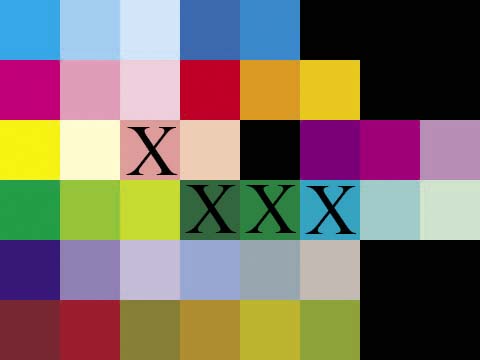
Color Palette used by Hillman in Clue and Real Clue Comics.
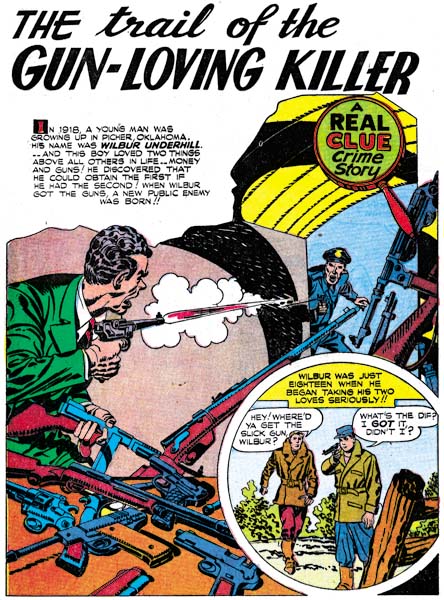
Joe Simon has said that the coloring was the responsibility of the publisher. There was a period (cover dates March to September 1947) where Simon and Kirby were producing work for crime comics from two different publishers; Clue Comics and Real Clue Crime Stories for Hillman and Headline Comics for Prize. It would therefore be interesting to compare the coloring between the two. The Simon and Kirby work produced for Clue and its renamed title Real Clue used a more complete palette than those for Headline. The Hillman work used 38 colors (excluding black and white). But this is a little misleading because some of the colors were rarely used; deep blue (CM50), some of the purple tints (MC25 and M50C25), and red brown (MYC25).
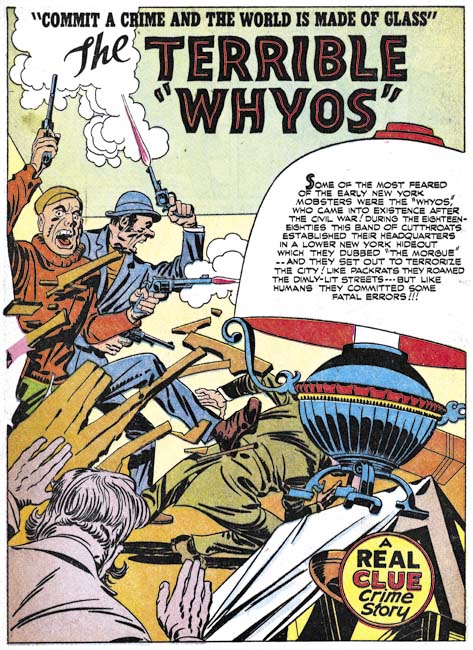
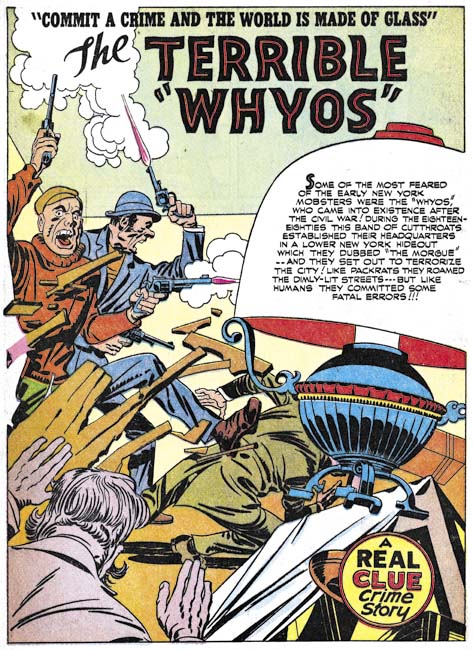
Real Clue Crime Stories v.2 n.5 (July 1947) “The Terrible Whyos”, pencils and inks by Jack Kirby
Perhaps the most distinctive feature of the Hillman palette was the common use of light yellow (Y25). We will see that this color was not used in Prize’s Headline Comics. Considering how most colors that include Y25 are avoided, it is surprising how often light yellow (Y25) was used. In one case Y25 was used for an automobile but it seems a poor choice for coloring prominent objects. However light yellow was generally used for background areas and it was surprisingly effective in making accompanying white areas stand out.
As mentioned previously, red brown (MYC25) was rarely employed but the other browns (dark MYC50, heavy YC50M50, medium YM50C25 and light YC25M25) were more frequently used. However not equally so as light brown (YC25M25) was not used nearly as commonly as the other three browns. Another not so frequently used color was dirty green (YC50M25).
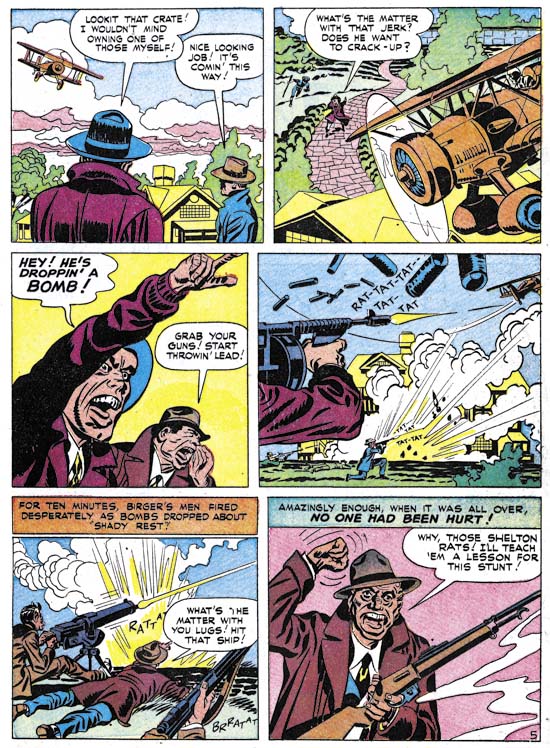
Real Clue Crime Stories v.2 n.7 (September 1947) “Gang War” page 5, pencils by Jack Kirby
Besides light yellow (Y25) the only other unusual colors with frequent use from the Hillman palette are pale green (C25Y25) and dark grey (C50M25Y25). Frankly with the very limited palette available for comic books the presence or absents of particular colors are of limited use in distinguishing different colorists. Also of use is how the artists uses the colors for the different objects. For instance the Hillman colorist generally uses middle green (YC50) for foliage and only much more rarely green (CY) or pale green (C25Y25). Police uniforms are dark blue (CM25) with brown shoes or boots. Caption boxes were colored with a variety of light colors; yellow (Y), light yellow (Y25), pale green (C25Y25), light orange (YM25) and even white. Desks and chairs are usual have a single color; generally dark brown (YMC50), heavy brown (YC50M50) or light brown (YM50C25).
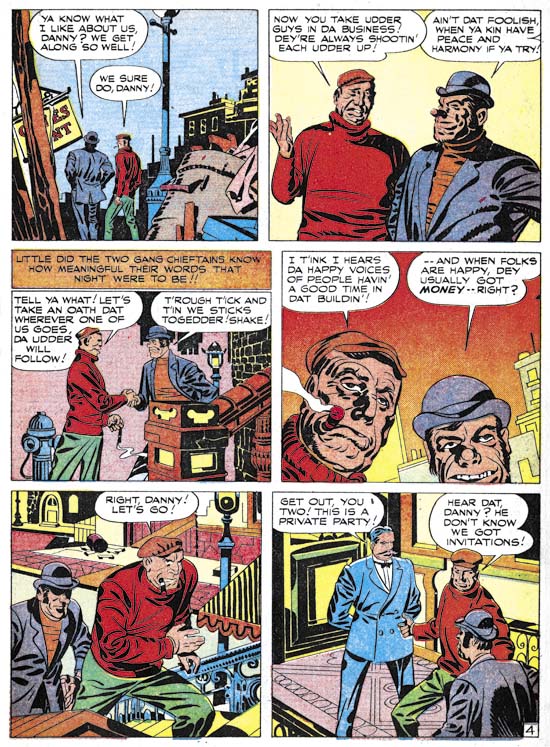
Real Clue Crime Stories v.2 n.5 (July 1947) “The Terrible Whyos” page 4, pencils and inks by Jack Kirby
Most golden age colorists were more concerned with providing clarity to a scene by providing the different objects with distinct colors. Realistic coloring was not a high priority. So with the Hillman colorist we get such oddities as multi-color sidewalks, pale green buildings and some really bizarre interiors. Not very realistic, but all more interesting than if a more realistic, and therefore more limited, selection of colors were used.
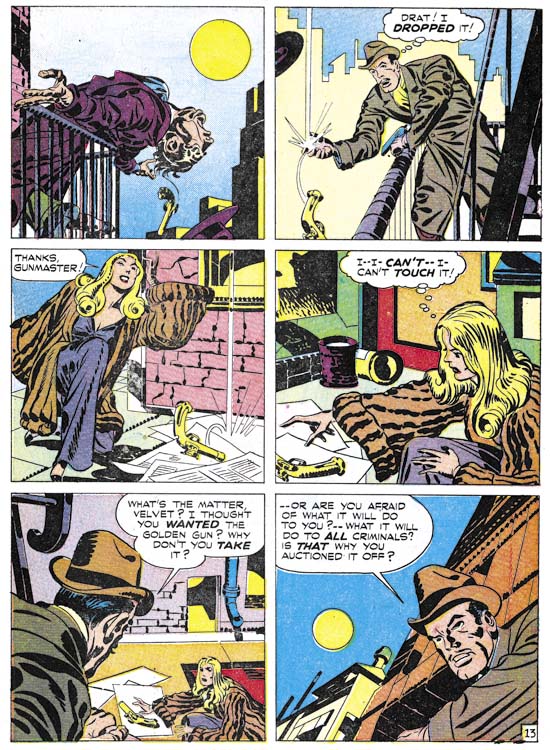
Real Clue Crime Stories v.2 n.6 August 1947) “Get Me the Golden Gun” page 13, pencils and inks by Jack Kirby
As previously mentioned, golden age colorists did not generally use graduated color tones for interior art. That is colors were restricted to mixtures of 100%, %50 or %25 of the cyan, magenta or yellow inks. But there was an exception to this rule and that was the use of simple color gradient usually to the background. The Hillman colorist made use of this varying a one ink of a color from 75% to 25%. Usually this was done rather smoothly but occasionally less care was taken. This was the sole exception that the Hillman colorist made to not using a 75% ink. The use of a starting value of 75% was not a whim. With the primitive presses used for comic books, 75% would sometimes fill in and become effectively 100%. If this happened to a gradient that started at 100% then a poor gradient would result with over much of it a pure color. With gradients starting at 75% any similar filling in would still provide a suitable gradient.
Although I have concentrated on the coloring of the Simon and Kirby pieces, the same colorists seemed to work on the stories drawn by other artists as well. The pencilers and inkers for Clue and Real Clue were used in other Hillman comics and were not the same ones that Simon and Kirby used for Prize’s Headline Comics. I therefore believe that Simon and Kirby were just supplying art to Hillman and not producing the entire comic as they were doing for Prize. I will compare the Hillman colorist to that used for Prize’s Headline Comic next week.
footnotes
* the complete comic color palette for three levels of cyan and magenta, two of yellow and a single of black. Those marked with asterisk are not shown in my standard comic palette:
K CMY25* CM
C50MY C50MY25* C50M
C25MY C25MY25* C25M
MY MY25* M
CM50Y CM50Y25* CM50
C50M50Y C50M50Y25* C50M50
C25M50Y C25M50Y25* C25M50
M50Y M50Y25* M50
CM25Y CM25Y25* CM25
C50M25Y C50M25Y25 C50M25
C25M25Y C25M25Y25 C25M25
M25Y M25Y25 M25
CY CY25* C
C50Y C50Y25 C50
C25Y C25Y25 C25
Y Y25 W
Posted in 2011/03, 5 Studio, Hillman, Periods, S&K Colorists, Serial Posts, z Archive
Tagged comic book colorists, simon and kirby
1 Comment
The Gangs of New York
Simon and Kirby crime tales, at least the earlier ones, were based on true stories. In a recent post I wrote about Simon and Kirby’s “Let Me Plan Your Murder” and the serial killer H. H. Holmes on which the story was based. I noted differences between the story which Joe and Jack presented and the facts that can be found on the Internet. These differences could be explained either as “poetic license” or inaccurate sources. Unfortunately there is no way to decide between the two explanations without knowing the actual sources used by Simon and Kirby. I remember reading somewhere (but regrettably I am not sure where) that one of the books Simon and Kirby used was “The Gangs of New York” by Herbert Asbury (1928). The book covers New York’s criminal elements from 19th to the early 20th centuries. Apparently this book was quite popular as there were four printings in the first year alone.

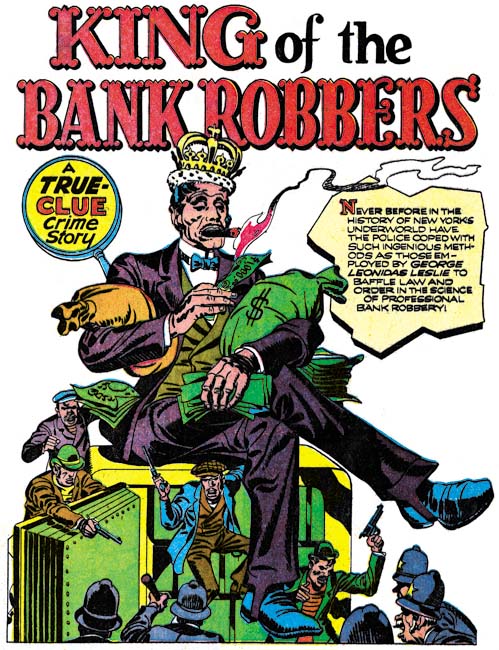
Clue Comics vol. 2 no. 1 (March 1947) “King of the Bank Robbers”, pencils by Jack Kirby
One of Simon and Kirby’s first entries in the crime genre was “King of the Bank Robbers” which was about George Leonidas Leslie. The same title was used for Chapter 10 of Asbury’s TGoNY. Asbury’s presentation pretty much matches the story depicted by Simon and Kirby. The main difference between the two takes is that Asbury went into more details than Simon and Kirby. However Joe and Jack embellished the facts to make it more of a story.

Real Clue Crime Stories vol. 2 no. 5 (July 1947) “The Terrible Whyos”, pencils and inks by Jack Kirby
Another example of a story taken from TGoNY was “The Terrible Whyos”. Without Asbury’s book a reader might doubt the accuracy of some of the things presented by Simon and Kirby. For instance in the story of perspective new member to the gang being rejected because he had not killed anyone. This might seem like an exaggeration but according to Asbury:
It has been said that during their period of greatest renown the captains of the Whyos would accept no man as a member until he had committed a murder, or at least had man an honest effort to thus enroll himself among the aristocracy of the underworld.
At one point Pike Ryan presents a poster showing the business rates, that is what to charge for commissioned crime ranging from blackening eyes to “da big sleep”. In the book Ashbury describes how when arrested Pike Ryan was found to have just a list and while the wording is not identical the rates were just as Simon and Kirby provided.

Real Clue Crime Stories vol. 2 no. 4 (June 1947) “Dandy Johnny Dolan”, art by unidentified artist
Simon and Kirby where not the only ones making use of Ashbury’s TGoNY. “Dandy Johnny Dolan” had no involvement from Simon and Kirby. While it just does not have the Simon and Kirby magic touch, it still is a rather nicely written and drawn story. But once again the events found in the story match what Ashbury presents in TGoNY, particularly how a cane Dolan took off one of his victims lead to being arrested for the crime.
All the comic book artists that used “The Gangs of New York” took liberties with the facts presented by Ashbury. In some case just to make a better story but in other cases because the true facts might be a little bit too much even in those pre-Comic Code days. Simon and Kirby might present some woman as a gangster’s girl friend but in reality she might have been a prostitute (and the criminal a pimp).
Even today “The Gangs of New York” is an enjoyable read. I understand it was reprinted about the same time as the movie of the same name came out. Ashbury does have a peculiar take on gangsters. As he tells it the gangs were all a thing of the past:
for there are now no gangs in New York, and no gangsters in the sense that the word has come into common use
It is hard to understand what Ashbury’s use of the word gangsters was if it excluded organized crime of his day. “The Gangs of New York” was published in 1927 about eight years after prohibition came into effect with the Eighteenth Amendment of the Constitution. Trade in illegal booze provided an abundant criminal income which propelled organized crime to great strength. Ashbury may have been blind to the new gangster, but the crime comics, including Simon and Kirby, were not.
Posted in 2010/12, 5 Studio, Artists, Hillman, Kirby, Jack, Odds & Ends, Periods, Prize, Topic, z Archive
Tagged Jack Kirby, the gangs of new york
Leave a comment
Simon and Kirby and Their True Stories

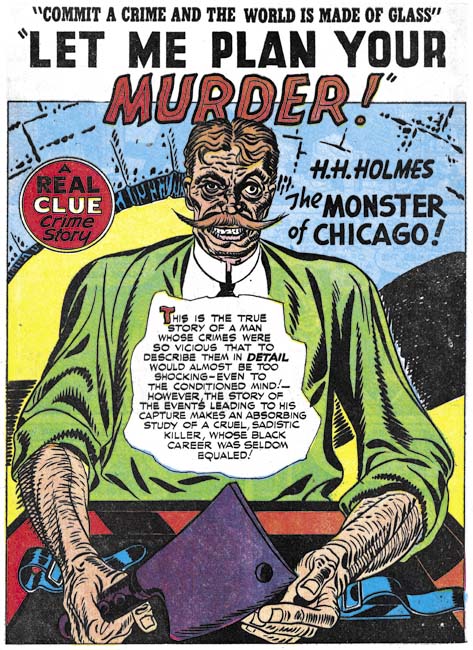
Real Clue Crime Stories v. 2 n 6 (August 1947) “Let Me Plan Your Murder” pencils by Jack Kirby
During Joe Simon’s deposition given in DC versus Fawcett he described the work that they were presently doing as being based on true stories. At that time (1948) Simon and Kirby were producing crime and romance comics. It is hard to say how true their romance stories were but they did run advertisements offering to pay for reader submitted stories. While romance did not usually make the newspapers, crime certainly did. Therefore it is possible to compare what Joe and Jack created with historical facts.
I plan to research a number of crime stories but here I will start with “Let Me Plan Your Murder, H. H. Holmes the Monster of Chicago”. There really was a murderer with the name Henry H. Holmes, or rather that was the name he was using when finally captured (his original name was Herman W. Mudgett). Holmes was a famous serial killer whose exploits can be found in great detail on the Internet (The Murder Castle of H. H. Holmes, The Master of the Murder Castle, and Wikipedia’s H. H. Holmes to mention just a few). There is no definitive count of the number of Holmes’ victims. The best estimates are in the range of 20 to 200. I will return to this issue below.
I will not summarize what is known about Henry Holmes as it is covered in detail in the links I supplied above. There is a lot to his story, much too much to cover in seven pages of a comic book. So it is not surprising that that much was left out in the story that Simon and Kirby told. But the question that interests me is how accurate were Joe and Jack for what they did tell? To start with how accurate was their portrayal of Holmes himself. The most prominent feature that Holmes’ possessed was his moustache. Kirby drew a distinctive moustache but that went out and slightly up while the real Holmes had a moustache that went down at the ends.
The story produced by Simon and Kirby have seven essential facts:
- Holmes constructed his castle with frequent firing of the workers so that no one would understand the true nature of what he was building.
This is an accurate description of how Holmes’ constructed his castle. Frequent dismissal of the work crews not only hid what he was doing but Holmes would also refuse to pay them. Holmes may have built his elaborate building without spending any of his own money!
- Numerous visitors to Chicago mysteriously disappeared.
Holmes operated his castle during the Chicago World’s Fair. He would rent out rooms to visitors. Apparently many visitors to the Fair never returned home. Did they stay at Holmes’ castle and become his victims or did they just go on to a new life and never return home? I cannot imagine that such a question could not be answered today but in 1892 they were left with only suspicions.
- Holmes concocted an insurance fraud with Howard Pietzel but instead of substituting the body of some victim actually kills Pietzel.
This is correct. Left out of Simon and Kirby’s account was the story of Pietzel’s wife and children. Holmes somehow convinced Mrs. Pietzel to give him custody of three of her five children. Holmes would end up killing the three children and there are suggestions that was to be the fate of Mrs. Pietzel as well.
- The cellar to Holmes’ castle was uncovered during the construction of a tunnel.
Simon and Kirby present this as an accident that started the unraveling of Holmes’ killing spree. Actually the tunneling was done after Holmes was apprehended and was done from the castle’s cellar. A large metal tank was found which when opened produced a horrendous stench. Despite the odor someone lit a match to see what was inside. The result was an explosion that fortunately left the workers without serious injury but any evidence of what the tank was used for was destroyed.
- Police investigated the Pietzel case for proof of Holmes’ criminal doings.
The tunnel was not what brought Holmes to justice what did that was fallout from the Pietzel insurance scheme. Holmes offered another criminal Marion Hedgepeth, a fee for the name of a lawyer who could be trusted. The lawyer’s name was provided and the fraud executed but Hedgepeth never was given his finder’s fee. A bad move on Holmes part because in revenge Hedgepeth reported Holmes scheme to the police. A examination of Pietzel’s remains did show that he had been murdered.
- Holmes’ real name was Herman Mudgett.
Not much to say on this point as Simon and Kirby got it right.
- After conviction Holmes confessed his crimes.
His confessions were well publicized but apparently not specific enough to indicate how many people Holmes actually killed. Probably so many that Holmes lost track.
Simon and Kirby got six of the seven essential facts correct. The one thing they got wrong (Holmes’ cellar discovered during tunnel construction) was not completely made up but did not play the part Joe and Jack presented. I do not know what source Simon and Kirby used for the story. Was the source material inaccurate or did Joe and Jack make the change on purpose? Without know the source we simply cannot tell.
On a side note, Simon and Kirby present “Let Me Plan Your Murder” as if told to a researcher. The motif of using someone tell the story was commonly used by Joe and Jack. The researcher of this story looks very much like “Red Hot” Blaze who regularly played the story telling roll in the Headline Comics stories that Simon and Kirby were doing at the same time. It is quite likely that “Let Me Plan Your Murder” was originally meant for Prize’s Headline Comics but for some reason switched to Hillman’s Real Clue.
Posted in 2010/12, 5 Studio, Artists, Hillman, Kirby, Jack, Periods, z Archive
Tagged H. H. Holmes, Jack Kirby, real clue
Leave a comment
Crime’s Better Half

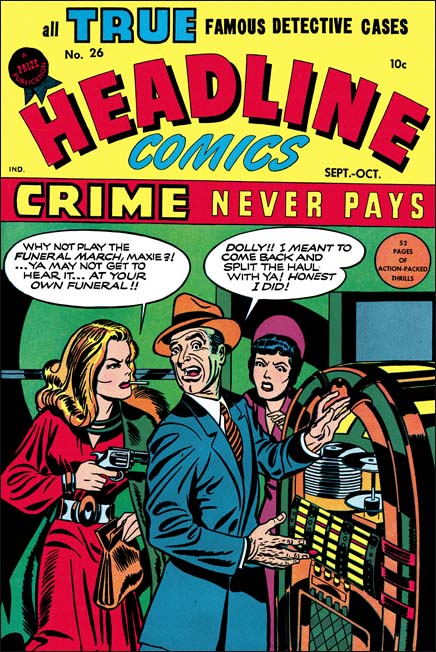
Headline #26 (September 1947), art by Jack Kirby
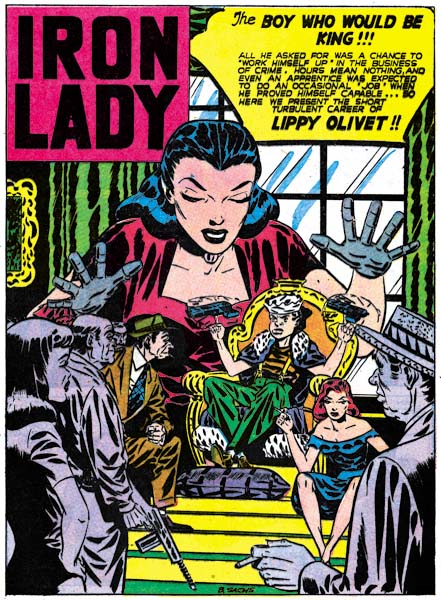
Simon and Kirby only worked in the crime genre during two periods. The first, and most extensive one, was from 1947 to about 1950 when the worked on Clue and Real Clue Comics for Hillman, as well as producing Headline and Justice Traps the Guilty for Prize. The second occasion was when they produced Police Trap for the own publishing company Mainline. Joe and Jack were always very creative and the crime genre gave them a wide range of subjects. They produced stories about gangsters, western outlaws, and other historical criminals. Another variation Simon and Kirby seemed fond of were women criminals. By no means were Joe and Jack the sole comic book creators that did work about crime by females (there even was a title Crimes By Women published by Fox). However like pretty much everything Simon and Kirby did, they created some very memorable work about women criminals.

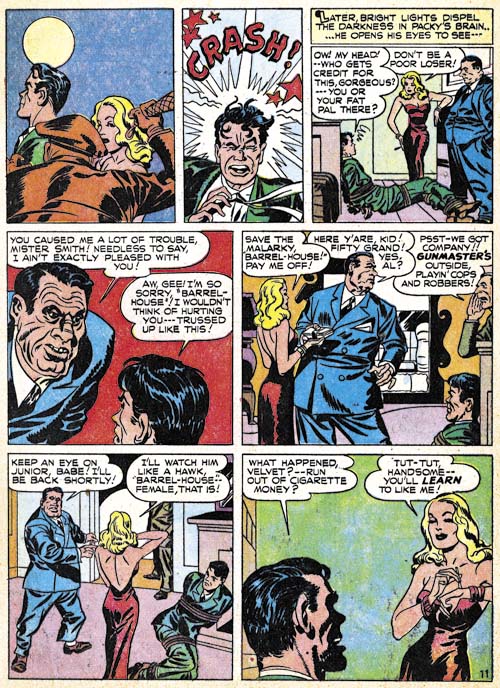
Clue Comics volume 2, number 3 (May 1947) “The Battle For Packy Smith” page 11, pencils by Jack Kirby
The first of Simon and Kirby’s beautiful villains was Velvet. She appeared in the second story about Packy Smith, a gentlemen highly sought after for the element X contained in his body. Packy was much very taken with the charming Velvet Silver, only to end up betrayed by her for the bounty that a crime lord had placed on his head. But once she was paid for her efforts, Velvet then proceeded to betray in turn the crime lord and freed Packy. Velvet may have been larcenous but she also had a heart of gold. A villain you cannot help but love.

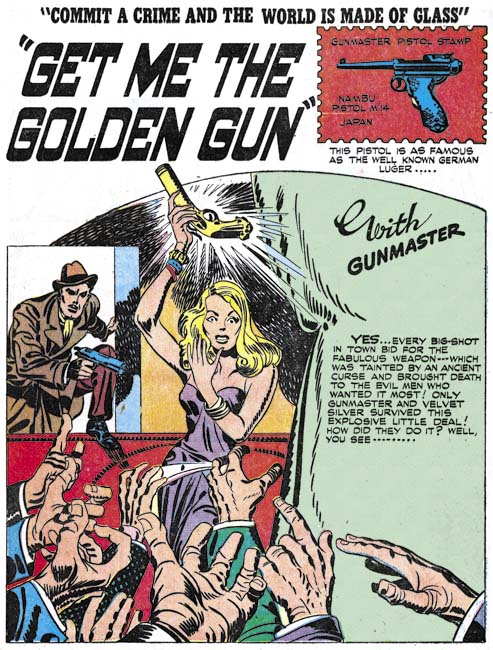
Real Clue Crime Stories volume 2 number 6 (August 1947) “Get Me the Golden Gun”, art by Jack Kirby
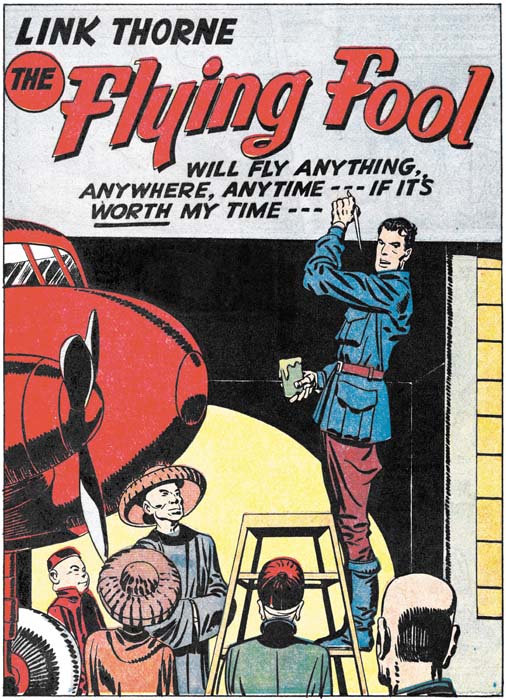
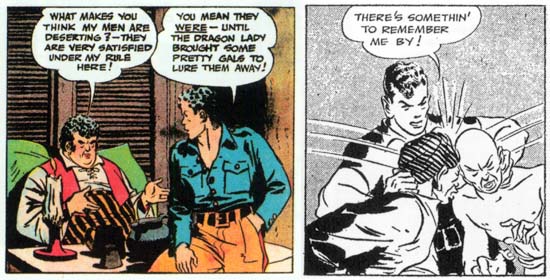
Packy never made a third appearance, but Velvet returned without Packy in “Get Me the Golden Gun”. It was the hero, Gunmaster, who now fell under her spell. While Packy had been a criminal himself, Gunmaster of course was not. So he found his attraction to Velvet to be very troublesome. While she was not quite so villainous as Velvet, Simon and Kirby developed a similar relationship between Riot O’Hara and Link Thorne in “The Flying Fool” (produced at the same time and for the same publisher Hillman).

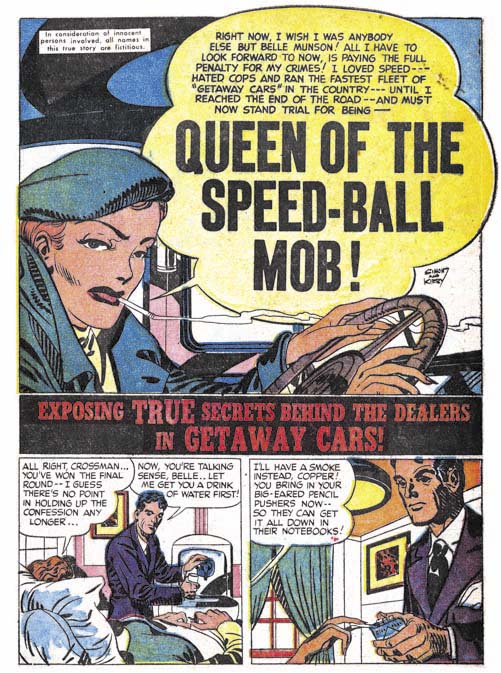
Justice Traps the Guilty #4 (May 1948) “Queen of the Speed-Ball Mob”, art by Jack Kirby
Gunmaster and Velvet were clearly meant to be fictional however the work Simon and Kirby produced for Prize were meant to be considered as true stories (or at least initially). So similar mismatched romance between a hero and a criminal were not repeated in Headline or Justice Traps the Guilty. Still women criminals played an important part of the Simon and Kirby repertoire for Prize. Often when the lead character was a female, Simon and Kirby would present the story as if it was told by the woman. Generally in such cases, the story would start with what I describe as a soliloquy splash. A splash were the main character introduces the story with their speech balloon forming the feature’s title. This device was common in Simon and Kirby romance publications but only seems to be used by Joe and Jack for the crime genre when the protagonist was a woman. Most likely this was because male criminals generally had a very bad ending while the woman repent and paid her debt to society. Apparently Simon and Kirby preferred not to kill or execute even villainous women but had no qualms about providing the male criminals with such fates. In all honesty this form of sexual discrimination is still very much prevalent today.

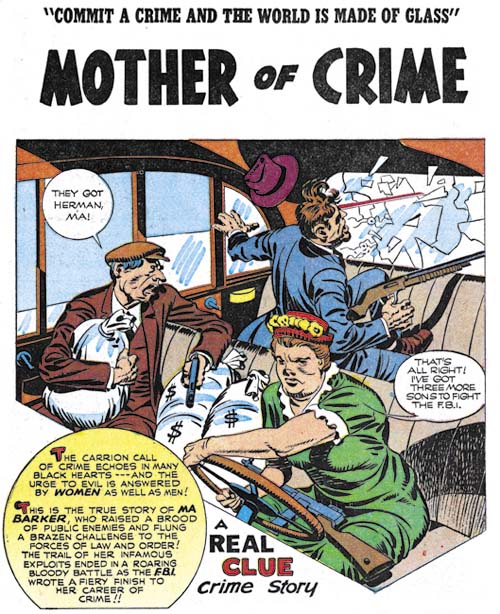
Real Clue Comics volume 2 number 4 (June 1947) “Mother Of Crime”, art by Jack Kirby
The Simon and Kirby rule was all female villains where young and beautiful and would in the end repent their life in crime. But of course every rule has exceptions. I doubt many would call Ma Barker either young or beautiful. Not only does she come to a bad end, she does not sound very repentful either. It is a marvelous story that fortunately was included in “The Best of Simon and Kirby”. If you have not bought the book yet, what are you waiting for?

Headline #25 (July 1947), pencils by Jack Kirby, inks by Joe Simon
Posted in 2010/11, 5 Studio, Artists, Hillman, Kirby, Jack, Odds & Ends, Periods, Prize, Topic, z Archive
Tagged Jack Kirby
2 Comments