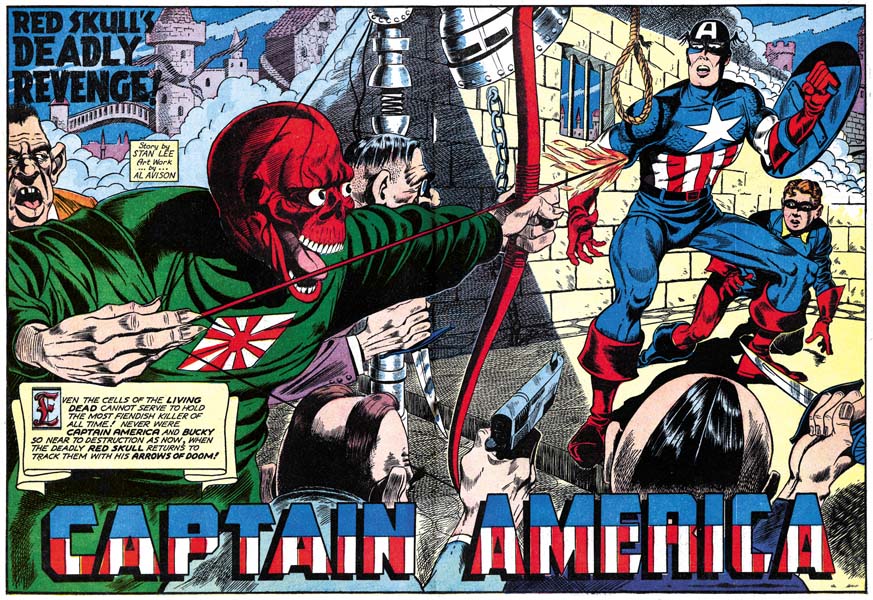
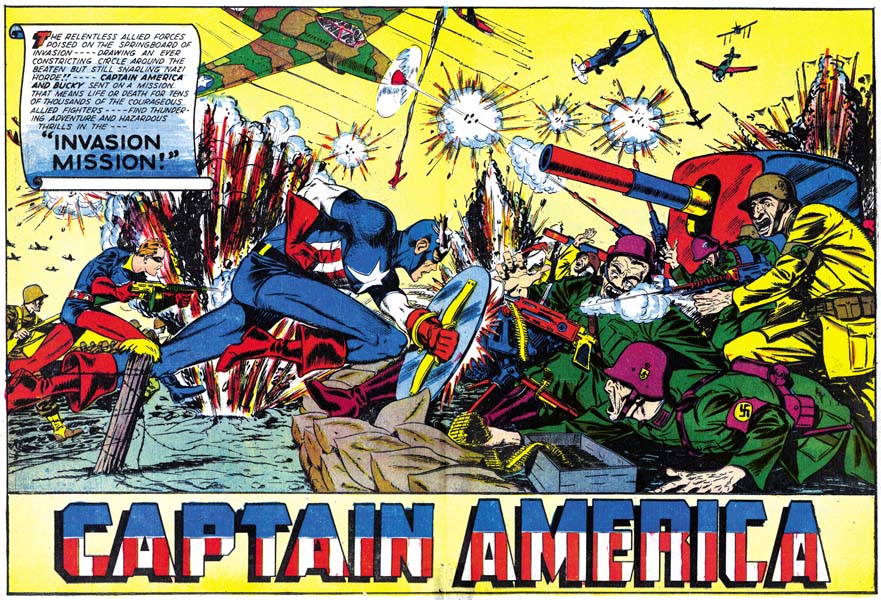
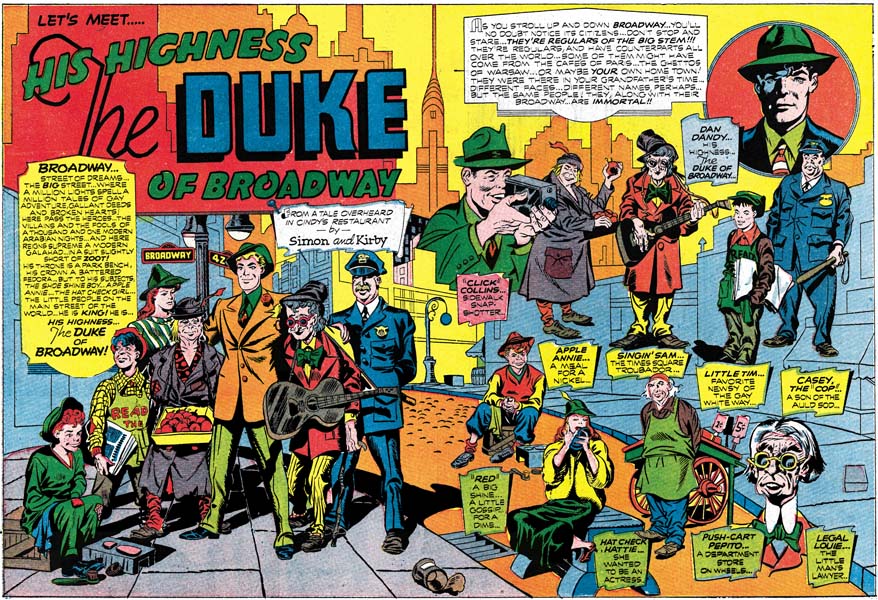
Please donate!
The Jack Kirby Museum is raising funds to open a "Pop-Up" Museum on the Lower East Side, near where Kirby was born and raised. Learn more here.About this Blog:
© 2006, 2007, 2008, 2009, 2010 & 2011 Harry Mendryk. Unless otherwise marked, all images are my own restorations. Further some of the images have copyrights by Joe Simon and Jack Kirby or Joe Simon alone. I am fortunate that Joe Simon has allowed me to also include some previously unpublished material. Please do not copy from this blog without permission.Pages
Categories
- 9/11 (6)
- Artists (268)
- Albistur, Jo (7)
- Avison, Al (8)
- Belfi, John (4)
- Breifer, Dick (9)
- Brewster, Ann (7)
- Burgos, Carl (1)
- Ditko, Steve (2)
- Donahue, Vic (12)
- Draut, Bill (50)
- Eadeh, Al (16)
- Gregg, George (5)
- Infantino, Carmine (6)
- Kirby, Jack (157)
- McCarty, Bob (9)
- Meskin, Mort (69)
- Morrow, Gray (1)
- Oda, Ben (1)
- Oleck, Jack (2)
- Powell, Bob (1)
- Premiani, Bruno (9)
- Prentice, John (29)
- Riley, Ken (2)
- Robinson, Jerry (10)
- Severin, John (7)
- Simon, Joe (57)
- Stallman, Manny (7)
- Starr, Leonard (13)
- Stein, Marvin (20)
- Walton, Bill (5)
- Checklist (19)
- Albistur, Joe (1)
- Brewster, Ann (1)
- Briefer, Dick (1)
- Donahue, Vic (1)
- Draut, Bill (1)
- Eadeh (1)
- Gregg, George (1)
- Infantino, Carmine (1)
- Kirby, Jack (1)
- McCarty, Bob (1)
- Premiani?, Bruno (1)
- Prentice, John (1)
- Riley, Ken (1)
- Robinson & Meskin (1)
- Severin, John (1)
- Simon, Joe (1)
- Stallman, Manny (1)
- Starr, Leonard (1)
- Stein, Marvin (1)
- Comic Checklists (20)
- All For Love (1)
- Black Magic, DC (1)
- Black Magic, Prize (1)
- Boys' Ranch (1)
- Charlie Chan (1)
- Clue (1)
- Fighting American (1)
- Foxhole (1)
- Headline (1)
- In Love (1)
- Justice Traps the Guilty (1)
- My Date (1)
- Personal Love (1)
- Prize Comics Western (1)
- Real West Romance (1)
- Western Love (1)
- Young Brides (1)
- Young Love (1)
- Young Romance (1)
- Your Dreams (1)
- Ink Checklist (1)
- Kirby, Jack (1)
- Periods (396)
- 1 Early (22)
- 2 Fox (14)
- 3 Timely (44)
- 4 DC (early) (46)
- 5 Studio (135)
- 6 Mainline (68)
- Assorted (10)
- Bullseye (8)
- Fighting American (6)
- Foxhole (13)
- In Love (16)
- Police Trap (7)
- Prize (15)
- 7 Freelance (74)
- Archie (13)
- Atlas Kirby (14)
- DC Kirby (4)
- Harvey (27)
- Prize (17)
- 8 Marvel (12)
- Assorted (6)
- Marvel Kirby (6)
- 9 DC (late) (6)
- Late (3)
- Serial Posts (139)
- Art of J. Simon (1)
- Art of Romance (41)
- Criminal Artists (4)
- Early Jack Kirby (9)
- End of S & K (1)
- Harvey Horror (3)
- It's a Crime (1)
- Kirby Austere Inking (1)
- Kirby Inkers (4)
- Little Shop of Horrors (1)
- Margin Notes (5)
- Replacing S&K (4)
- S&K Colorists (3)
- Start of S&K (12)
- Wide Angle Scream (15)
- Topic (341)
- Alternate Takes (16)
- Anthologies (6)
- Art Editing (4)
- Best of Simon & Kirby (2)
- Captain America (5)
- Comicscope (3)
- Experts (3)
- Featured Work (64)
- First Romance (1)
- Ghosting (7)
- Harvey Covers (24)
- Kirby Inking Kirby (4)
- Kirby Krackle (3)
- Kirby Or Not (28)
- Lettering (13)
- My Two Cents (7)
- Odds & Ends (128)
- Publications (24)
- Quote (4)
- Restoration (3)
- Robots (3)
- S&K Superheroes (2)
- Swiping (8)
- Wertham & Censoring (5)
- Why Comics Declined (1)
- Uncategorized (51)
- z Archive (595)
- 2006/03 (16)
- 2006/04 (14)
- 2006/05 (15)
- 2006/06 (16)
- 2006/07 (10)
- 2006/08 (24)
- 2006/09 (11)
- 2006/10 (19)
- 2006/11 (20)
- 2006/12 (14)
- 2007/01 (16)
- 2007/02 (17)
- 2007/03 (14)
- 2007/04 (10)
- 2007/05 (12)
- 2007/06 (8)
- 2007/07 (7)
- 2007/08 (8)
- 2007/09 (6)
- 2007/10 (10)
- 2007/11 (7)
- 2007/12 (4)
- 2008/01 (4)
- 2008/02 (7)
- 2008/03 (12)
- 2008/04 (8)
- 2008/05 (8)
- 2008/06 (11)
- 2008/07 (6)
- 2008/08 (12)
- 2008/09 (7)
- 2008/10 (8)
- 2008/11 (4)
- 2008/12 (6)
- 2009/01 (10)
- 2009/02 (4)
- 2009/03 (5)
- 2009/04 (8)
- 2009/05 (6)
- 2009/06 (5)
- 2009/07 (8)
- 2009/08 (6)
- 2009/09 (5)
- 2009/10 (6)
- 2009/11 (4)
- 2009/12 (3)
- 2010/01 (6)
- 2010/02 (7)
- 2010/03 (7)
- 2010/04 (4)
- 2010/05 (7)
- 2010/06 (5)
- 2010/07 (8)
- 2010/08 (4)
- 2010/09 (6)
- 2010/10 (9)
- 2010/11 (5)
- 2010/12 (5)
- 2011/01 (4)
- 2011/02 (2)
- 2011/03 (5)
- 2011/04 (6)
- 2011/05 (3)
- 2011/06 (5)
- 2011/07 (7)
- 2011/08 (5)
- 2011/09 (4)
- 2011/10 (10)
- 2011/11 (6)
- 2011/12 (5)
- 2012/01 (3)
- 2012/02 (2)
- 2012/03 (8)
- 2012/04 (3)
- 2012/05 (2)
Comic related blogs
Groups (membership required)
Web pages
Monthly Archives: February 2008
The Wide Angle Scream, The Pinup
Towards the end of 1950 Simon and Kirby had some hit titles all published by Prize. For the crime genre there were Headline and Justice Traps the Guilty. Having two titles in the same genre is always a sign of a success. More important would be the Young Romance and Young Love titles for the romance genre that Joe and Jack started. However Simon and Kirby were not ones to just sit back and milk past achievements, they were always trying to produce new titles. October of 1950 would see the release of two new S&K productions. For Prize again they would release their first in the horror genre, Black Magic. That title would run for about five years and would be joined in 1952 by Strange World of Your Dreams, again an indication of success. Simon and Kirby would also release in October Boys’ Ranch, only it would be published by Harvey Comics. Boys’ Ranch is considered by many fans as one of Simon and Kirby’s greatest creations. Unfortunately it was not so well received at the time and the title only lasted six issues.
Boys’ Ranch may not have been as big a success as Joe and Jack had hoped, but it was not for lack of trying. S&K used in Boys’ Ranch some things that they had never tried before, among which were pinups. I am not sure where the idea for the pinups came but Simon and Kirby put it to good use. Each issue of Boys’ Ranch contained both introductory and centerfold pinups. Pinups are unlike splash pages since without any attachment to a story a pinup can be a self sufficient entity. In this respect they are much more like cover art except the image need not be crowded by a prominent title. As stand-alone pieces of art, The Boys’ Ranch pinups represent some of the finest work that Simon and Kirby did. With the expanse that the double page provides, the centerfold pinups are particularly effective.

Boys’ Ranch #1 (October 1950) “Boys’ Ranch”, art by Jack Kirby
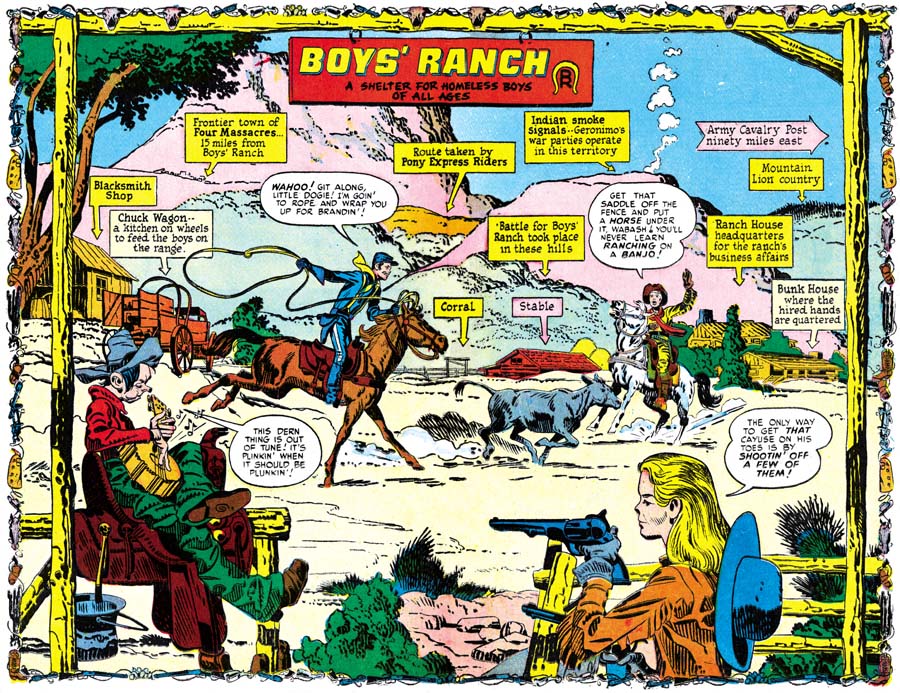
Larger image
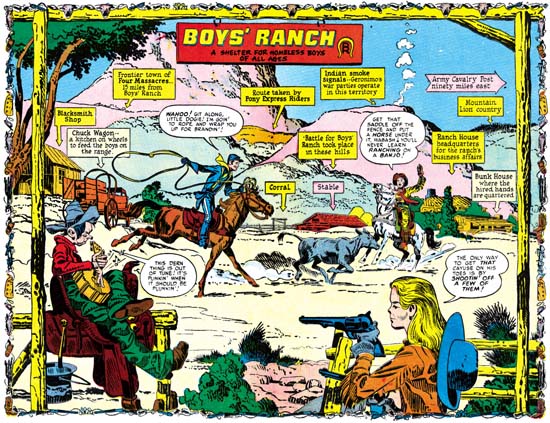
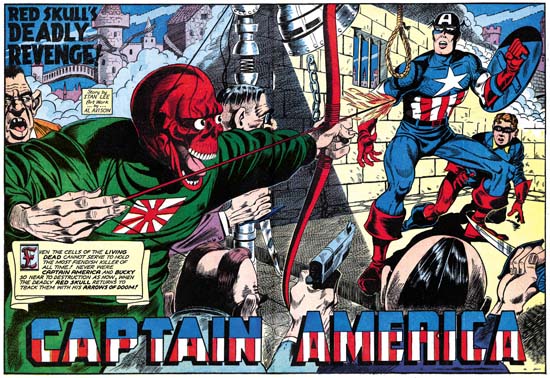
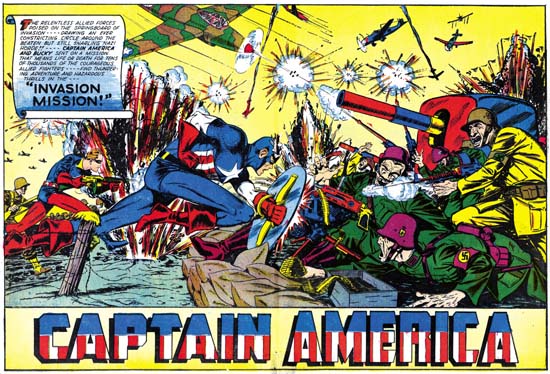
The centerfold for the first issue introduces the cast and the locale. We find Tommy learning how to lasso cattle while Wabash loafs with his guitar. Angel threatens to use his marksmanship to get Wabash moving. Three sides of the image are framed with rough timber with the title hanging from the top post. The complete circumference is edged with cattle skulls, pistols and other western paraphernalia reminiscent of the bottom edge of the wide splash from Captain America #8 (November 1941). This emphasis on design, unusual in the Boys’ Ranch splashes, does not save this particular centerfold. The more distant view used is not Jack Kirby’s forte for he generally does better when he thrusts his cast into the foreground. There are lots of assorted details provided, many requiring explanations from captions, but just not enough interest to hold our attention long. This is a rare example, in my opinion, of a Kirby double page piece of art that does not come up to his usual high standards.

Boys’ Ranch #2 (December 1950) “Four Massacres”, art by Jack Kirby
Larger image
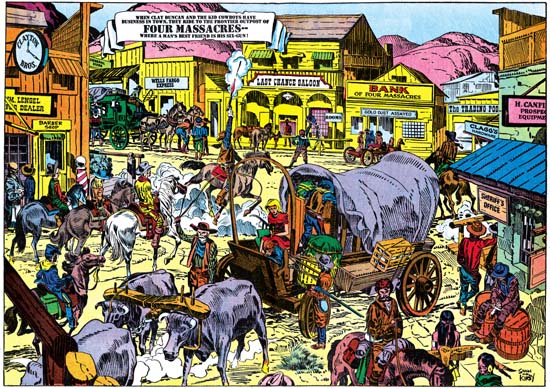
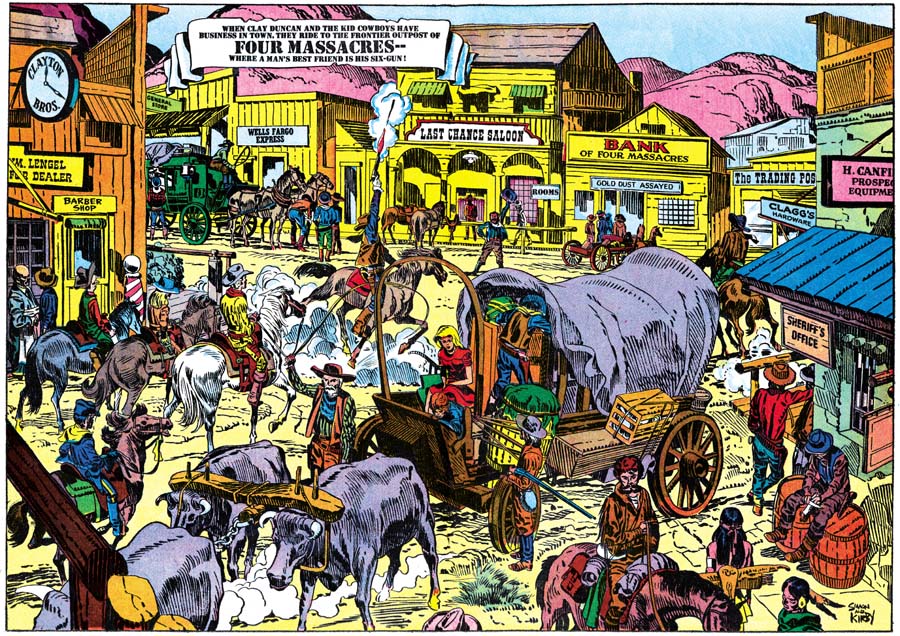
Another more distant view but this time Kirby makes it more interesting by providing more to look at. It is a crowded image but because this is in a comic book and a reader would tend to view it from left to right there should have been no difficulty in finding the Boys’ Ranch characters on the far left as they enter the town. I will leave it up to my readers to ferret out all the details. This splash is filled with individuals and groups all telling their own little stories, no need for captions to explain it all. Whatever the reasons for the short comings of the wide pinup from Boys’ Ranch #1, Jack is now clearly getting into the control of this new format.

Boys’ Ranch #3 (February 1951) “Social Night in Town”, art by Jack Kirby
Larger image
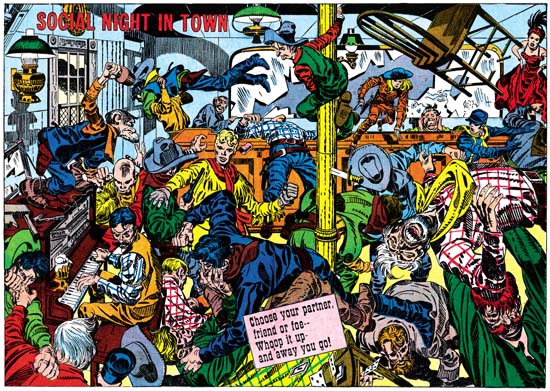
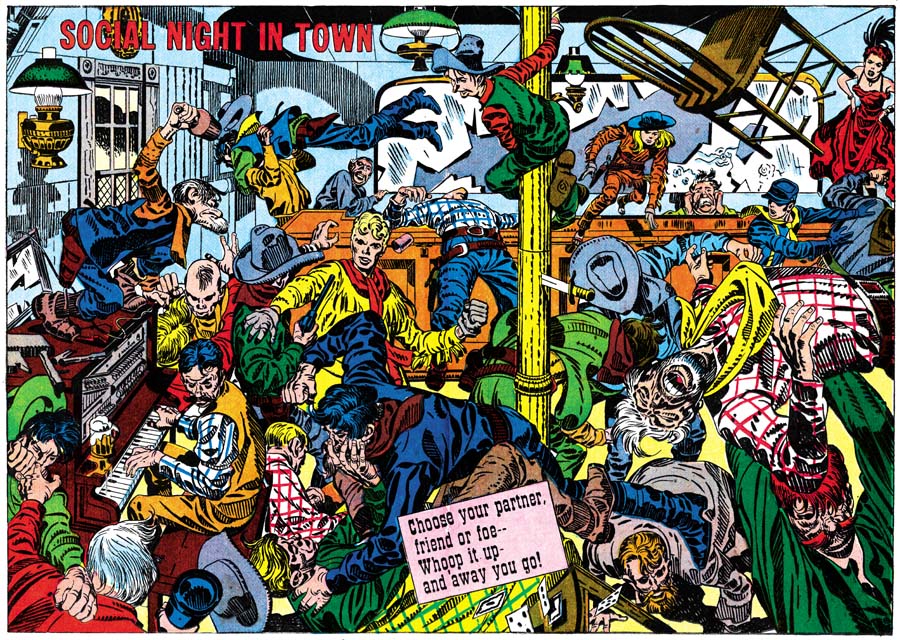
With “Social Night in Town” Jack Kirby is in top form; this is certainly one of his classic drawings. This is Kirby at his best, a slugfest up close and personal. I like to think of this sort of composition as Kirby’s comic book equivalent of Jackson Pollock. There is no true focus to the image as it is an all over drawing with every portion as important as any other. Jack’s mastery of exaggerated perspective allows him to make this look easy but I honestly cannot think of another comic artist who could come close to providing such an exciting fight scene. Kirby has done this sort of thing before in for example “The Villain from Valhalla” in Adventure Comics #75 (June 1942), but the wide format allows a treatment just not possible on a single page. It would sound much too dry to describe all the details but I cannot help point out Wabash clinging in relative safety high on the near center post enjoying watching all the proceedings. Relative is the operative word because note the knife sticking in the post below him and the chair flying high on the right. The theme of cowboy’s letting off steam in a bar fight may not have been a cliche in 1950 but it soon would be. Comic books could do it in a way that television or movies simple could not match no matter how hard they tried. Not that their directors would likely have noticed Kirby’s work in 1950, but they should have.
As wonderful as “Social Night in Town” is, the best was yet to come. Unfortunately that will have to be covered in the next chapter.
Posted in 2008/02, 5 Studio, Artists, Harvey, Kirby, Jack, Periods, Serial Posts, Wide Angle Scream, z Archive
Leave a comment
Daring Mystery and Joe Simon BK (Before Kirby)
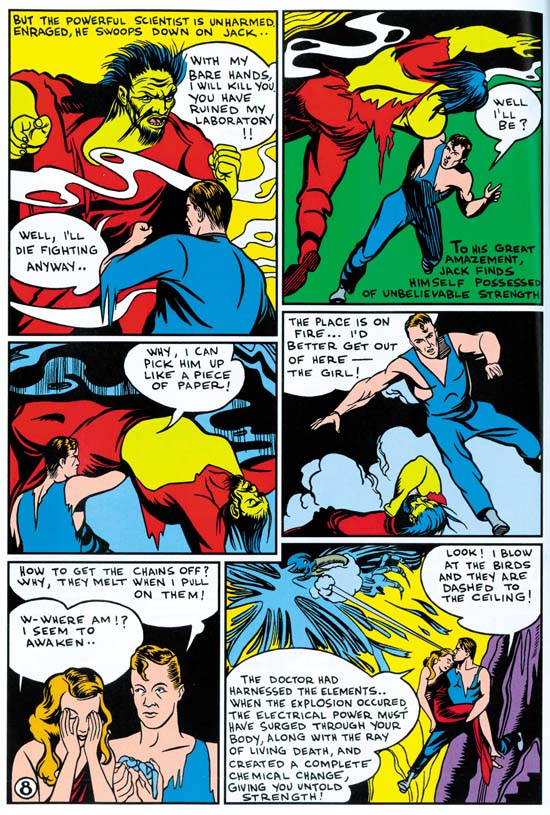
To achieve an understanding of Joe Simon as a comic book artist it is important to study some of the work that he did prior to meeting Jack Kirby. Unfortunately Joe’s initial efforts are from the early days of the golden age of comics so the comics that Simon’s art first appeared in are now rare and expensive. This would not be too great a problem if the work had been reprinted. Sadly that has not been the case, even a trade back reprint of the Blue Bolt stories failed to include Joe’s origin story. Fortunately Marvel has recently published Daring Mystery 1 for their Golden Age Marvel Masterpieces series. This volume reprints Daring Mystery issues #1 to #4 and therefore provides four or five early stories by Joe Simon. I hesitate on the exact story count because I keep going back and forth whether to attribute the one from DM #4 to Joe, although he has said he did it. These stories include one of his first published works (the Fiery Mask story “The Fantastic Thriller of the Walking Corpses”) and all of them were done over the period before meeting Jack Kirby.

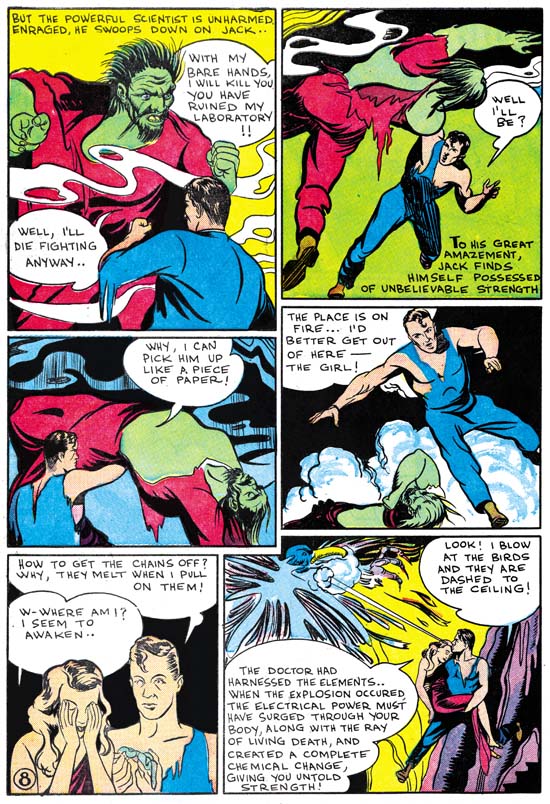
Daring Mystery #1 (January 1940) “The Fantastic Thriller of the Walking Corpses” page 8, art by Joe Simon
In the past I have been somewhat critical of the reprint job Marvel did for their Golden Age Marvel Masterpieces volume on the Human Torch. The restoration of the art for that volume included some modern re-inking. This not only diminishes its value for comic scholars but also makes what was some really great artwork look rather inferior. Therefore I was curious how accurate the restoration was done for Daring Mystery. I am happy to say that restoration of the line art looks very exact. The only place I found anything that could be described as re-inking was a case where apparently the original colorist supplied a shirt in one panel that Joe had apparently failed to include (see panel 4 of the original above). In this case the modern restorer adding line art that did not originally exist. Although I would have preferred it if the restorer added nothing that was not originally there, this seems a very minor and rare transgression.

Daring Mystery #1 (2008) “The Fantastic Thriller of the Walking Corpses” page 8, art by Joe Simon as reprinted by Marvel
That is not to say I am completely happy about the restoration job. Marvel’s reprints are all recolored. With modern presses and the fine resolution screening they use, recolored golden age comics have a distinct tendency to look very flat. While I am unhappy about this effect I have come to accept it provided that the recoloring remains faithful to the original. That had seemed to be Marvel’s most recent policy but it was not maintained in this volume. Some of the original subtle and not so subtle coloring was blatantly ignored. For instance as in panels 4 and 6 smoke the originally white with light blue touches became flooded with that blue. Even the giant villains clothing was turned to green color flesh in panels 2 and 3 while in panel 4 flesh became red shirt. All this suggests color accuracy was sacrificed for speed.
As a student of Simon and Kirby it was Joe Simon’s contributions to Daring Mystery that I am most interested in. There are a lot of others stories and artists contained in this reprint. Frankly I am surprised that Marvel decided to reprint Daring Mystery at all, none of these features survived more then a few issues. The characters never became hits and none of them played any part of the modern Marvel universe. That is until recently when Marvel resurrected some as part of a mini-series call The Twelve, which includes Joe Simon’s Fiery Mask among others. In a way the absence of big stars is actually part of the charm of this reprint volume. It is just filled with odd-ball heroes and quirky stories. It even includes a story by Fletcher Hanks although identified in the volume as Harry Fletcher, apparently one of his pseudonyms.
The volume has an introduction written by Ronin Ro, the author of the Jack Kirby biography “Tales to Astonish”. I am not sure why Ronin was chosen to introduce the book since Jack Kirby is nowhere in evidence. Still Mr. Ro is a talented writer and his essay shows he “gets” what gives this book its charm. Unfortunately Ronin Ro has made a mess of the history of the original Daring Mystery. It is no more accurate to describe Joe Simon as a writer then any of the other pioneer comic book artists; Joe’s stint in the newspaper industry was as a staff artist not a writer. Nor was Simon an editor for Timely when these issues of Daring Mystery were produced, that would come later. All Joe’s work in this reprint volume was originally was done for Funnies Inc. which supplied art to Timely in the days before Goodman started his own artist bullpen and all are from before he met Jack Kirby.
Posted in 2008/02, Uncategorized, z Archive
2 Comments
Second Anniversary and the Red Raven Contest

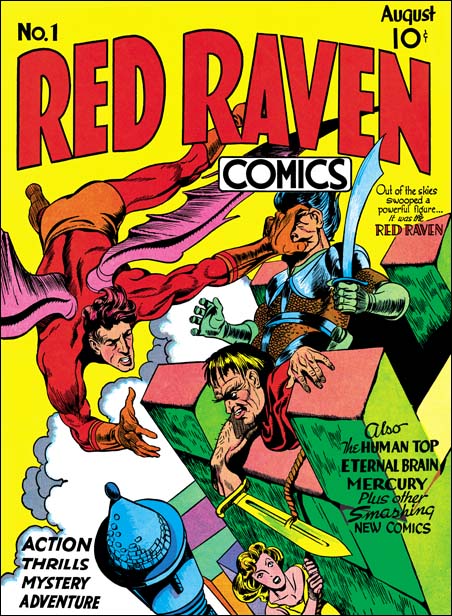
Red Raven Comics #1 (August 1940)
In a few weeks this Simon and Kirby Blog will be reach its second anniversary, my first post was on March 17, 2006. When I started blogging I really had no idea how long I would keep at it. Actually I still do not know but I have somehow managed to post once a week (on Friday or Saturday). Other bloggers post more often, that does not bother me and I hope that my readers do not mind either. Each blog entry has some research behind it, perhaps not as thorough as it would be if I were publishing something but more then I would do for casual comments on the places like the Kirby List. Even without the blog I would be doing that research, but writing about it allows me to organize my thoughts in a way otherwise not possible. It is surprising how difficult it can be to describe what can seem so obvious, let alone when things are not obvious at all. The effort is worth it because it brings with it a new level of understanding. This blog also provides feedback, perhaps not often as I would like, but the comments that are left are invariably quite thoughtful and informative. I offer a special thanks to what I like to think as my loyal opposition. Perhaps they do not always disagree with me but they always have interesting points to make. Rest assured even when our opinions do differ I respect and value the time they take. Besides I have been known to make mistakes and to change my opinion. Readers should not accept anything I say in my blog as unchangeable gospel.
In recognition of my second anniversary I am going to have a contest. It has been a while since I had a contest and this time I have a real special prize. The winner will receive a color copy of The Red Raven Comics #1. This is a slim hardcover volume with restorations of the cover and all interior art. Red Raven #1 is an early effort by Joe Simon as art editor for Timely and has some nice work by Jack Kirby. Some of the stories are a bit odd, but that is to be expected from the golden age of comics. I wish I could offer it to all my readers but I am sure Marvel would slap me done hard if they found out. Maybe someday Marvel will get around to reprinting it themselves.
Anyone can enter, not just people from the US. To enter the contest all you have to do is email me at hmendryk at yahoo dot com (you know the drill, replace “at” and “dot” with the appropriate characters). Include in the title the phrase “Red Raven Contest”. In the text of the email include your address. Please note I do not keep this information nor do I pass it on to anyone else. One entry per person. I will pick the winner at random on March 15. Good luck.
Posted in 2008/02, Uncategorized, z Archive
2 Comments
The Art of Romance, Chapter 3, The Field No Longer Their’s Alone
(Young Romance #5 – #8)
In this chapter I will be writing about the next four issues of Young Romance (#5 to #8). For the most part this set is a continuation of the earlier issues. The main artists were same; Jack Kirby, Bill Draut and the team of Jerry Robinson and Mort Meskin. A couple of minor artists that appeared in issues #1 and #2 do not reappear, but a new one would have a contribution which I will discuss in more detail below. Young Romance is still on a bimonthly schedule. This is surprising because by now S&K and Prize were surely aware that they had a hit. When the crime genre Headline (starting with issue #23, March 1947) was a success Simon and Kirby launched Justice Traps the Guilty for Prize seven months later. Yet after over a year they neither made Young Romance a monthly nor created another title. Other publishers had not failed to notice; based on “All the Romance Comics Ever Published (?)” romance titles began to appear published by Fox (My Life #4, September 1948), Timely (My Romance #1, September), and Fawcett (Sweethearts #68, October). Perhaps Prize along with Simon and Kirby were surprised at their own success and fearful that it was just a fad.
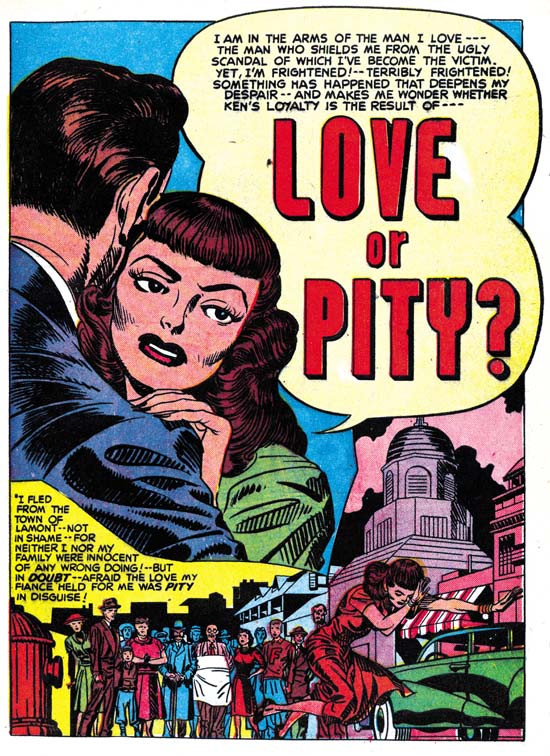
Young Romance #8 (November 1948) “Love or Pity”, art by Jack Kirby
Jack Kirby continued to be the most prominent artist for Young Romance. Kirby did nine out of the twenty stories in these four issues, or 97 out of 177 pages. It may have been even more since as I will discuss below a tenth story may also have been penciled by Jack. Kirby would continue to create the first story in the comic. This lead story would remain the longest story in the comic with thirteen or fourteen pages while other stories would have at most nine pages. The design of the lead story splash page would continue to have a character’s speech balloon used as the title caption. I particularly like the splash for “Love or Pity”. The design is done quite well with a close-up of a couple dominating the page and another section enacting a little scene like some sort of tableau. We have seen this emphasis in design for some of Simon and Kirby’s double page splashes, but it is also to be found in a number of the smaller splashes drawn by Kirby in Young Romance. In the depiction of the large couple we only get to see the face of the woman, the man’s face and his emotions remain a mystery. The woman arches her left eyebrow, looks askance and her hand’s placement on the man’s shoulder seems tentative. All this makes her appear apprehensive and her attempt to dispel her concerns by moving closer into the man’s embrace seems to have failed. From the title caption we learn why, she is uncertain about the man’s true feelings. Many have described Kirby’s woman as not being truly beautiful but it is a criticism I do not share. I find the woman in this splash attractive enough and, more importantly, very human. While some other artists might have been able to make the woman appear even more beautiful I do not know any that are able to invest them with the same sensitivity that Kirby has. Jack does not draw Barbie dolls but rather woman whose appearance reflects their personality and emotions. I find that makes Kirby’s woman truly beautiful indeed.
The second section of the splash depicts a crowd looking disapprovingly on as the woman runs away in shame. Jack has chosen a low viewing angle so that the woman towers over the background crowd giving drama to the scene. The woman’s pose is rather unusual; she looks more like she is tripping and about to fall. Not an inappropriate metaphor for her descent into scandal. The second section is well done but its impact suffers from its diminished size. Envision this section enlarged and expanded toward the right and you can imagine what a double page romance splash might have looked like had Simon and Kirby ever done one. It is too bad they never did.
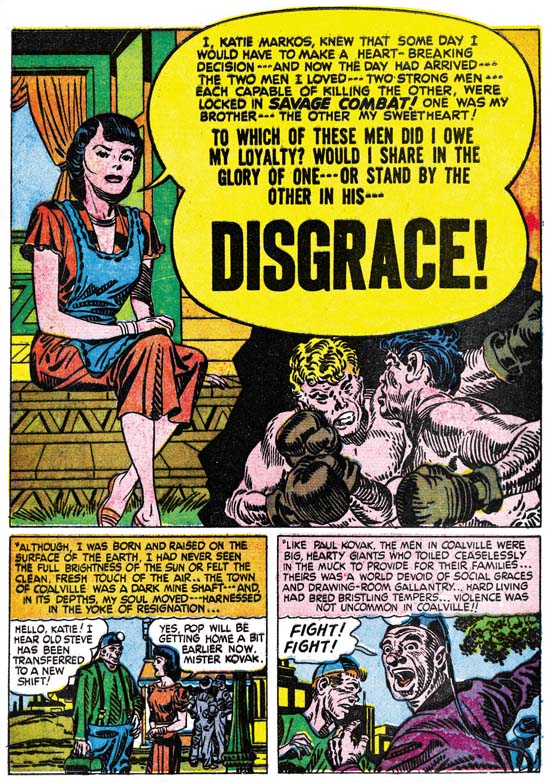
Young Romance #6 (July 1948) “Disgrace”, art by Jack Kirby
One change that seemed to have taken place from the earlier issues of Young Romance was that action no longer appeared quite as commonly in Jack Kirby’s romance stories. Not that action disappeared completely, it would always show up in more Kirby romance stories then it does in those by any of the other studio artists. “Disgrace” is a case in point. If I had to pick one Kirby romance story most likely to satisfy the general Kirby readership, this would be the one. The heroine feels trapped in a coal mining town which she detests for the violence its inhabitants so frequently adopt. Her brother has managed to escape the town but she is dismayed at his career as a prize fighter and his particularly brutal nature. She falls in love with a man only to discover that he also is a professional boxer. She cannot accept more violence in her life so she breaks it off. Later she finds to her horror that her brother and former love are scheduled to meet in the arena. Where does her loyalty lie, with her violent brother or the man she still loves? Jack Kirby is justly famous for his depiction of a punch and the fight in this story is a pure slugfest.
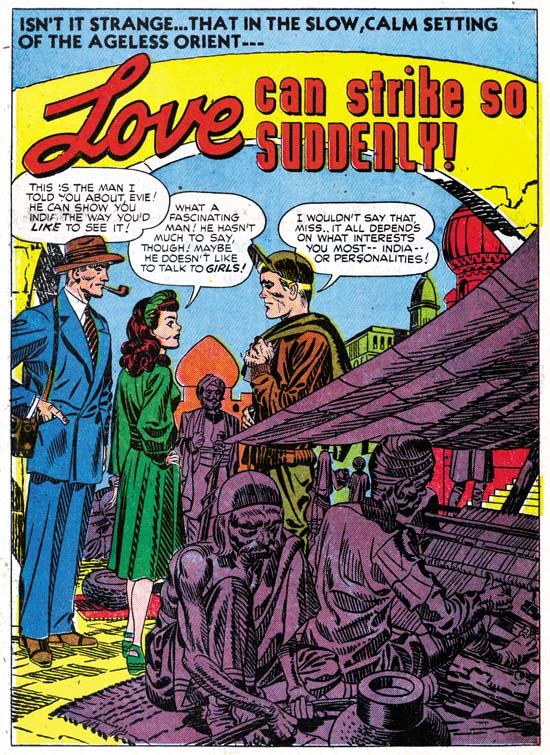
Young Romance #8 (November 1948) “Love Can Strike So Suddenly”, art by Jack Kirby
Kirby may have tuned down his use of action but he still looked for means to keep his stories exciting. One of his techniques was to make use of the exotic location of some of the stories. Had the splash of “Love Can Strike So Suddenly” depicted a normal local it would have seemed quite banal. All the main characters are just standing around. Even the dialog is not nearly dramatic enough to rescue this page. However by inserting his cast into a street in India, Jack has made this one of his memorable splashes. I am sure Kirby has swiped this from some source, perhaps National Geographic, but I am also certain that he has made his version far more interesting then the original. I have recently discussed this story; it is the source for a swipe used years later in Simon and Kirby’s own romance comic In Love.
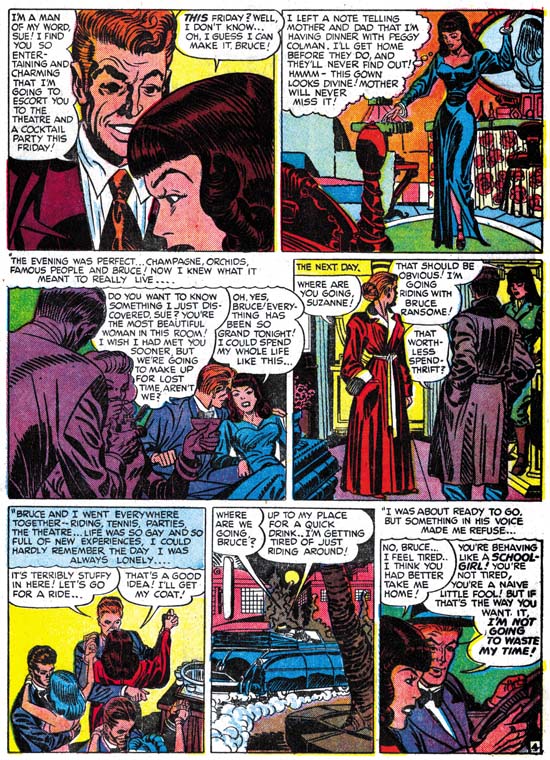
Young Romance #7 (September 1948) “Mother Said No” page 4, art by Jack Kirby and Carmine Infantino?
The Jack Kirby Checklist does not include “Mother Said No” among its listings of Kirby’s work. It is easy to understand why, the man in the first panel of the page imaged above does not look he was drawn by Jack. Or does he? Kirby often drew his men with wild eyebrows but these look excessive even for Jack. But how much of these exaggerated eyebrows were in the original drawing and how much were due to the inker’s interpretation of the pencils? The layouts throughout the story look like they were done by Jack. It is hard to be sure, but once the eyebrows are ignored a lot to the drawing looks like Kirby to me.
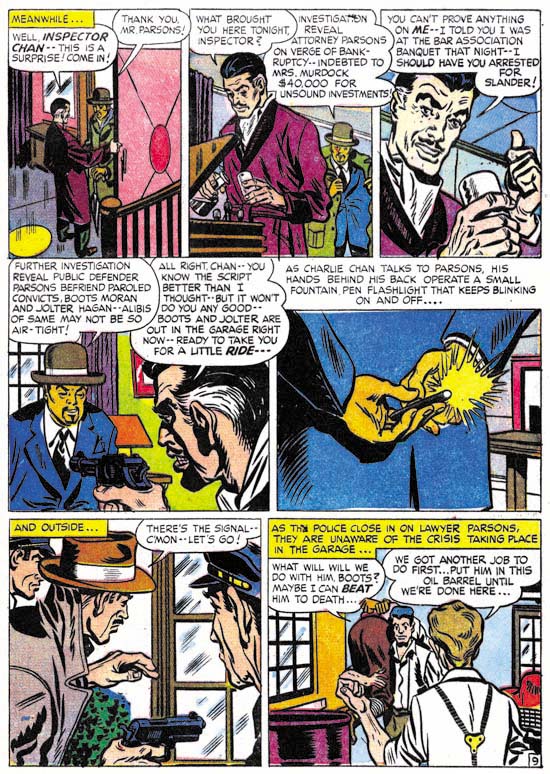
Charlie Chan #1 (June 1948) “The Hit and Run Murder Case” page 9, art by Carmine Infantino
Nearly identical men’s eyebrows seen in “Mother Said No” can also be found in work that Carmine Infantino did in Charlie Chan. Compare the man in the third panel of page nine of “The Hit and Run Murder Case” shown above to the one in the first panel of the page I previously presented from “Mother Said No”. Further examples of Infantino’s work for the Simon and Kirby studio can be found in an earlier post. While the details of the eyebrows seem to match in the two stories, the proportions used in drawing the faces do not. Nor are Carmine’s layouts in Charlie Chan similar to those found in “Mother Said No”. The inking for “Mother Said No” was done in the studio style which would normally suggest Jack or Joe’s involvement. However Carmine used the studio style inking in some parts of Charlie Chan, particularly the splashes. I really need to do a more thorough comparison, but some of the spotting in “Mother Said No” does not look like it was done by either Jack or Joe. My initial conclusion is that in “Mother Said No” Carmine was inking Jack’s pencils. If that is true what is not clear is whether Kirby’s pencils were not very tight, or if instead they were overwhelmed by Carmine’s inking. In either case I am presently inclined to consider this a joint piece with Jack as the primary artist.
There is a serious problem with the analysis that I presented above because of an interview of Carmine Infantino from The Jack Kirby Collector #34. In that interview Carmine clearly said that Charlie Chan was the only work he did for Simon and Kirby, and later added that he never inked Jack’s pencils. I really want to do a more careful analysis before I am ready to contest Infantino’s statements so for now I consider my conclusions as preliminary. Hopefully a re-examination of this issue will be the subject of another post in not too distant future.
Young Romance #6 (July 1948) “Gossip”, art by Bill Draut
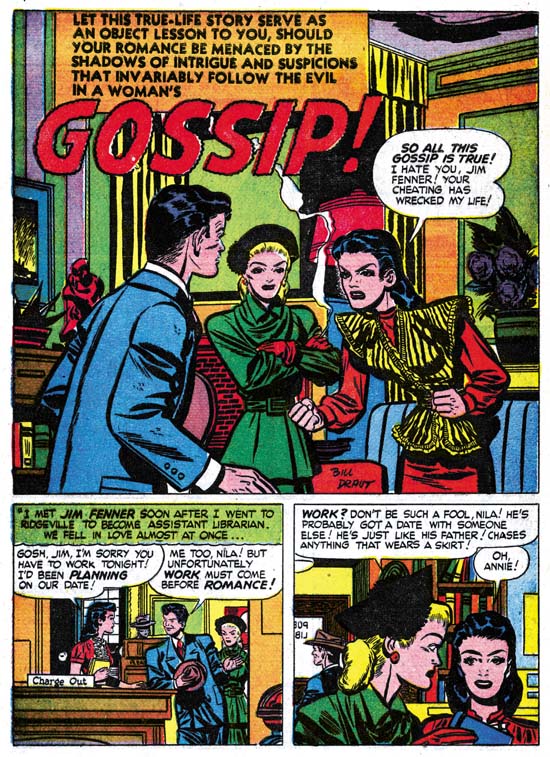
Kirby did not draw all the stories in YR #5 to #8; Bill Draut remained a significant contributor with seven stories out of twenty, or 52 pages out of 177. Bill’s art started to change. Gone were the splashes with an emphasis on design, I do not believe it would reappear in Draut’s work until 1954 for In Love. I suspect Joe Simon had a hand in laying out some of the earlier Draut splashes for Young Romance, but from this point on Draut would do it himself. The other change would be the appearance of more and more traits that would be typical of Draut. Note the brickwork for the fireplace in the “Gossip” splash. This is a Draut trademark that will reappear from time to time through his association with the Simon and Kirby studio. Another Draut trademark, which actually showed up before, is the brunette’s pose. Draut portrays a person’s anger by leaning the torso and thrusting the head forward, and sometimes having the person clench their fists. This is a pose not quite like any that I have seen Kirby use and it is one of the reasons that I do not believe Jack was providing layouts for Bill as some authorities have claimed.
Young Romance #5 (May 1948) “Jealousy”, art by Jerry Robinson and Mort Meskin
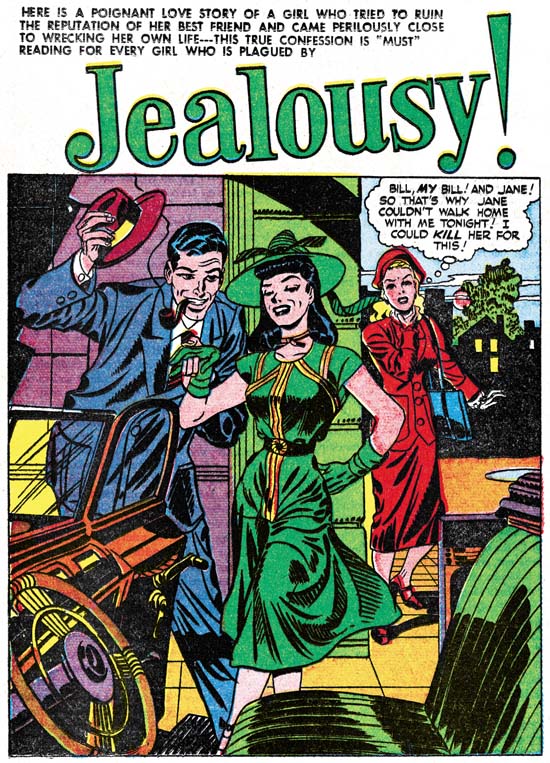
The final two contributors to Young Romance #5 to #8 was the team of Jerry Robinson and Mort Meskin. I attribute three stories from issues #5 and #6 to Robinson and Meskin, one of which (“The Inferior Male”) was signed. The Jack Kirby Checklist credits the splash page of “Jealousy” to Jack Kirby as inked by Joe Simon. The expressive formality of the foreground couple is not typical of Kirby. Nor are the long and simple eyebrows usually found in Simon’s inking. The only thing that suggests Kirby/Simon to me is some of the Studio style inking such as the abstract arch at the top of the wall and the picket fence crosshatching on the lower part of the woman’s dress (see inking glossary). However the “Jealousy” splash presents cloth folds created by long, narrow sweeping brush strokes, this is exactly the inking technique used by Mort Meskin. Also note the man has a type of grin that is so typical for Mort. The eyebrows found in “Jealousy” may also be found in the Robinson and Meskin work found in these early issues of Young Romance. The unusual formal pose of the couple would not be surprising for Robinson and Meskin. The only problem with a Robinson and Meskin attribution for the “Jealousy” splash is the Studio style inking which is not found in other R&M art. I think the best explanation for this discrepancy is that either Simon or Kirby in their roll as art editor stepped in to touch up the splash. I feel the splash matches the art in the rest of the story and it all should be attributed to Jerry Robinson and Mort Meskin.
July marked the last month that Robinson and Meskin art would appear in Simon and Kirby productions. Mort Meskin would return by himself over a year later, after which he would be a frequent contributor until the end of the studio. This is all very hard to reconcile with Carmine Infantino’s TJKC #34 interview where he says that he accepted the Charlie Chan job for the experience he would get by working with Kirby and Meskin. Carmine even describes Mort as working right next to Jack. Carmine’s stay was from June 1948 until February 1949 (cover dates). This does overlap Robinson and Meskin’s period (January to July 1948) but is well before Meskin’s solo return in December of 1949. I just do not find it creditable that Mort was working in the studio at a time when he and Robinson were probably producing more work for other publishers then for S&K. Would Mort and Jerry have been working separately? Would the small amount of work for S&K justify Mort’s presence in the studio? I am afraid I have to conclude that Carmine’s memory has failed him; perhaps he has mixed up the time of his presence in the studio with that of his brother Jimmy who did work for S&K at the same time as Meskin.
Chapter 1, A New Genre (YR #1 – #4)
Chapter 2, Early Artists (YR #1 – #4)
Chapter 3, The Field No Longer Their’s Alone (YR #5 – #8)
Chapter 4, An Explosion of Romance (YR #9 – #12, YL #1 – #4)
Chapter 5, New Talent (YR #9 – 12, YL #1 – #4)
Chapter 6, Love on the Range (RWR #1 – #7, WL #1 – #6)
Chapter 7, More Love on the Range (RWR #1 – #7, WL #1 – #6)
Chapter 8, Kirby on the Range? (RWR #1 – #7, WL #1 – #6)
Chapter 9, More Romance (YR #13 – #16, YL #5 – #6)
Chapter 10, The Peak of the Love Glut (YR #17 – #20, YL #7 – #8)
Chapter 11, After the Glut (YR #21 – #23, YL #9 – #10)
Chapter 12, A Smaller Studio (YR #24 – #26, YL #12 – #14)
Chapter 13, Romance Bottoms Out (YR #27 – #29, YL #15 – #17)
Chapter 14, The Third Suspect (YR #30 – #32, YL #18 – #20)
Chapter 15, The Action of Romance (YR #33 – #35, YL #21 – #23)
Chapter 16, Someone Old and Someone New (YR #36 – #38, YL #24 – #26)
Chapter 17, The Assistant (YR #39 – #41, YL #27 – #29)
Chapter 18, Meskin Takes Over (YR #42 – #44, YL #30 – #32)
Chapter 19, More Artists (YR #45 – #47, YL #33 – #35)
Chapter 20, Romance Still Matters (YR #48 – #50, YL #36 – #38, YB #1)
Chapter 21, Roussos Messes Up (YR #51 – #53, YL #39 – #41, YB #2 – 3)
Chapter 22, He’s the Man (YR #54 – #56, YL #42 – #44, YB #4)
Chapter 23, New Ways of Doing Things (YR #57 – #59, YL #45 – #47, YB #5 – #6)
Chapter 24, A New Artist (YR #60 – #62, YL #48 – #50, YB #7 – #8)
Chapter 25, More New Faces (YR #63 – #65, YLe #51 – #53, YB #9 – #11)
Chapter 26, Goodbye Jack (YR #66 – #68, YL #54 – #56, YB #12 – #14)
Chapter 27, The Return of Mort (YR #69 – #71, YL #57 – #59, YB #15 – #17)
Chapter 28, A Glut of Artists (YR #72 – #74, YL #60 – #62, YB #18 & #19, IL #1 & #2)
Chapter 29, Trouble Begins (YR #75 – #77, YL #63 – #65, YB #20 – #22, IL #3 – #5)
Chapter 30, Transition (YR #78 – #80, YL #66 – #68, YBs #23 – #25, IL #6, ILY #7)
Chapter 30, Appendix (YB #23)
Chapter 31, Kirby, Kirby and More Kirby (YR #81 – #82, YL #69 – #70, YB #26 – #27)
Chapter 32, The Kirby Beat Goes On (YR #83 – #84, YL #71 – #72, YB #28 – #29)
Chapter 33, End of an Era (YR #85 – #87, YL #73, YB #30, AFL #1)
Chapter 34, A New Prize Title (YR #88 – #91, AFL #2 – #5, PL #1 – #2)
Chapter 35, Settling In ( YR #92 – #94, AFL #6 – #8, PL #3 – #5)
Appendix, J.O. Is Joe Orlando
Chapter 36, More Kirby (YR #95 – #97, AFL #9 – #11, PL #6 – #8)
Chapter 37, Some Surprises (YR #98 – #100, AFL #12 – #14, PL #9 – #11)
Chapter 38, All Things Must End (YR #101 – #103, AFL #15 – #17, PL #12 – #14)

The Wide Angle Scream, It’s a Crime
With the early demise of the Stuntman and Boy Explorer titles, Simon and Kirby’s next important project would be crime anthologies. Perhaps mindful that during the comic book glut it was previously existing titles that made it into the newsstand racks, Prize Comic’s Headline would be converted into a crime genre comic with issue #23 (March 1947). All the art for Headline issues #23 and #24 would be penciled by Jack Kirby, a feat that would not be repeated again until late in 1955. Most likely Simon and Kirby followed the same procedure that Joe reported as being used when launching romance comics; that is preparing the initial issues ahead of time before striking a deal with a publisher. The other thing unique about these first two crime issues of Headline was they both included double page splashes.

Headline #23 (March 1947) “Burned at the Stake”, art by Jack Kirby
Larger Image
Although the last published double page splashes by Simon and Kirby were designed with two or more sections, we previously saw that enactment section had taken over in three unpublished Stuntman wide splashes. This approach was continued here in “Burned at the Stake”. There is a heading across the top, the story title, an introductory caption and a round panel portrait, but these sections are all subservient to the enactment. We find four armored and armed soldiers approaching a single individual at the top of some stairs. This composition is not just happenstance. Like other Western languages, English is read from left to right and readers have become accustomed to viewing even illustrations in this direction. Placing something higher on the page also provides it with prominence. Thus in this case the eye follows the advancing soldiers from down on the left, upwards and toward the right, until it reaches the main character of the story, Guy Fawkes. Essentially the same composition was found in the enactment section for “The Rescue of Robin Hood“. Only in this case the center of attention was not a hero as Stuntman was. Did the man mean to set off the explosives and if so would the soldiers be in time to prevent him? The double page splash was not meant to answer those questions. Quite the contrary, leaving them unanswered would hopefully entice the viewer to buy the comic book.

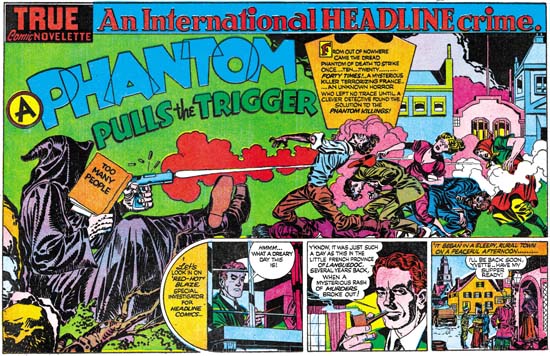
Headline #24 (May 1947) “A Phantom Pulls the Trigger”, art by Jack Kirby
Larger Image
“A Phantom Pulls the Trigger” might mistakenly be considered to be composed contrary to the normal left to right reading. It is true that the primary focus would seem to be the hooded figure on the left, the opposite of the expected location. In this case however the viewer’s progress from left to right is meant to indicate the progress of time, from the action of the firing of the pistol on the left to the affect of the killing of the people on the right. Kirby has countered the diminishing affect of placing the most important figure on the left by increasing his visual size. It is unclear whether the hooded figure is truly meant to be larger then his victims or if he is just closer to the viewer.
A section devoted to the start of the story makes a come back after last being used for the double page splash in Captain America #10 (January 1942). That this strip of panels is not an afterthought can be clearly seen by the way the hooded figure props his feet up on story panels and how the victims are firmly standing or lying upon it.
Simon and Kirby would discontinue using double page splashes in their crime genre comics. In my opinion this was not because crime did not lend itself to exciting wide splashes. I find the double page splashes from Headline #23 and #24 to be very effective and Kirby would pencil a number of single page splashes that could have benefited from a wider format. The problem I believe was due to an inherent weakness in use of the double page splash. For proper printing a wide splash must be placed as the centerfold page. With such a location the splash might be overlooked by a potential customer and thus loose its importance for inducing the purchase of the comic. But that was nothing new; it was a problem from when it was first introduced. What may have been more important was how the double page splashed affected the organization of the comic. Having a wide splash meant that a story had to start at on a particular page in the middle of the comic. This also placed restrictions on the page length for preceding stories as well. Organization of a comic book was simply easier without the wide splash. Now that Simon and Kirby was busy producing Headline and would soon be starting Young Romance, the double page splash may have been considered more trouble then it was worth. It would be a number of years before S&K would return to the wide splash, which is a shame because they did it better then anyone else. However in a few years Joe and Jack would put the centerfold to another good use. But that is a story for the next chapter.
Posted in 2008/02, Artists, Kirby, Jack, Periods, Prize, Serial Posts, Wide Angle Scream, z Archive
Leave a comment