Alternate Takes


Justice Traps the Guilty #56
Justice Traps the Guilty #56 (November 1953), art by Marvin Stein

The cover for Justice Traps the Guilty #56 is probably Marvin Stein’s most famous piece of comic book art. It has been reproduced in Joe Simon’s book “The Comic Book Makers” and “The Art of Jack Kirby” by Ray Wyman, Jr. (in fact my restoration above was made using the same comic book found in the Wyman’s book). The cover’s fame rests not so much on its artistic value but on the people portrayed in the police lineup. Here as the suspects we find starting from our left Ben Oda (Simon and Kirby’s letterer), Joe Simon, Joe Genalo (Prize editor), Mort Meskin and Jack Kirby. This was, of course, an inside joke because none of these individuals were actually criminals, nor were they likely to be recognized by the public. Most of the members of the lineup are people that have previously been discussed in this blog and should need no further introduction with the exception of Joe Genalo. Joe Genalo was working for Prize as an editor, not for Simon and Kirby. Annual postal statements may not be relied on completely but the one in Headline’s March 1953 issue shows Joe Genalo as editor (unfortunately I do not have the equivalent one for Justice Traps the Guilty). Genalo is again listed as editor in the postal statements found in the March 1954 issues of both Headline and Justice Traps the Guilty. The identification of the person in the line up as Joe Genalo is based on Joe Simon in “The Comic Book Makers”; however there is a problem with this. In a photo taken of the Simon and Kirby studio there is a person that Joe also has named as Joe Genalo. The presence of Jimmy Infantino in the photograph indicates that it was probably taken in 1951. The photo “Genalo” does not wear glasses and is much younger then the man on Marvin Stein’s cover even though only a couple of years separate the two. It would be expected that the man portrayed by Stein would be someone important to Marvin’s work and that certainly would suggest that it truly was Joe Genalo in the lineup. I therefore believe that Joe’s photo identification is incorrect.

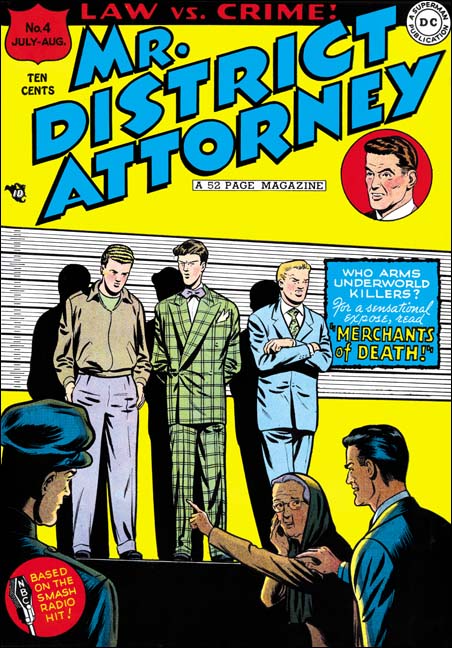
Mr. District Attorney #4
Mr. District Attorney #4 (July 1948), art by Win Mortimer

Stein’s police lineup was not the only one to appear on the front of a comic book. The similarity between the covers for Justice Traps the Guilty #56 and Mr. District Attorney #4 are striking. Both show the police and a female in the foreground with the lineup in the background higher up on a stage. Further the female for both is on the right pointing out a suspect on the left. Examples like this one are generally referred to in comic book discussions as swipes. It is also examples like this that are the reason I so thoroughly hate that term. I use it only because it is so entrenched in discussions about comic book artists and their art. Among many comic book fans the term swipe is used as a condemnation. However deriving art based on some previous art is not something unique to comic books. The same thing is done in the fine arts without all the negative associations. No one accuses Michelangelo of swiping from Donatello. If the reader wants to think that Marvin Stein swiped his cover from Win Mortimer that is fine. Just note that although the idea may have originated with Mortimer, nothing in Stein’s cover is a close copy of Mortimer’s work. Kudos for Mortimer for coming up with the idea, but kudos for Stein for using it to make something of his own.

As far as I know Win Mortimer never worked for Simon and Kirby and therefore I am not too familiar with his work. In my opinion a good piece of cover art should tell a story and Mortimer certain does that with his cover. An elderly woman points out one of the boys in the lineup while she looks back fearfully to a man in a suit, presumable the District Attorney. Mr. DA rests his hand on her shoulder to provide reassurance. At first glance the boys in the lineup do not appear to be criminal types, everybody seems so clean cut. But that is deceptive because it is based on today’s standards. The boy in the center of the line has a plaid suit with wide lapels and a lavender bow tie. At the time this was hardly considered conservative fashion and despite lacking baggy pants suggested the zoot suit. Zoot suits were infamous during the war and often identified in the minds of the public with Latino gangs. The boy on our right is more conservatively dressed but has a toothy squint that suggests he is not your normal teenager either. However even after a more extended examination, there seems little to suggest that the suspect on our left is not a clean cut American boy. The fact that his response to the lady’s identification is to hang his head in shame supports that notion. The question is what crime could such a seemingly nice boy have committed that lead him to this lineup? Unfortunately this is one shortcoming to Mortimer’s cover as no clue is provided as to his offense, nor is there an interior story to enlighten us. The cover is a little dry for my tastes but an excellent piece of comic book art nonetheless.

I frequently remark in this blog that one should not compare artists that worked for S&K to Jack Kirby. I do so not only as a warning to my readers, but as an admonition to myself. Kirby is such an outstanding talent that the shadow that he casts tends to obscure other artists. I guess that is what happened to me with Stein’s JTTG #56 cover. Previously I found it interesting for the people portrayed but considered it as not having much artistic merit. Having compared it to Mr. District Attorney #4, I now realize it has much to commend it. We may know no more specifics about the crime then with Mortimer’s cover, but no reason to question the woman’s accusation. As depicted on the cover, Simon clenches his fists, turns to face the woman and sneers something (probably “why you little…”). Nor are there any doubts as to the criminal nature of the rest of the lineup. Oda has the cold hard stare of a gunman, Genola’s poorly fitting jacket makes him look like head of some small extortionist gang, Mort has the appearance of a bookie, and Jack, despite his size, could be a small time thug. Marvin Stein has also done a much better job of composing the image. In Mortimer’s cover the foreground and background figures are only connected by the woman’s gesture. However Stein raises the foreground figures up, added a figure, and arranges them in a ‘U’ shape. This all provides a strong visual link to the lineup. Another weakness on Mortimer’s cover is how the woman’s backward glance at the District Attorney directs our vision away from the image. Stein places the DA on the other side of the woman so that she now faces into the image; I find that a very satisfactory solution. Finally Stein uses a spotlight on the lineup which provides an arching shadow giving more focus to the image then Mortimer’s more photographic like approach. I am sure Stein picked up this use of an arch from Jack Kirby who used arcs frequently. All in all Marvin Stein has provided an excellent reinterpretation of Mortimer’s original concept.

Young Romance #8
Young Romance #8 (November 1948) “Love Can Strike So Suddenly”, art by Jack Kirby

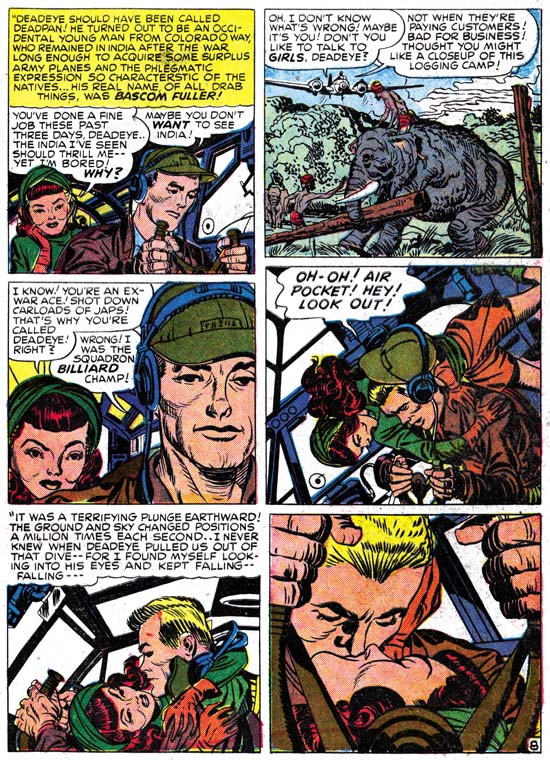
Jack Kirby’s take on romance always seemed to have more of an emphasis on action then most other comic book artists. The above sequence from an early Young Romance is a great example of this. The dramatic plunge of the airplane after hitting an air pocket literally lands a seemingly indifferent lady onto the lap of a reluctant man. The analogy of the airplane’s occupants fall and their falling in love is presented by both the images and accompanying text. It took chance to supply the action needed to overcome the barriers each had placed before their true feelings. This sequence may have played a small part in the overall story but it was pivotal. It was also the quintessence of Kirby’s vision of romance.

In Love #2
In Love #2 (October 1954) “Marilyn’s Men” page 14 panels 5 and 6, art by Bill Draut

In Love #2
In Love #2 (October 1954) “Marilyn’s Men” page 15 panel 1, art by Bill Draut

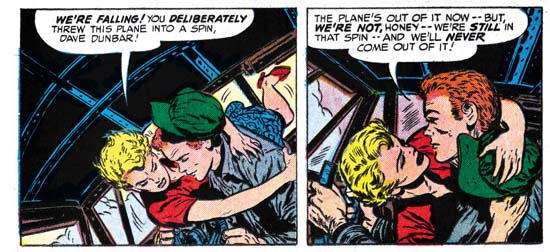
Kirby’s predilection for action in romance stories stayed with him. Although most of the story “Marilyn’s Men” from In Love #2 was drawn by Bill Draut, I believe that much of the plotting and at least some of the scripting came from Jack. Therefore I feel that the occurrence of essentially the same three panels from Young Romance #8 was not Draut trying to pull something over on his bosses, instead Bill was just following Simon and Kirby’s direction. The premise was similar between the two stories, both involved a plane flight where the relationship between the man and woman changes during the trip. There are significant differences between the two stories as well. In YR it is an accident that breaks down the resistance of both parties, whereas with In Love the pilot’s maneuver is purposeful, showing that it was only Marilyn’s reluctance to love that had to be overcome.

Draut’s swipe is not a close copy of Kirby’s art. Most of the deviation in the art can be attributed to differences in the two stories. Unlike most of the female characters in S&K romances, Marilyn had relatively short hair. Undoubtedly this was visual shorthand for her success as a businesswoman. Unfortunately Marilyn’s shorter hair could not provide the same affect to the first panel where she first is lifted out of her seat. Draut does what he can but Kirby’s heroine had more hair to add drama with. In Kirby’s story the heroine is seated behind the pilot while Marilyn is on his side. Jack therefore can show more of the lady as she goes from her seat to the pilot’s lap. Draut must provide a more foreshortened view and even rotated the pilot in relation to the cabin so that in the end the visual logic of the first scene breaks down. In the second panel Draut has everything under control. In fact here Draut improves on Kirby’s composition by having Marilyn ending up gazing into the pilot’s face, while Kirby left her looking to the side. There is one logical peculiarity in Draut’s presentation. In the first panel Marilyn’s left arm is already on the pilot’s shoulder while his hat is just beginning to come off his head. Yet in the second panel Marilyn’s left hand holds the hat down. How did that transition happen? Jack provides the answer by using the pilot’s headset to constrain the hat’s travel. The final panel, the dramatic view of the kiss, is very similar between the two versions, but by no means identical. The pilot’s face is typical Draut and not a close copy of Kirby’s version. Bill has also added some shadows of the window frames to add even more drama to the scene. While Kirby has good control over the unusual perspective, in Draut’s rendition where is Marilyn’s nose? It does not seem possible to trace its position without violating the man’s facial structure.

In Love #2
In Love #2 (October 1954) art by Bill Draut

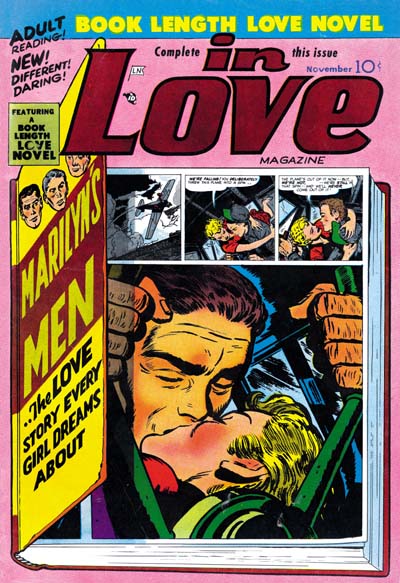
Jack was a master at visual storytelling so it comes as no surprise that the dramatic kiss occupies the last panel of his page. In “Marilyn’s Men” the kiss has been placed on the first panel of the page following the other two scenes. This greatly diminishes the impact of the story line. This may not have been Draut’s fault, the layout of the page suggests that the kiss panel was placed there afterwards. Perhaps editing was required to reduce the page count. That it was known then what the proper layout for this sequence was is shown in the cover where not only is the kiss the last panel, but it has also been enlarged.

The three panel sequence from Young Romance #8 hardly stands out as the most memorable panels from Kirby’s early romance work. Even so someone remembered and then used them as a reference for a comic done almost six years later.

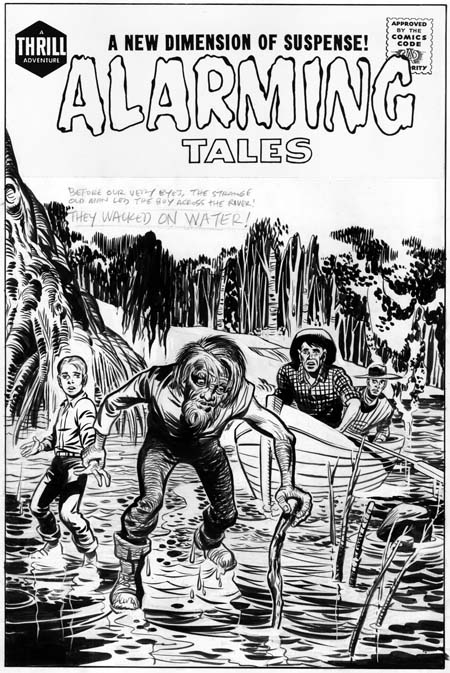
Alarming Tales #3
Alarming Tales #3 (January 1958) restored art, by Joe Simon

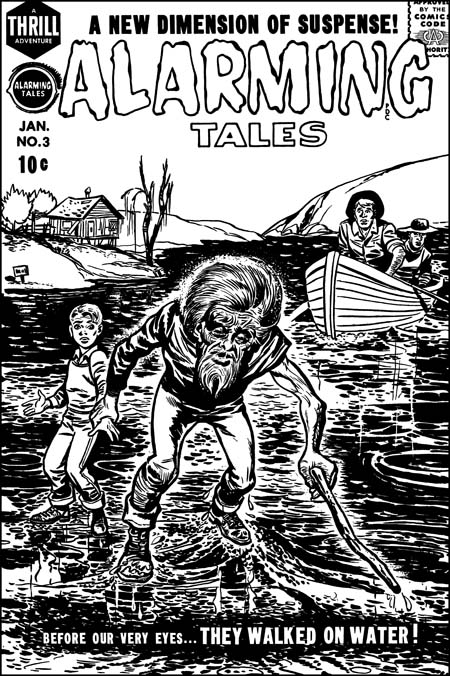
A recurring theme in my posts is how well Joe Simon could mimic Jack Kirby. This has resulted in a number of pieces that Joe did becoming attributed to Jack. Do not get me wrong, the overwhelming number of the items in the Jack Kirby Checklist are correctly attributed. Still there are a small number of entrees that are wrong and it is important to try to correct those mistakes. I would like to say that my study of Joe Simon’s art has enabled me to spot all the attribution errors that others have made. I would like to say that but it would not be completely true. A case in point is the cover for Alarming Tales #3. I provide an image of the restored line art to this cover above, a color version can be seen in a previous post.

In the past I have followed the Jack Kirby Checklist in saying Kirby did this cover. Not everyone agreed, for one sharp eyed Nick Caputo demurred. I was not completely satisfied with the Kirby attribution because I knew of the existence of another version of the cover art. It seemed to me that a comparison of the two would probably resolve the credit issue. As I hope to show in this post, that has turned out to be the case.Alarming Tales #3
Unused original art for Alarming Tales #3, by Jack Kirby.

I provide an image of the unused version above. A note of caution when comparing the two versions. The unused one is original art and therefore has not been subjected to the blurring and loss of details that are the results of the printing process, all of which the published version has been subjected to. Also the title on the original art is a recent addition. The presence of penciled text indicates the decision to come up with new cover art was made before title stats would have been applied to the original.The derivation of the final cover from the unpublished version is obvious, both have the same cast of characters in about the same positions. The greatest difference is the backgrounds. Not only has the background been completely changed, it has been pushed much further back in the released cover. A closer examination reveals that the people are not identical. The size of the old man has been increased while the relative size of the boy and, even more so, the men in the boat has been reduced. The old man’s head has been enlarged and the position of his left arm has been shifted. The details of all figures have been changed. Curiously the boy’s pants have been given a stripe like those worn by the USPS mail carriers. My original suspicion that reworked stats of the first cover were used to construct the final state was incorrect.I think most readers will agree with me that the original art is more beautiful then the final cover. So why spend the time and effort to replace it? The answer to this riddle is that the purpose of a comic book cover is to entice a viewer to purchase it. To do so it must stand out from the rest of the comics on the rack. The problem with the original version is that the old man is overwhelmed by the background. By simplifying and pushing the other elements back, the old man and his feat of walking on water becomes more obvious and dramatic. It is a question of design taking priority over artistry.

Alarming Tales #3
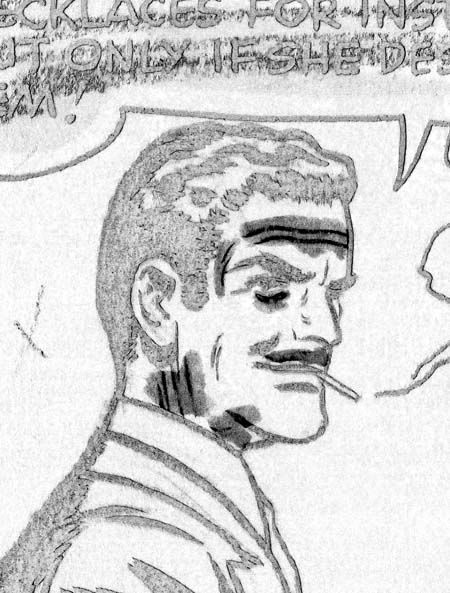
Close-up of the old man by Jack Kirby and the Joe Simon rendition.

Because the compositions of the two versions are so similar, we must look at the details in order to arrive at the correct attributions. Although not a standard part of Kirby’s repertoire, the old man of the first state seems to be not only his pencils but his inking as well. There are subtleties that his copyist is unable or unwilling to capture. Some of the alterations do seem on purpose, in the final state the old man has been made older and more frail. In doing so the published version has lost the quiet dignity and resolve that the original old man possessed.

Alarming Tales #3
Close-up of the young boy by Jack Kirby and the Joe Simon version

Personally I do not find much in the final state of the old man to suggest who was responsible. For an answer to that question I turn to a close-up of the young boy. Once again the original version seems to have Kirby’s touch all over it. Some of Jack’s style has been preserved in the published interpretation but purposeful alterations have been made as well. Frankly in Kirby’s hands the boy has been given a somewhat dim witted response to his predicament. The copyist on the other hand has widen the boys eyes, raised his eyebrows and furrowed his forehead. All this gives the boy a more intelligent and surprised reaction to being lead by the old man over water. It is the boy’s eyebrows that convince me that the copyist is Joe Simon. Similar eyebrows crop up often in Joe’s work going back as far as the cover for Champ #19 (June 1942) .

The men in the boat are typical Kirby creations. Unfortunately it is hard to compare the two versions because in the published one they have been reduced in size and their finer features lost by the reproduction process.

I mentioned above that I believe Jack Kirby inked his own pencils for the unused Alarming Tales #1 cover. That is not surprising because AT #1 is a comic where Jack did most of the work, including the inking. When I previously discussed the inking in AT #1 I found some of it similar to the standard Studio style while others were closer to the Austere style. On a whole I felt the material was transitional between those two Kirby inking methods. The inking style exhibited on the unused cover is a bit of an anomaly. It is true that the bow of the boat exhibits what looks like typical picket fence brushwork (see the Inking Glossary). It should be noted that it is unusual for the rails of a picket fence inking to depict literal objects like it does here with the bow edges. A better example of typical Kirby brushwork can be found in the folds of the boy’s shirt. They exhibit the tendency to be flatter then the underlying form that was common for Kirby at this time. The form lines on the tree on the left side of the image also look like Jack’s. But other inking methods used are very unusual for Jack, in particular the form lines on the old man’s pants. I do not recall Kirby ever doing something like that before.

Also unusual about the inking is the abundant use of white-out. Although Kirby was a bold inker his control was so great that he usually had to make few adjustments with white-out. Actually some of the white-out on the unused cover were not mistakes at all. Many of the trees in the background and some of the branches in the water were actually created by white-out. The old man’s hair was done by a combination of standard inking and the use of white-out. But mistakes were corrected, for instance the edges of the drooping fronds left of center on the top were worked over. Some earth lines in the background and a water stain on the upper part of the boat were removed. I am not sure what to make of Jack removing the bottom of the boy’s shoes. Perhaps it was done to indicate that he the lacked the old man’s confidence and so could not tread as lightly over the water surface? A most surprising correction is found in the depiction of the water, much of what now looks white has abundant use of white out. The white-out does not completely hide the underlying inking and judging from their faint markings the water surface was originally much darker.

Despite all the features that are not usually found in Jack Kirby’s inking, I find the combination of boldness and control so characteristic of his work that I am pretty confident to credit him with the inking. The published cover shows Joe Simon equally bold with his use of the brush but without the same nuance of control exhibited by Kirby. It is interesting that Joe made the water surface very dark, just the thing that Jack spent so much effort to remove from his own version.

I love comparing different artists’ versions of the same subject. It is not a question of trying to determine who the better artist is. What I find interesting are the different decisions each artist made and what the reasons for those decisions were.

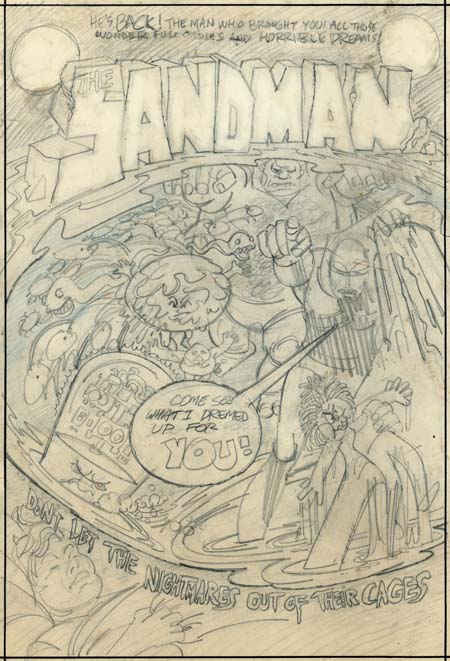
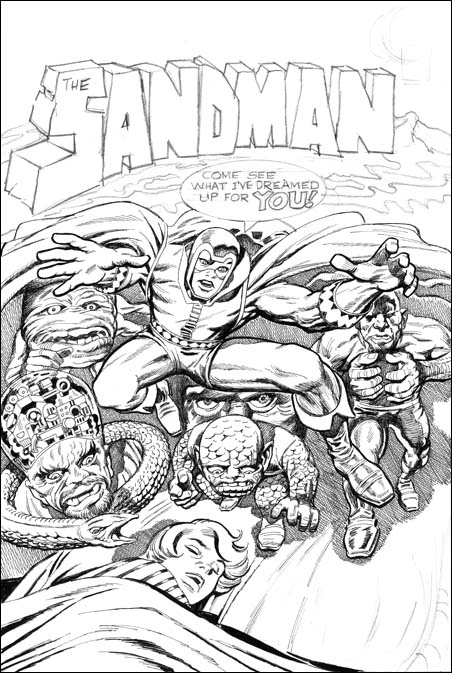
Sandman #1 cover rough
Sandman cover rough by Jerry Grandenetti

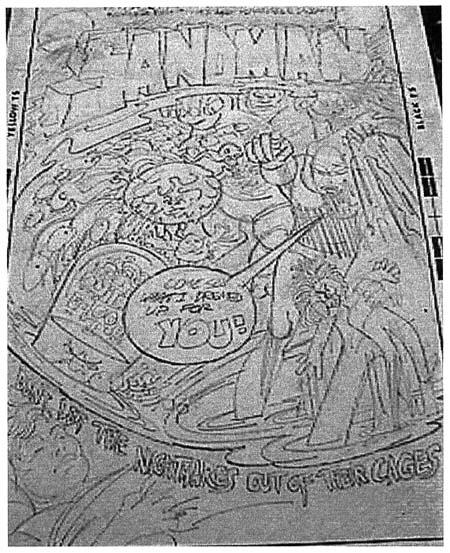
A few months ago I posted on a cover rough that Jerry Grandenetti did for the 1974 version of the Sandman. Kris Brownlow provided an image from an old eBay listing which, to put it kindly, was of a rather poor quality (the eBay lister’s fault, not Kris’s). Happily I have been able to obtain the original piece through the help of Scotty Moore.

The better image of the Grandenetti cover is welcome indeed. Now we can make out the text from the top of the cover:

HE’S BACK! THE MAN WHO BROUGHT YOU ALL THOSE WONDERFUL STORIES AND HORRIBLE DREAMS

This obviously refers to the golden age version of the Sandman that Simon and Kirby produced. Potential readers would likely have been aware of that Sandman from reprints that had appeared in the back of the various New Gods titles.

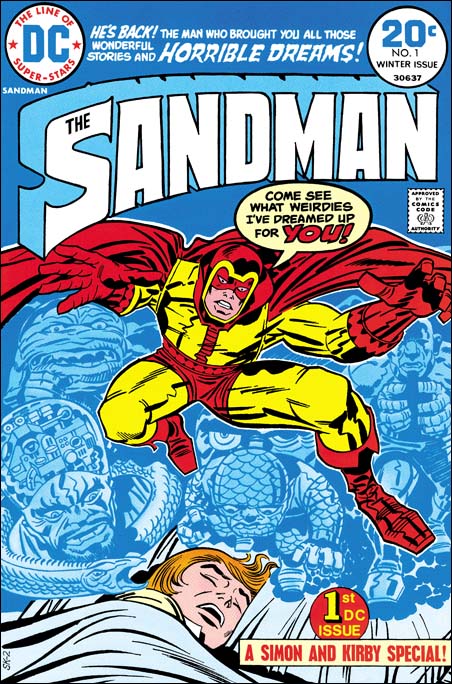
Sandman #1
Sandman #1 (Winter 1974) art by Jack Kirby

Now that it is possible to have a good understanding of the cover rough, it is clear that there is a correspondence between Grandenetti’s rendition and Jack Kirby’s published version. I previously pointed out that the machine head guy on the lower left was common to both. Also the group of snakes became represented by a single serpent. Now it can be seen that other figures correspond as well. The small man a little left of center on the cover rough becomes the scaly man on the bottom of the dream scene on the published cover. Also a little left of center is a figure whose body is nothing more then a circular head with small face surrounded by a rough or folded skin. In Kirby’s drawing the face becomes larger to encompass the entire head, but the folded skin and lack of a true body leave little doubt that it represents the same figure. Grandenetti’s muscle man on the upper right was retained by Kirby although the arms, originally in a Frankenstein pose, were changed to bring the hands together. Grandenetti had a number of circles with multiple legs (spiders?) on the left, which Jack did not made use of. Further Jack dropped the arm holding the doll and added a mysterious and threatening set of eyes. Of course the most important change is that Grandenettis’s Sandman had been delegated to the side almost lost among the dream figures. Kirby instead placed Sandman front and center using his signature exaggerated perspective. There is no doubt in my mind now that Jack saw either this Grandenetti cover or, less likely, yet another version of it.

This is convincing evidence that the bronze age Sandman was originally a Joe Simon concept. At that time Joe had been doing a number of projects for DC. Simon would be the creator and writer while another artist, generally Grandenetti, would do the art. Originally Sandman was going to be nothing more then another comic that Simon would produce for DC. However remembering the success of the golden age Sandman, Carmine Infantino probably twisted Kirby’s arm to got him to team up once again with Joe. But Jack had a long period of creating and writing material without getting the proper credit and had only recently been able to escape that fate. Now he was thrust back to teaming up with another and, worse yet, working on someone else’s concept. Despite the success of the new Sandman, Jack would not, in all likelihood refused to, continue his collaboration with Joe. Thus a Sandman was the first comic that the Simon and Kirby teamed did for DC and it would turn out the last not only for DC but anyone else as well.
The resurfacing of the Grandenetti cover is very fortuitous as I was planning to sometime in the next few weeks to post on the golden age Simon and Kirby Sandman. If that is not enough Sandman for you, I will also post sometime soon on a question I was asked by Scotty Moore about what was used as the basis for the inking of the published version of the Sandman #1 cover.

The back of the Grandenetti cover draft has some enigmatic text:

I’VE GOT IT, JUST
WHAT YOU DEMANDED
THE CASH -
THE LOOT -
THE/A COOL
MILLION

An idea for a crime comic proposal?

Original Art
Sandman cover rough by Jerry Grandenetti

Some time ago I received an email from Kris Brownlow asking if I knew anything about a Sandman cover drawn by Jerry Grandenetti. Kris thought he remembered seeing it on eBay in the late 90’s. Unfortunately I knew nothing about the cover nor was Kris able to find anyone on various comic lists who knew anything either. When I asked Joe Simon he confirmed that Jerry was involved in the early stages of the Sandman proposal. That tantalizing state was were things remained until recently Kris stumbled on a printout that he had made, and forgotten, of the original eBay image. I would like to thank Kris not only for the scan of the printout he provided but also for his diligence in uncovering this fascinating piece of comic book history. I have done some Photoshop adjustments of the scan, but because it is a second generation copy of what was probably a poor scan to begin with, there was a limit to what I could do.

Both Kirby and Simon were working for DC in the early 70’s. Jack’s New Gods titles had not been as successful as hoped and DC had him doing other things such as Kamandi. Joe’s DC work was more on the lines of a creator, writer and editor. The art for Joe’s books was done by others, including Jerry Grandenetti. Since Joe’s titles would last only a few issues I would hazard a guess that his books were not big sellers. It must have seemed obvious to Carmine Infantino to try re-uniting the Simon and Kirby team. Perhaps with a bit of arm twisting, Carmine persuaded Jack. So after many years of working separately, Joe and Jack produced Sandman. The comic seemed to sell well enough but Kirby had his own personal goals which did not include turning back the clock to a long past working relationship. More issues of Sandman would follow and Jack would contribute covers and eventually some story art, but he would do so without Joe’s help.

Original Art
Unpublished Sandman cover, pencils by Jack Kirby and inks by Joe Simon.

Joe Simon inked a version of the Sandman cover drawn by Jack Kirby. Perhaps because of Joe’s use of crosshatching (which DC staff derogatorily called hay) or because of the liberties that Joe took (such as rounding off of finger tips), this cover was never published. But it does stand as an intermediate state between Jerry’s version and the final published cover. Kirby must have seen Jerry’s rough, or perhaps some other intermediate layout that we do not know about, because Jack keeps a couple figures. Most notable is the machine headed guy on the left in both versions. The pose of the legs of a scaling demon on the second state is similar to a larger figure higher up on the page in Jerry’s sketch. Jerry had a number of serpents on the left side which was reduced to a single one in the Kirby/Simon cover.

The above similarities were unchanged in the final published state. But there are other features shared between the Grandenetti and the Kirby/Simon versions that did not survive to the final cover. Both have the Sandman logo looking like it was made of stone. The logo in both sits on what looks like a swirling river. This river sweeps down from the right to the left but in Jerry’s rough, though not the Kirby/Simon art, the river turns back in to form part of the divide between the nightmare world and the sleeping boy. Both early states seem to have a mountain formation the immediate right of the end of the logo.

On the Grandenetti version the Sandman declares:

Come see what I dreamed up for you!

This was modified slightly for the Kirby/Simon art:

Come See what I’ve dreamed up for you!

The text was again altered slightly in the published cover to:

Come see what weirdies I’ve dreamed up for you!

Other features are only found in the initial Grandenetti state. Such as the text that also separates the nightmare scene from the sleeping boy. Or the hand raising up from the river holding a doll. There are other figures but with the poor quality of the scan of Grandenetti’s drawing it is hard to make out what some of them represent. The most dramatic change was made to the Sandman. In Jerry’s rough the Sandman is easy to overlook standing on the right among all the chaos. With the second state the hero becomes front and center with the exaggerated perspective that Kirby so favored.

Sandman #1
Sandman #1 (Winter 1974) art by Jack Kirby

Except for the inking, the published cover is not very different from the rejected Kirby/Simon version. The rock formation logo has been replaced with a more modern and sleek version, but otherwise keeps the overall form. The flowing water and mountain have been completely eliminated.

Since we have three versions of the Sandman cover, are there more? Joe’s collection includes two copies of the Kirby/Simon state. These copies do not differ significantly in layout from the second state and I believe they were actually made years later. The published comic has a job number of SK-2 so what was SK-1? Very likely SK-1 was the Kirby/Simon version. I have seen on a couple occasions the original art of another Sandman cover rough purportedly done by Joe Simon. On that example the drawing is very amateurish and was certainly not done by Joe. Who knows, maybe there are more Sandman covers out there?

Next Page »