
Category Archives: Simon, Joe

Early Joe Simon and Flash Gordon

The most certain way of spotting a comic book swipe* is, of course, to find the earlier version that from which it was swiped. But it is possible to recognize a swipe even when the original has not yet been found. Deviations in art style or level of detail in the art is one method that can be used to suggest that swiping has been used. Repetition of a particular image is another.


Daring Mystery #2 (February 1940) “Phantom Bullet” page 9, pencils, inks and letters by Joe Simon

An early assignment for Joe Simon (released only one month after his earliest published work) was “Phantom Bullet” for Timely Comics. Note the despairing female in the second to last panel from page 9. Actually there is little in the art to suggest that this is might be a swipe. Perhaps only that the woman’s pose seems not to match very well to the action. However such a defect could easily be excused since Simon had just begun to learn his trade as a comic book artist. His previous experience as a staff artist for a newspaper did not overly prepare him for the special requirements of sequential art.


Wonderworld Comics #13 (May 1940), pencils and inks by Joe Simon

When Simon became editor for Fox Comics he would draw the cover art. The same damsel in distress shows up on the cover of Wonderworld #13. The Wonderworld figure is a close match for the one in Phantom Bullet but by no means identical.


Flash Gordon (February 4, 1934), art by Alex Raymond

So at this point nearly the same figure appears on two occasions. While this is not proof that the figure was swiped it certainly is strongly suggestive that it was. The proof came when I recently noticed a panel shown above from the newspaper syndication strip Flash Gordon. Simon was a big fan of Raymond’s Flash Gordon (as well as Hal Foster’s Prince Valiant). Other swipes by Simon from Flash Gordon have been previously reported (Art by Joe Simon, Chapter 4, Footnote) so the fact that Raymond is the source of the female figure is not totally unexpected. Still it is nice to have confirmation on a swipe that was already expected based on its repeated use. The biggest surprise is that date of the Raymond original, February 1934, six years prior to Simon’s swipe. It is possible that Simon and kept a copy over the years but it is also possible that he had picked up a reprint book. Raymond’s Flash Gordon was very popular at the time and reprints the publisher Whitman had released at least one volume in 1940.


Wonderworld Comics #13 (May 1940) art by Joe Simon
Flash Gordon (February 4, 1934) art by Alex Raymond
Daring Mystery #2 (February 1940) art by Joe Simon

Above I have scaled the figures to the same dimensions for an earlier comparison. It can be seen how much of the damsel in the Wonderworld #13 cover was copied from Flash Gordon. Even much of the detailing of the folds and shadows of the woman’s dress are shared between the two. Not surprisingly the figure from the Phantom Bullet panel has less details but even in it some of the folds of the dress were copied from Raymond’s work. While the similarity of both of Simon’s version to the Flash Gordon original are too close for anything other than swiping, they are not so close to suggest anything other than a hand drawn copy. There was a time on the defunct Kirby-list where some claimed Simon used a copying device such as an overhead projector. They may all seem very similar but when I tried to overlay one drawing over another there were so many differences that the resulting overlay was too confusing. As an example compare the female’s buttocks. They are much longer in the two drawings by Simon than they are in the Raymond original. Such mistakes would are quite typical of hand drawn copies but would not be expected to be found in a copy made with the aid of a mechanical or optical device.


Silver Streak #2 (January 1940), pencils and inks by Joe Simon

One of the first pieces of comic book art that Joe Simon ever did was the cover for Silver Streak #2 (January 1940). One can question the anatomical accuracy but nonetheless it is a great cover full of energy and interest. Again by itself there is nothing in the cover art that glaringly suggests the use of swipes. However familiarity with Simon’s art style suggests that the gun firing hero might, just might, be a swipe because of the amount of detail provided for the anatomy.


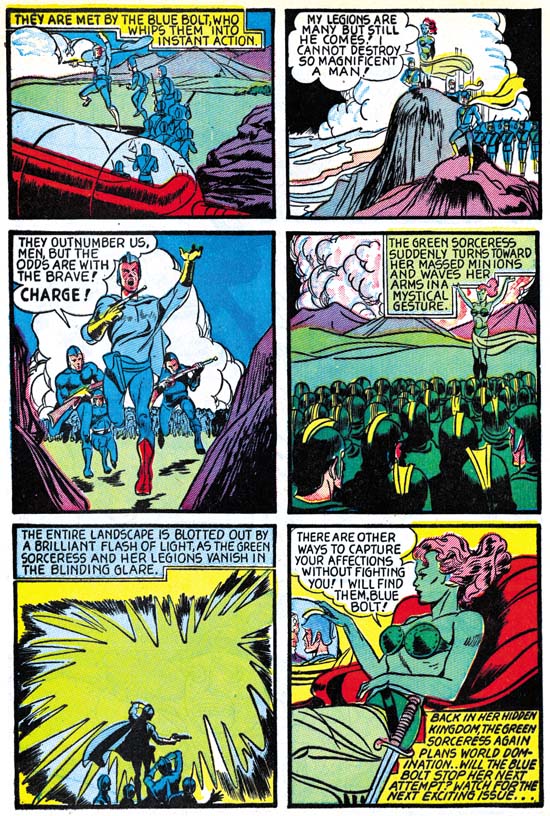
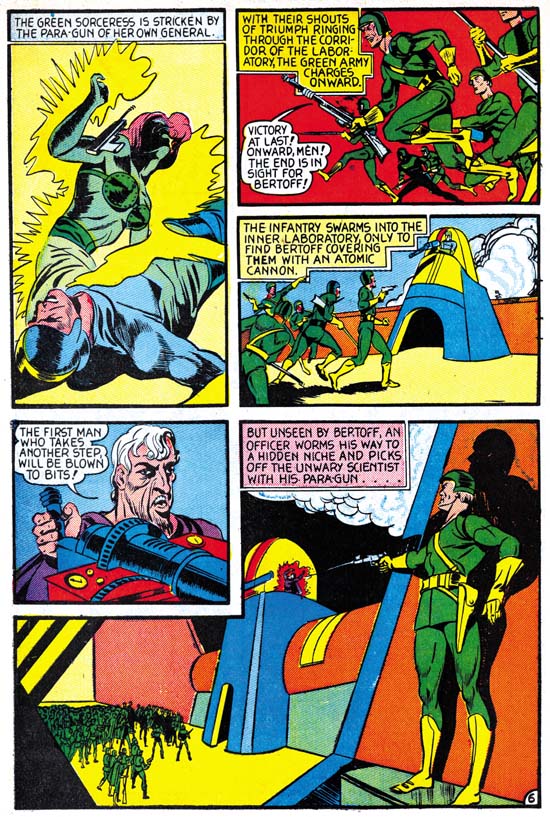
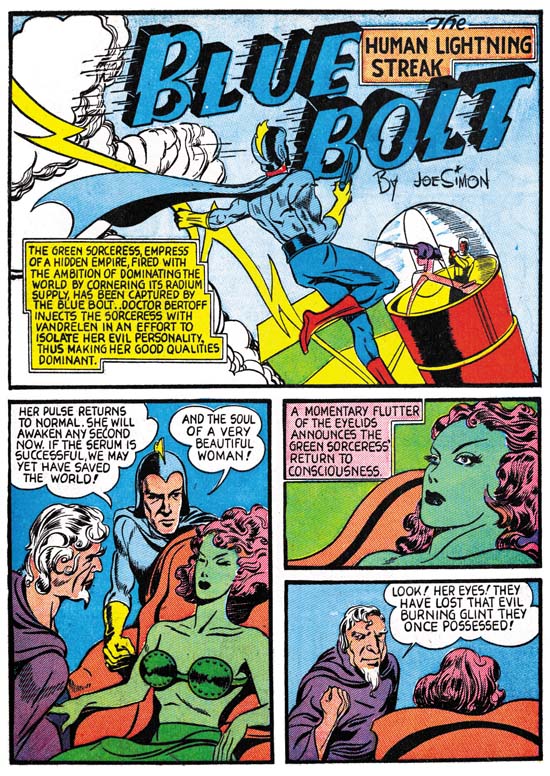
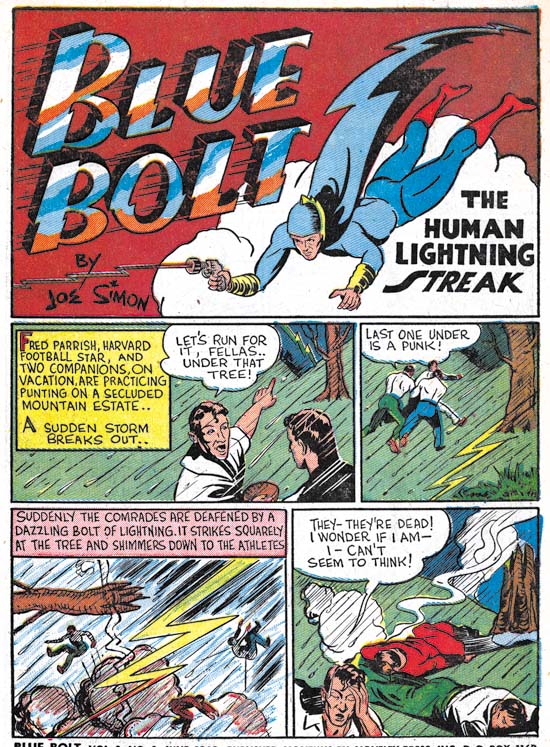
Blue Bolt #1 (June 1940) “The Human Lighting Streak” panel 4 of page 6, pencils, inks and letters by Joe Simon.

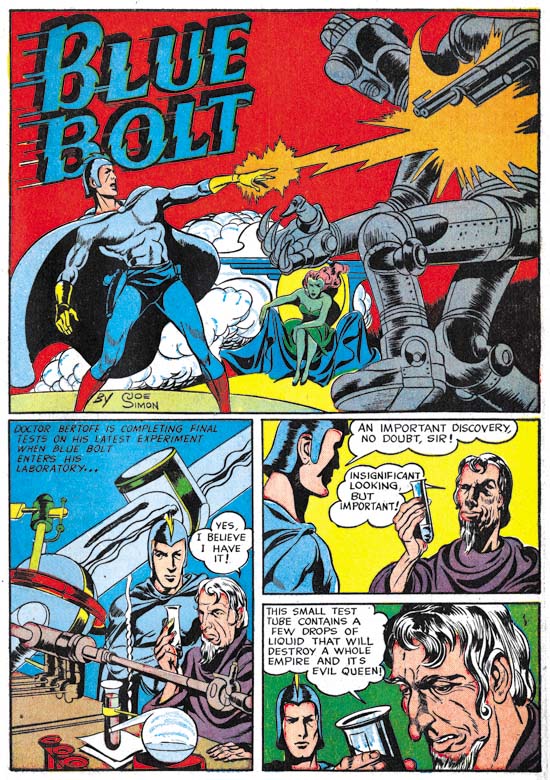
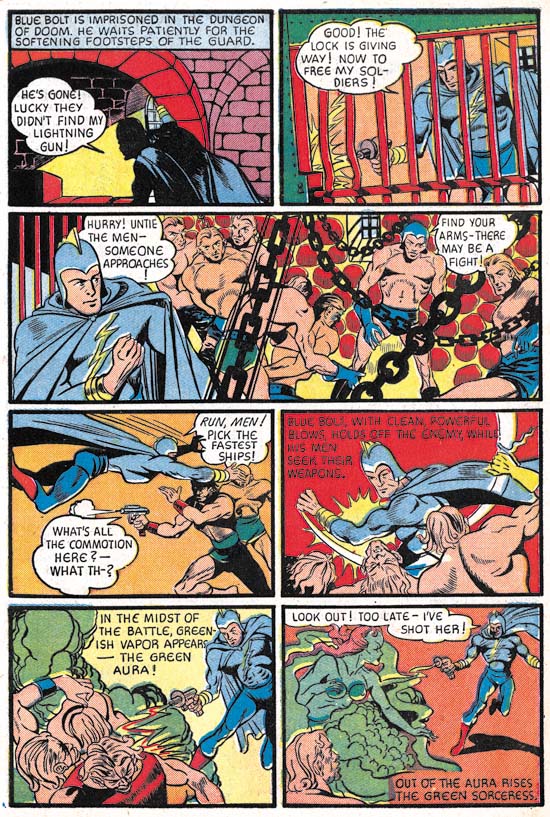
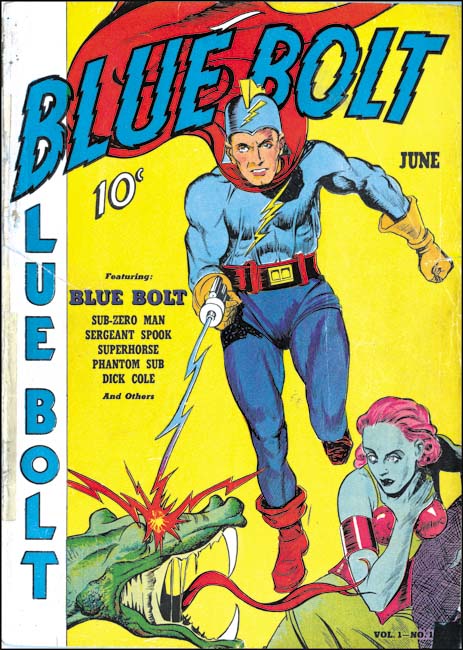
Not long afterwards Simon created Blue Bolt. Actually as I discussed in a previous post (In the Beginning, Chapter #1, Blue Bolt #1) the origin story for Blue Bolt may have been created earlier than its cover date indicates. The same female figure appears once again although under more general circumstances the green sorceress would not be described as a damsel in distress. But while usually a villainess she would periodically become in need of saving by Blue Bolt. Once more repetition suggests the use of a swipe.


Flash Gordon (April 22, 1934), art by Alex Raymond

Earlier I believed that this second female image was little more than an altered version of the first. However on reviewing the material in preparation for this post I concluded that there must be a different source for the second figure. However considering the great similarity between the two figures I believed that the Alex Raymond was also the source of the second swipe. I then did more searching and found the source of the second female figure in the Flash Gordon strip from April 22, 1934.


Blue Bolt #1 (June 1940) art by Joe Simon
Flash Gordon (February 4, 1934) art by Alex Raymond
Silver Streak #2 (January 1940) art by Joe Simon

AgainI have matched the original and the two swipes as closely as possible. While sharing some even rather small details the two Simon images are not exact copies of the Raymond original.

Flash Gordon is once again going to be reprinted this time by two publishers, IDW and Titan. IDW’s first volume is already out and Titan’s is scheduled for release in March. I am sure that many more sources for Simon’s swiping will be found in these volumes.

Footnotes:

* I find “swipe” to be an objectionable term because of the connotation of theft that it is based on. There is no similar expression in the fine arts where no one would describe Michelangelo’s Moses as being a swipe of Donatello’s St. John the Evangelist (as shown in Kirby Swipes from Simon). However the term swipe is so entrenched in discussions on comic books that it must be accepted.

Posted in 2011/12, Artists, Simon, Joe, Swiping, Topic, z Archive | Leave a comment

In the Beginning, Chapter 9, More Moonlighting


Blue Bolt #7 (December 1940) Blue Bolt, pencils by Jack Kirby, inks by Joe Simon, letters by Howard Ferguson

Blue Bolt #7 continues the Simon and Kirby collaboration in its purist form, that is with Jack doing the pencils and Joe providing the inks. The only other feature from December that showed such a degree of collaboration was the Black Owl from Prize Comics #7 which I will discuss below. Both of these features were done while moonlighting. As we will see below the features created for their regular gig at Timely were not quite the same joint effort.

The enlarging World War II, romance, betrayal, spies and assassins are just some of the elements of this engaging story. Simon and Kirby were not satisfied with telling a simple confrontation between a hero and a villain they had to put in as much as possible. Ten pages hardly seemed enough to fit all that they included. It does not seem that Blue Bolt had any significant impact on the rest of the comic book industry of the day but it should have.
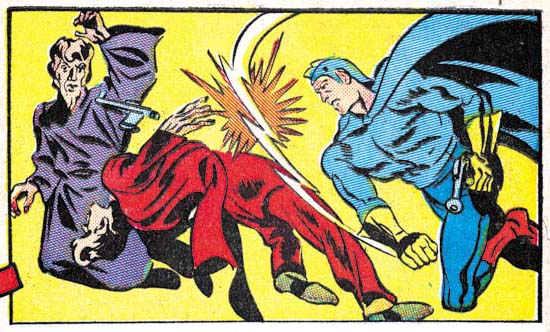

Blue Bolt #7 (December 1940) Blue Bolt page 8 panel 1, pencils by Jack Kirby, inks by Joe Simon, letters by Howard Ferguson (horizontally flipped image)

Sure Blue Bolt was science fiction but that did not mean that the hero always used a ray gun. Previously Kirby had a penchant for dramatic slugfests but now he began to take that art to a new level.

I present the above image in reverse…
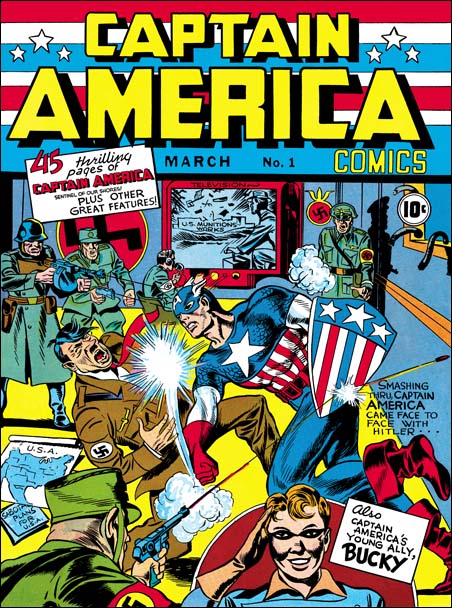

Captain America #1 (March 1941), pencils by Jack Kirby

as I want to highlight that roll Blue Bolt played in laying the groundwork for a future hit. Captain America would appear on newsstands just three months later.
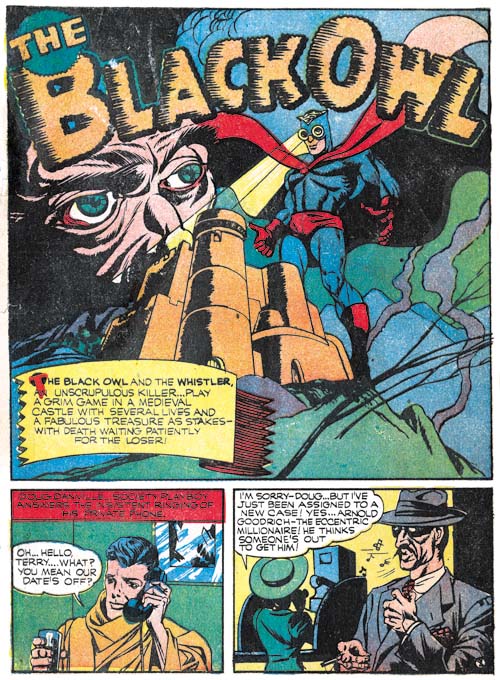

Prize Comics #7 (December 1940) The Black Owl, pencils by Jack Kirby, inks by Joe Simon?, letters by Howard Ferguson

Blue Bolt was not the only moonlighting job that Simon and Kirby produced for December they also did Black Owl for Prize Comics #7. Joe and Jack would end up doing a Black Owl story for three issues which I discussed previously (Simon and Kirby’s Black Owl). All three stories were reprinted in Titan’s “Simon and Kirby Library: Superheroes” (shameless plug). The Black Owl was not a Simon and Kirby creation and I really do not know much about previous appearances of the character.  But of course Simon and Kirby added their distinct touch if in nothing more than the story and art.
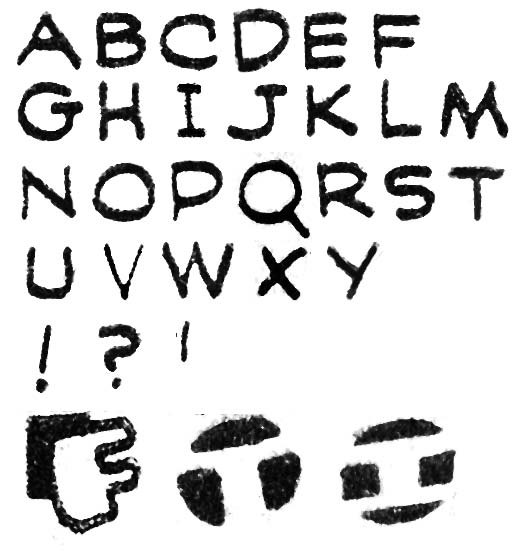

Prize Comics #7 (December 1940) The Black Owl, letters by Howard Ferguson

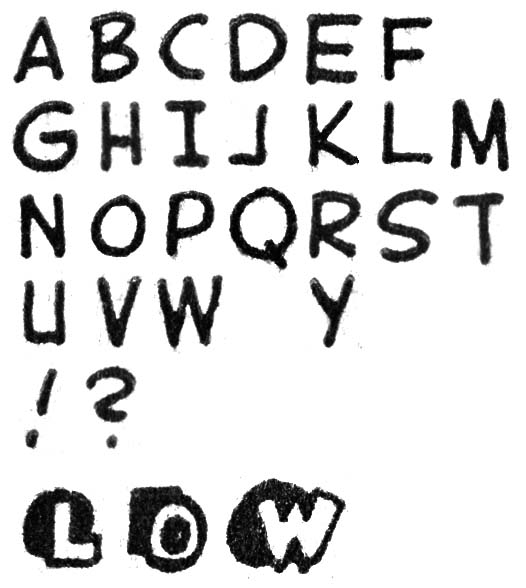
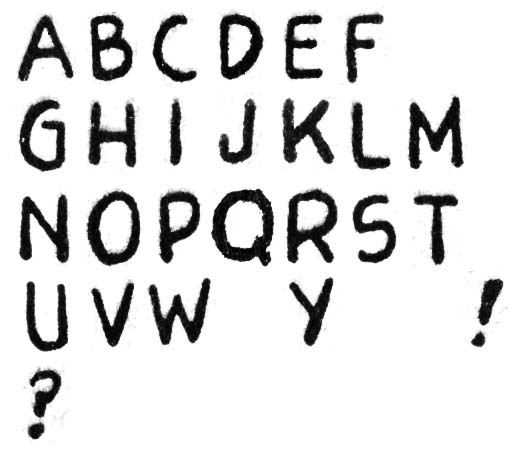
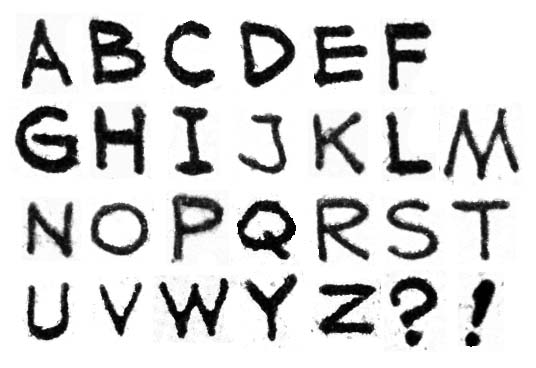
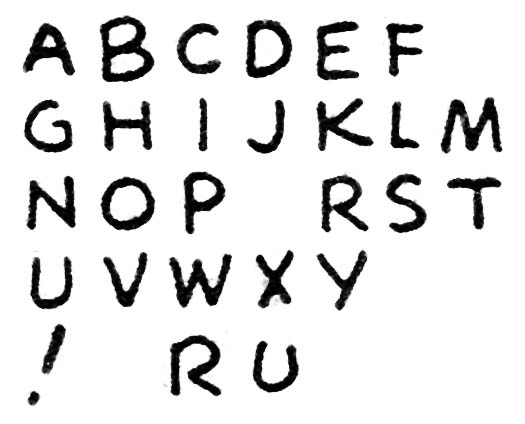
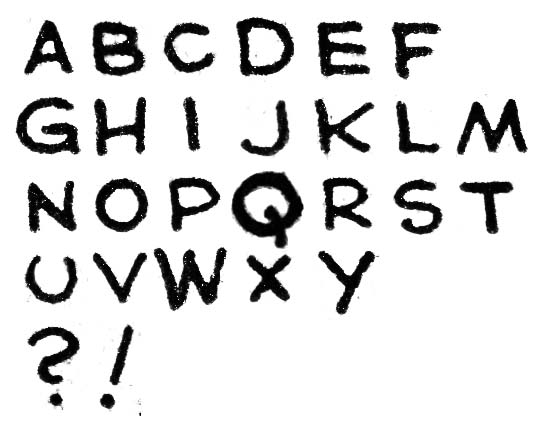
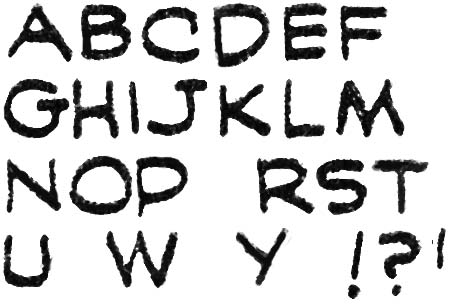
Howard Ferguson provided the lettering for the Black Owl story. I have previously provided the lettering samples for Ferguson’s Prize Comics #7 but I have since made a correction and some additions to it. A recap of the more useful features would seem in order. The most useful trait for identifying Ferguson lettering is the little vertical stroke attached to the upper end of the letter ‘C’. Another useful trait is the very shallow hook for the letter ‘J’ but unfortunately that is not a common letter. Some other traits are less useful but still should be noted particularly the way the upper portions of the letters ‘P’ and ‘R’ predominate over the lower portion. The letter ‘S’ is similarly often affected by a predominate upper portion but there is some variation in this feature. Another trait is found in some but not all ‘N’ is the manner that the left vertical stroke is sometimes tilted downward to the left somewhat. Perhaps not as useful than the letter ‘C’ but certainly easier spot is Ferguson’s special handling of the first letter in captions (examples are provided above). I believe all these traits (except the special ‘N’) were retained by Ferguson the rest of his career. I plan to review his entire career after I finish this serial post.

In is at this time that in my opinion Ferguson’s lettering has gone from good to great. This is not due to form of his letters which has changed only a little from previous work. Rather it steady and firm hand used and the spacing and legibility of the final results. Ferguson’s work is not mechanical but neither is it overly variable.

Besides an improvement in quality, the lettering differs from what was done not that long ago for Blue Bolt #5 (October 1940) by three changes.

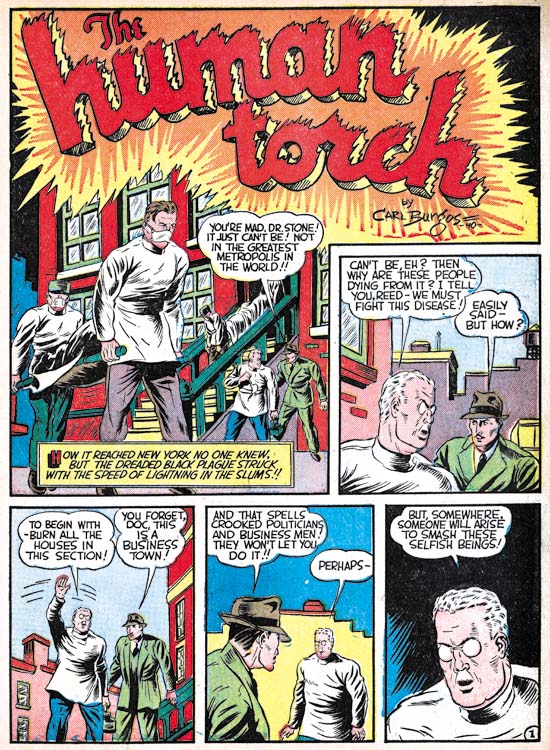
I have previously pointed out the special handling of the first letter in captions. Such enlarged and specially formed letters are similar to the first letter of chapters often found in older books. The analogy is not perfect but it is close enough that I have decided to adopt the name given to them, drop capitals (or drop caps for short). Drop caps were used by other comic book letterers but Ferguson began using a special version where the letter is created a negative space in a black field such as the two final examples in the image above. I shall refer to these as negative drop caps. It was the introduction of negative drop caps that is one of the things that distinguish Prize #7 from Blue Bolt #5. But there appears to be two flavors of negative drop caps. The first that appeared in Blue Bolt #6 and the Terry Vance feature from Marvel Mystery #13 (both November 1940) had vertically oriented letters. Later in Blue Bolt #7, Prize Comics #7 and the Human Torch and the Terry Vance features from Marvel Mystery #14 (all December 1940) Ferguson introduced negative spot caps that were tilted.

The second change in Ferguson lettering concerns the letter ‘G’. In Blue Bolt #6 (November 1940) and earlier Howard constructed the ‘G’ with a small horizontal element on the left side of the bottom of the character and does not extend to the right. In Prize Comics #7 and the Human Torch story from Marvel Mystery #14 (both December 1940) Ferguson extends the small horizontal so that it appears on both the left and the right side. Interestingly Blue Bolt #7 (December 1940) uses the old form of ‘G’ for most of the first page of the story while otherwise using the new ‘G’. The old ‘G’ is used in BB #5 (October), BB #6 (November) and the Terry Vance stories from MM #13 and #14 (November and December). As mentioned both forms of ‘G’ appear in BB #7 (December). Only the newer ‘G’ appears in the Human Torch of MM #14 (December).

The third change involves the form of the letters ‘I’ and ‘J’. Ferguson’s older form for these letters excluded any horizontal elements while the newer form did. While the letter ‘I’ is common enough, horizontal strokes are not supposed to be added when the letter is used with others to form a word. Unfortunately the isolated use of ‘I’ and the use of ‘J’ are not too common. The old form of ‘I’ and ‘J’ appear in BB #5 (October), BB #6, Terry Vance from MM #13 (November) and BB #7 (December) with the new forms used in PC #7 and the Terry Vance feature of MM #14 (both December).

With these three changes in Ferguson’s lettering it would seem possible to sort out the relative order that Ferguson lettered the work appearing in the months from October to December. Regrettably it turns out that no ordering is possible that will satisfy all three criteria for all cases. The few cases of lettering by Ferguson from later periods suggest that perhaps he was not consistent in his use of ‘G’. Hopefully this question will be answered as my review progresses.
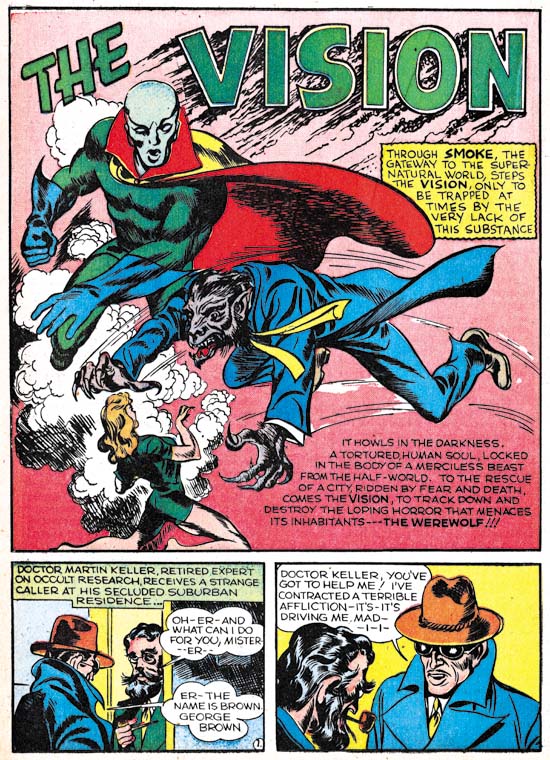

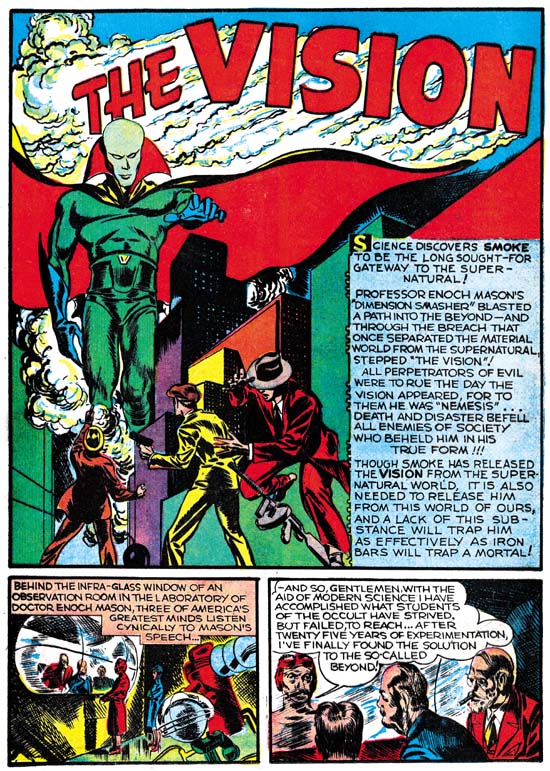
Marvel Mystery #14 (December 1940) The Vision, pencils, inks and letters by Jack Kirby,

The Vision became a regular Marvel Mystery Comics features with his second appearance in MM #14 (December 1940). As in the previous issue, Kirby would provide pencils, inks and letters for the Vision story. Even today the Simon and Kirby Vision is a largely neglected feature and at that time it was very much overshadowed by the Human Torch and the Sub-Mariner. (This story was reprinted in “The Best of Simon and Kirby”, another shameless plug).

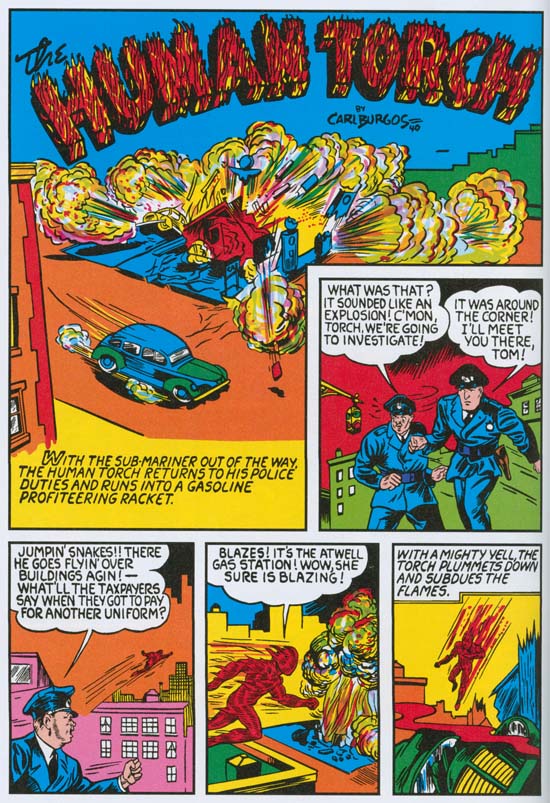
Lettering by Howard Ferguson also appeared in Marvel Mystery #14 in the Human Torch and the Terry Vance features.
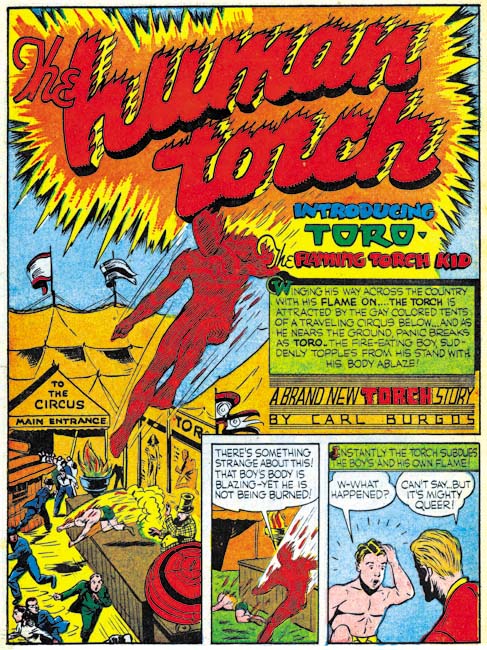

Human Torch #2(1) (Fall 1940) the Human Torch “Introducing Toro”, pencils by Carl Burgos, lettering by Howard Ferguson

As mentioned in the previous chapter, Timely did not release a Red Raven #2 issue. Instead that titles mailing license was used instead for a new title, Human Torch Comics #2. That the first issue was numbered 2 has brought about confusion to the numbering of the title even back when it was released. I have added “(1)” to the issue number to indicate it is actually the first issue. The cover is dated as Fall 1940 which means there might be some question as to what month to assign it. However Marvel Mystery #13 (November 1940) and #14 (December 1940) have house advertisement for the Human Torch #2(1). The MM ads provides a release date of September 25. Normally comics are cover dated about two months after their release so it is seems appropriate to assign HT #2(1) to December.

This issue has been reprinted in the Golden Age Masterwork series. Unfortunately Marvel did a horrendous job re-creating it. I have discussed this previously (The Human Torch #2) but I feel I need to emphasize here that the reprint volume is useless for anything beyond a casual reading. It is simply not possible to use this reprint book to examine the art or lettering. Luckily I will be using scans from the original comic in my discussions here.
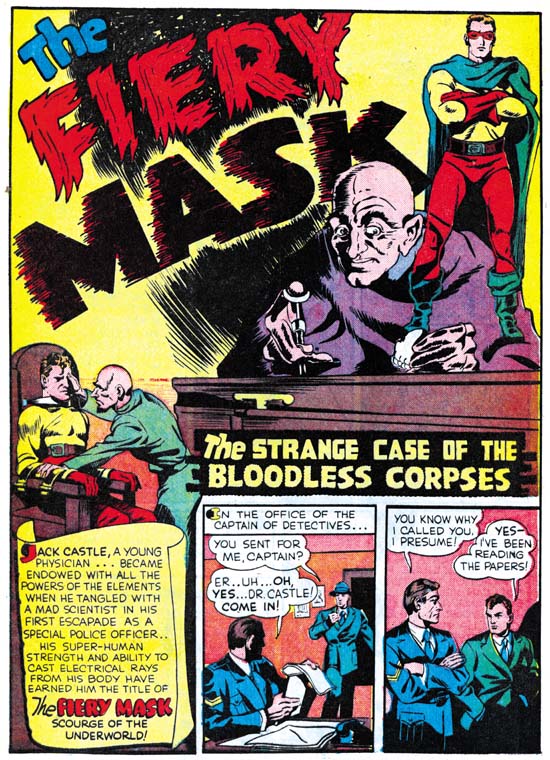

Human Torch #2(1) (Fall 1940) the Fiery Mask “The Strange Case of the Bloodless Corpses”, pencils and inks by Joe Simon, letters by Howard Ferguson

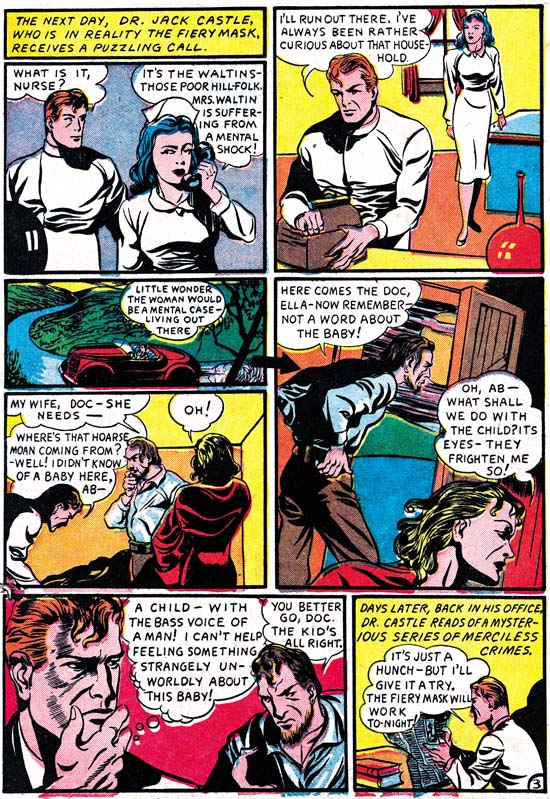
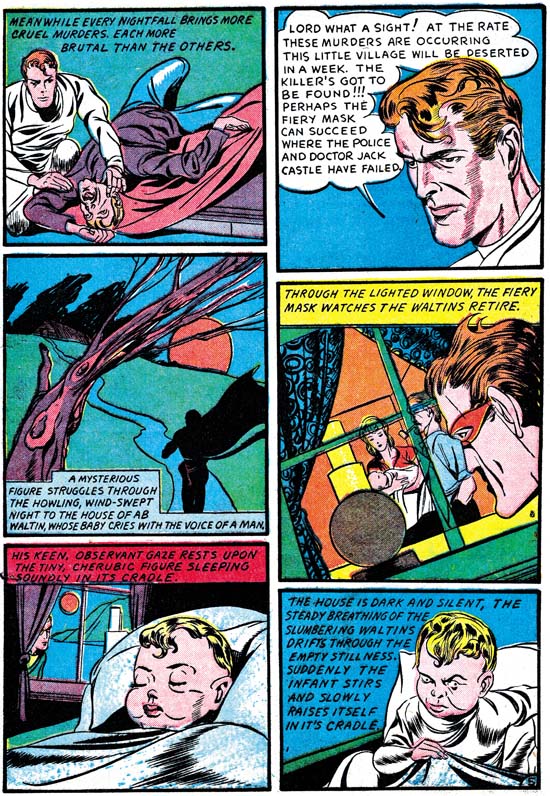
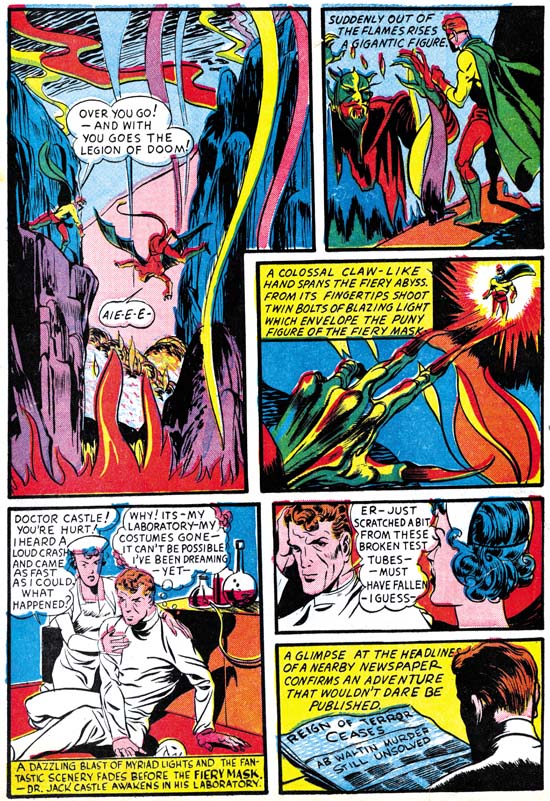
The Fiery Mask was one of Simon’s earliest creations having first appeared in Daring Mystery #1 (January 1940, Daring Mystery and Joe Simon BK (Before Kirby)). Another artist drew the character for Daring Mystery #5 (June 1940) but Simon returned with Kirby’s help to provide the Fiery Mask for Daring Mystery #6 (September 1940). Simon worked on the Fiery Mask one last time for Human Torch #2(1) (Fall 1940). I periodically get asked, but I really feel this was a solo effort because I cannot find any sign that Kirby had anything to do with this Fiery Mask story, “The Strange Case of the Bloodless Corpses”. Simon’s comic book art improved rapidly so that even though only a short period had past the art style for HT #2(1) Fiery Mask story shows it was definitely drawn when Simon became editor at Timely and was not some older inventoried story from when he first started working in comics. Still it would be nice to provide a more accurate date for the story as it theoretically have been done a few months earlier and inventoried or it could have been drawn later specifically for the HT #2(1) issue.

Fortunately the lettering Howard Ferguson did for the story may provide a clue. As mentioned before Ferguson’s work had been undergoing development during this period. The Fiery Mask story lacks negative drop caps and uses the older form of the letters ‘G’, ‘I’ and ‘J’. Therefore I believe it must have been done no later than the work for Blue Bolt #5 (October 1940). It likely was originally intended for Daring Mystery #7 which possibly was meant to be released in October or November but that publication of that issue was delayed until April 1941. Or alternatively it might have been meant for Red Raven Comics #2 which should have come out in October but that title got cancelled. But in any case the Fiery Mask story was done earlier than the Human Torch story in the same issue as that story was lettered by Ferguson but with the tilted negative drop caps, the new ‘I’ and ‘J’ and mostly using the new ‘G’ all of which suggests a December date.
Posted in 2011/11, 3 Timely, Artists, Assorted, Kirby, Jack, Lettering, Periods, Serial Posts, Simon, Joe, Start of S&K, Topic, z Archive | Tagged , , | Leave a comment

In the Beginning, Chapter 8, A New Title


Blue Bolt #6 (November 1940), pencils by Jack Kirby, inks by Joe Simon, letters by Howard Ferguson and Joe Simon

Blue Bolt #6 is the second feature to include Simon and Kirby credits. Once again Kirby provides the pencils while Simon does the inking. Although it is not known who wrote the script, the story has the special Simon and Kirby quality that already was very different from the standard comic book fare of the day. Now the green sorceress is joined by Marto, a man with enlarged head and an atrophied body who uses a special mechanical device to overcome his physical limitations.


Famous Funnies #76 (November 1940) Lightnin’ and the Lone Rider, pencils, inks and letters by Jack Kirby

Kirby seemed to have a fascination with advanced beings with large heads. The earliest prototype appeared in a western feature that Jack work on called Lightnin’ and the Lone Rider. Actually this feature had been appearing in Famous Funnies at the same time as Blue Bolt #6. The Lone Rider was initially developed as a syndication strip back in late 1938 to early 1939 (Early Jack Kirby, Chapter 1, Lighting and the Lone Ranger). However it appears Kirby returned to the feature sometime later. Exactly when is uncertain but I believe it was while Kirby was still working for Fox Comics (Early Jack Kirby, Chapter 3, Moonlighting). However based on the art style I believe it was done before Kirby started working with Joe Simon and therefore outside the current discussion. However the recent appearance of the large headed adversary in Famous Funnies may have inspired Kirby to create an updated version for Blue Bolt.


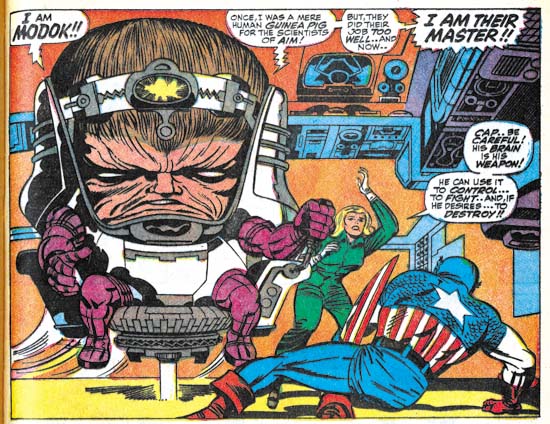
Tales of Suspense #94 (October 1967) pencils by Jack Kirby, inks by Joe Sinnott, letters by Sam Rosen

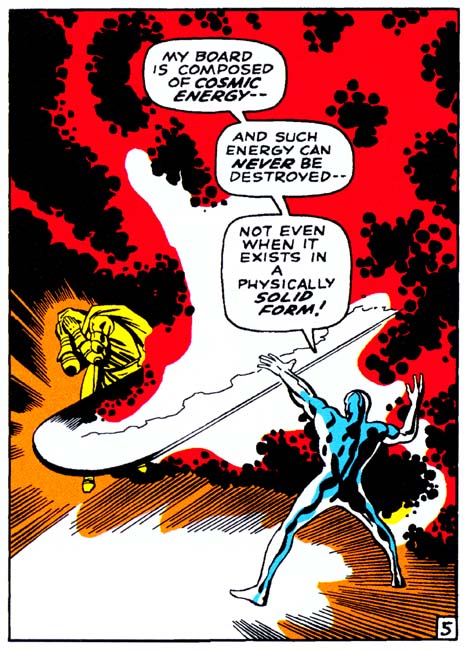
It is surprising how some ideas seem to lay dormant for years before Kirby would return to them. If there was another appearance of the Marto character I do not recall it. But in 1967 Kirby returned to the theme when he created Modok. While the background stories were very different, the similarity between Marto and Modok is too great to be require much discussion.


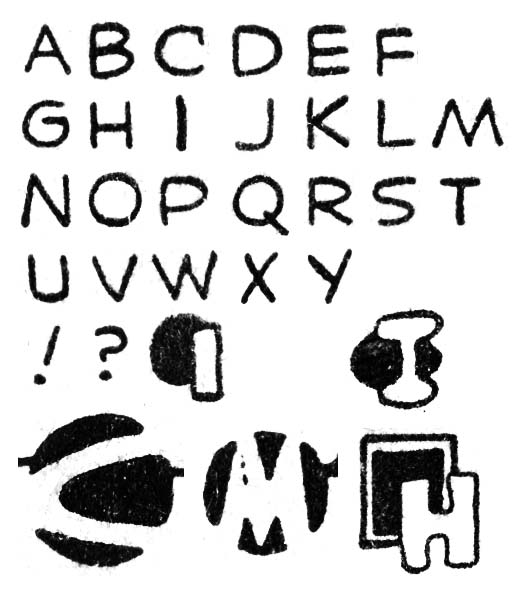
Blue Bolt #6 (November 1940), letters by Howard Ferguson

The first six pages of the Blue Bolt feature were lettered by Howard Ferguson. The seventh page has some lettering by Ferguson but most of the page was lettered by Joe Simon. The style of the letters has not change at all from examples from the previous month. The use of circular or square shapes attached to the first letter of captions is also the same as what has been seen earlier. One new feature in Ferguson’s repertoire is the use of other abstract shapes with the first caption letter such as the oval and double square show above. The most interesting addition is the rendering of the letter as a negative space on a circular black field such as the ‘C’ and ‘M’ shown above. This simple but elegant design was the most effective design that Ferguson adopted. Unfortunately Ferguson had no control on how the colorist would handle it. When a separate color was added the letter would stand out. But without that special color addition the design becomes more abstract and harder to read as a letter. Unfortunately the colorist failed to apply a separate color to many of these negative letters in Blue Bolt #6.


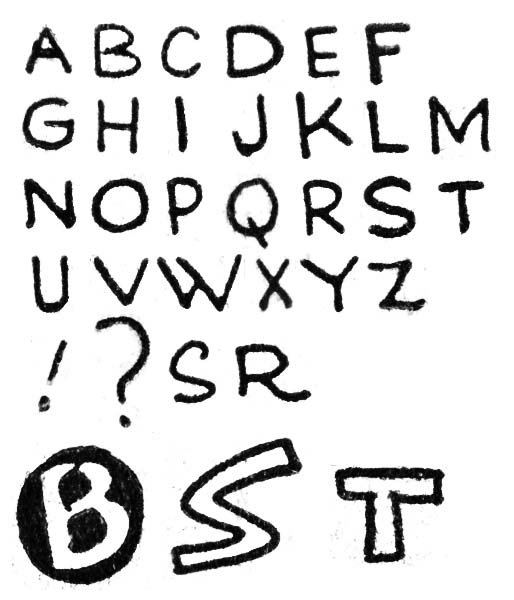
Blue Bolt #6 (November 1940), letters by Joe Simon

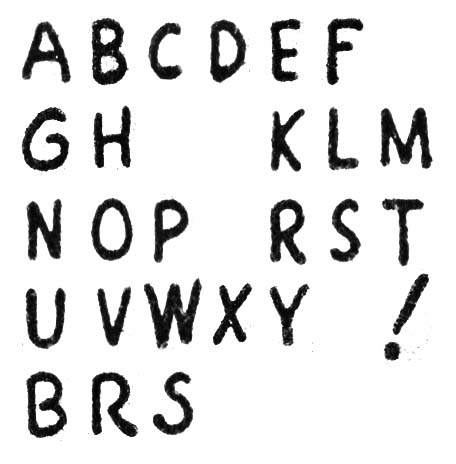
Joe Simon did the lettering for most of page 7 and all of pages 8 to 10. Here Simon does a more careful job at lettering but the basic form of the letters remains the same. As mention previously the ‘W’ that Simon used is very helpful in spotting his work and while not quite as distinct his ‘M’ is useful as well. There still are occasional little elaborations that Simon uses like the ‘S’ and ‘R’ shown above. The lettering for page 9 seems particularly well done. Also found on that page are special first caption letters, something Simon normally did not do. While unusual for Simon, the use of open letters (which allow the addition of a color) was also done by other letterers. However Joe places one ‘B’ as a negative letter on a black circular field. This must have been a response to what Ferguson was doing in the same story. Simon’s design is not as abstract as Ferguson’s but it still an effective device.


Marvel Mystery #13 (November 1940) The Vision, pencils, inks and letters by Jack Kirby

In the previous chapter I mentioned the unusual lack of Kirby art in the Timely comics for October. The one explanation I provided was that Kirby might have done some art for Red Raven #2 only it was never published due to the abrupt cancellation of that title. Here I will suggest another (but not necessarily conflicting) explanation. Kirby might have been busy creating a new feature as in this month Marvel Mystery #13 debuted “The Vision”. The pencils, inks and letters were all done by Kirby. The only thing that suggests that Simon was involved (other than as the editor) was the motif of the Vision being able to appear from smoke of any kind. This is similar to the power of the Flame, a Fox comics feature, who could transport using fire as a portal. While Kirby had worked for Fox Comics he had nothing to do with the Flame. Simon on the other hand was not only the editor for the comics that included the Flame but had also drew the character on some of the covers.

As I mentioned Jack did the lettering for the Vision story. Kirby’s lettering was unchanged from the last time we saw it (Red Raven #1, August 1940 see In the Beginning, Chapter 5). Ferguson provided lettering for the Terry Vance feature from MM #13 in a style that matches his work in Blue Bolt #6.

Posted in 2011/11, 3 Timely, Artists, Assorted, Kirby, Jack, Lettering, Periods, Serial Posts, Simon, Joe, Start of S&K, Topic, z Archive | Tagged , , , | Leave a comment

In the Beginning, Chapter 6, Blue Bolt #4


Blue Bolt #4 (September 1940), pencils by Jack Kirby, inking by Joe Simon

Blue Bolt #4 was the first story created in the definitive Simon and Kirby manner with all the pencils done by Jack and the inking by Joe. While previous Blue Bolt installments were quite nice, it is with BB #4 that the Simon and Kirby magic really unfolds. Exciting visuals, unusual perspectives and a great story. Both Joe and Jack had done their own individual work before this but it lacked the special qualities found in BB #4. Even the work they had done together in Blue Bolt #2 and #3 or Daring Mystery #6 is not quite as good. Only Kirby’s “Mercury in the 20th Century” for Red Raven #1 matches BB #4. The Blue Bolt story may have been signed by Joe Simon alone, but it was certainly a Simon and Kirby creation.

The Kirby Checklist states that Simon got assists in the inking from Avison and Gabriele. While I cannot prove this to be incorrect I also cannot find any evidence of it. The inking looks like the hand of one artist and that was Simon. Joe had made great strides in his inking and much of that can probably be credited to his working with Jack. In fact the inking of the robot and some of the other devices was done in the manner that Kirby had already been doing for his science fiction stories. While Kirby was and would remain a better inker, Simon’s inking talent far exceeded the abilities at that time of Avison or Gabriele.

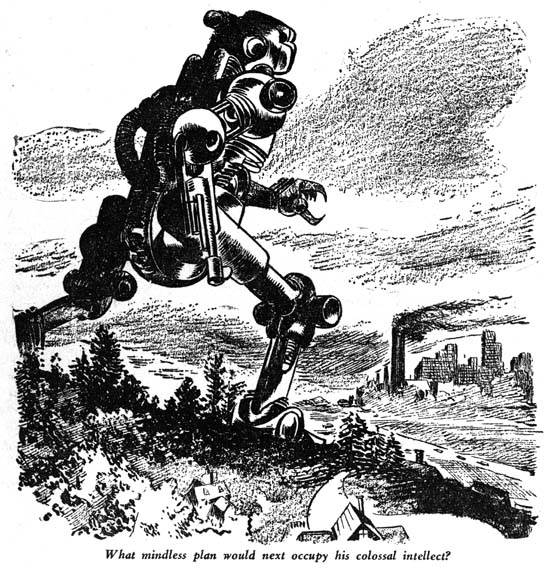
One of the star attractions of the Blue Bolt #4 story was the formidable robot. The splash panel shows a exciting confrontation between Blue Bolt and the mechanical foe. The story takes a different, but still dramatic, turn. The robot’s murderous rampage is handled with what would be typical Simon and Kirby restraint. A restraint that would not diminish but actually enhance the effect. Close-ups, silhouettes and shadows would provide the substance while leaving it to the reader’s imagination to fill in the rest.


Marvel Stories v2 n2 (November 1940) “A Dictator for all Time”, art by Jack Kirby

Both Simon and Kirby would do more than just comic books while working at Timely. They would also supply art for some of the pulps that the company produced. The pulp art was created under different circumstances and with unique techniques. As far as I can tell illustrations were not joint efforts but were individually executed instead. The pencils and inks that were used to create comic book art were replaced with the use of a special textured paper that would translate pencils into dots suitable for printing. While the pulp art may not shed much light on the beginnings of the Simon and Kirby partnership they sometimes are not completely independent of the comic book art. The horrific robot from Blue Bolt #4 makes a reappearance in Marvel Stories volume 2 number 2 a couple of months later. The details may differ but both share one clawed hand with the other arm transformed into a gun. While the robot drawn for the pulp story “A Dictator for all Time” might have been impressive it really had nothing to do with the story. There we find a rather benign machine more of an immense computer than a terrifying weapon.


Blue Bolt #4 (September 1940), letters by unidentified letterer

Another unidentified letter was used for Blue Bolt #4. This letter differed from the one used for BB #3 in the form of the letters used for ‘G’, ‘J’, ‘K’, ‘M’ and ‘W’. It may seem surprising that so many different letterers would work on Blue Bolt but Joe’s position as editor for first Fox then Timely probably provided a lot of resources to turn to. The letterer for Blue Bolt #4 did the most professional work to appear in Blue Bolt to date. One of his interesting contributions was to do caption lettering with a slight slant upward to the right while keeping balloon text as vertical.
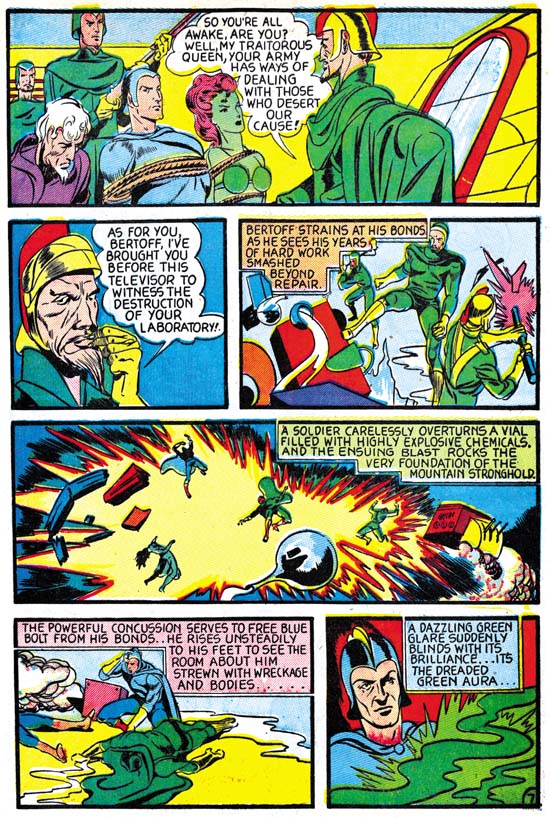

Marvel Mystery #11 (September 1940) “The Human Torch”, letters by Howard Ferguson

The letterer for BB #4 used some larger and specially formed first letters in the captions. A similar approach was used by Howard Ferguson at this time but his first caption letters are even more special. While the BB #4 letterer provided one of this first caption letter with a 3-D effect shadow he never provides the sort of abstract black shapes that Ferguson used. The difference between the two letterers also shows up in their letters ‘G’ and ‘J’.


Blue Bolt #4 (September 1940), page 9 letters by unidentified letterer

Actually not all of Blue Bolt #4 was lettered by the individual discussed above. One page, page 9, was lettered by yet another artist. This page lacks the slanted lettering to the captions as well as any special effects to the first caption letter. The letters ‘G’ and ‘Y’ are distinct between the two. The second letterer also had a tendency to fail to properly connect the lines in ‘B’ and ‘R’ as shown in the bottom line of lettering examples above. His letter ‘S’ is somewhat variable but often has a bottom that is proportionally larger than the top.

As if it was not enough that there were two letterers to work on Blue Bolt #4, one caption (panel 6 on page 9) was lettered by Joe Simon. It has his very distinctive ‘W’ and recognizable ‘M’.

When Simon and Kirby first started working together for story art it was Jack helping out on a few pages for Blue Bolt #2 (July 1940) and #3 (August 1940). In August and September work was also done for Timely. Some of this later work (Blue Bolt #4) was done in what would be the classic Simon and Kirby manner, that is Jack providing the pencils with Joe doing the inking. But other work seems to have been mostly done by Kirby with little, if any, help from Simon (“Cosmic Carson”, Red Raven #1). Other distribution of working efforts were also done. Even greater variation is found in the lettering. Sometimes Simon or Kirby would do the lettering. Otherwise a number of different letterers were employed. Some more professional than others. One of these was Howard Ferguson who in the future would play an important roll as the definitive Simon and Kirby letterer. However initially Ferguson did more lettering for features not created by Simon and Kirby. What we have seen so far is not the sudden teaming up of Simon and Kirby but rather Joe putting together comic books using a variety of resources in a variety of ways.

Posted in 2011/10, 3 Timely, Artists, Assorted, Kirby, Jack, Lettering, Periods, Serial Posts, Simon, Joe, Start of S&K, Topic, z Archive | Tagged , , | Leave a comment

In the Beginning, Chapter 5, Timely and Howard Ferguson


Marvel Mystery #11 (September 1940) “The Human Torch”, pencils by Carl Burgos, letters by Howard Ferguson

Joe Simon was hired by Timely for the purpose of setting up a bullpen so that the comic book art could be created in-house. Previously Timely’s Marvel Mystery Comics, Daring Mystery Comics and Mystic Comics had be done by Funnies Inc. a shop run by Lloyd Jacquet. In “The Comic Book Makers” Joe says that he was to make things difficult for Funnies Inc. so that they would give up on the features they had doing for Timely. This must have put Joe in a rather awkward situation as he at that time he was also supplying Funnies Inc. with Blue Bolt stories.


Marvel Mystery #11 (September 1940) “The Human Torch”, letters by Howard Ferguson

September 1940 is the earliest cover date that I comfortably assign lettering credits to Howard Ferguson. This attribution is mainly based on the special lettering Ferguson applied to the first letter of a caption. This was the comic book equivalent of the oversized and often stylized first letter of a chapter that used to be very popular but has more recently gone out of fashion. A number of letterers emphasized the first letter often by enlarging and opening up its interior so that it could be colored. Some also included a “shadow” affect to the letter. But Ferguson was the only letterer that I am aware of who would place behind the letter not its shadow but an abstract black shape often of a square of circular shape. Todd Klein (Howard Ferguson, letterer) does not seem to appreciate them but I find this technique a great way to attract the attention and provide an element of design to the captions which are often overly plain.

Howard lettered a number of stories release in September but based on the form of the letters he used I believe the earliest ones he did were those for “The Human Torch” and “Terry Vance” stories from  Marvel Mystery #11 (September 1940). This may seem odd because these stories were still being provided by Jacquet’s shop. Ferguson seems to make an effort to make his lettering special, in particular the special first letters of the captions. Therefore I find it unlikely that he was moonlighting for Funnies Inc. without Simon being aware of it. Perhaps this was part of Joe’s campaign to make things difficult for the Funnies shop.


Marvel Mystery #10 (August 1940) “The Human Torch”, pencils by Carl Burgos, letters by an unidentified letterer (from Marvel Masterworks*)

Most captions for the “The Human Torch” and “Terry Vance” from Marvel Mystery #11 (September 1940) have a wavy line for a border. That is except for the one caption found on the splash page. The double line border has been cited as a Ferguson trademark and in fact we will see its use by Ferguson in the future. A double line border also appears in the captions throughout “The Human Torch” from Marvel Mystery #10 (August 1940).


Marvel Mystery #10 (August 1940) “The Human Torch”, letters by an unidentified letterer (from Marvel Masterworks*)

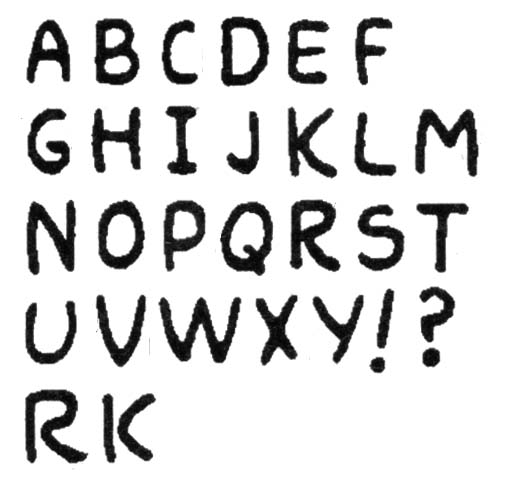
Comparison of the lettering in “The Human Torch” of Marvel Mystery #10 to that found in the same feature from Marvel Mystery #11 suggests that they were not done by the same letterer. Nowhere in MM #10 does the letterer use the special first letters for the captions like Ferguson used for MM #11. The closest the unknown letter gets to that is some over sized and open interior letters. Note the different form used for the letter ‘M’. In MM #10 the letter ‘S’ has the lower portion larger than the upper “half” while Ferguson typically did the reverse. But most importantly the letters for MM #10 just did not have the firm hand that Ferguson had. Often the strokes for the letters are not quite straight but curve slightly instead. In some places the letters ‘R’ and ‘K’ are not correctly connected (I provide some examples at the bottom of the letter guide above). I just do not believe Ferguson lettered “The Human Torch” from Marvel Mystery #10. Because of this and the use of this technique by other letterers it does not seem advisable to use double line caption borders as sufficient criteria for crediting lettering to Howard Ferguson.


Blue Bolt #3 (August 1940) letters by unidentified letterer

Now that I have Ferguson’s lettering for Marvel Mystery #11 to compare with I want to briefly return to examples from the previous month that some have credited to him. First I would like to compare it to Blue Bolt #3. Note the difference in the letters ‘M’ and ‘W’. In BB #3 the center angle of each does not extend are far as the outer lets while in MM #11 the center angle extends the full distance. Also note the differences between the two for the form of the letter ‘G’ or ‘K’.


Red Raven #1 (August 1940) “The Red Raven”, letters by unidentified letterer

The lettering for Red Raven #1 also differs from Ferguson’s for Marvel Mystery #11. The letters ‘K and ‘Y’ are different between the two. The outer legs for ‘M’ are almost vertical in MM #11 while they have a distinct slant in RR #1. However it will be shown below that Ferguson’s lettering changed somewhat for Daring Mystery #6 done the same month as Marvel Mystery #11. I believe we are seeing Ferguson in the process of learning what for him was a new craft. It is quite possible that Howard had done some lettering for earlier comics. Perhaps the lettering for Red Raven #1, Blue Bolt #3 or Marvel Mystery #10 might have been done by Ferguson only in yet a more primitive stage of his development. The problem is how to identify which, if any, were done by Ferguson particularly since each seems to have been done by a different letterer. At this time I will simply attribute RR #1, BB #3 and MM #11 to an unknown letterers and accept the work in MM #11 as the earliest examples that can confidently be credited to Ferguson.
 

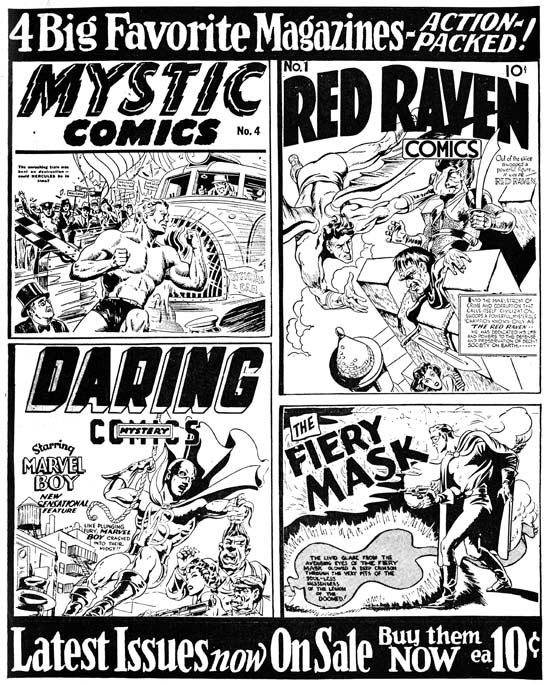
Marvel Mystery #11 (September 1940) house ad

The inside front cover for Marvel Mystery #11 has a black and white house ad which shows the three other titles that Timely was publishing at that time. Red Raven #1 was released in the previous month but being a bi-monthly was still considered the current issue. The fourth panel for the advertisement does not show a cover but advertises a feature, the Fiery Mask. This was a Joe Simon creation that had been included in Daring Mystery although the last couple appearances (Daring Mystery #4 and #5) were not drawn by Simon. The presence of the Fiery Mask in this ad together with the two Kirby covers clearly was an attempt to promote those features which Simon was most responsible for.

Simon probably had little to do with Mystics Comics #4 that was in the Marvel Mystery #11 house ad. It seems that there is an inconsistency in the dating of that comic with the cover indicating August and the indicia listing it as July. Such discrepancies are not that unusual and I always go with the cover date since it was used for indicating when the comic might be removed from the rack and therefore would generally provide a more reliable date.
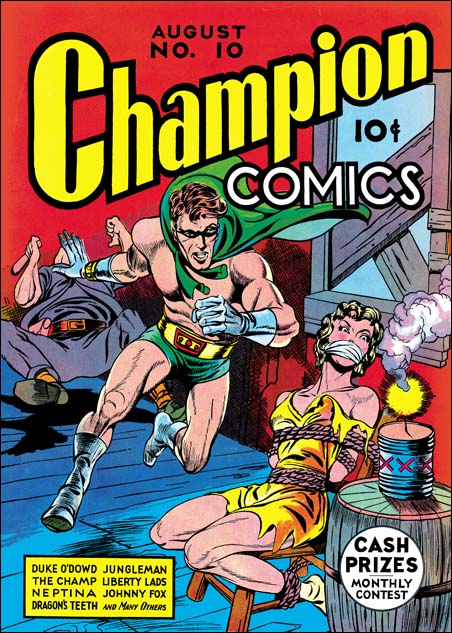

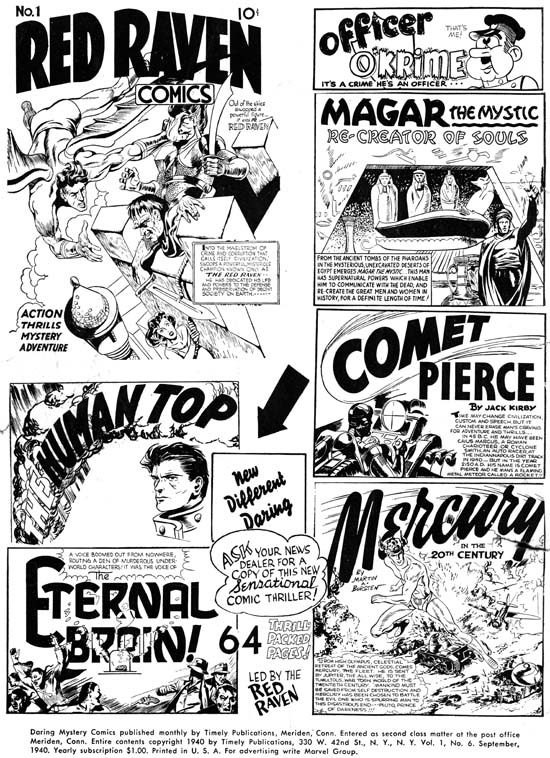
Daring Mystery #6 (September 1940) house ad

The house ad found in Daring Mystery #6 is entirely given over to the Red Raven #1. All Red Raven features are listed including the short comic filler “Officer O’Krime.
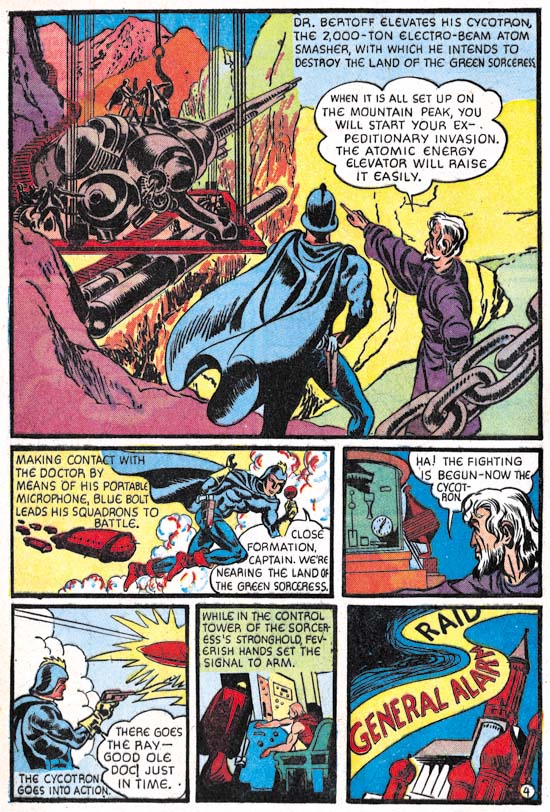

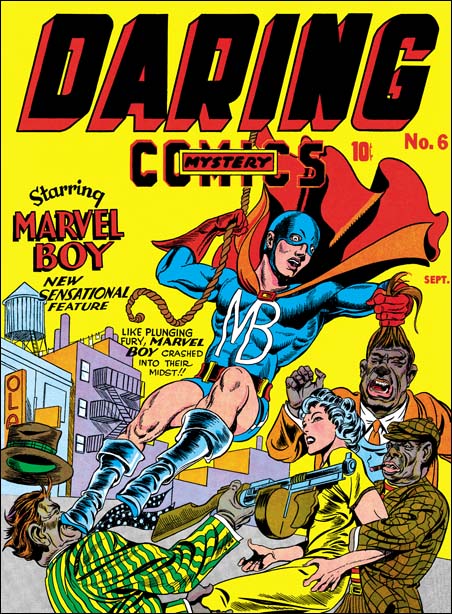
Daring Mystery #6 (September 1940) pencils by Jack Kirby, inking and lettering by Joe Simon

Simon and Kirby involvement in Daring Mystery #6 is obvious as they produced two stories for that issue. The cover was also a Simon and Kirby production with Jack providing the pencils, Joe the inking and lettering. That it was Simon’s lettering is clear by the letter ‘R’ in the word “their” which sometimes turns up in his lettering (see below for an example). Also the ‘W’ in “new” is done in the typical Simon manner (see below as well). The lettering for the covers of Daring Mystery #6 and Red Raven #1 are really well done. This might come as a surprise considering that Joe himself describes his lettering as not professional. However a really well done story lettering requires both precision and speed, a combination that Joe never mastered in his lettering. On the other hand more time would be expended on covers allowing Simon to use his talent for design and his skills with the brush.
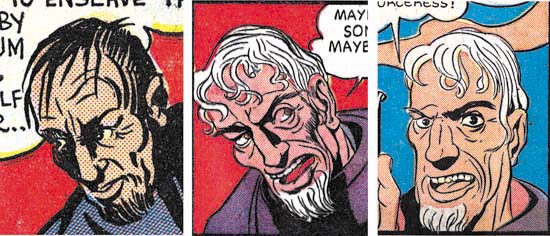

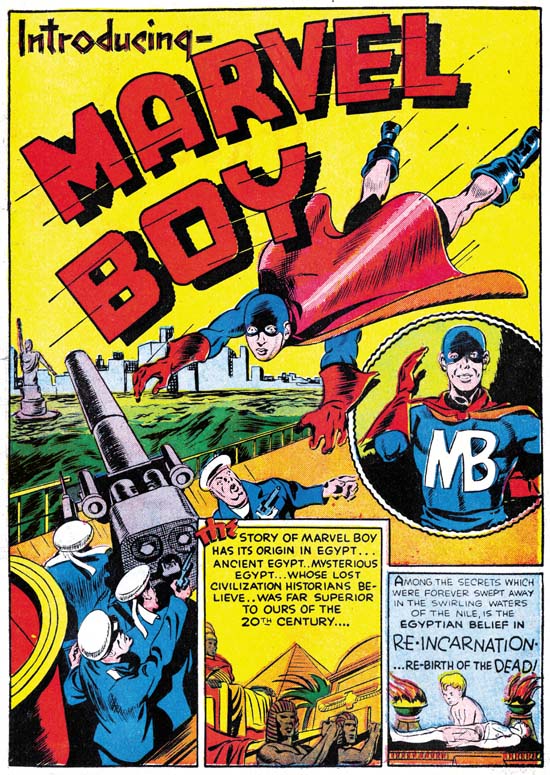
Daring Mystery #6 (September 1940) “Introducing Marvel Boy” pencils and inking by Joe Simon, lettering by Howard Ferguson

The art for “Introducing Marvel Boy” was created by an unusual assortment of artists. The first three pages were drawn and inked by Joe Simon with no sign of any involvement by Jack Kirby. The hero’s gloves, boots and skull cap show would be used again six months later in another Simon and Kirby creation, Captain America.


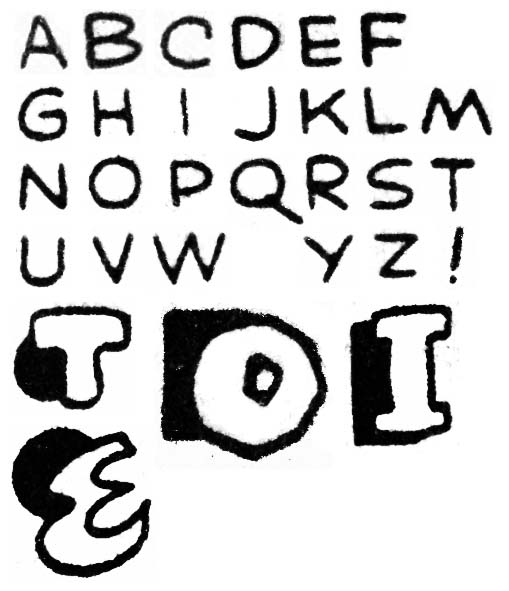
Daring Mystery #6 (September 1940) “Introducing Marvel Boy” lettering by Howard Ferguson

The lettering for the first three pages of the Marvel Boy story, the same pages Simon drew, was done by Howard Ferguson. One of the things that identifies this as Ferguson’s work is the presence of the same first caption letters that we saw in Marvel Mystery #11 (September 1940). Ferguson has even gone further and on the splash page provided the first caption with an enlarged, scripted and colored word “the”. This highlighting of the first word of a caption would appear again in future lettering by Ferguson. I have previously described Marvel Mystery #11 as providing the earliest work that can be confidently credited to Ferguson. The reason I gave MM #11 that distinction and not this story from DM #6 is that the Marvel Boy story shows the first appearance of a small vertical stroke applied to the letter ‘C’. This would be virtual trademark of Ferguson throughout most of his career and an easy and reliable indicator of his lettering. Ferguson has adjusted the letter ‘M’ to his more frequent format with distinctly slanted outer legs although since so many other letterers use this form it is of lesser importance in identifying Howard’s work. Oddly for DM #6 Ferguson has altered his letter ‘K’ to a shape not typical for him at all. But the letter ‘G’ still has not been altered to Ferguson’s more typical later form.


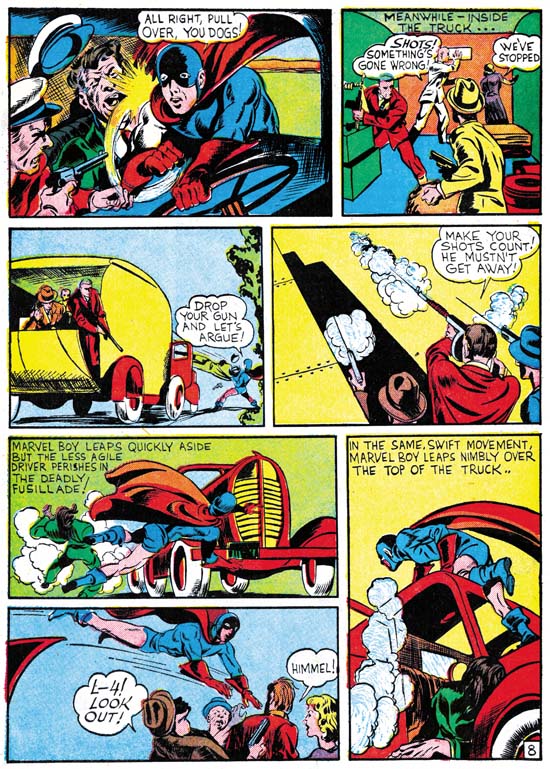
Daring Mystery #6 (September 1940) “Introducing Marvel Boy” page 8, pencils by Jack Kirby, lettering by Joe Simon

While Simon drew the first three pages of the Marvel Boy story it was Jack Kirby who penciled the remaining seven pages. The inking credit for these Kirby pages is hard to determine. Certainly Jack was not inking this work. Perhaps Joe was involved but to me it looks like the work of a number of different inkers. So it seems likely that by this time Simon had hired some studio assistants to help with choirs such as inking. I have been asked a number of times about who did what inking in this early Timely bullpen but to be honest I have not worked that out myself and I am dubious that such inking attributions can be reliably determined. So except for those cases where the inking was done primarily by Kirby or Simon I will leave off inking credits in this serial post.


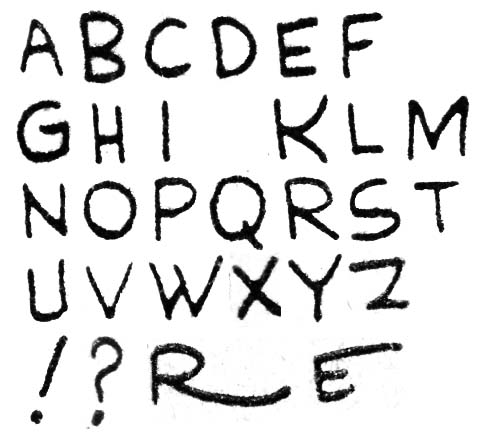
Daring Mystery #6 (September 1940) “Introducing Marvel Boy” lettering by Joe Simon

The lettering for the Kirby pages was not done by Ferguson but by Joe Simon. This clearly indicated by the presence of Joe’s rather unique letter ‘W’. While not quite as useful, Joe’s letter ‘M’ is also of use in spotting his lettering. For the most part Simon tries to be more professional than some of his earlier lettering work but occasionally he provides his letters with dramatic extensions such as the ‘R’ and ‘E’ show at the bottom of the above letter samples. Even today Joe likes to use such flairs in his signature.


Daring Mystery #6 (September 1940) “The Fiery Mask” page 3, pencils by Joe Simon

Both Simon and Kirby worked on “The Fiery Mask” story in Daring Mystery #6. Once again it is Joe that penciled the start of the story (pages 1 to 4). Also like the Marvel Boy story, Joe inked his own pages. Simon’s pages contain a number of swipes from Alex Raymond’s Flash Gordon (Art by Joe Simon, Chapter 5).


Daring Mystery #6 (September 1940) “The Fiery Mask” page 5, pencils by Jack Kirby

Kirby penciled pages 5 to 10 of “The Fiery Mask”. While Simon’s pages include a number of swipes I am not aware of any in those penciled by Kirby. The most likely conclusion is that in this story Kirby is not working from Simon layouts or if he was Jack felt free to alter them.


Daring Mystery #6 (September 1940) “The Fiery Mask” page 5, pencils by Jack Kirby with some inking by Joe Simon

Like the Kirby pages from the Marvel Boy story, the inking seems to have been done by a number of different hands. But Simon’s inking seems present in some places particular the lower half of the last page. However there is some inking using fine lines, such as in the second panel of page 5, that is untypical of Simon. None of the inking seems attributable to Kirby.


Daring Mystery #6 (September 1940) “The Fiery Mask” lettering by Joe Simon?

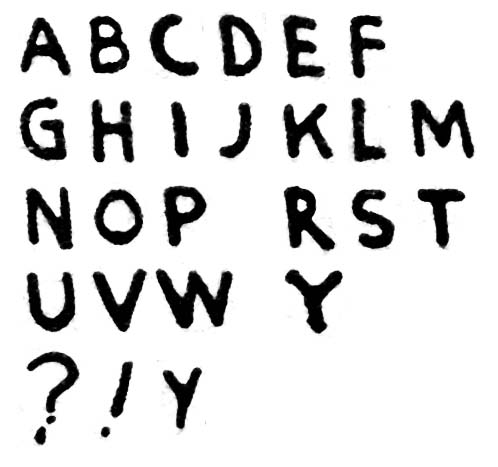
The lettering for the Fiery Mask story was handled by two letterers. I very questionably attribute the lettering of the first two pages to Simon. Completely missing is Joe’s characteristic ‘W’ or anything that could be described as flaring of the letters. However the ‘M’ looks very much like Joe’s. The question mark is similar to Simon’s as well. Further the rather amateurish quality to the lettering is very much in agreement with Simon’s ability. Letter size varies and while all the lettering is vertically oriented in some places it actually slants slightly upward to the left. But I would like to emphasize that the attribution of this letter to Simon is provisional as I have not have had a chance to study some of Joe’s later lettering.


Daring Mystery #6 (September 1940) “The Fiery Mask” lettering by unidentified letter

Pages 3 to 10 of the Fiery Mask story were done by a different lettering. I have taken all the letter examples shown above from the speech balloons where the letters are all vertically oriented. However in all the captions the letters are slanted upward to the right. The letters ‘M’ and ‘Y’ are not like Joe’s. The second letterer does a little more profession job. Letter sizes are more consistent and the letters themselves seemed done with firmer control. However sometimes the letter ‘R’ lacks the connection as shown at the bottom of the lettering examples above. Also occasionally the ‘U’ gets an almost horseshoe shape.


Red Raven #1 (August 1940) “Mercury in the 20th Century” lettering by Jack Kirby

I somehow failed to include an example of Kirby lettering when I discussed Red Raven #1 and so I provide it here. As reported previously, Jack had a very distinctive, horseshoe shaped, letter ‘U’ that is very useful in identifying his work. Kirby’s ‘G’ is also rather distinctive with its small vertical stroke attached to the letter’s hook. While the second letterer for the Fiery Mask story occasionally makes a horse shoe shape ‘U’ Kirby only occasionally makes one that does not have that shape. Further the second letterer’s ‘G’ lacks Kirby’s unique form. So I do not believe the second letter in the Fiery Mask story is Jack.

Still to be discussed is Blue Bolt #4 also cover dated September which I will cover in the next chapter.

* I have been forced to use the Marvel Masterworks because I do not have access to original comics for some of the issues that I will be discussing. This is not without risks because Marvel is notorious for the use of recreated art for their reprints.

Posted in 2011/10, 3 Timely, Artists, Assorted, Kirby, Jack, Lettering, Periods, Serial Posts, Simon, Joe, Start of S&K, Topic, z Archive | Tagged , , | 2 Comments