
Please donate!
The Jack Kirby Museum is raising funds to open a "Pop-Up" Museum on the Lower East Side, near where Kirby was born and raised. Learn more here.About this Blog:
© 2006, 2007, 2008, 2009, 2010 & 2011 Harry Mendryk. Unless otherwise marked, all images are my own restorations. Further some of the images have copyrights by Joe Simon and Jack Kirby or Joe Simon alone. I am fortunate that Joe Simon has allowed me to also include some previously unpublished material. Please do not copy from this blog without permission.Pages
Categories
- 9/11 (6)
- Artists (268)
- Albistur, Jo (7)
- Avison, Al (8)
- Belfi, John (4)
- Breifer, Dick (9)
- Brewster, Ann (7)
- Burgos, Carl (1)
- Ditko, Steve (2)
- Donahue, Vic (12)
- Draut, Bill (50)
- Eadeh, Al (16)
- Gregg, George (5)
- Infantino, Carmine (6)
- Kirby, Jack (157)
- McCarty, Bob (9)
- Meskin, Mort (69)
- Morrow, Gray (1)
- Oda, Ben (1)
- Oleck, Jack (2)
- Powell, Bob (1)
- Premiani, Bruno (9)
- Prentice, John (29)
- Riley, Ken (2)
- Robinson, Jerry (10)
- Severin, John (7)
- Simon, Joe (57)
- Stallman, Manny (7)
- Starr, Leonard (13)
- Stein, Marvin (20)
- Walton, Bill (5)
- Checklist (19)
- Albistur, Joe (1)
- Brewster, Ann (1)
- Briefer, Dick (1)
- Donahue, Vic (1)
- Draut, Bill (1)
- Eadeh (1)
- Gregg, George (1)
- Infantino, Carmine (1)
- Kirby, Jack (1)
- McCarty, Bob (1)
- Premiani?, Bruno (1)
- Prentice, John (1)
- Riley, Ken (1)
- Robinson & Meskin (1)
- Severin, John (1)
- Simon, Joe (1)
- Stallman, Manny (1)
- Starr, Leonard (1)
- Stein, Marvin (1)
- Comic Checklists (20)
- All For Love (1)
- Black Magic, DC (1)
- Black Magic, Prize (1)
- Boys' Ranch (1)
- Charlie Chan (1)
- Clue (1)
- Fighting American (1)
- Foxhole (1)
- Headline (1)
- In Love (1)
- Justice Traps the Guilty (1)
- My Date (1)
- Personal Love (1)
- Prize Comics Western (1)
- Real West Romance (1)
- Western Love (1)
- Young Brides (1)
- Young Love (1)
- Young Romance (1)
- Your Dreams (1)
- Ink Checklist (1)
- Kirby, Jack (1)
- Periods (396)
- 1 Early (22)
- 2 Fox (14)
- 3 Timely (44)
- 4 DC (early) (46)
- 5 Studio (135)
- 6 Mainline (68)
- Assorted (10)
- Bullseye (8)
- Fighting American (6)
- Foxhole (13)
- In Love (16)
- Police Trap (7)
- Prize (15)
- 7 Freelance (74)
- Archie (13)
- Atlas Kirby (14)
- DC Kirby (4)
- Harvey (27)
- Prize (17)
- 8 Marvel (12)
- Assorted (6)
- Marvel Kirby (6)
- 9 DC (late) (6)
- Late (3)
- Serial Posts (139)
- Art of J. Simon (1)
- Art of Romance (41)
- Criminal Artists (4)
- Early Jack Kirby (9)
- End of S & K (1)
- Harvey Horror (3)
- It's a Crime (1)
- Kirby Austere Inking (1)
- Kirby Inkers (4)
- Little Shop of Horrors (1)
- Margin Notes (5)
- Replacing S&K (4)
- S&K Colorists (3)
- Start of S&K (12)
- Wide Angle Scream (15)
- Topic (341)
- Alternate Takes (16)
- Anthologies (6)
- Art Editing (4)
- Best of Simon & Kirby (2)
- Captain America (5)
- Comicscope (3)
- Experts (3)
- Featured Work (64)
- First Romance (1)
- Ghosting (7)
- Harvey Covers (24)
- Kirby Inking Kirby (4)
- Kirby Krackle (3)
- Kirby Or Not (28)
- Lettering (13)
- My Two Cents (7)
- Odds & Ends (128)
- Publications (24)
- Quote (4)
- Restoration (3)
- Robots (3)
- S&K Superheroes (2)
- Swiping (8)
- Wertham & Censoring (5)
- Why Comics Declined (1)
- Uncategorized (51)
- z Archive (595)
- 2006/03 (16)
- 2006/04 (14)
- 2006/05 (15)
- 2006/06 (16)
- 2006/07 (10)
- 2006/08 (24)
- 2006/09 (11)
- 2006/10 (19)
- 2006/11 (20)
- 2006/12 (14)
- 2007/01 (16)
- 2007/02 (17)
- 2007/03 (14)
- 2007/04 (10)
- 2007/05 (12)
- 2007/06 (8)
- 2007/07 (7)
- 2007/08 (8)
- 2007/09 (6)
- 2007/10 (10)
- 2007/11 (7)
- 2007/12 (4)
- 2008/01 (4)
- 2008/02 (7)
- 2008/03 (12)
- 2008/04 (8)
- 2008/05 (8)
- 2008/06 (11)
- 2008/07 (6)
- 2008/08 (12)
- 2008/09 (7)
- 2008/10 (8)
- 2008/11 (4)
- 2008/12 (6)
- 2009/01 (10)
- 2009/02 (4)
- 2009/03 (5)
- 2009/04 (8)
- 2009/05 (6)
- 2009/06 (5)
- 2009/07 (8)
- 2009/08 (6)
- 2009/09 (5)
- 2009/10 (6)
- 2009/11 (4)
- 2009/12 (3)
- 2010/01 (6)
- 2010/02 (7)
- 2010/03 (7)
- 2010/04 (4)
- 2010/05 (7)
- 2010/06 (5)
- 2010/07 (8)
- 2010/08 (4)
- 2010/09 (6)
- 2010/10 (9)
- 2010/11 (5)
- 2010/12 (5)
- 2011/01 (4)
- 2011/02 (2)
- 2011/03 (5)
- 2011/04 (6)
- 2011/05 (3)
- 2011/06 (5)
- 2011/07 (7)
- 2011/08 (5)
- 2011/09 (4)
- 2011/10 (10)
- 2011/11 (6)
- 2011/12 (5)
- 2012/01 (3)
- 2012/02 (2)
- 2012/03 (8)
- 2012/04 (3)
- 2012/05 (2)
Comic related blogs
Groups (membership required)
Web pages
Category Archives: Wide Angle Scream
The Wide Angle Scream, American Royalty
I have decided to resurrect this old serial post. I originally started it when I had then begun to restore S&K’s double page splashes. I wanted the restoration to be on the same level that I do for covers. However that required an awful lot of effort since these splashes have twice the area of the covers and the printing quality is much inferior. Eventually the amount of work proved too excessive and other restoration projects became more important. I feel that the subject matter of the serial post is too important and should not be completely abandoned. So I return to the subject although in the future the quality of the restorations will not be quite so high. Since it has now been over a year since my last chapter, I thought I should provide a very broad summary of the previous posts.
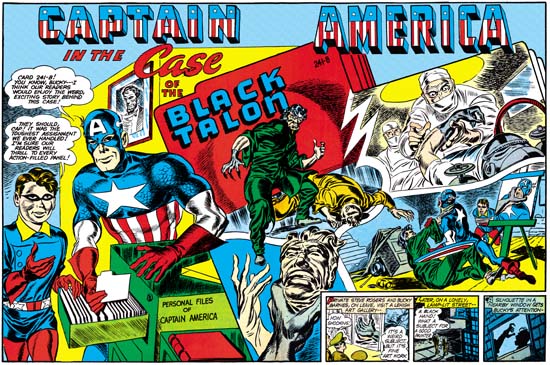
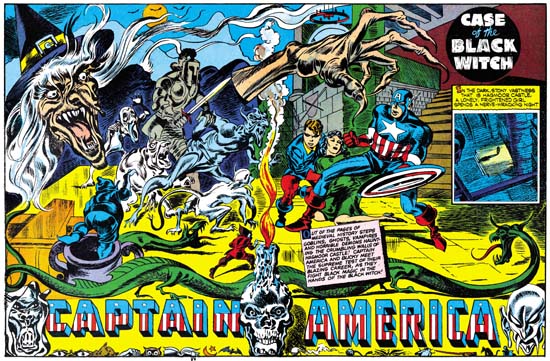
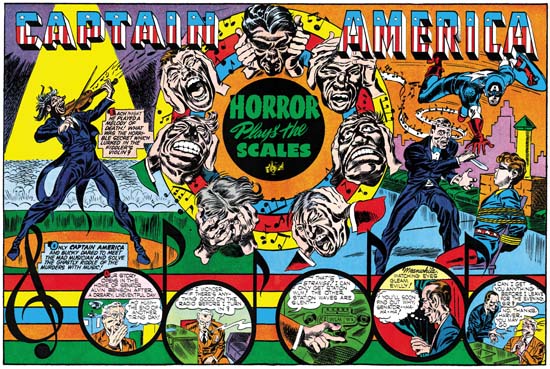
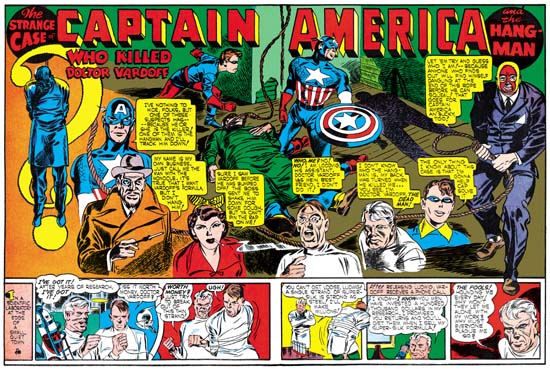
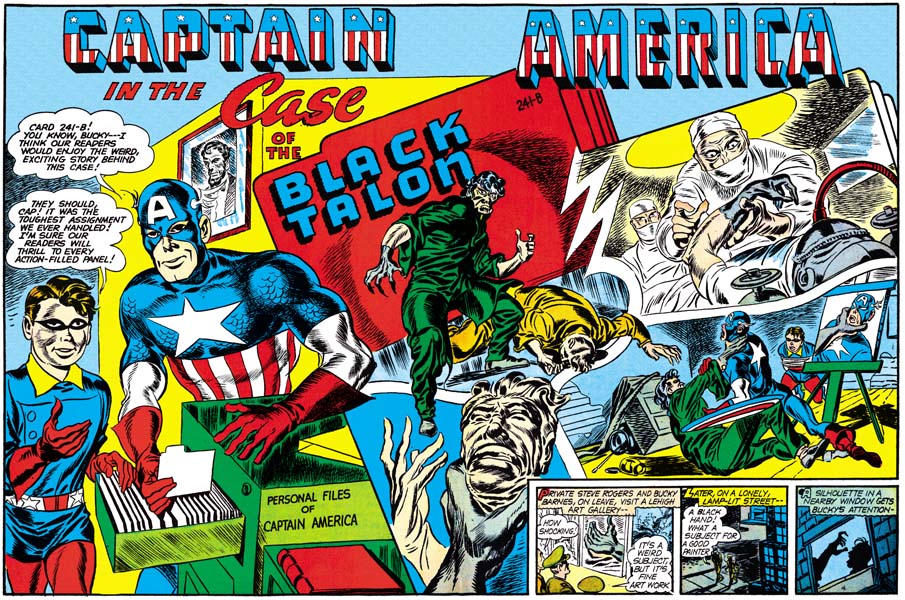
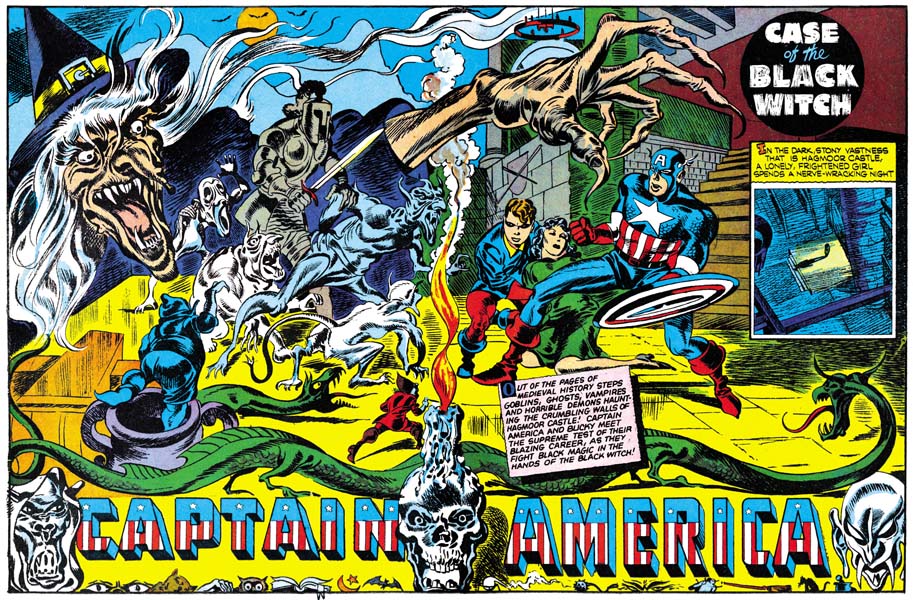
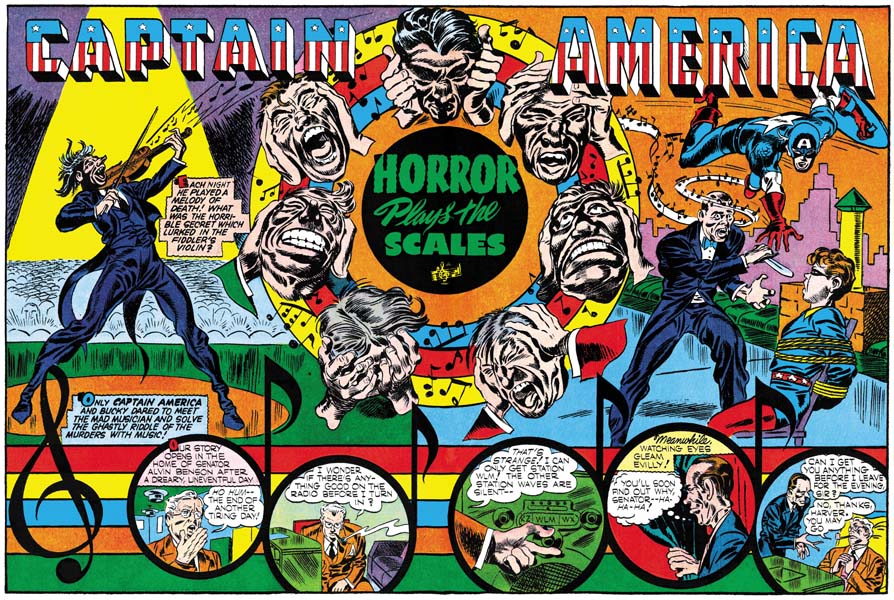
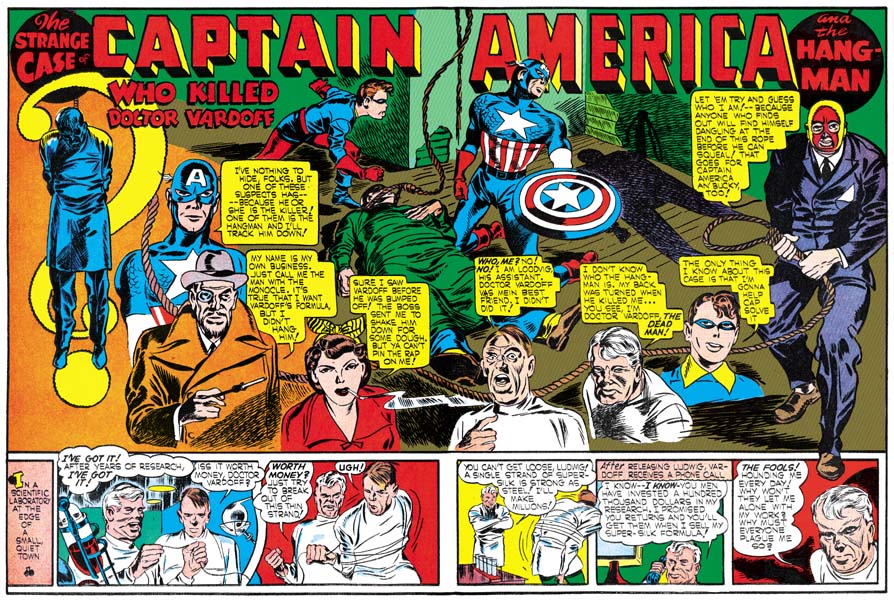
Simon and Kirby’s use of a double page splash began with Captain America #6 (September 1941). The five Cap double page splashes had a strong emphasis on design (#6, #7, #8, #9, and #10). The splashes would consist of three sections. One section common to all was what I called the enactment; it is a scene or tableau but is not part of the actual story. The second section is also common to all Captain America wide splashes; it consists of panels for the true start of the story. Although the third section is present in all of these splashes what it comprises of is not consistent, it can be a cast of characters, floating heads or a sort of comic book equivalent of movie trailers.
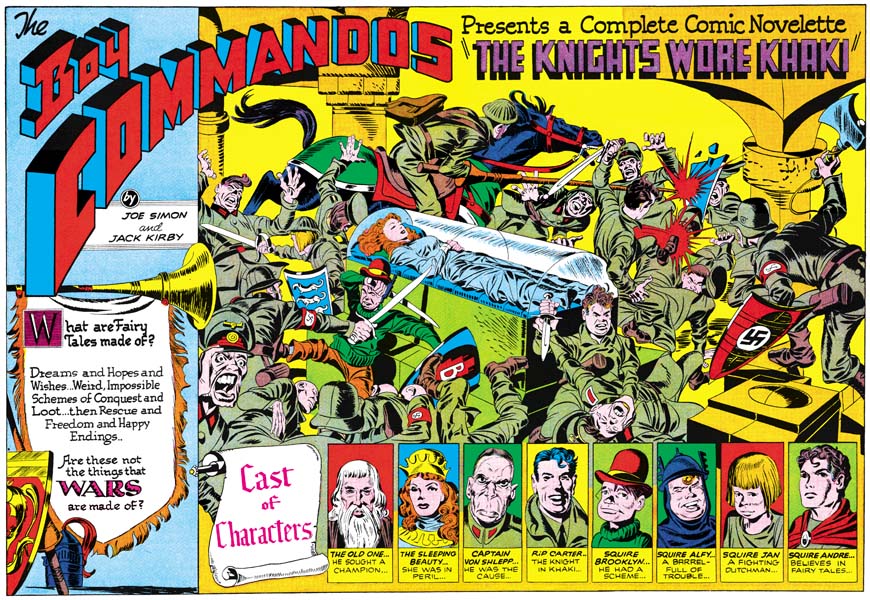
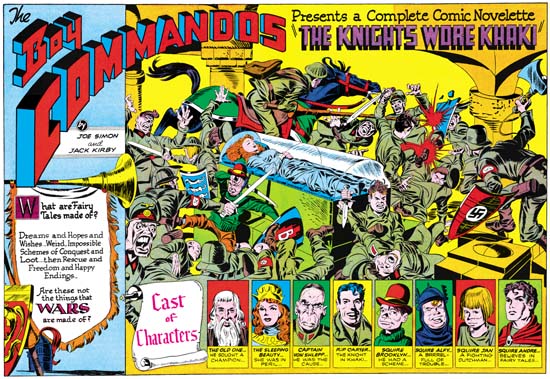
During the period that Simon and Kirby worked for DC they only produced one double page splash, that was for Boy Commandos #2 (Spring 1943). Here once again the splash was made in three sections. The enactment is present but it consists of a larger number of individuals then ever attempted in Captain America. Some organization is achieved by deploying them around the glass case containing a sleeping beauty, but even so there is so much chaos that it takes some time to sort out all that is taking place. There is also a cast of character sections. Unlike the Cap wide splashes there is no start of the story; instead the third section is given over to a large introductory text.
After returning from the war, Simon and Kirby launched Stuntman and Boy Explorers that were published by Harvey Comics. A wide splash was used with Stuntman. Only two were published but Jack had made worked on three others. The first one (Stuntman #1, April 1946, “The House of Madness”) used an unusual design, effectively two enactments laid out as large panels separated by a sweeping gutter. The second (Stuntman #2, June 1946, “The Rescue of Robin Hood”) reverted to a more standard tri-part design with sections for the title, enactment and cast of characters. Although the exposition is pretty much isolated from the rest of the splash, the title and cast of characters are nicely integrated. I also posted on one of the unpublished wide splash ( “Terror Island”). For the first time Kirby provides just one section, an enactment. There is a title, an introduction and even a floating head of the Panda, but these are subservient to the large enactment and do not achieve the status of their own section.
Because of copyright issues I do not consider it appropriate to reproduce the other two double wide Stuntman splashes. They can be found in Joe Simon’s book “The Comic Book Makers”. Both are further variations of a single large enactment section found in “Terror Island”. In one (“Jungle Lord”) Jack presents a smaller cast as compared to that for “Terror Island”. The enactment takes place in the tree tops where we find Stuntman battling a gorilla in the foreground while in the back Don Daring clings to a tree and a jungle boy makes off with Sandra Sylvan. Since the cast is smaller in the “Jungle Lord” splash as compared to “Terror Island” the action can be brought closer to the reader with dramatic results. The inking of the final wide splash (“The Evil Sons of M. LeBlanc”) was never completed, so it clearly was the last one worked on. This is another single section with Stuntman confronting three opponents. I find that the plain room in “The Evil Sons of M. LeBlanc” as compared to all the foliage of “Jungle Lord” brings greater focus and excitement to the depiction.
The Stuntman period is interesting because it marked the only time during his collaboration with Kirby that Simon did a significant stint at drawing. Early in his association with Jack, the two would draw different pages from the same story. Initially this seemed to be the working method for Captain America but quickly Jack took over all the drawing choirs for the S&K partnership. With the exception of some work done while in the Coast Guard, Joe did not seem to contribute much penciling to what was produced by S&K during the war. But while Kirby was penciling Stuntman and Boy Explorers Joe would pencil three backup features; the Duke of Broadway, the Vagabond Prince and Kid Adonis. Despite what some experts have said, these were drawn entirely by Joe except for a few small parts that Jack altered in his role as an art editor. Joe has said that Harvey kept track of the mail and that the Duke of Broadway got a better reader response then Stuntman. This was likely to be during the period after the original titles had been cancelled and Harvey was printing the unused work in comics such as Green Hornet. After the Harvey Stuntman/Boy Explorers period and until the breakup of the Simon and Kirby team, Joe’s penciling contributions would be uncommon (48 Famous Americans for J. C. Penny and “Deadly Doolittle” for Fighting American).

Boys Explorers #1 (May 1946) “His Highness the Duke of Broadway”, art by Joe Simon
Larger image
Joe only did one double wide splash for his Harvey features (“His Highness the Duke of Broadway” from Boy Explorers #1, May 1946). It is actually surprising that he did any considering the short lives of these titles (due to a comic book glut) and the fact that his stories are all back-up features. Like the one from Stuntman #1 a month before, this double page splash is comprised of two sections. Not that use of the same number of sections makes these two splashes truly similar. While that from Stuntman #1 is unusual in being composed of two enactments, the splash for the Duke feature is made of two familiar sections, an enactment on our left and a cast of characters on the right. The cast of characters consists of both full figures and floating heads accompanied by short captions that provide their names and a short description. At ten in number it was quite an ambitious cast, Joe obviously wanted a lot of supporting characters so as to provide the potential for much variation in his stories (unfortunately there would only be five). In this splash much of the cast are floating in front of the cityscape. Even those that are attached to the ground seem unnaturally placed because of the way they block the small avenue (surprisingly small since it is meant to be either Broadway or 42nd Street). The cityscape itself is carefully drawn so to provide an interesting background but subtlety rendered so that the cast would still stand out.
Such a large number of cast members required the use of half the splash. But this was the cast for the feature, only some of them would show up in this particular story. With such a large assemblage on the right side Joe needed something on the left to balance. His solution was to present most of the cast together solidly placed on the sidewalk. While this was a satisfactory solution as far as the composition was concerned, frankly it is not very exciting. Joe would do much better and more innovating designs for some of the regular splashes for his features. Still this double wide splash shows an emphasis on design that would disappear from the later ones by Kirby for Stuntman.
Stylistically the drawing for the splash differs from what Joe did in the story itself. Click Collins and Legal Louie are exceptions as they seem to better match what was done for the story. It still looks to me that it was penciled by Simon, only it is closer to what Joe had done previously and to what he would again do later in his career. Nothing on the splash refers to what will be found in the story. Everything is very generic, describing the feature as a whole and not this particular story. All this makes me suspect that Joe did the splash some time before as a presentation piece for the pitch he made to Harvey. Joe was not one to let all that effort to create this splash go to waste, so he appended it to the first story.
Posted in 2008/02, Artists, Harvey, Periods, Serial Posts, Simon, Joe, Wide Angle Scream, z Archive
3 Comments
The Wide Angle Scream, “Terror Island”

Stuntman #3 (unpublished) “Terror Island”
Enlarged view
Joe Simon and Jack Kirby must have had high expectations for their creation, Stuntman. There exist three double page splashes that were never published, at least not as regular Simon and Kirby productions. Since S&K always placed their wide splashes in the centerfold, this meant that they had already started working for up to Stuntman issue #5. That is until the post-war comic book glut caused the early demise of their new comic books. Joe still has the three splash pages and with their double size art they are really marvelous to behold. However when reduced to the size necessary for use on the Internet they can be difficult to appreciate. Therefore I hope my readers will understand that I felt it necessary to provide my own coloring for use in this blog. I would have like to have used the color version that Joe did for his book “The Comic Book Makers” but so far I have not found it in his collection. The “extra!” strip on the top, the “a Simon-Kirby Production” and the Stuntman title are missing from the art and I provided them from other wide splashes. Glue marks clearly indicated that the “extra!” strip is was present, or something like it. However I did not scan the original art (it is much too large) and the source of the image does not indicate the placement for the “production” (if it was even present) or the title.
Because two of the double splashes are completely inked I am not absolutely sure which was originally meant for Stuntman #3. I choose “Terror Island” to post on first. However this choice was not completely arbitrary. As mentioned above “Terror Island” clearly had an “extra!” along the top a feature that it shares with the double wide splashes for Stuntman #1 and #2. The other completely inked splash did not have this “extra!” strip, the lack of which it shares with the unfinished Stuntman double splash.
“Terror Island” introduces a new antagonist, the Panda. Of course Stuntman had faced various opponents in his previous stories but they all were rather generic. None of the earlier villains really stood out and it is clear that none were ever meant to reappear in future Stuntman stories. The Panda seems special and I believe was Simon and Kirby’s first attempt to create Stuntman’s nemesis, the equivalent of the Red Skull for Captain America. Basing a villain on a panda may seem an odd choice, after all what could be more cute and cuddly then a panda, at least in the mind of the public. Sure Jack draws the Panda to look as vicious as possible without loosing his panda look. But the real source for this character is not the bear, but China’s leader Mao Tse-tung (nowadays his name is normally transcribed as Zedong). Today with all the world companies scrambling to get a share of the Chinese market it is easy to forget at that time communist China was a very closed society. As China’s leader and his with description of the U.S. as a “paper tiger” Mao was considered a special menace. Still it is not at all clear whether the Panda really could fulfill the role Joe and Jack were casting him for.
The art for this wide splash marked a new approach. All previous double splashes were actually composed of various different sections. But for the “Terror Island” splash no similar attempt was really made. It is true that there is some introductory text and a round panel portraying the Panda, but this hardly compares to the cast of characters often provided in older double splashes. Yes it is also true that space has been left in the upper left for the titles, but no art is associate with these titles. What we are presented with for the first time is an enactment that dominates the entire splash. But what a scene! It sprawls across the pages from the lower left to the upper right. It is just the sort of chaos that we have seen before in the Boy Commandos wide splash. There is some control over the composition. The Panda and his attacking bug army occupy the left page. All are advancing toward the right where we find Stuntman, Sandra Sylvan and Don Daring amid a mass of falling wreckage. Although the uncolored ink art might be a bit confusing, I am sure Jack (who did the penciling) knew how much the final coloring would help to make it understandable. This splash is one of those that Jack could just let his imagination run wild. Previously when discussing the cover for Adventure #98 I had mentioned how Jack was often inaccurate when drawing animals but nonetheless was very successful in giving them a certain life. This splash provides and example of what I meant. A biologist would shudder and the giant bugs Kirby presents us with. Some of the inaccuracies can be explained by the needs of the subject. The wasp like insect that the Panda is mounted on could never fly with its wings in their present location. But if that beast’s wings were in the correct position the Panda could not mount it. But other errors have no artistic excuse. The legs of the insects and the spider are attached in the most bizarre places. If Jack used a biology book for a reference he obviously did not make any attempt to follow it closely. Regardless of these “errors” these giant bugs have a very menacing life to them.
My personal preferences is for the earlier wide splashes with their greater emphasis on design. But there is just no denying the shear brilliance that radiates from these post war double splashes. When you look at the original art for the “Terror Island” splash there are no signs of hesitation or rework. Jack seemed to have it all figured out in his mind before he put it on the illustration board. But with such a complicated drawing how was he able to do that? It just astonishes me.
Posted in 2006/11, 5 Studio, Harvey, Periods, Serial Posts, Wide Angle Scream, z Archive
Leave a comment
The Wide Angle Scream, Stuntman #2

Stuntman #2 (June 1946) “House of Madness”
Enlarged view
When I finished up the posts of the Captain America double page splashes I said that Simon and Kirby would not repeat those sort of designs. Well I lied. Stuntman #2 has the same sort of emphasis of design over composition seen in the Cap spreads. It is interesting to compare this splash with one from the Boy Commandos with a similar medieval theme.
I have hoped that my discussions on the design elements would make it clear what the distinction was between design and composition, at least as I use the terms. Composition is how a scene is arranged, that is in comics how the figures and non-figurative elements are arranged and how they direct the eye. Design is how disjoint parts, the text and different images, are arranged on the page. For instance in the image on the right side of Stuntman #2 is composed with the attacking knights starting on the lower left and rising as the eye goes toward the right until it meets the pivotal Stuntman and finally the defended Don Darling and Sandra Sylvan. The composition does not end there as the large candlestick brings the eye down, and (although not really part of the scene) the cast of characters bring the eye back to the start of the image. Actually that is just a condensed description. Notice the use of arcs (the curtains, shadows, the stonework for the pillar and the doorway) along the top and how they are used to highlight certain figures. Particularly effective is Stuntman’s placement in front of the pillar, despite the fact that he is closely surrounded by other figures this placement makes him standout. This is a marvelous composition and Kirby’s penciling is just fantastic.
But the right hand scene is just part of the page and that is why I said earlier that the design was more important then the composition in Stuntman #2. Like most of the Cap double splashes, here we find a three part layout. Starting on the left is the title section, followed on the right by the enactment and below with the cast of characters. The title compartment depicts an archery contest. On the left a series of colorful pendants almost hide a figure blowing a horn. The competition between four archers is arranged along the bottom. The archers are alternated with their targets, the backs of which provide the cast of characters. The rest of the title section scene is left bare so that the Simon and Kirby credits, the Stuntman title and the story title are prominently shown. The story title is nicely placed on the drape hanging from the horn, a similar device was used in the Boy Commandos spread. An interesting touch is how the introduction text is placed on a wall in the enactment section and how the text is lined up to fit the perspective of this wall.
Except for the left edge of the enactment compartment, the whole splash is nicely integrated. I find this a much more successful effort then that for Stuntman #1. It is really a shame that this title fell victim to the post-war comic glut. There are three unpublished double page splashes for Stuntman. Unfortunately I do not have any scans for them right now but perhaps I will get a chance to pick up something from Joe Simon.
Posted in 2006/10, 5 Studio, Harvey, Periods, Serial Posts, Wide Angle Scream, z Archive
1 Comment
The Wide Angle Scream, Stuntman #1

Stuntman #1 (April 1946) “House of Madness”
Enlarged view
When Joe Simon rejoined Jack Kirby after the war rather then just return to working for DC the two decided to produce their own comic books. They turned to Joe’s old friend Al Harvey to do the publication for Stuntman and Boy Explorers Comics. Now they had complete control over the contents and did not have to deal with DC’s editors. Wishing to recreate the success they enjoyed with Captain America S&K returned to the use of the double page splash in Stuntman.
The first Stuntman wide splash, “House of Madness” was published three years after the Boy Commandos splash. But the Stuntman Splash does not continue with the type of layout used in the Boy Commandos. Nor does Stuntman look back at the approach for double wide splashes found in Captain America. Instead we find Simon and Kirby using an entirely new design approach. In Stuntman we find two sections separated by a sweeping gutter, as if the splash was composed of two large irregularly shaped story panels.
The left panel starts at the top with the declaration that this is a Simon and Kirby production of Stuntman. The story title, “House of Madness” is embedded in the iris of a large bloodshot floating eye. Proceeding down we see that the eye appears to be some sort of projection by a beam emanating from a building complex on the lower right of the panel. As if in response to this signal, a car races in from the left. It is hard to be sure who the driver is but the red head and blue “collar” suggest it might be Stuntman at the wheel.
The right panel shows a scene of typical Kirby composition. Perhaps composition is not the best term, because Jack laid out his figures more with the intent of covering the area and not as much concern about unifying the movement. We find Stuntman in the midst of a leap. He has just physically burst into the room, the pieces of wood debris are falling with him. It might seem that if you project his flight Stuntman would miss the crowd shown below. But Simon and Kirby splashes (and covers also) should not be taken so literally. Had S&K tried to present a more “correct” representation we would have been presented with the soles of Stuntman’s feet and would not have been able to see his face. No, we can be sure that Stuntman is truly about to attack the crowd below. His opponents include a bearded giant holding Don Darling and Sandra Sylvan easily under each arm. Also appearing is a modern day Icarus about to take flight, a gun firing dwarf and a witch. A sign makes it clear that these characters are both crazy and dangerous.
Including in the panel is text written on what appears to be a scroll like piece of paper. From this text we are provided with the information that it really is Stuntman in the car racing toward a mental hospital to save his friends from the danger of an insane but evil group.
I have mixed feelings about this particular splash. On the one hand it is an interesting idea to use two enactments to introduce the story. However you really need to read the text in the second panel to realize what the first panel is meant to depict. Further there is really little to visually connect the two panels. All there is is the text banner along the top and the partial overlapping by the Stuntman title. Otherwise the panels provide very different views and compositions. This two scene design for a wide splash would not be repeated.
Posted in 2006/09, 5 Studio, Harvey, Periods, Serial Posts, Wide Angle Scream, z Archive
Leave a comment
The Wide Angle Scream, Boy Commandos #2

Boy Commandos #2 (Spring 1943) “The Knights Wore Khaki”
Enlarged view
When it comes to double page splashes, there are great differences between Simon and Kirby’s DC years compared to their Timely period. Once the wide splash appeared in Captain America #6 it became a standard part of that title. At DC despite the fact that S&K largely worked on three different features (Sandman, the Newsboy Legion, and the Boy Commandos) there is only a single example of a double page splash. Much of this can be explained by the fact that the wide splash required the use of the center page if publication problems were to be avoided. Planning for this was not an issue with Captain America because Joe Simon was the art editor and with Jack Kirby he produced the entire Cap comic. At DC S&K provided work for other editors and most of their work were for comic titles that included other features (Adventure, Star Spangled and Detective Comics). Under these conditions it was probably difficult for Joe and Jack to plan for the use of the center fold. But this does not explain the lack of wide splashes in Boy Commandos Comics. Even if they were not the editors, Joe and Jack should have been able to have more control in the Boy Commandos Comic, at least initially.
There is a also big design difference between the Cap wide splashes and the single DC example. At a glance at “The Knights Wore Khaki” splash we might feel we have found the same sort of three compartment design that was so common in Captain America. Common to both is are enactment and cast of characters sections. Missing from Boy Commandos is the one constant of Cap wide splashes, the start of the story. Instead we find a new section which brings an importance to the introduction text. But the three sections are not integrated like they were in Cap. Yes there are some visual linkages. The Boy Commandos title goes from the introduction text section into the enactment part. Also in the introduction text section there is a horn that extends into the enactment. The left portion of the host of characters has a scroll below which can be seen part of the enactment. Also all three sections contain middle age thematic material that link them together. But despite all that the compartments really look they are laid out in three distinct sections. This is nothing like the carefully integrated designs of wide splashes found in Captain America.
There really is not a lot to say about the cast of characters section. It is basically a row of simple panels with head shots. Do not get me wrong, Kirby as done his usually marvelous depictions. The glare given by Captain Von Shlepp just hits you in your guts, you can just tell he is not going to be a pleasant person. All the other head shots provide distinctly personalities. But as for the design, there really is nothing new here and it shares a problem that the story start sometimes had in Captain America. Laying out of row of panels tends to visually separate those panels from the rest of the splash and defeats any integration with the reset of the page.
I have more positive feelings about the introduction text compartment. Sure, like the host of characters, it does stand out as a separate identity. But that does have the benefit of providing less distractions to the text. I also love how the drape hanging from the horn is used to frame the text. It was also a good for the design that the start of the Boy Commando title starts in this section since that part takes up so much room. This part may not be integrated with the rest of the page, but within this section we are given a rather nice design.
In the enactment part that we see the greatest change from previous double page splashes. Most of the Cap splash enactments were limited to three or four characters; Cap, Bucky, the foe and/or the victim. But the Boy Commandos have five heroes so the enactment has to be more complicated. Joe Simon once remarked to me how difficult it was to draw a story with such a crew and how well Jack managed it. You can really appreciate this when examining Boy Commando stories not done by S&K. Invariably these stories center on Brooklyn and to a lesser extent Rip Carter. But all the rest of the cast pretty much get shoved to the insignificant parts. But the easy path was not Jack’s way, all the heroes play important parts, and that is true in this splash also.
There was one splash (Captain America #8 “Case of the Black Witch”) were Simon and Kirby had a large cast of characters in the enactment. S&K used a candle flame and smoke to divide the ensemble into to half and bring some order to the splash. The Sleeping Beauty serves a similar purpose in this splash. She provides a center focus of calm that visually matches her sleep. But unlike the candle in Cap #8, Sleeping Beauty does not bring order to the rest of the splash. Instead she is eye in the center of a hurricane. She is surrounded by chaos on steroids. An all over composition as if Jackson Pollack had become a comic book artist. No part more significant then others. The fight is not something that can be comprehended at a glance. It takes extended viewing to understand the action. For example in the upper right at first it looks like a Nazi’s shield has been shattered by a blow from a sword. But a closer look reveals that the damage is actually being done by the joisting spear from the soldier on the horse. It may take time to understand in some cases what head belongs to what body. But time spent on viewing this Kirby masterpiece is time well spent. This sort of exciting chaos shows up in other (single) splash pages at this time and we will see further wide splash examples in the future.
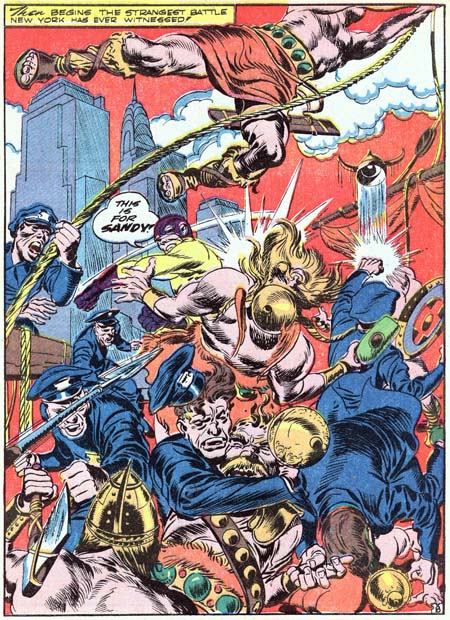
Adventure #75 (June 1942) “The Villain From Valhalla” by Jack Kirby
I will not attempt a detailed description of this scene, that would take way to long and would not be anywhere near the fun of doing your own examination. But I would like to point out relatively low key way that S&K handles the heroes. Brooklyn stands out in the front left because he is not wearing a soldier’s uniform like all the rest. But it is easy to miss Jan on the left because he is turning away from the viewer. Similarly that is Rip Carter on the horse at the top, but we can only tell by his action since his face is hidden. On the upper right we are presented a the back view of Andre. We do get a good view of Alfy in the front right but even he can be missed among all the fighting faces and bodies.
The other thing I want to point out is the Nazi officer on the left. The officer turns towards the viewer and brings up his hand to enforce his yell. One might think that he is yelling at the viewer, but since his is the enemy that does not make any sense. Instead he must be yelling for unseen reinforcements. This is a motif that Jack would use from time to time. We already saw it with a Japanese soldier on the cover the Champ #23 (October 1942). In later years Kirby would modify it and use it with the hero that really is (loudly) addressing the viewer (Captain America #197, May 1976).
I generally concentrate on the visual art of Simon and Kirby. But of course comics are pictures and words. Check out the writing on this splash. It is short but effectively contributes its part to making this a great piece of comic book art. I particularly like how the text in the cast of characters has a staccato rhythm but reads like a long sentence. I have heard stories of DC writers delivering Simon and Kirby with scripts only to find as they left the building the scripts sailing out of the studio windows. That story is actually so great that it makes me doubt its veracity. But writing like that shown on this splash is so excellent, so similar to the writing in Simon and Kirby done after the war, and so dissimilar to DC writing at the time. If Joe and Jack used the scripts provided by DC it was as a template to be modified at will in order to achieve S&K’s unique quality.
This Boy Commandos work makes me really regret that Simon and Kirby did not do other wide splashes during there DC years. But we will see further exciting examples of this demanding pectoral device when Joe and Jack set up their own shop after the war.
Posted in 2006/09, 4 DC (early), Periods, Serial Posts, Wide Angle Scream, z Archive
Leave a comment