

Tag Archives: marvin stein

Art of Romance, Chapter 34, A New Prize Title

(May – December 1957: Young Romance #88 – #91, All For Love #2 – #5, Personal Love #1 – #2)

This serial post has now entered the period after the crash and near collapse of the comic book industry. Prize Comics was never a big publisher but these must have been particularly difficult times. At the start of this period Prize was only publishing three bi-monthly titles Justice Traps the Guilty, Young Romance and the new released All For Love. In September they would also release another new romance title, Personal Love. Like All For Love, Personal Love was not produced by Simon and Kirby. The annual postal statements list Joe Genalo as the editor and the contents seem somewhat different from that found in Young Romance. The artists used also seemed to be different as well, at least during this period. Jack Kirby appeared in three of the four issues of Young Romance covered by this post but did no work for All For Love or Personal Love. Lou Cameron played an important part in Young Romance #89 and #90 but he does not appear in the other Prize romance titles. On the other hand Ted Galindo appears frequently in All For Love and Personal Love but he does not show up in these issue of Young Romance.

Since at this time Kirby was freelancing for DC and Atlas, it is clear that he and Joe were no longer running their old studio. So the question becomes how Young Romance was actually produced. While previously there can be found examples of Jack in his roll as an art editor stepping in to fix up some parts of stories supplied by other artists or provide a splash page, I have seen no examples of that practice in the period from 1957 to 1960. On the other hand the annual postal statements still listed both Simon and Kirby as editors up to 1960. My suspicion is that Jack really was not involved in the editorial work for Young Romance and it was Joe who was really producing the title. Not that I believe this effort took much of Joe’s time; it was only a single bi-monthly title.

Young Romance #91
Young Romance #91 (December 1957) “The Waiting Game”, pencils by Jack Kirby, inks by Marvin Stein

Jack Kirby provided art for three of the four issues of Young Romance during this period. However all were rather short pieces (1, 4 and 5 pages) and only one of them was the lead feature (a position often reserved for Jack in the past). All were nicely done but hardly very remarkable (for Kirby). Jack did not inked any of the pieces but one of them “The Waiting Game” looks very much like it was inked by Marvin Stein. Not the blunt but still subtle handling of the face of the man in the background of the splash. Of particular significance is the handling of the lady in the first story panel. She share a rather distorted perspective that I find hard to describe but is so often seen in Stein’s own work when a head is viewed from above and to the side. I am not as confident that Stein inked the other two Kirby stories but he could have.

Young Romance #91
Young Romance #91 (December 1957) “Live Alone and Love It”, art by Marvin Stein

Marvin Stein not only inked a work for Jack Kirby but he penciled and inked his own story for Young Romance. I have remarked before how I find Stein’s style more appropriate for the crime genre than it was for romance. His “Live Alone and Love It” seems done in a particularly blunt manner even for Stein. Note the simplified eyebrows of the lady on this page, very reminiscent of the inking found in some of the Kirby pieces, another reason to possibly attribute to Marvin some of the more recent inking of Kirby’s art. Stein was an exception in that he appeared not only in Young Romance but also All For Love and Personal Love as well. However prior to this he also was one of the very few artists that worked on both Simon and Kirby productions along with the titles not produced by that pair.

Young Romance #89
Young Romance #89 (August 1957) “Pal Joannie”, art by Lou Cameron

Lou Cameron, an artist new for Young Romance, played an important part in issues #89 and #90 supplying 5 stories. His work was really excellent; great graphic story telling and beautifully drawn women. Like some of the other younger artists new to the title, Lou drew in what I would describe as a more modern style. I am not that familiar with Cameron’s art but he also work for Atlas, DC and St. John Publishing. I am not sure what to attribute his sudden abundant appearance and just as quick disappearance in Young Romance but he is one of the artists that I wish had made a longer contribution to the title.


Young Romance #91 (December 1957) “That Certain Something”, art by Vince Colletta

Young Romance #91 included the only appearance of Vince Colletta in a Simon and Kirby production. Colletta did a lot of work for Atlas, much of it romance art. However he is most famous as the inker that Kirby fans love to hate. Mostly this is due to his habit of erasing some of Kirby’s pencils to speed up the inking. Oddly Colletta has a small but very vocal group of supporters who I refer to as Colletta apologists. According to the Colletta apologists, Vince was the greatest romance artist who worked in a realistic style. While I admire Colletta’s romance art, neither of these assertions are true. I have never heard anyone other than a Colletta apologists claim Vince as their favorite romance artist and as far as I can tell Colletta apologists otherwise have no interest in romance art. And while his woman are beautiful they are not truly realistic. This is fortunate because I do not believe true realism would be appropriate for comic books. For my part, while I find Colletta’s women beautiful, I also find them to lack any individuality. The only distinction found between individual examples are the hair styles and clothes. Still he is another of those artists that I wish provided more work for Young Romance.

Young Romance #89
Young Romance #89 (August 1957) “Rock-A-Bye To Love”, art by unidentified artist

In these last few chapters of the Art of Romance, I do not plan to discuss all the artists that appear in the Prize titles. Frankly most of them are not that great and I am so far unable to identify them. That is not to say that they are totally uninteresting. This is a period of transition for Young Romance as the title tries to maintain its appeal with a more modern audience. Hence the inclusion of rock-and-roll in some of the stories. However there is a tendency for rock music to be judged somewhat negatively.

All For Love #2
All For Love #2 (June 1957) “My Destiny”, art by Mort Meskin

Mort Meskin provides two stories for All For Love #2 (June 1957). Both works appear to have been inked by Mort as well. As far as the art is concerned the work is nicely done but does not differ much, if at all, from the romance work that Mort did up until the end of 1955. It is not the art that is a cause for a surprise but his appearance in a Prize comic. As I wrote, his romance work was about a year and a half prior to this but his art appeared in the Prize crime titles for a few months further (March 1956). His last work for Prize Comics Western was for the July 1956 issue. Then suddenly these two stories in All For Love and then Meskin disappears from further Prize comics. I suspect that Prize offered much lower page rates than what DC did which is where Meskin was doing most of his work at this time. But it is suggestive that it was in All For Love that Meskin appeared and not Young Romance which was still being produced by Simon and Kirby. In any case I believe this was the last romance comic book art that Mort Meskin would ever create.

All For Love #3
All For Love #3 (August 1957) “The Voice of Love”, art by Marvin Stein

As mentioned above, Marvin Stein was one of the few artists appearing in Young Romance as well as All For Love or Personal Love. If anything, the art for “The Voice of Love” shown above is more carefully drawn than that from Young Romance #91.

All For Love #3
All For Love #3 (August 1957) “The Match”, art by Ted Galindo

Ted Galindo provided work for all the Prize titles at this time except for Young Romance. Ted had previously drawn a story for Foxhole which, to be frank, was really not that well done. His romance work was much better, most likely because he now was a more experienced comic book artist. I feel the best work he was doing at this time appeared in Justice Traps the Guilty which will be the subject of a future chapter to Criminal Artists.

All For Love #2
All For Love #2 (June 1957), art by J.O.

Some of the Prize titles during this period had cover art signed only as JO. No interior stories bear that signature and as far as I can seen none of the unsigned pieces were by this artist. The covers are very well done and indicate that this is a talented artist. I have only begun investigating whom this might be and have not reached any but the most tenuous conclusions. Although I have as yet no good evidence to back it up, I wonder if this might be by Joe Orlando.

Personal Love #1
Personal Love #1 (September 1957), “The Truth About Love”, art by unidentified artist

I could not resist including another romance story from this period with a rock-n-roll reference. In the background of the splash can be seen a singer playing an acoustic guitar. That, plus the lyrics he sings, clearly were meant to be a reference to Elvis Presley who was very popular at that time (and since).

Chapter 1, A New Genre (YR #1 – #4)
Chapter 2, Early Artists (YR #1 – #4)
Chapter 3, The Field No Longer Their’s Alone (YR #5 – #8)
Chapter 4, An Explosion of Romance (YR #9 – #12, YL #1 – #4)
Chapter 5, New Talent (YR #9 – 12, YL #1 – #4)
Chapter 6, Love on the Range (RWR #1 – #7, WL #1 – #6)
Chapter 7, More Love on the Range (RWR #1 – #7, WL #1 – #6)
Chapter 8, Kirby on the Range? (RWR #1 – #7, WL #1 – #6)
Chapter 9, More Romance (YR #13 – #16, YL #5 – #6)
Chapter 10, The Peak of the Love Glut (YR #17 – #20, YL #7 – #8)
Chapter 11, After the Glut (YR #21 – #23, YL #9 – #10)
Chapter 12, A Smaller Studio (YR #24 – #26, YL #12 – #14)
Chapter 13, Romance Bottoms Out (YR #27 – #29, YL #15 – #17)
Chapter 14, The Third Suspect (YR #30 – #32, YL #18 – #20)
Chapter 15, The Action of Romance (YR #33 – #35, YL #21 – #23)
Chapter 16, Someone Old and Someone New (YR #36 – #38, YL #24 – #26)
Chapter 17, The Assistant (YR #39 – #41, YL #27 – #29)
Chapter 18, Meskin Takes Over (YR #42 – #44, YL #30 – #32)
Chapter 19, More Artists (YR #45 – #47, YL #33 – #35)
Chapter 20, Romance Still Matters (YR #48 – #50, YL #36 – #38, YB #1)
Chapter 21, Roussos Messes Up (YR #51 – #53, YL #39 – #41, YB #2 – 3)
Chapter 22, He’s the Man (YR #54 – #56, YL #42 – #44, YB #4)
Chapter 23, New Ways of Doing Things (YR #57 – #59, YL #45 – #47, YB #5 – #6)
Chapter 24, A New Artist (YR #60 – #62, YL #48 – #50, YB #7 – #8)
Chapter 25, More New Faces (YR #63 – #65, YLe #51 – #53, YB #9 – #11)
Chapter 26, Goodbye Jack (YR #66 – #68, YL #54 – #56, YB #12 – #14)
Chapter 27, The Return of Mort (YR #69 – #71, YL #57 – #59, YB #15 – #17)
Chapter 28, A Glut of Artists (YR #72 – #74, YL #60 – #62, YB #18 & #19, IL #1 & #2)
Chapter 29, Trouble Begins (YR #75 – #77, YL #63 – #65, YB #20 – #22, IL #3 – #5)
Chapter 30, Transition (YR #78 – #80, YL #66 – #68, YBs #23 – #25, IL #6, ILY #7)
Chapter 30, Appendix (YB #23)
Chapter 31, Kirby, Kirby and More Kirby (YR #81 – #82, YL #69 – #70, YB #26 – #27)
Chapter 32, The Kirby Beat Goes On (YR #83 – #84, YL #71 – #72, YB #28 – #29)
Chapter 33, End of an Era (YR #85 – #87, YL #73, YB #30, AFL #1)
Chapter 34, A New Prize Title (YR #88 – #91, AFL #2 – #5, PL #1 – #2)
Chapter 35, Settling In ( YR #92 – #94, AFL #6 – #8, PL #3 – #5)
Appendix, J.O. Is Joe Orlando
Chapter 36, More Kirby (YR #95 – #97, AFL #9 – #11, PL #6 – #8)
Chapter 37, Some Surprises (YR #98 – #100, AFL #12 – #14, PL #9 – #11)
Chapter 38, All Things Must End (YR #101 – #103, AFL #15 – #17, PL #12 – #14)

Posted in 2010/07, 7 Freelance, Art of Romance, Artists, Kirby, Jack, Periods, Prize, Serial Posts, z Archive | Tagged , , , , , | 4 Comments

Criminal Artists, Chapter 1, Marvin Stein

Introduction

It was always my intention to finish the serial post “It’s a Crime” by covering the Prize crime titles during the period when they were no longer produced by Simon and Kirby. My reluctance to continue may have been in part due to how inappropriate it seemed to review the material as a series of sequential time periods as I had been doing previously. Unlike what was seen in the Simon and Kirby produced crime titles, the later issues did not change that much over most of their runs. Much of the consistency of the crime comics was due to the presence of one single artist providing most of the covers and lead stories. So I have decided to end my original serial post and start a new one. In this one I will be covering the crime titles Headline and Justice Traps the Guilty from March 1951 to April 1958 (cover dates) but by devoting a separate chapter to different artists.

When Joe Simon and Jack Kirby started producing crime comics for Prize the stories were rather strong. Gun battles with lots of bullets and pools of blood were not uncommon. I do not believe they went as far as some publishers but still it was pretty violent stuff. At that same time there was a vocal oppositions to comics, particularly the crime ones. I am sure that it was because of this public criticism that Simon and Kirby began to tone down the violence. There were still gun shootouts but little if any blood. These less violent crime stories continued even after Simon and Kirby stopped producing the titles. I am sure this is why comic book fandom has pretty much forgotten about the later Headline and Justice Traps the Guilty comics. However I am not sure this is justified. The stories are well written and while the artists are not well known today many of them did really nice jobs. The most detracting thing I can say about them is that there are so many issues and as I said above they all looked pretty much the same. An analogy (which I am sure some readers will reject) can be found with Marvel monster stories. Good reads but I doubt anyone would read through them all without occasionally taking a break with some other genre.

Marvin Stein

The first artist for this serial post had to be, just had to be, Marvin Stein. The Prize crime titles were virtually defined by his presence. Marvin did all the non-photographic covers for Headline that were not done by Jack Kirby (issues #46 to #77, March 1951 to September 1956). This is almost true for Justice Traps the Guilty (issues #20 and #24 to #88, November 1950 and March 1951 to August 1957). Only the covers for the last 4 issues of JTTG were done by someone else. Similarly Stein generally provided the first (lead) story. Unfortunately I am still uncertain about identifying some of Stein’s earlier work. There are a few early lead stories that may or may not be attributable to Stein. There is at least two that were definitely not done by Marvin. But before long Stein would take over the lead story and keep it. Up until the end of Headline and to issue #89 of Justice Traps the Guilty. And while some other artist did the lead story for JTTG #90 he imitated Marvin Stein! Not only was Marvin the cover and lead artist, many issues had a second story by him as well. Even after he was no longer the lead artist, each JTTG would have a story done by Stein up to the very last issue (#92, April 1958).

Justice Traps the Guilty #14
Justice Traps the Guilty #14 (February 1950) “Knockout Racket”, art by Marvin Stein?

The earliest work for Prize Comics signed by Marvin Stein was in JTTG #22 (January 1951). Although unsigned, the cover for JTTG #20 (November 1950) was almost certainly done by Stein as well. There are a number of earlier pieces whose attribution to Marvin becomes progressively more difficult and uncertain. One thing is clear is that Stein did not arrive at the Simon and Kirby studio with his mature style. “Knockout Racket” is the earliest lead story that I am comfortable to even questionably assign to Stein. But it is tentative; perhaps the only thing on the page shown above that I can point to that suggests Stein’s mature style are the eyes of the lady in splash. The first page shows a device often used by Simon and Kirby for their romance stories, the soliloquy splash. This is a format where a character in the splash introduces the story and where the speech balloon contains the title. All of Stein’s lead stories use a soliloquy splash while those other early lead stories by other artists did not. However I am not prepared to assign all lead stories with soliloquy splashes to Marvin.

Justice Traps the Guilty #27
Justice Traps the Guilty #27 (June 1951) “Sky Smugglers”, art by Marvin Stein

Marvin Stein was still far from his mature style when he did “Sky Smugglers”. Although unsigned, as most of his crime stories were, there are enough examples of typical Stein traits to leave no doubt that this was his work. One trait in particular to note is the shadow that trails down the right side of the face for the man in the splash. Normally comic book artists draw shadows that originate from a single light source but in this face Stein is using two light sources; a prominent one from the front a little to our right and a secondary one further back and from the left. The shadow exists in the region not fully illuminated by either of these light sources. I refer to this type of shadow as a negative highlight. Marvin would use this technique often and in the future would even move the shadow towards the center of the face. Negative highlights are something I have not noticed used by Kirby or any other artist working for the studio. However this device was also used by Wally Wood from whom I suspect Stein picked it up.

Justice Traps the Guilty #38
Justice Traps the Guilty #38 (May 1952), art by Marvin Stein

Stein had arrived at his mature style by 1952 and the cover for JTTG #38 is a good example of that style. Stein was comfortable with action but handled it in his own manner. His characters would throw a punch with a rather forward motion unlike the more rotational manner Kirby would use. While he lacked Kirby’s exaggerated perspective, Stein still had good command of perspective and used it well in establishing a point of view. He seemed to have picked up Kirby’s penchant for flat edged fingers. Stein developed a simplified drawing for more distant faces in a manner that was distinctly his own. Marvin inked with a rather blunt brush which can easily be mistaken for crude inking but is actually rather nuanced. Note the inking on the gymnasium equipment at the bottom center; Stein would often use this sort of rice kernel pattern for inking shadows.

Justice Traps the Guilty #46
Justice Traps the Guilty #46 (January 1953), art by Marvin Stein

The romance, western and crime genre that Stein most often drew generally did not provide much opportunity to depict the human body. Examples such as this boxing scene show that Marvin could do a real good job. I do not know if he was working from some reference material but it still is a very respectable piece.

Justice Traps the Guilty #42
Justice Traps the Guilty #42 (September 1952) “Scandal Sheet Shakedown” page 9, art by Marvin Stein

Stein’s depiction of men improved more rapidly than that of his women. The lady in the first panel still retains some of the artificially arched eyebrows found in Stein’s earlier work. The same lady in panel 3 seems more realistic. It is just me or does she somewhat resemble Jack Kirby’s work? I think this is most likely a case of Kirby influencing Stein. Observe how Stein’s rather blunt brush still manages his characters with individuality and expressiveness. I particular like Marvin’s work on the three thugs in panel 5. Each has his own distinct personality.

Also note Stein’s manipulation of the point of view. Starting with a close-up to establish the main characters before moving to a more distance shot to place them on the street. Then another close-up is followed by what looks like yet one more but actually introduces a group of secondary characters in the background. Stein then makes a large jump in the viewpoint placing the thugs in the foreground and the main characters in the distant back. As we will see Marvin Stein very carefully controls viewpoint and pacing.

Justice Traps the Guilty #68
Justice Traps the Guilty #68 (November 1954) “Not Fit for Duty” page 6, art by Marvin Stein

I admit that I am searching for a word to use for describing a technique Stein frequently uses. For now I will use choreography for the way that Stein would sometimes arrange panels into a short time interval sequence, but I admit it is not the best term for my purpose. But note how in the first five panels shows the policeman’s capture of a thug. Not only does each panel only advance the time by a small amount but look how Marvin brings the action closer and closer to the reader.

I have mentioned Stein’s blunt brush but look how masterfully he has captured the older cop in the last panel!

Justice Traps the Guilty #84
Justice Traps the Guilty #84 (December 1956) “Stakeout” page 3, art by Marvin Stein

Another choreographed sequence occupies the entire page although perhaps not as successful as the previous example. This might have been at least in part due to the Comic Code’s restriction on the depiction of violence. The more distant viewpoints may have satisfied the Comic Code but the also lessened the impact.

Justice Traps the Guilty #70
Justice Traps the Guilty #70 (January 1955) “Feud” page 8, art by Marvin Stein

Here is another choreographed sequence that is still successful despite the Comic Code. By keeping the thug outside of the viewpoint we do not actually see the results of the cop’s use of his machine gun but there can be little doubt about it’s effectiveness.

Justice Traps the Guilty #75
Justice Traps the Guilty #75 (June 1955) “Tragic Circle” page 7

A final example of a choreographed sequence by Stein. But again ruined by the Comic Code. Any child could see gun fights by gangsters or cowboys on the television and in the movies but for some reason the Comic Code had to protect them from seeing someone being struck by a bullet. Without the accompanying text the reader would be left perplexed by the killer’s sudden collapse.

Despite the Comic Code this is still a great page. Further it is a good example of the way Stein often used blacks to enhance the story. While not realistic in the technical sense of the word, the eye isolated in the killer’s shadowed half of the face seems appropriate as he takes aim (panel 4). Even the industrial ceiling adds interest to the images.

Justice Traps the Guilty #53
Justice Traps the Guilty #53 (v.6, n.11) August 1953 “The Wreckers”, art by Marvin Stein

Some of Stein’s more simpler splashes are actually very strong. Here we have nothing more than a talking head and a simple background. But the person’s clothing and the bars on the window indicate we are being addressed to by a prisoner. Once again Marvin is using a rather blunt brush but notice how masterly he handles the nuances that make this portrait so successful. Here also is an example of Stein’s use of a negative shadow. In fact much of the interest of this head shot is generated by this deceptively simple device. The colorist makes it even better by giving the farther portions of the face a purple color showing one of the two light sources as being more powerful than the other. Typically Marvin makes the depth of the head too shallow but far from detracting from the image this makes it all the more expressive. The lack of a good distinction between the eyebrow and the associated shadows is another of Stein’s mannerisms one that sometimes even appears when he inks Jack Kirby’s pencils.

Headline #60
Headline #60 (July 1953) “Finger Man”, art by Marvin Stein

Here Marvin Stein provides an even more stripped down version of a prisoner in a soliloquy splash. The image may be simpler but with nothing lost in it’s impact. In fact I believe this is perhaps the best portrayal of a criminal by a comic book artists I have ever seen. The reader has no doubt that he is being addressed to by a hardened individual. An important contributor to the effect of this image is the strong negative highlights. No longer delegated to one side, here the shadow traces a path down the center of the face.

Before closing I should mention the influence of Jack Kirby on Marvin Stein. I am not that familiar with Stein’s earlier career but he seemed to have had 5 to 7 years experience when he arrived at the Simon and Kirby studio. Marvin was one of the few artists that actually worked in the studio (at least for a period) and the presence there of comic book greats Jack Kirby and Mort Meskin had to have made an impression on him. His artwork certainly seemed to blossom over a relatively short time. Kirby seemed to have the greatest influence on Stein. It does not seem an accident that Stein’s use of point of view, carefully sequenced panels, and action became so important to his art. These same qualities can be found in Kirby’s own work. However Stein is not a Kirby imitator; he developed his own drawing style and methods for graphically telling stories. Still from time to time some have claimed that Kirby provided layouts for some of Stein’s work. I even succumbed to that error (It’s a Crime, The Master and His Protégé). The problem with this claim of Kirby layouts is that Stein’s work consistently shows the same characteristics throughout his career. If Kirby was helping this would have to have been for everything Stein did including work done after the Simon and Kirby studio had broken up. In addition Stein’s art included elements for handling action was generally quite distinctive from Kirby’s. I think we can safely dismiss all claims of significant Kirby help except for his roll as a mentor.

Marvin Stein is one of those forgotten comic book artists. When remembered at all it is for his being one of Jack Kirby’s inkers. Partly this is because Marvin Stein’s work was largely for two titles for Prize, a small publisher (Headline and Justice Traps the Guilty). But Stein did work on other Prize titles and for other publishers as well including Atlas. I think another reasons for his neglect among comic fans was the distortions his figures often exhibit. From certain views his heads seem too shallow. When using a high viewpoint his heads have a distortion that is hard to describe but so typical of Stein. These distortions were not so visible in Marvin’s earlier work and seemed to become more pronounced over the years. But I do not considered academic accuracy a requirement for comic book art, quite the contrary. I have come to appreciate Stein’s distortions and the expressionistic quality they gave to his art. I will say that while Marvin’s drawing style worked well with the crime and western genre it seemed a poor match for romance stories. The final factor in the decline of Stein’s reputation was his inking. Stein’s inking looks deceptively simple. It certainly does not offer much for those that are fans of detailed and intricate art work. However I hope that some of the examples I have provided in this post will show that his brushwork was capable of great subtleties. While some have claimed Stein’s work looks rushed I think a more accurate description would be economical. Stein carefully provided the essentials for the story and left out that which he considered extraneous. It is an approach that I admire.

Posted in 2010/06, Artists, Criminal Artists, Serial Posts, Stein, Marvin, z Archive | Tagged , , , , | 7 Comments

Art of Romance, Chapter 30, Transition

(July – December 1955: Young Romance #78 – #80, Young Love #66 – #68, Young Brides #23 – #25, In Love #6, I Love You #7)

Number of Romance titles 1947 - 1958
Number of Romance titles 1947 – 1958 (the period covered in this chapter is shaded in blue)

This continued to be troubling times for comic book publishers. Although the graph of the number of romance titles shows a relatively flat period, in fact the number of publishers of romance comics continued to decline (The Real Reason for the Decline of Comics). Simon and Kirby’s publishing venture (Mainline) ended in the period covered in the last chapter (Chapter 29) but they had transferred their titles to Charlton for publication. Even that did not save the Simon and Kirby titles for long. The Mainline romance title, In Love, ended at Charlton with issue #6 (July 1955).

There was an important change in the rostrum of artists supplying work for the Simon and Kirby romance comics, Jack Kirby was back providing art for the Prize love titles. During the period covered in this chapter Kirby would draw 47 pages of art followed by Joanquin Albistur (33 pages); Bill Draut (29 pages); Mort Meskin (16 pages); Bob McCarty, Ann Brewster and Marvin Stein were all tied (13 pages); Bill Benulis (7 pages); and John Prentice, Al Gordon and Lazurus (6 pages each). There were still a lot of relatively new and unidentified artists (58 pages). Kirby had returned to being the primary artists after a period of relative inactivity. However Kirby’s return came toward the end of this period but before that return the things were pretty much like it was during the last chapter.

Young Romance #78
Young Romance #78 (August 1955) “Army Nurse”, art by Joaquin Albistur

As noted above, Jo Albistur was the second most productive artists during this period. Albistur worked for Simon and Kirby for a little over a single year but during that time he was an important contributor to both Prize and Mainline titles and even appeared in Win A Prize (Charlton). However Albistur was never used for Black Magic, probably because that was not his strongest forte. Apparently Jo did a little work for another comic publisher (which I find much too dry) and appeared in Humorama as well (but too risque to be shown in this blog). Despite his short appearance, Jo Albistur is one of my favorite artist that worked for Simon and Kirby. He would last appear in Young Romance #79 (October 1955).

Young Romance #78
Young Romance #78 (August 1955) “Dream House for Two”, art by Bill Draut

Bill Draut could be described as the work horse for the Simon and Kirby studio. More than any other artists, Bill consistently produced a significant amount of art for all Simon and Kirby productions. He was also the longest running artist working for the studio having started on some features used in Stuntman and Boy Explorers titles that Joe and Jack launched after returning from military service. Draut met Joe Simon in Washington DC when both were still in the service (Bill in the Marines and Joe in the Coast Guard). It was Joe who convinced Bill to try working as a comic book artist. As far as I know the only other publisher that Draut worked for up to now was Harvey Comics. I do not know if Bill independently met Al Harvey or whether this connections was through Joe as well. Unlike the other artists in this post, we will see a little more work by Bill but not for a few chapters.

Young Love #68
Young Love #68 (December 1955) “No One To Marry”, pencils by Mort Meskin

Mort Meskin did not work for as long as Bill Draut but he certainly created more art than anyone other than Kirby and there were periods that he even out produced Jack. Mort has been a very over looked artist. This is partly because his work during the war has largely not be reprinted. Further during much of the fifties he was over shadowed by Kirby. Jack was THE best comic book artist but that does not mean all other artists are not worthy of recognition. The work that Meskin is most well know for was for DC horror titles during the late 50′s. Mort tried to adapt his art to look more like the DC studio style making that perhaps his lest artistically successful period. I intend to include in this serial post Prize romance titles not produced by Joe and Jack so we will see a little more work by Meskin. But Mort would never again work for Simon and Kirby.

Young Romance #79
Young Romance #79 (October 1955) “A Vision of Beauty”, art by John Prentice

John Prentice was the last of what I refer to as the usual suspects (along with Draut and Meskin). While he would appear in some Harvey titles that I believe were edited by Joe Simon, he also would not be used in any more Simon and Kirby productions nor in any of the other Prize romance titles. He would do a little work for DC but unlike Draut and Meskin, his later career was actually quite successful. Prentice was called upon to take over the Rip Kirby syndication strip after the untimely death of Alex Raymond. I cannot think of an artist better suited to this task. I am not saying Prentice was as good an artist as Raymond but John was so influenced by Alex that he was able to take the strip over without a too obvious style change. I am a great admirer of the work Prentice did for Joe and Jack but I believe his work on Rip Kirby was even greater. Unfortunately I doubt we will see Prentice’s Rip Kirby reprinted (at least in my life time) but I do intend to post about it someday.

Young Love #68
Young Love #68 (December 1955) “Language of Love”, art by Bob McCarty

Bob McCarty appeared often enough in Simon and Kirby productions that perhaps I should also include him in the “usual suspects. I have to admit that for sometime I credited work by McCarty from 1954 and 1955 to John Prentice. For some reason McCarty’s style changed to one more like Prentice’s at this time. This maybe nothing more than their being mutually influenced by Alex Raymond’s Rip Kirby strip. However the resemblance on occasion is so close that a more personal connection is possible.

Young Romance #79
Young Romance #79 (October 1955) “Poor Marcie”, art by Ann Brewster

This is at least the second time that Ann Brewster had worked for Joe and Jack although the first time seemed to have been limited to a single piece (Chapter 9). As far as I know she is the only female artist that ever worked for Simon and Kirby but then again there were not many women in the comic book field. Brewster’s talents was recognized by Joe and Jack because she was one of the few artists to be used for Prize romance covers. I am not sure whether this resulted in any financial gain for Ann as her covers were created from stats made from her splashes. That it was the splashes that were the source is shown by the “original” of the cover for Young Romance #79 that is part of Joe Simon’s collection.

Young Love #67
Young Love #67 (October 1955) “The Desperate Time”, art by Marvin Stein

With all the influx of new and returning artists during this last year it is surprising that it did not include more work by Marvin Stein. But Marvin does show up in a couple of stories late in 1955. Frankly I was not enthusiastic about much of Stein’s romance work although he had gotten better just before he stopped regularly providing work to Joe and Jack in 1952 (Chapter 16). Marvin returns as a much improved artist from the experience he accumulated as the lead artist for Headline and Justice Traps the Guilty (during the period when these titles were not produced by Simon and Kirby). The women that Stein would now draw were attractive and natural looking. While his drawing and inking has greatly improved Marvin still lacks the ability or inclination to depict intimacy; a serious failing in the romance genre. I am not overly enthusiastic about his romance art I find his work in the crime genre to be exceptional (I will be covering this in a future post).

In Love #6
In Love #6 (July 1955) “A Typical Teen Ager”, art by Art Gates

Art Gates has often been included in recent chapters of the Art of Romance however they were examples of his more realistic style. But I thought I would include one of his gag strips from In Love. Although as we have seen Gates did more realistic comic book art my impression is that he received more work doing gag features. But whatever the style Gates seemed to specialize in short one or two page features.

Young Love #67
Young Love #67 (October 1955) “Hazardous Honeymoon”, art by Bill Benulis

While I cannot identify a number of the studio artists from this period there are some that I believe I can and so I will include some examples. “Hazardous Honeymoon” is unsigned but I still believe it was done by Benulis. Benulis style has a more modern look compared to most artists working for the S&K studio but he did not do a lot of work for Joe and Jack.

Young Love #68
Young Love #68 (December 1955) “Echo of a Dream”, art by Harry Lazarus

I admit I might not have included “Echo of a Dream” in this chapter had it been unsigned. This is the only piece that I know of that Lazarus did for Simon and Kirby but he also did a story for Justice Traps the Guilty about the same time.

Young Brides #24
Young Brides #24 (September 1955) “Count Romance Out”, art by Al Gordon

Al Gordon is another artist who I might not have provided an example image for had he not signed the work. I do not want to give the impression that I thinks he or any of the unidentified artists are not competent it is just that in most case I cannot get to excited about them either. Gordon also do some work for Bullseye.

In Love #6
In Love #6 (July 1955) “I Deeply Regret”, art by unidentified artist

The period covered by this chapter does not seem to have much art purchased from other failing publishers. Such art picked up from failing romance titles seemed to be a significant feature of the comics covered in the previous two chapters. So far the only one I recognized for this chapter was “I Deeply Regret”. The lettering does not seemed to have been done by Ben Oda who was still the only letterer that Simon and Kirby used. That the lettering was not Oda’s is particularly obvious in the caption found in the splash. The floating captions with the unusual large first letter are also rather unique. I suspect with some searching it should be possible to identify the original source for this story.


I Love You #7 (September 1955), pencils by Jack Kirby

I wonder whether it was ever Charlton’s intention to continue to publish Simon and Kirby’s former Mainline titles? Perhaps they only wanted to pick up some finished art cheap and get the second class mailing licenses. Whatever their original plans were, Charlton replaced In Love with a new title, I Love You. Since the I Love You issue number picked up from where In Love left off it certainly was using In Love’s mailing license. There was even a cover by Jack Kirby, although not one of his best efforts. The interior art was done by different artists from those previously used by the Simon and Kirby studio. I presume they are all artists that had been working for Charlton. I Love You would become a long running Charlton romance title.

Young Brides #25
Young Brides #25 (November 1955), art by Joe Simon?

The contents of Young Brides #25 was very distinctive for reasons that I will discuss below but even the cover is rather unique. For most of the period covered in this chapter the covers were created by a small group of studio artists (Bill Draut, Mort Meskin and Ann Brewster). This was also true during the period covered in the previous two chapters except the list of artists also included John Prentice and Bob McCarty. The cover for Young Brides #25 was distinctive because it was one of two covers that clearly was not done by any of the previous cover artists. The inker for the cover included the use of picket fence crosshatching (Inking Glossary) which suggests the possibility that Jack Kirby may have been involved. Picket fence crosshatching was one of the techniques of the studio style that typically was used on Kirby’s pencils. I will not completely rule out Kirby having penciled the two figures but I am do not find them convincing examples of his drawing style either. However the dog in the background strongly reminds me of Joe Simon’s work and so I am questionably crediting this cover to him. If true this is one of the few covers that Joe did during the Simon and Kirby collaboration.

Young Brides #25
Young Brides #25 (November 1955) “Cafe Society Lover, pencils by Jack Kirby

Young Romance #79 (October 1955) included a short piece (“Problem Clinic”) by Jack Kirby. The piece itself is not all that good; perhaps spoiled by poor inking (I have questionably credited the inking to Marvin Stein). However it marked the return of Kirby to the Prize romance titles from which he has been completely absent for about a year.

Jack Kirby next appeared in Young Brides #25 (November 1955). But this issue was odd because it contained three full stories drawn by Jack; an unusually high number. These stories are all much better than his “Problem Clinic” from last month’s Young Romance #79. Perhaps this is due to a better inking job. While I cannot rule out Jack providing some touch-ups, the spotting does not appear to have been done by Kirby.

Young Romance #80
Young Romance #80 (December 1955) “Old Enough to Marry”, pencils by Jack Kirby

Young Love #68 and Young Romance #80 both came out in December 1953. YL #68 was very much the same as most of the issues discussed in this chapter; a Meskin cover and story art by Meskin, Draut, McCarty, Stein and Lazurus. YR #80 was something entirely different; not only did Jack draw the cover he also penciled every story.

A short comment about the splash for “Old Enough to Marry”. At a glance it might appear that Jack has returned to the old soliloquy splash layout where a character introduces the story with his speech balloon containing the title. But the older man’s speech is actually part of the story. Other studio artists had stopped using the story splash format. If he was aware of that, Kirby was undeterred and with good reason. Jack may not have been doing much romance art during the previous year but he certainly has not lost his touch.

I will close this chapter with a good news, bad news section. The bad news first. Simon and Kirby productions will never be the same. One of the fundamental themes of this blog is that Simon and Kirby productions are not just Jack drawing and Joe inking. What Simon and Kirby did was much, much more. They put together entire contents and the studio artists they employed played an important part in provided those comics with varied and interesting content. While we will see some of this artists again under special circumstances and different venues, the absence of so many artists from future Simon and Kirby productions begs for an explanation. I can offer two possibilities. The first is that future Simon and Kirby productions, which were all romance work, seems to have been done on the cheap. The artists used in the future were on a whole not of the same caliber as those previously used. Lower pay made working for Simon and Kirby not as attractive as it was previously. The second explanation for the missing studio artists was the sudden termination of any work for 1956. The entire comic industry was collapsing and this included the Simon and Kirby studio. I do not know precisely when the actual studio closed but I believe it had done so by the end of 1955. If not then certainly by the end of 1956 when Jack Kirby had begun doing freelance work for DC and Atlas. It must have been a shock for the studio artists that the work offered by Simon and Kirby came to a sudden end. Joe Simon has said that all the artists were paid and I believe him but I wonder if the cash flow problems may have meant that for some the payment was delayed. In any case I suspect the sudden end of it all left many of the artists with hard feelings.

Now the good news. Not only will Simon and Kirby productions will never be the same but for the next year they are going to be unlike anything that was done before. The Prize romance titles will for the most part be drawn by Kirby alone. Such all, or near all, Kirby titles have happened in the past but under special circumstances. For instance the early issues of Boys’ Ranch and Fighting American were almost entirely by Kirby. It was part of the Simon and Kirby modus operandi that Jack would dominate the initial issues of a new title. But the Prize romance titles were hardly new; Young Romance had been running for over 8 years. Such a long stretch of all Kirby comics was completely unprecedented. Not only do we get a lot of Kirby but he was in great form; Jack came back to romance work revitalized. We will even get to see numerous examples of Kirby inking his own pencils. This is more unusual than many Kirby fans think. In the past the studio provided assistants and inking was done like a production line with different hands performing different chores. when a piece is said to be inked by Kirby even in this blog what this really means is that Jack provided the finishing touches. Now that the studio was gone Jack got less assistance and he did more of the inking himself. He also developed an inking style that was quicker but still pleasing. I have previously written about this style (Jack Kirby’s Austere Inking) and happily I now will get a chance to show some more. I am sure that the next few chapters of the Art of Romance will please Kirby fans.

Chapter 1, A New Genre (YR #1 – #4)
Chapter 2, Early Artists (YR #1 – #4)
Chapter 3, The Field No Longer Their’s Alone (YR #5 – #8)
Chapter 4, An Explosion of Romance (YR #9 – #12, YL #1 – #4)
Chapter 5, New Talent (YR #9 – 12, YL #1 – #4)
Chapter 6, Love on the Range (RWR #1 – #7, WL #1 – #6)
Chapter 7, More Love on the Range (RWR #1 – #7, WL #1 – #6)
Chapter 8, Kirby on the Range? (RWR #1 – #7, WL #1 – #6)
Chapter 9, More Romance (YR #13 – #16, YL #5 – #6)
Chapter 10, The Peak of the Love Glut (YR #17 – #20, YL #7 – #8)
Chapter 11, After the Glut (YR #21 – #23, YL #9 – #10)
Chapter 12, A Smaller Studio (YR #24 – #26, YL #12 – #14)
Chapter 13, Romance Bottoms Out (YR #27 – #29, YL #15 – #17)
Chapter 14, The Third Suspect (YR #30 – #32, YL #18 – #20)
Chapter 15, The Action of Romance (YR #33 – #35, YL #21 – #23)
Chapter 16, Someone Old and Someone New (YR #36 – #38, YL #24 – #26)
Chapter 17, The Assistant (YR #39 – #41, YL #27 – #29)
Chapter 18, Meskin Takes Over (YR #42 – #44, YL #30 – #32)
Chapter 19, More Artists (YR #45 – #47, YL #33 – #35)
Chapter 20, Romance Still Matters (YR #48 – #50, YL #36 – #38, YB #1)
Chapter 21, Roussos Messes Up (YR #51 – #53, YL #39 – #41, YB #2 – 3)
Chapter 22, He’s the Man (YR #54 – #56, YL #42 – #44, YB #4)
Chapter 23, New Ways of Doing Things (YR #57 – #59, YL #45 – #47, YB #5 – #6)
Chapter 24, A New Artist (YR #60 – #62, YL #48 – #50, YB #7 – #8)
Chapter 25, More New Faces (YR #63 – #65, YLe #51 – #53, YB #9 – #11)
Chapter 26, Goodbye Jack (YR #66 – #68, YL #54 – #56, YB #12 – #14)
Chapter 27, The Return of Mort (YR #69 – #71, YL #57 – #59, YB #15 – #17)
Chapter 28, A Glut of Artists (YR #72 – #74, YL #60 – #62, YB #18 & #19, IL #1 & #2)
Chapter 29, Trouble Begins (YR #75 – #77, YL #63 – #65, YB #20 – #22, IL #3 – #5)
Chapter 30, Transition (YR #78 – #80, YL #66 – #68, YBs #23 – #25, IL #6, ILY #7)
Chapter 30, Appendix (YB #23)
Chapter 31, Kirby, Kirby and More Kirby (YR #81 – #82, YL #69 – #70, YB #26 – #27)
Chapter 32, The Kirby Beat Goes On (YR #83 – #84, YL #71 – #72, YB #28 – #29)
Chapter 33, End of an Era (YR #85 – #87, YL #73, YB #30, AFL #1)
Chapter 34, A New Prize Title (YR #88 – #91, AFL #2 – #5, PL #1 – #2)
Chapter 35, Settling In ( YR #92 – #94, AFL #6 – #8, PL #3 – #5)
Appendix, J.O. Is Joe Orlando
Chapter 36, More Kirby (YR #95 – #97, AFL #9 – #11, PL #6 – #8)
Chapter 37, Some Surprises (YR #98 – #100, AFL #12 – #14, PL #9 – #11)
Chapter 38, All Things Must End (YR #101 – #103, AFL #15 – #17, PL #12 – #14)

Posted in 2010/05, 6 Mainline, Art of Romance, Artists, Brewster, Ann, Draut, Bill, In Love, Kirby, Jack, McCarty, Bob, Meskin, Mort, Periods, Prentice, John, Prize, Serial Posts, Simon, Joe, Stein, Marvin, z Archive | Tagged , , , , , , , , , , , | 6 Comments

Dating a Simon and Kirby Studio Photograph


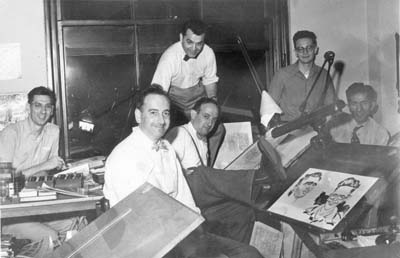
Simon and Kirby studio Left to right: Joe Genalo, Joe Simon, Jack Kirby, Mort Meskin, Jimmy Infantino and Ben Oda. Caricatures (probably drawn by Joe Simon) of Marvin Stein and Jimmy Infantino.

I have seen a number of photographs of the Simon and Kirby studio but the one above is my favorite. One reason is that it shows more of the individuals who worked there than any other photo I have seen. But also I just enjoy the camaraderie that is depicted. Jack Kirby seems ready to leap at the viewer, Mort Meskin raises his leg to, shall we say, pass gas and Joe Simon looks amused by it all. The two caricatures in front of Joe were not meant for publication but were executed for the shear pleasure of it. Because of the limitations of the photograph it is hard to be certain but the caricatures look like Joe’s work. The fact that one of them is Marvin Stein who is not present in the image leads me to believe that Marvin was the photographer.

The original print for this photograph was severely damaged. I restored a scan of it using Photoshop some years ago and saved it on a CD. I have made a lot of scans for material from Joe Simon’s collection and the CD with this photo got lost among the numerous CDs and DVDs that I have accumulated. I had low resolution copies of it and knew I had a high resolution version somewhere but I just could not locate it. Sometime ago I discovered that CDs and DVDs are really poor for archival storage. With my recent completion of work on “Simon and Kirby Superheroes” I decided it would be best to transfer all my CDs and DVDs to hard disks with USB interfaces. Fortunately I had made two copies for every disk I saved and I was able (with much work) to retrieve almost all the archived files (I lost a very few files but nothing that could not be replaced). In the process I finally came across my original high resolution file for the studio photograph.

There was nothing written on the original photograph to indicate when it was made. The photo included Jim Infantino and judging from his rather limited appearance in Simon and Kirby romance comics I earlier concluded this photo was probably taken in either 1951 or 1952. However there was a lot of uncertainty in that estimate and in any case a more accurate one would be desirable. Now that I had recovered the detailed scan I resolved to see what I could do about it.

Joe Genola is shown coloring a comic cover. I was pretty certain that the cover was for the Prize Comics Western title. Unfortunately the viewing angle is so severe that it is impossible to make out exactly what the cover looked like.
Close-up of studio photograph
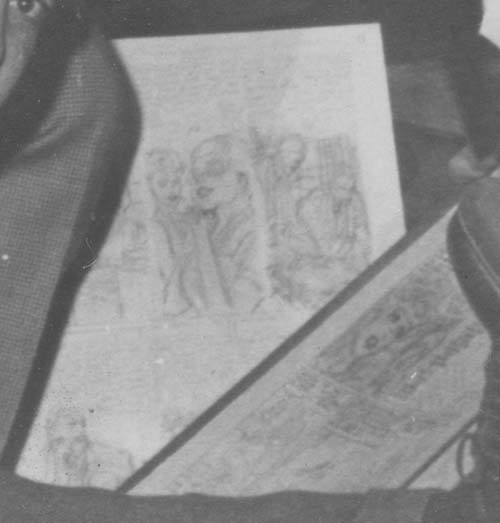
Close-up of the studio photograph

There are a couple pages of unfinished art behind Mort Meskin; one on his drawing table and the other propped up next to Kirby. When enlarged the photo shows this art to have been done by Mort. The art revealed in the detail of this photograph is of interest in and of itself because it shows a stage in the art production that I have not seen before for either Meskin or the Simon and Kirby studio. We can see a penciled but as yet an uninked page. The speech balloons and the accompanying text are all penciled in.
Young Romance #38
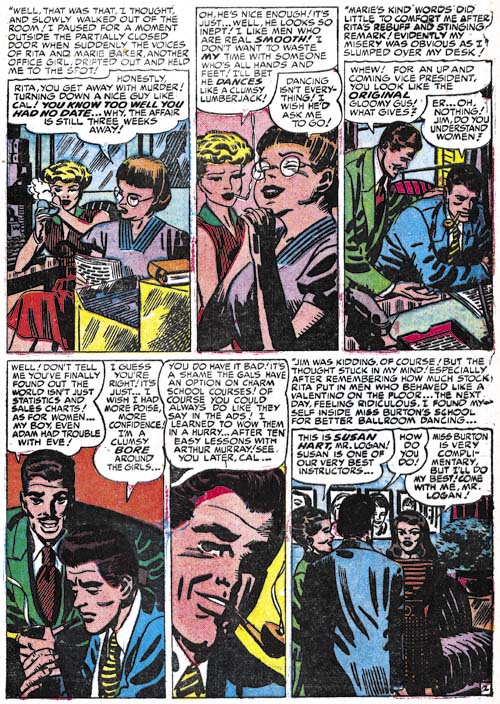
Young Romance #38 (October 1951) “His Dancing Teacher” page 2, art by Mort Meskin

After much searching I managed to locate Meskin’s two art pages. The easiest one to identify was the more vertical one beside Mort’s drawing table. It was page 2 of “His Dancing Teacher” from Young Romance #38 (October 1951). The pencils look pretty tight with no indication of where spotting should be added.
Young Romance #38
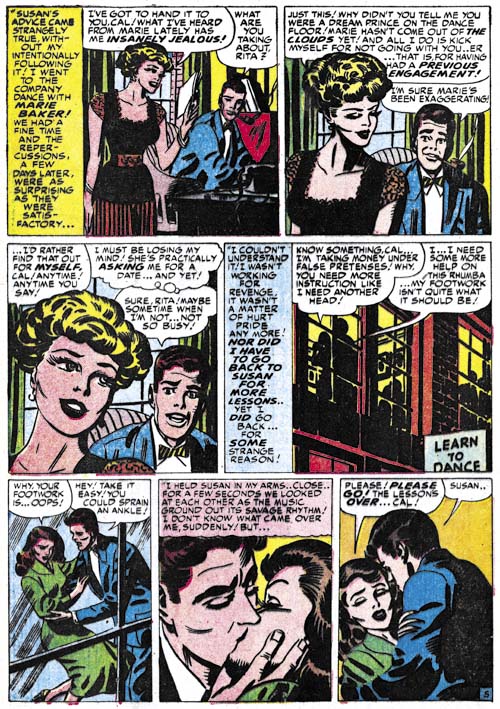
Young Romance #38 (October 1951) “His Dancing Teacher” page 5, art by Mort Meskin

While the page that Mort is currently working on is a little harder to see I am still very confident it is page 5 from the same story. The pencils for panel three seem tight. It is harder to make out the other panels but they really seem to be little more than outlines. It would appear that Mort laid out the entire page then went back and finished it off with some more detailed penciling.

There is another page of art on the floor that also appears to have been drawn by Meskin. Unfortunately only a single panel can be made out and I have so far not been able to identify it. But I do not believe it is from the same “His Dancing Teacher” story.

Because comics were typically cover dated a couple of months later then the actually release and because time also has to be allocated for printing and distribution of the comic, cover dates have to be adjusted to indicate the calendar date for when the art was created. This adjustment would date this photograph to about May 1951. Happily this is well within the range of my original estimate (1951 or 1952).

I had hoped that I would be able to even more closely date this photograph. In the lower left corner by Joe Genola there is a tabloid sized newspaper. It shows two lines of a headline but I can only make out the first line which I believe reads “Beat Red China” although I am not certain about the China word. Still it makes sense since during this time the Korean war was being waged. It is still harder to make out the paper’s name but the first part looks like “Daily”. Two logical candidates are the Daily News and the Daily Mirror. A check of the microfilm of the Daily Mirror from that period pretty much rules it out; the Mirror included a black band at the top of the title page that is clearly not present in the close-up of the photograph. The top of the Daily News does look very much like the paper in the studio. Unfortunately hours of searching through microfilm failed to disclose a matching headline.

Posted in 5 Studio, Periods, Prize | Tagged , , , , , , | 2 Comments