Please donate!
The Jack Kirby Museum is raising funds to open a "Pop-Up" Museum on the Lower East Side, near where Kirby was born and raised. Learn more here.About this Blog:
© 2006, 2007, 2008, 2009, 2010 & 2011 Harry Mendryk. Unless otherwise marked, all images are my own restorations. Further some of the images have copyrights by Joe Simon and Jack Kirby or Joe Simon alone. I am fortunate that Joe Simon has allowed me to also include some previously unpublished material. Please do not copy from this blog without permission.Pages
Categories
- 9/11 (6)
- Artists (268)
- Albistur, Jo (7)
- Avison, Al (8)
- Belfi, John (4)
- Breifer, Dick (9)
- Brewster, Ann (7)
- Burgos, Carl (1)
- Ditko, Steve (2)
- Donahue, Vic (12)
- Draut, Bill (50)
- Eadeh, Al (16)
- Gregg, George (5)
- Infantino, Carmine (6)
- Kirby, Jack (157)
- McCarty, Bob (9)
- Meskin, Mort (69)
- Morrow, Gray (1)
- Oda, Ben (1)
- Oleck, Jack (2)
- Powell, Bob (1)
- Premiani, Bruno (9)
- Prentice, John (29)
- Riley, Ken (2)
- Robinson, Jerry (10)
- Severin, John (7)
- Simon, Joe (57)
- Stallman, Manny (7)
- Starr, Leonard (13)
- Stein, Marvin (20)
- Walton, Bill (5)
- Checklist (19)
- Albistur, Joe (1)
- Brewster, Ann (1)
- Briefer, Dick (1)
- Donahue, Vic (1)
- Draut, Bill (1)
- Eadeh (1)
- Gregg, George (1)
- Infantino, Carmine (1)
- Kirby, Jack (1)
- McCarty, Bob (1)
- Premiani?, Bruno (1)
- Prentice, John (1)
- Riley, Ken (1)
- Robinson & Meskin (1)
- Severin, John (1)
- Simon, Joe (1)
- Stallman, Manny (1)
- Starr, Leonard (1)
- Stein, Marvin (1)
- Comic Checklists (20)
- All For Love (1)
- Black Magic, DC (1)
- Black Magic, Prize (1)
- Boys' Ranch (1)
- Charlie Chan (1)
- Clue (1)
- Fighting American (1)
- Foxhole (1)
- Headline (1)
- In Love (1)
- Justice Traps the Guilty (1)
- My Date (1)
- Personal Love (1)
- Prize Comics Western (1)
- Real West Romance (1)
- Western Love (1)
- Young Brides (1)
- Young Love (1)
- Young Romance (1)
- Your Dreams (1)
- Ink Checklist (1)
- Kirby, Jack (1)
- Periods (396)
- 1 Early (22)
- 2 Fox (14)
- 3 Timely (44)
- 4 DC (early) (46)
- 5 Studio (135)
- 6 Mainline (68)
- Assorted (10)
- Bullseye (8)
- Fighting American (6)
- Foxhole (13)
- In Love (16)
- Police Trap (7)
- Prize (15)
- 7 Freelance (74)
- Archie (13)
- Atlas Kirby (14)
- DC Kirby (4)
- Harvey (27)
- Prize (17)
- 8 Marvel (12)
- Assorted (6)
- Marvel Kirby (6)
- 9 DC (late) (6)
- Late (3)
- Serial Posts (139)
- Art of J. Simon (1)
- Art of Romance (41)
- Criminal Artists (4)
- Early Jack Kirby (9)
- End of S & K (1)
- Harvey Horror (3)
- It's a Crime (1)
- Kirby Austere Inking (1)
- Kirby Inkers (4)
- Little Shop of Horrors (1)
- Margin Notes (5)
- Replacing S&K (4)
- S&K Colorists (3)
- Start of S&K (12)
- Wide Angle Scream (15)
- Topic (341)
- Alternate Takes (16)
- Anthologies (6)
- Art Editing (4)
- Best of Simon & Kirby (2)
- Captain America (5)
- Comicscope (3)
- Experts (3)
- Featured Work (64)
- First Romance (1)
- Ghosting (7)
- Harvey Covers (24)
- Kirby Inking Kirby (4)
- Kirby Krackle (3)
- Kirby Or Not (28)
- Lettering (13)
- My Two Cents (7)
- Odds & Ends (128)
- Publications (24)
- Quote (4)
- Restoration (3)
- Robots (3)
- S&K Superheroes (2)
- Swiping (8)
- Wertham & Censoring (5)
- Why Comics Declined (1)
- Uncategorized (51)
- z Archive (595)
- 2006/03 (16)
- 2006/04 (14)
- 2006/05 (15)
- 2006/06 (16)
- 2006/07 (10)
- 2006/08 (24)
- 2006/09 (11)
- 2006/10 (19)
- 2006/11 (20)
- 2006/12 (14)
- 2007/01 (16)
- 2007/02 (17)
- 2007/03 (14)
- 2007/04 (10)
- 2007/05 (12)
- 2007/06 (8)
- 2007/07 (7)
- 2007/08 (8)
- 2007/09 (6)
- 2007/10 (10)
- 2007/11 (7)
- 2007/12 (4)
- 2008/01 (4)
- 2008/02 (7)
- 2008/03 (12)
- 2008/04 (8)
- 2008/05 (8)
- 2008/06 (11)
- 2008/07 (6)
- 2008/08 (12)
- 2008/09 (7)
- 2008/10 (8)
- 2008/11 (4)
- 2008/12 (6)
- 2009/01 (10)
- 2009/02 (4)
- 2009/03 (5)
- 2009/04 (8)
- 2009/05 (6)
- 2009/06 (5)
- 2009/07 (8)
- 2009/08 (6)
- 2009/09 (5)
- 2009/10 (6)
- 2009/11 (4)
- 2009/12 (3)
- 2010/01 (6)
- 2010/02 (7)
- 2010/03 (7)
- 2010/04 (4)
- 2010/05 (7)
- 2010/06 (5)
- 2010/07 (8)
- 2010/08 (4)
- 2010/09 (6)
- 2010/10 (9)
- 2010/11 (5)
- 2010/12 (5)
- 2011/01 (4)
- 2011/02 (2)
- 2011/03 (5)
- 2011/04 (6)
- 2011/05 (3)
- 2011/06 (5)
- 2011/07 (7)
- 2011/08 (5)
- 2011/09 (4)
- 2011/10 (10)
- 2011/11 (6)
- 2011/12 (5)
- 2012/01 (3)
- 2012/02 (2)
- 2012/03 (8)
- 2012/04 (3)
- 2012/05 (2)
Comic related blogs
Groups (membership required)
Web pages
Tag Archives: ted galindo
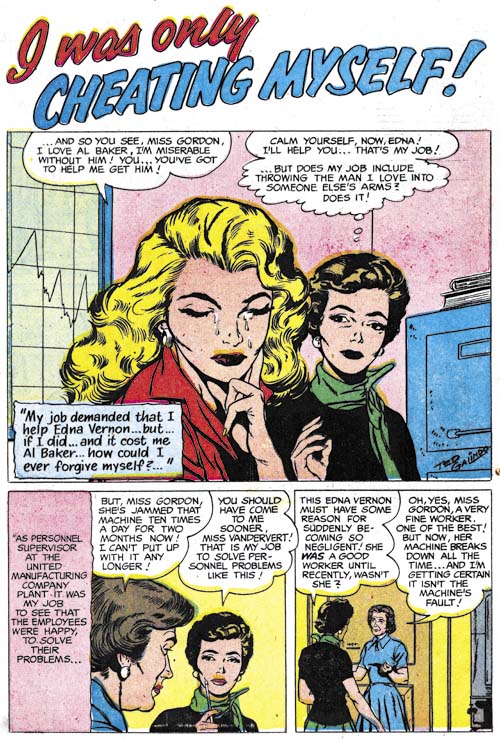
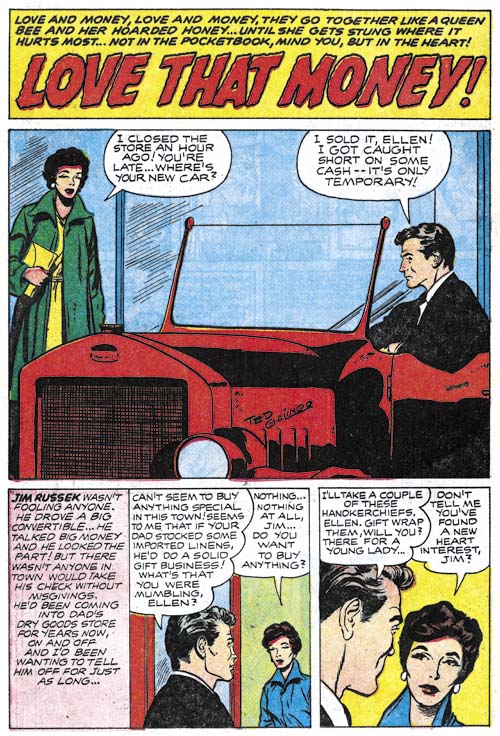
Criminal Artist, Chapter 4, Ted Galindo
If I were writing this serial post based on the amount of material produced for the Prize crime comics, Ted Galindo would have had the third chapter ahead of Bill Draut. Although he worked on Prize crime comics for just a little over two years he was quite productive during that time. Some issues even had two stories drawn by this artist. Most of Ted’s art appeared in Justice Traps the Guilty because the other Prize title, Headline, was cancelled only two issues after Galindo started to provide work.

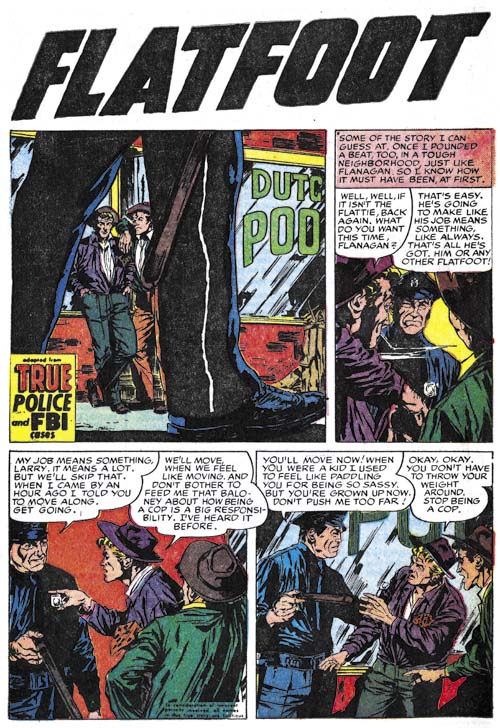
Justice Traps the Guilty #68 (November 1954) “Flatfoot”, art by Ted Galindo
Galindo’s first piece for Prize Comics was “Flatfoot” from Justice Traps the Guilty #68 (November 1954). This was even before “It’s Mutual” that he did for Foxhole #4 (April 1955). The earliest listing for Ted in the GCD is February 1955 so it is possible that “Flatfoot” is Galindo’s earliest published comic book art (or not, the GCD is a work in progress and is not always accurate). In this early piece, Ted is already an accomplished artist but has not arrived at his more distinctive style. The most significant difference is the much heavier inking. His later work would have a minimum of spotting but blacks played an important part of the art in “Flatfoot”. Ted’s predilection for splashless stories is also suggested by the rather small splash provided in this story. Also already present is Galindo’s fondness for tall narrow panels.

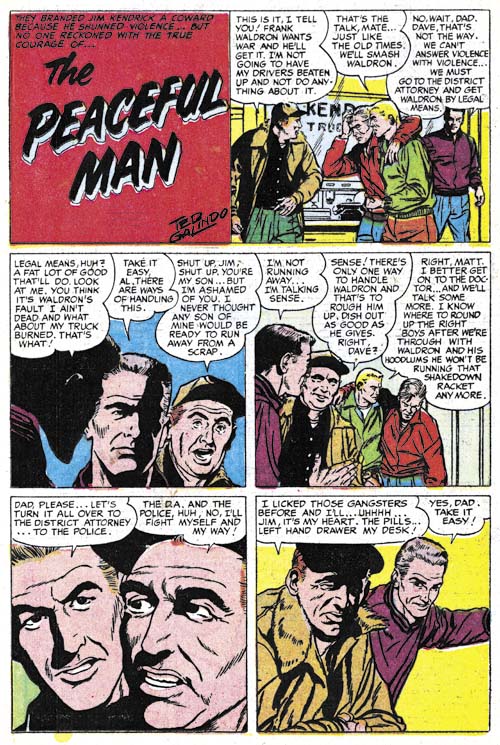
Justice Traps the Guilty #84 (December 1956) “The Peaceful Man”, art by Ted Galindo
Galindo’s JTTG #68 work was not repeated and this artist would not reappear until “Flash Cameron Investigates a Disaster” for Headline #76 (May 1956). Judging from the GCD, Galindo had worked in the interim mostly for Charlton. With his reappearance in Prize Comics, Ted had fully arrived at his familiar style. Most of his stories would not include a splash panel but would instead start with a title panel no larger than the rest of the story panels. Since most artists in the Prize crime comics used half page splashes, Galindo’s format indicates that even though Prize artists were working from a script they still had leeway in the panel layouts. His inking would be light with minimum spotting. But when he used black it was usually in relatively large areas filled with ink.

Justice Traps the Guilty #85 (February 1957) “The Coffee Man” page 3, art by Ted Galindo
One of Galindo’s strengths was his adept characterizations. The post Comic Code Prize crime comics often included sequences of talking heads. with less talented hands these sequences could become rather boring, but Galindo’s carefully handling of the viewing angle and his effective emotional portrayals keep his stories interesting. On page 3 of “The Coffee Man” You can just feel the captain’s discomfort with a disagreeable duty. Even more importantly you can see Willie’s progression from a happy attitude to sadden realization that his life has been drastically offered. No blazing guns, but still a great piece of comic book art.

Justice Traps the Guilty #87 (June 1957) “Wall Of Silence” page 6, art by Ted Galindo
While Galindo could handle emotional portrayal he was no slouch when it came to action. As the example from “Wall of Silence” shows, this was not Kirby action. Frankly I am not sure where Galindo drew his inspiration, perhaps from Alex Raymond’s syndication strip Rip Kirby.

Justice Traps the Guilty #89 (October 1957) “The Printed Word” page 4, art by Ted Galindo
Generally Galindo’s strengths lay in his careful handling of talking heads and action, but in “The Printed Word” he shows how well he could do suspense. And it is not just page 4, the whole story is filled with effective drama. Ted’s use of blacks plays a important roll in the telling of the story. Note in particular how sinister the assailants shadowed face is in the final panel. The 50′s were important years for Alfred Hitchcock with such movies as “Strangers on a Train”, “Dial M for Murder” and “Rear Window”. I am sure Galindo was paying attention and that Hitchcock was an important influence, particularly for this story.

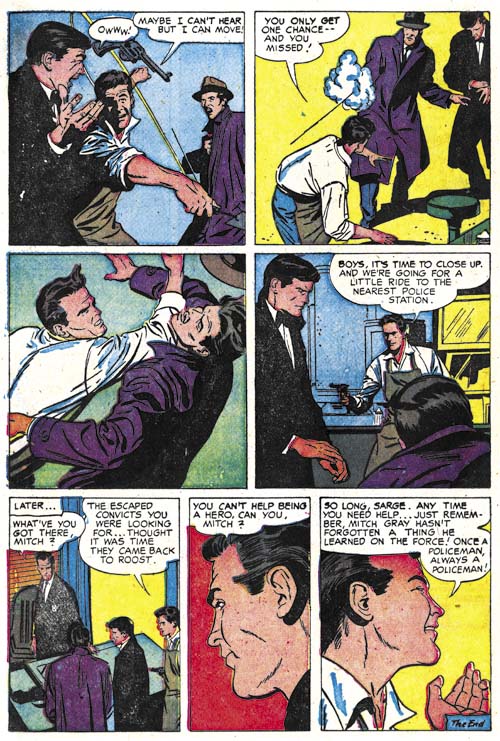
Justice Traps the Guilty #91 (February 1958) “G-Man Justice”, art by Ted Galindo
As I mentioned earlier, most of Galindo’s crime stories do not include a splash. “G-Man Justice” is one of the rare exceptions. During most of the later history of Justice Traps the Guilty Marvin Stein was the primary artist and would provide the cover and the lead story. But during the end of the run Stein’s prominence was replaced by other artist. This provided Galindo with the opportunity to provide a lead story. But a lead story had to have a splash and I suspect this is why Galindo provided one for “G-Man Justice”. It is not a bad job, but in all honesty it is not that great either.
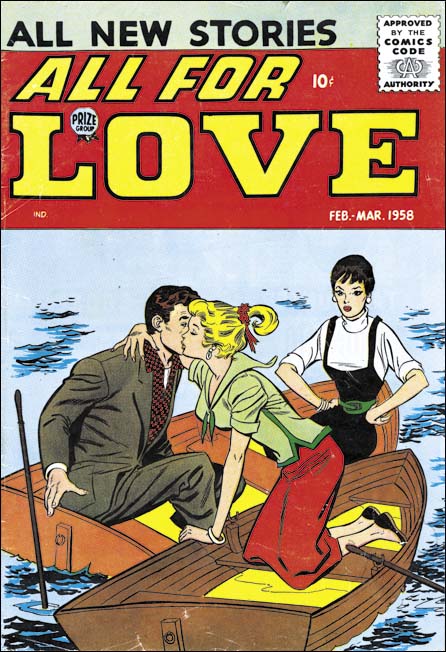
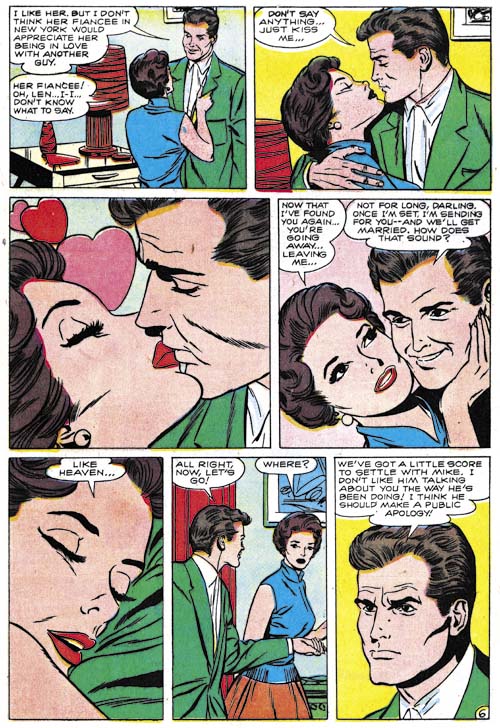
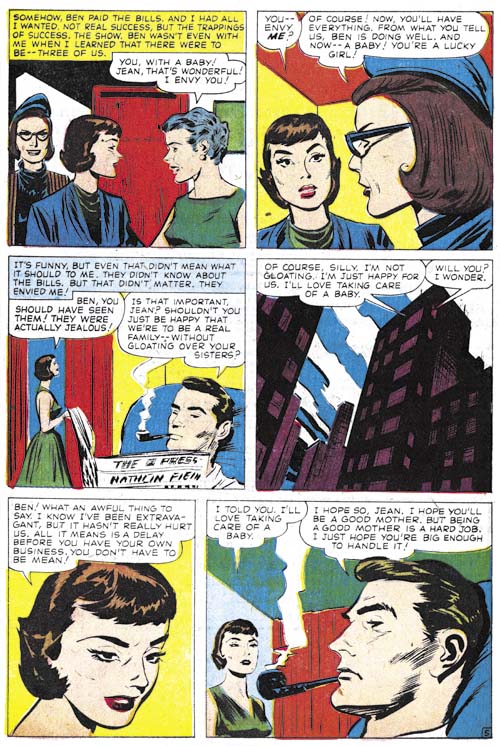
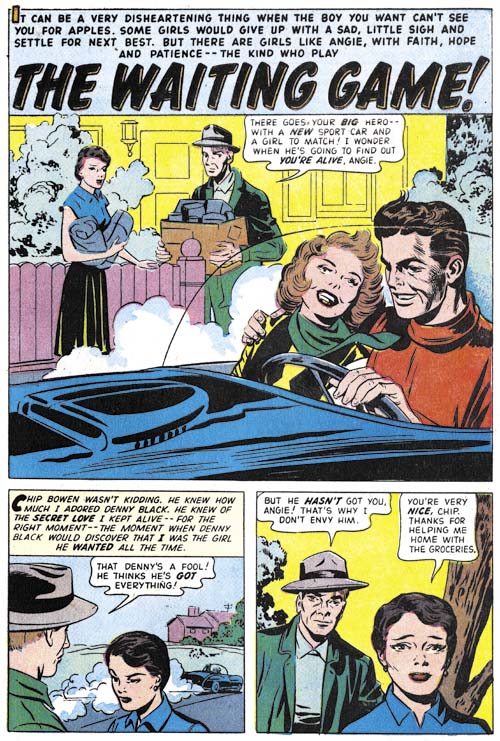
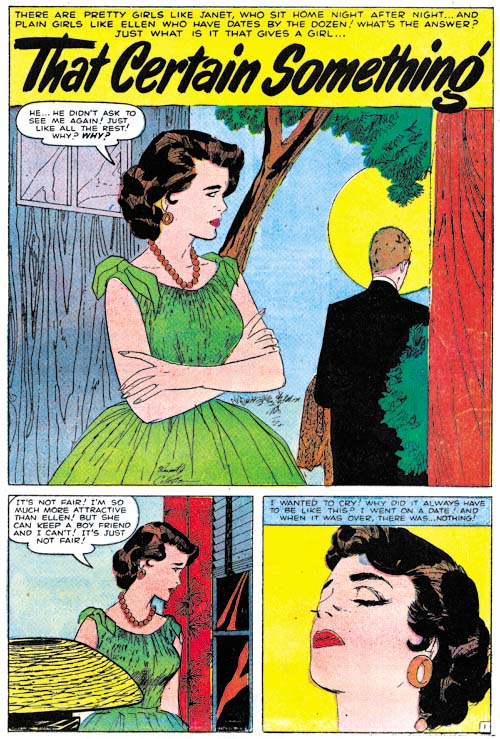
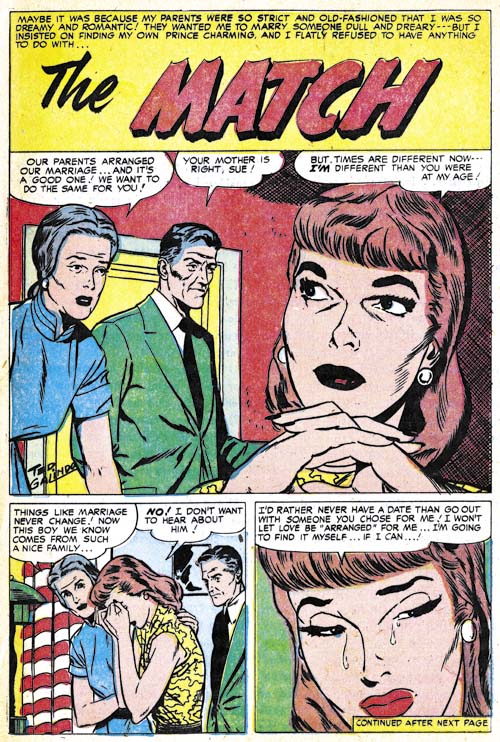
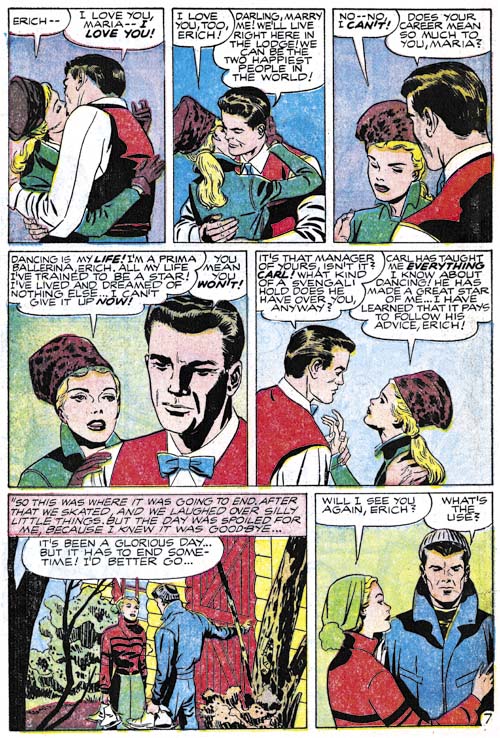
Ted Galindo did a lot of romance art first for the Prize love comics not produced by Simon and Kirby (All for Love and Personal Love) and later in all the titles edited by Joe Simon alone. I have discussed this work in the final chapters of the Art of Romance (Chapters 32, 33, 34, 35, 36, 37 and 38). Galindo’s romance work was rather nice, but it is his crime art that really shines. Ted also did work for the re-launched Black Magic. Hopefully someday I will write about that title as well.
Posted in 2010/12, Criminal Artists, Serial Posts, z Archive
Tagged criminal artist, ted galindo
Leave a comment
Art of Romance, Chapter 38, A Final Transition
(July – December 1959: Young Romance #101 – #103, All For Love #15 – #17, Personal Love #12 – #14)
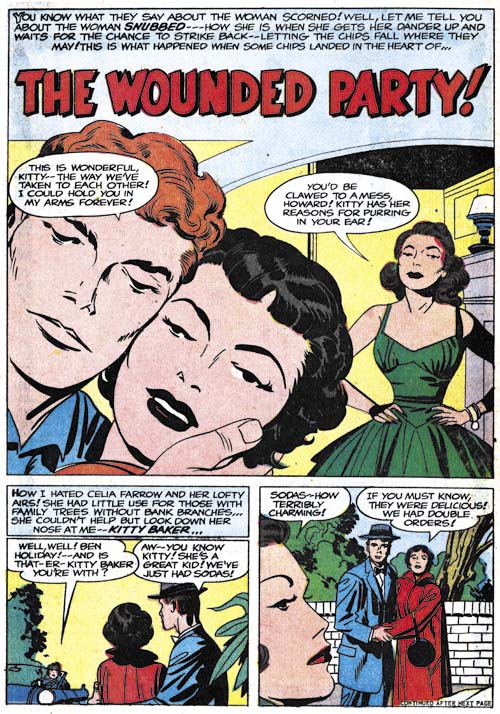
Young Romance #102 (October 1959) “The Wounded Party”, pencils and inks by Jack Kirby
Jack Kirby was comparatively busy with romance art during this period providing one cover and four stories. All really nice pieces and all but one of them inked by Kirby himself. I do not think realism was ever an appropriate description of Kirby’s art, but his work seems especially abstract during this period. Note the simplified nostrils of both the man and the woman. The bridge of the nose seems unnatural. Details such as the eyelids are often dropped. But while these are by no means realistic portrayals, they are by no means unexpressive.
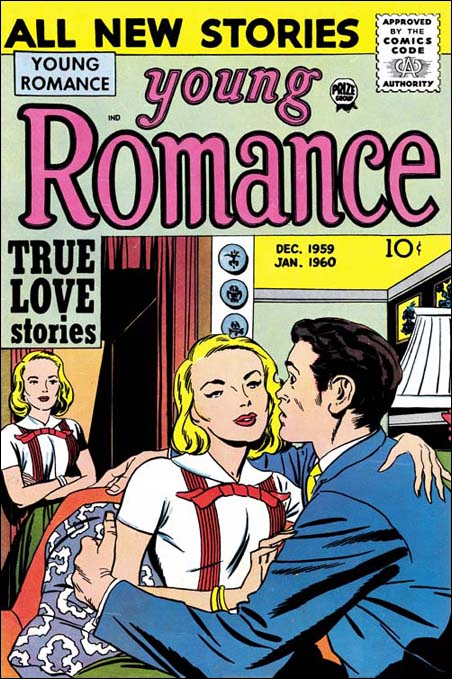
Young Romance #103 (December 1959), pencils and inks by Jack Kirby
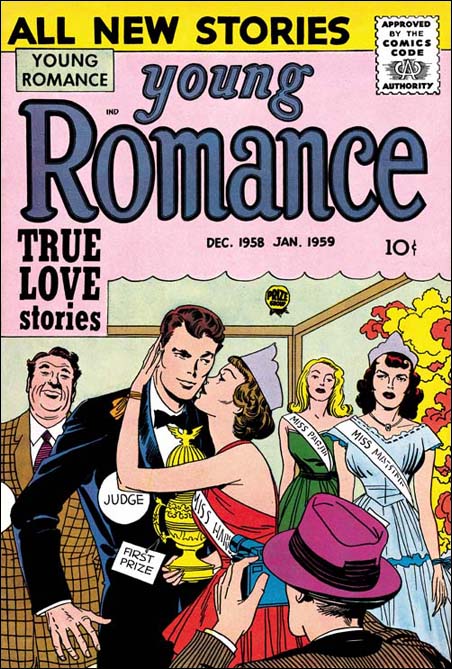
Kirby’s last cover for Young Romance, or any Prize publication. Jack presents a nicely humorous variation on the theme of a third party looking at a romantic couple.
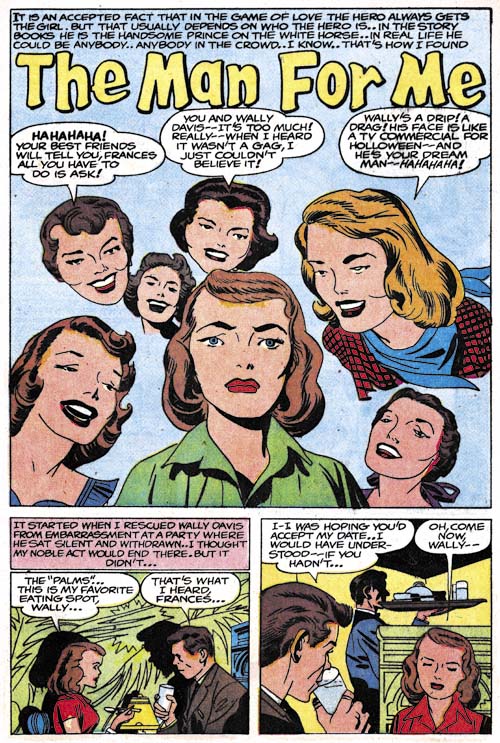
Young Romance #103 (December 1959) “The Man For Me”, pencils and inks by Jack Kirby
Floating heads are not typical for Kirby’s art, but he does turn to them every once in a while. In this case it provides good examples of how Kirby was now drawing woman. In this respect his art is at a mid-point. Earlier Jack drew woman with much variation in looks, some of which while not completely unattractive would hardly be described as beauty queens. Later in his career, most of Kirby’s woman looked alike; differing mainly in their hair and clothes styles. In the splash for “The Man For Me” there still is some variation in the faces of the woman but nowhere near as much as before. All are attractive but I wonder if many readers in 1959 would have consider these woman as truly beautiful?
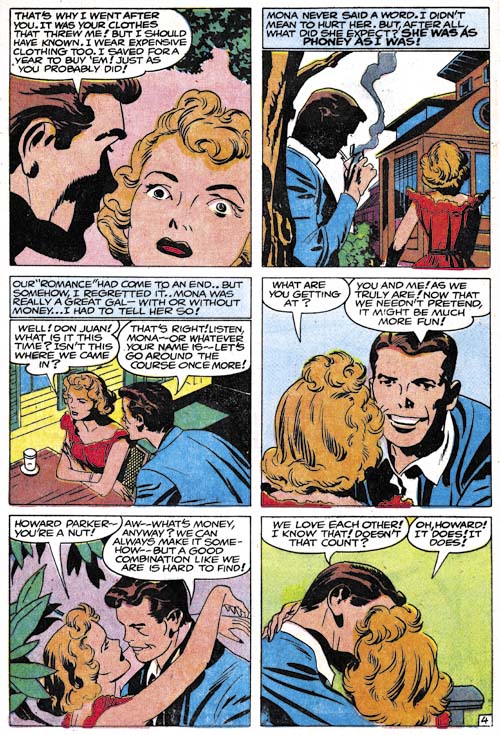
Young Romance #103 (December 1959) “Liars In Love” page 4, pencils and inks by Jack Kirby
A final example of Kirby’s romance graphic story telling. Shifting perspective, varying viewing distances, body language and facial expressions all played a part in Jack’s art. What a master.
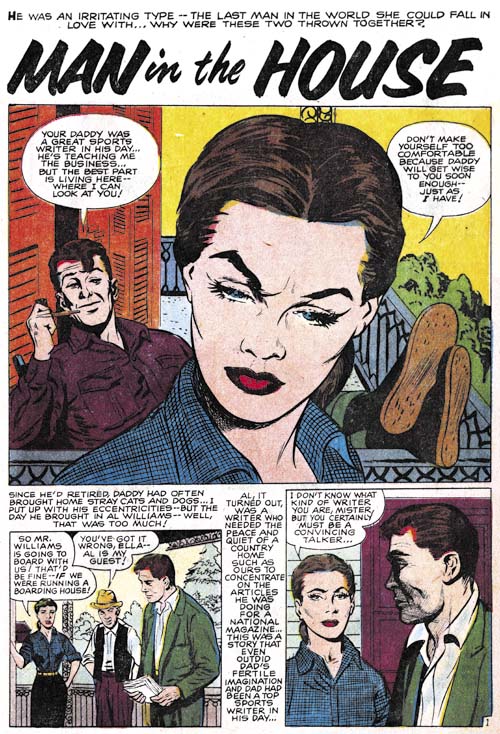
Young Romance #101 (August 1959) “Man In The House”, pencils by John Prentice, inks by Joe Simon
In the last chapter I briefly discussed a piece that looked like the work of John Prentice. The problem was that it was not nearly as well done as was typical for Prentice. I put off deciding about the attribution until this chapter where I would have four stories by the same artist to examine. While it is perfectly possible for one artist to imitate another, it is difficult if not impossible for such imitation to be consistent over an entire story, let alone a number of stories. This work must have been drawn by John Prentice. But there are some parts that look like some other artist hand, in fact like a particular artist, Joe Simon. I now believe that unlike his prior practice, Prentice only supplied pencils which Simon then inked. I have to say that as much as I admire Joe as an artist he really was not doing Prentice justice. Perhaps it was Joe’s blunt brush, which had gotten even blunter over the years. Perhaps Joe was in a rush.
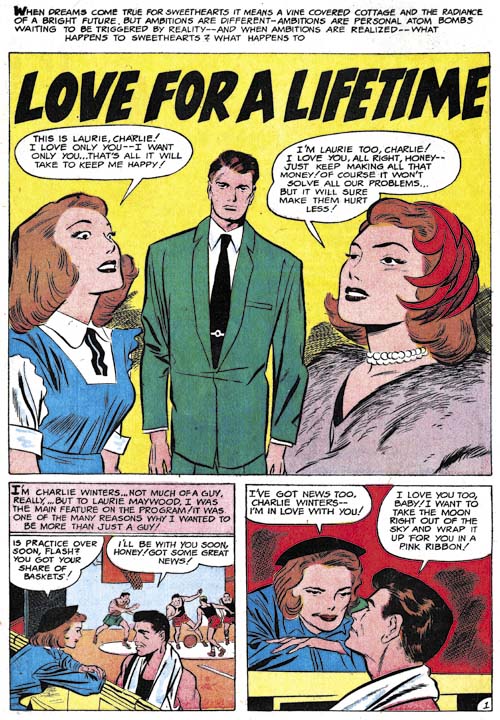
All For Love #15 (August 1959) “Love For a Lifetime”, pencils by Jack Kirby
During the prior year and a half, Kirby only appeared in Young Romance. “Love for a Lifetime” is the first, and only, piece Jack did for All For Love. This was not the only example of an artist that appeared in Young Romance and either All For Love or Personal Love. I will be pointing out some other below and conclude with an explanation why this was happening. Kirby did not ink “Love for a Lifetime”. Nor was it inked by the artist who Jack used often at this time for his inking (who I believe was Marvin Stein). The inker did a good job but I have no idea who he was. This seems to be the only piece he inked for Kirby.
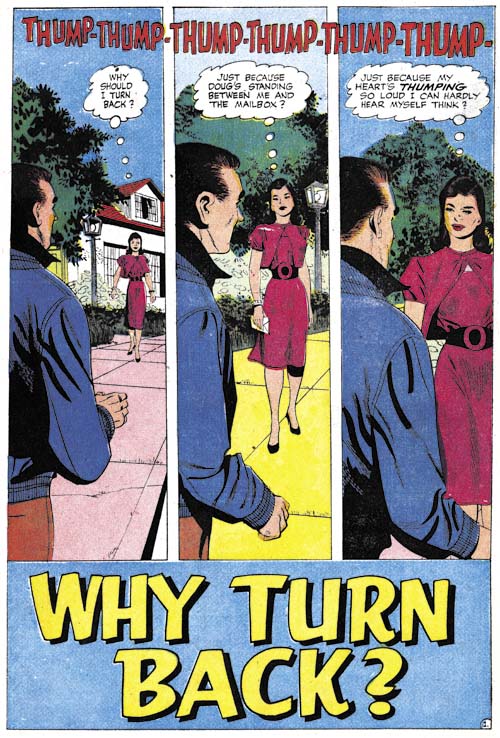
All For Love #17 (December 1959) “Why Turn Back”, art by Paul Reinman
Previously Paul Reinman was another artist who frequented Young Romance but never appeared in either All For Love or Personal Love. During the period covered in this chapter, Reinman drew four stories but only one appeared in Young Romance. The others were published in All For Love.
The piece I selected as an example of Paul’s work is perhaps not the most typical of his art. But I find the art for the opening page rather nice. The tall narrow panels and the way the lady advances in each panel is very interesting. There is something a little unnatural about it all but it is still very effective.
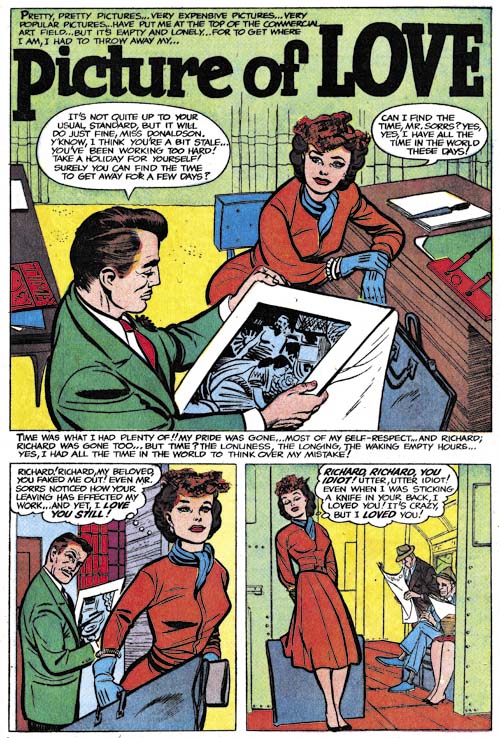
All For Love #15 (August 1959) “Scheduled For Heartbreak”, art by Bob Powell
A new artist appearing in the Prize romance, or more correctly reappearing in the case of Young Romance, is Bob Powell. Powell did five stories; two for Young Romance, two for All For Love and the last for Personal Love. Hence is another example of an artist during this period appearing in all the Prize romance comics. Powell used studio assistants and his art varied quite a bit. I believe Bob had little if anything to do with some of the work attributed to him for the Harvey romance titles. Quality of the Prize romances vary but in my opinion all had significant involvement by Powell himself.
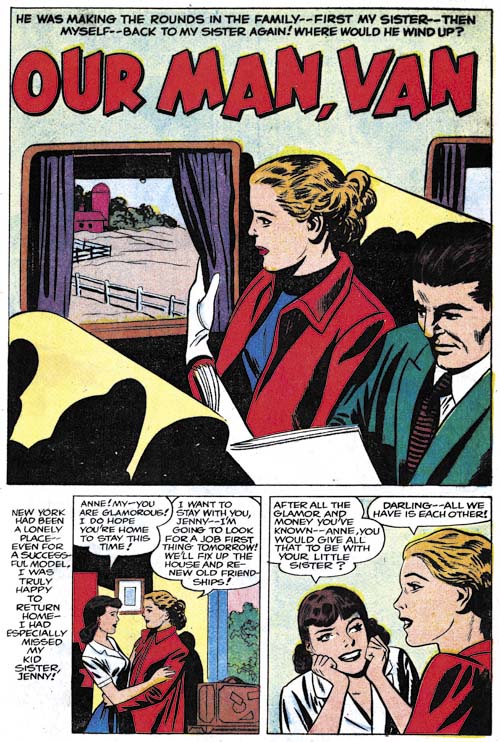
All For Love #17 (December 1959) “Our Man, Van”, pencils by Bruno Premiani, inks by Joe Simon
Perhaps my biggest surprise when reviewing this period was return the of Bruno Premiani. Premiani last worked for Simon and Kirby from in 1949 and 1950. He is said to have left the United States in 1952 (in a short biography by an unknown author which no longer resides on the web) but returned in 1960. However “Our Man, Van” indicates Bruno was actually back in the U.S. around July 1959 (the proper date for creation of art with a December cover date).
Premiani, just like John Prentice, provided pencils only Which Joe Simon then inked. Again it was not the best combination. Further Bruno only did this one story (probably because he began working for the better paying DC).
I should add that earlier in this series I always included a question mark with my Premiani attributions. That was because the work for Prize looked different from what at that time I had seen by Premiani. Since then I have examined a story in DC’s Greatest Adventure that Bruno did that shows a similar drawing style. So I have now dropped off the question mark feeling confident that Premiani was indeed the correct attribution.
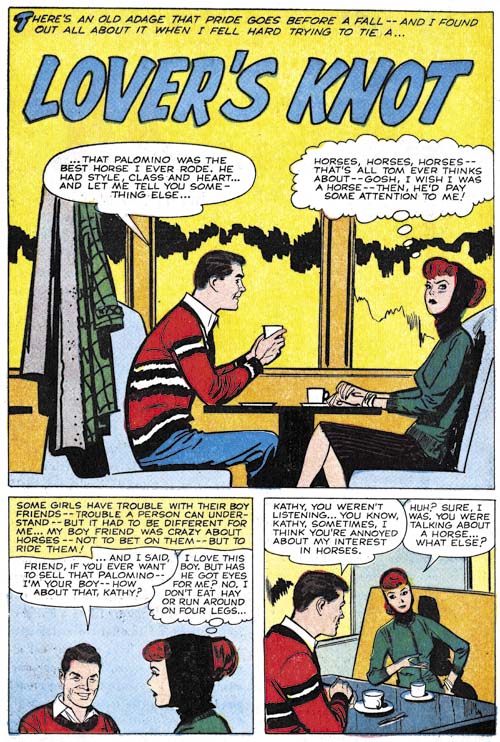
Personal Love #12 (July 1959) “Lover’s Knot”, pencils and inks by Marvin Stein
There is only a single piece during this period by Marvin Stein (same thing was reported in the last chapter). Marvin has gone further in simplifying his art. That is saying a lot since his earlier work would hardly be called complex. Stein has gone so far that I doubt I would have recognized his hand in this work had it not been for “Lost Paradise” (AFL #14, June 1959), the previous piece that he did. While his art style had changed he has not lost his skill at graphically telling a story. It would have been interesting to see where Stein’s style would end up had he continued to do comic book art but unfortunately I believe this he is last comic piece.
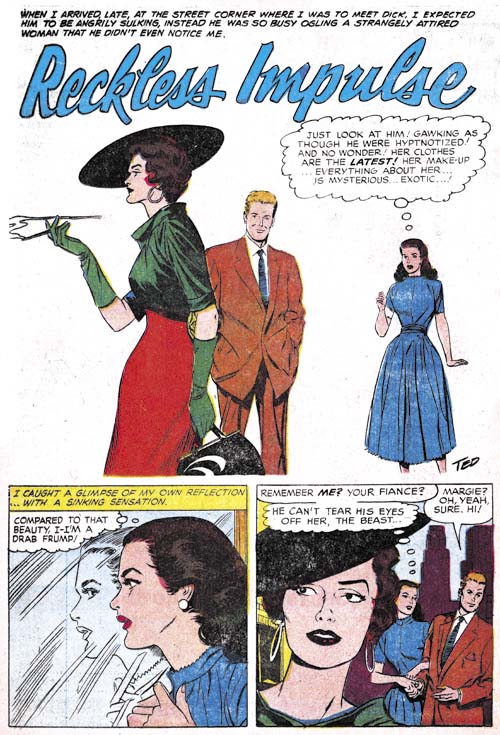
Personal Love #13 (September 1959) “Reckless Impulse”, art by Ted Galindo
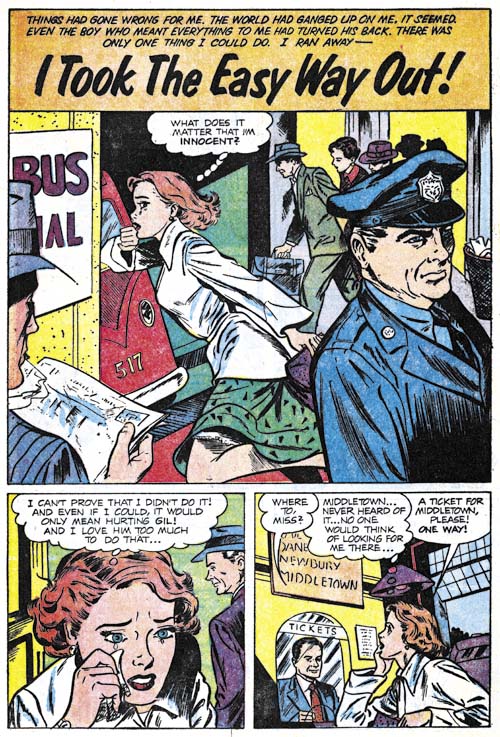
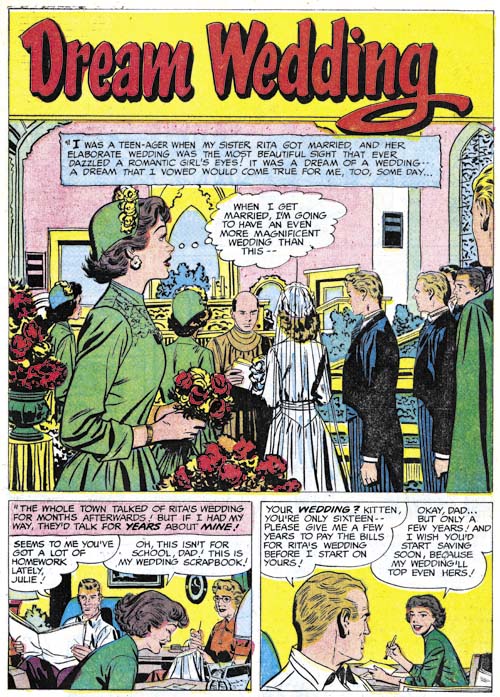
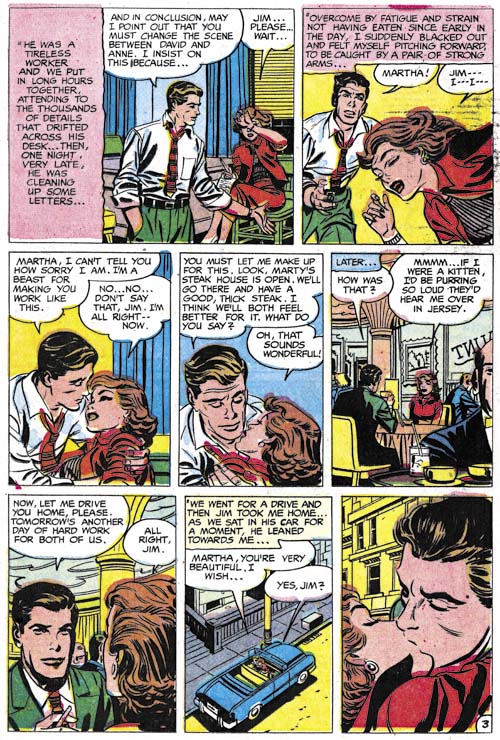
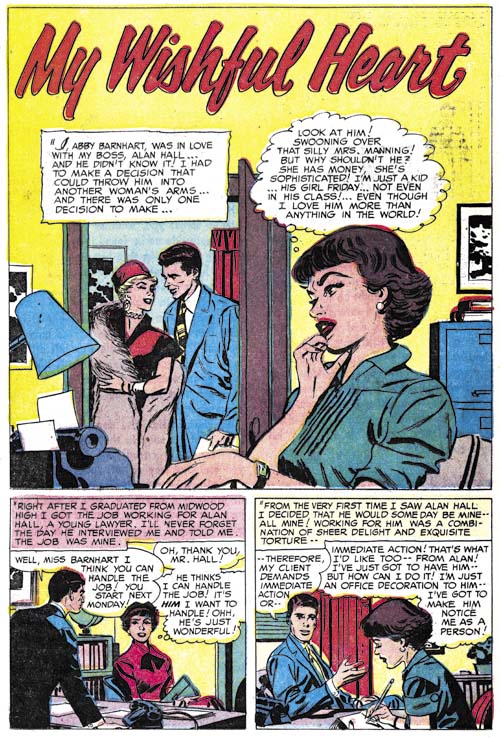
While some artists were appearing in both Young Romance as well as All For Love or Personal Love, Ted Galindo was not one of them. All three stories that he did appeared in Personal Love. He really was a talented artist and among the Prize romance artists he seemed to be the one to experiment the most. For the “Reckless Impulse” splash, Ted has completely eliminated all the background as well as the panel border. The rest is very effective.
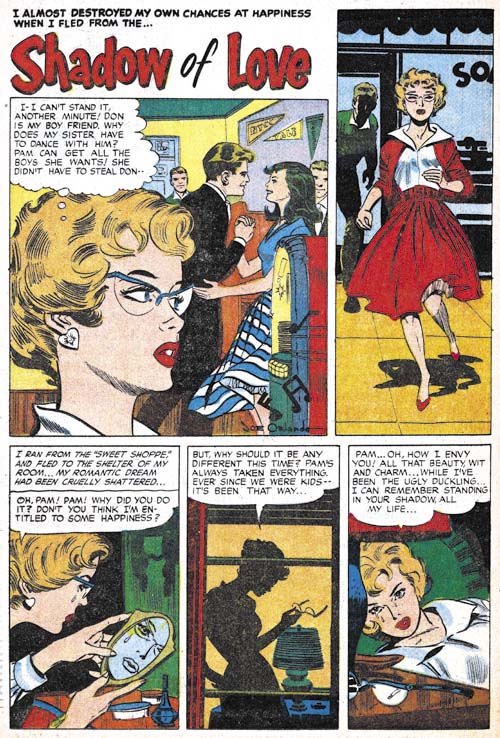
Personal Love #13 (September 1959) “Shadow of Love”, art by Joe Orlando
Yet another Orlando signature that I missed until this latest review. During this period Joe also did an unsigned piece. Orlando also seemed to like to experiment a little. The splash is actually part of the story but what is more interesting is that the second panel is higher than the splash. The three remaining panels are also tall and narrow.
Chapter Conclusion
In his book, The Comic Book Makers, Joe reports that when Mike Bleier (one of the partners for Prize Comics) died in 1960 the remaining partner, Teddy Epstein, asked Joe to take over the comics. So it is not surprising that the postal statements from 1960 until 1963 list Simon as the editor. In 1960 Joe would replace All For Love and Personal Love with a re-launched Young Love and a new title Going Steady. In the past I believed these steps were taken by Joe as soon as he began as the romance editor. This review has made me change my mind. During the previous year and a half the different artists appeared in Young Romance as compared to All For Love or Personal Love. Jack Kirby and Paul Reinman were only shown in Young Romance while Ted Galindo and Joe Orlando only worked for All For Love and Personal Love. Other artists, most unidentified, also followed this pattern. The only exception seems to have been Marvin Stein who appeared in all the Prize titles. However Jack Kirby is in the August issue of All For Love and Reinman does work for the December issue. John Prentice appears in YR #101, AFL #15, #16 and #17. Bob Powell shows up in YR #103, AFL #15 and #16, as well as PL #16. My conclusion is that Joe started as the romance editor in August when this mixing of artists began. This would mean that the 1960 date of Bleier’s death is inaccurate; that he actual died in 1959. I believe that such a error is understandable and not particularly significant.
Series Conclusion
When I started this serial post, Art of Romance, I knew it would take some time to finish. Well over two years later and with 38 chapters I have finally come to the end. Prize’s romance comics would continue from 1960 to 1963 but they were different from what came before. In his book, Joe described it as a basement operation with substantially reduced art and script costs. Most importantly for this blog, they would no longer include any involvement from Jack Kirby. In fact there would be no further Simon and Kirby collaboration of any type until many years later. I am certain I will post about the Prize romance titles under Joe Simon someday, but I am not prepared to do it now.
While for most fans, Simon and Kirby’s reputation rests on their superhero, crime, horror and similar genre, the romance genre was much more important to Joe and Jack. To put some perspective on it for the period spanned by this serial post (cover dates September 1947 to December 1959) Jack Kirby drew a total of 3855 pages of art*. At 1936 pages, romance was by far the greatest part of that work. The breakdown per genre is:
1936 romance
507 hero
459 crime
417 horror
356 western
91 humor
45 science fiction
24 war
20 anthology
There was more romance art than all the other genre combined. Once Simon and Kirby launched Young Romance, they never stop producing romance comics right up to their parting of ways at the end of 1959 (cover dates). Simon and Kirby produced no other genre continually during that period.
One of the themes of this blog is that Simon and Kirby did not only create art, they produced comics as well. Actually that is how they made most of their money. While working together, Simon and Kirby produced 7593 pages of romance art**. This included the work of a lot of different artists and since Simon and Kirby seem to encourage the creators to sign their work, this serial post was able to identify and give examples of the majority of the contributors.
I thought I was well acquainted with Simon and Kirby romance work when I started Art of Romance but I learned a lot by reviewing them sequentially. Much of the knowledge I gained concerned artist attributions but there was three more general observations as well.
Based on interviews of a couple writers that Simon and Kirby had employed, Jack was heavily involved in supplying the writers with plots. But in my opinion, Kirby subsequently had little if anything to do with the stories supplied to the other artists. However I believe something very different happened with the stories that Kirby drew himself. I find the writing of the Kirby drawn romances to be very different for the stories drawn by others. Frequently they display phrasing that to me sound very much the writing of Kirby himself. I am certain that Jack would re-write much of the scripts that he drew.
With the exception of Jack’s own art, Simon and Kirby left all inking of art to the artists themselves. That does not mean that all the other artists inked their own work but the great majority of them appeared to do so. Certain this was the case for frequent contributors Bill Draut and John Prentice. Mort Meskin’s pencils often inked his own pencils but he for a time he used George Roussos as an inker as well. I do not claim to have sorted it all out but my opinion is that Mort did almost all his own inking with a relatively small fraction inked by George. Inking of Kirby’s pencils was something very different. Joe Simon has described it as an assembly line with different inkers contributing to different parts of the same story. My observations of the actual comics supports Joe’s statements. When I identify a particular inker of Kirby’s art I am not saying that they were the only inker but rather just the only one I thought I could identify but other inkers may have been involved as well.
My final observation concerned the question of Kirby layouts for other artists; an often repeated claim. It is also one that is difficult to disprove by conventional comparisons. That is because it is hard to distinguish the difference between layouts, influence and swiping. Particularly since it often involves admittedly subjective criteria. The methodology I have found often useful was panel layouts. I would compare panel layouts from Kirby’s own work and those of other artists during the same period. After all its seems very unlikely that Kirby would adopt different panel layouts for work supplied to other artists to complete. I often found particular panel layout used by some artist over and over again. for instance during one period Leonard Starr frequently used tall narrow panels that rarely appeared in Kirby’s art. Using panel layouts I can confidently say that Kirby did not supply layouts to more important artists like Bill Draut, Mort Meskin, John Prentice, Bob McCarty and others. Kirby did appear to provide layouts for some minor and less talented artist but then the difficulty becomes distinguishing Kirby layouts that were finished and inked by the other artist from Kirby pencils just inked by another artist.
Footnotes:
* In the calculation present here I am excluding the work Kirby did for DC and Atlas after the breakup of the Simon and Kirby studio. I have included the 146 pages of Boy Commandos in the hero genre. Personally I do not consider the Boy commandos published during the time of World War II as war comics, but the post-war examples clearly do not belong in that genre.
** I am excluding from these calculations All For Love and Personal Love. As I discuss above Joe Simon may have been the editor of these titles as well for a period. However there is little reason to believe Jack Kirby had anything to do with them other than supplying a single story for All For Love.
Chapter 1, A New Genre (YR #1 – #4)
Chapter 2, Early Artists (YR #1 – #4)
Chapter 3, The Field No Longer Their’s Alone (YR #5 – #8)
Chapter 4, An Explosion of Romance (YR #9 – #12, YL #1 – #4)
Chapter 5, New Talent (YR #9 – 12, YL #1 – #4)
Chapter 6, Love on the Range (RWR #1 – #7, WL #1 – #6)
Chapter 7, More Love on the Range (RWR #1 – #7, WL #1 – #6)
Chapter 8, Kirby on the Range? (RWR #1 – #7, WL #1 – #6)
Chapter 9, More Romance (YR #13 – #16, YL #5 – #6)
Chapter 10, The Peak of the Love Glut (YR #17 – #20, YL #7 – #8)
Chapter 11, After the Glut (YR #21 – #23, YL #9 – #10)
Chapter 12, A Smaller Studio (YR #24 – #26, YL #12 – #14)
Chapter 13, Romance Bottoms Out (YR #27 – #29, YL #15 – #17)
Chapter 14, The Third Suspect (YR #30 – #32, YL #18 – #20)
Chapter 15, The Action of Romance (YR #33 – #35, YL #21 – #23)
Chapter 16, Someone Old and Someone New (YR #36 – #38, YL #24 – #26)
Chapter 17, The Assistant (YR #39 – #41, YL #27 – #29)
Chapter 18, Meskin Takes Over (YR #42 – #44, YL #30 – #32)
Chapter 19, More Artists (YR #45 – #47, YL #33 – #35)
Chapter 20, Romance Still Matters (YR #48 – #50, YL #36 – #38, YB #1)
Chapter 21, Roussos Messes Up (YR #51 – #53, YL #39 – #41, YB #2 – 3)
Chapter 22, He’s the Man (YR #54 – #56, YL #42 – #44, YB #4)
Chapter 23, New Ways of Doing Things (YR #57 – #59, YL #45 – #47, YB #5 – #6)
Chapter 24, A New Artist (YR #60 – #62, YL #48 – #50, YB #7 – #8)
Chapter 25, More New Faces (YR #63 – #65, YLe #51 – #53, YB #9 – #11)
Chapter 26, Goodbye Jack (YR #66 – #68, YL #54 – #56, YB #12 – #14)
Chapter 27, The Return of Mort (YR #69 – #71, YL #57 – #59, YB #15 – #17)
Chapter 28, A Glut of Artists (YR #72 – #74, YL #60 – #62, YB #18 & #19, IL #1 & #2)
Chapter 29, Trouble Begins (YR #75 – #77, YL #63 – #65, YB #20 – #22, IL #3 – #5)
Chapter 30, Transition (YR #78 – #80, YL #66 – #68, YBs #23 – #25, IL #6, ILY #7)
Chapter 30, Appendix (YB #23)
Chapter 31, Kirby, Kirby and More Kirby (YR #81 – #82, YL #69 – #70, YB #26 – #27)
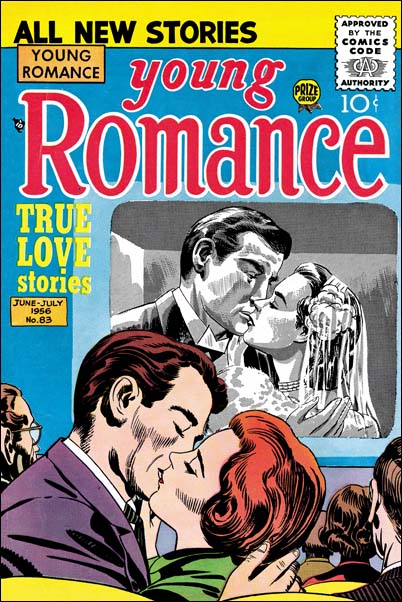
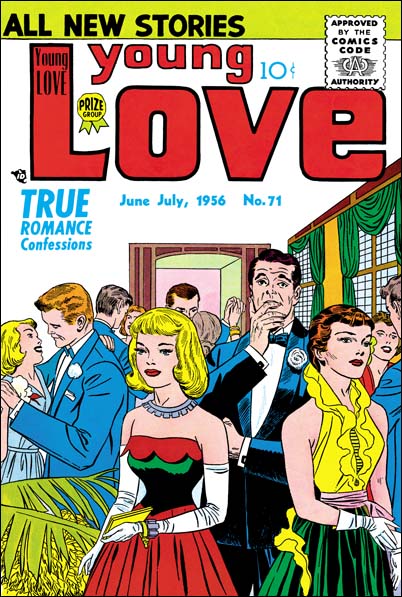
Chapter 32, The Kirby Beat Goes On (YR #83 – #84, YL #71 – #72, YB #28 – #29)
Chapter 33, End of an Era (YR #85 – #87, YL #73, YB #30, AFL #1)
Chapter 34, A New Prize Title (YR #88 – #91, AFL #2 – #5, PL #1 – #2)
Chapter 35, Settling In ( YR #92 – #94, AFL #6 – #8, PL #3 – #5)
Appendix, J.O. Is Joe Orlando
Chapter 36, More Kirby (YR #95 – #97, AFL #9 – #11, PL #6 – #8)
Chapter 37, Some Surprises (YR #98 – #100, AFL #12 – #14, PL #9 – #11)
Chapter 38, All Things Must End (YR #101 – #103, AFL #15 – #17, PL #12 – #14)

Posted in Art of Romance, Serial Posts
Tagged Art of Romance, bob powell, Bruno Premiani, Jack Kirby, joe orlando, Joe Simon, john prentice, marvin stein, paul reinman, ted galindo
6 Comments
Art of Romance, Chapter 37, Some Surprises
(January – June 1959: Young Romance #98 – #100, All For Love #12 – #14, Personal Love #9 – #11)

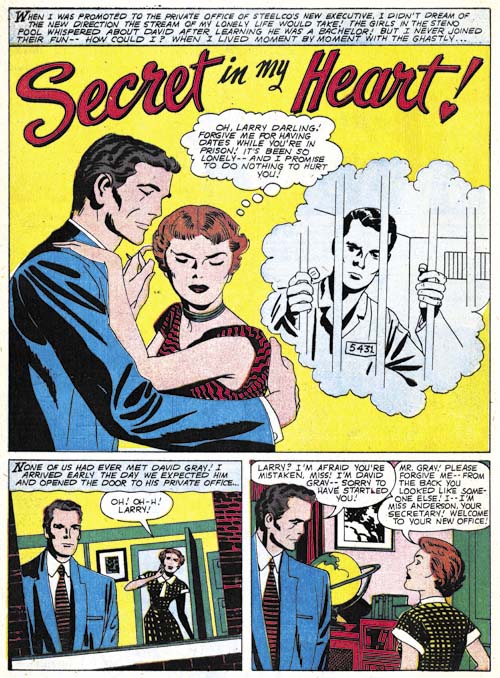
Young Romance #98 (February 1959) “Secret In My Heart”, pencils and inks by Jack Kirby
Kirby provides four stories for two issues of Young Romance (YR #98 and #99). I believe Jack inked three of the stories himself as well as the splash page for the fourth story. It is hard to be sure because some of the old inking techniques such as arched shadows (Inking Glossary) do not show up often. Further the other inker, who I believe was Marvin Stein, was doing a pretty good job matching Kirby’s work.
Note the tilted image in the first story panel. This is a bit unusual for Kirby but then again Jack was always trying something different.

Young Romance #99 (April 1959) “Man Wanted” page 2, pencils and inks by Jack Kirby
Above is an example of the great graphical story telling Kirby was doing during this period. Jack’s drawing style has taken on a more abstract quality. Note the eyelids of the woman in the second panel. They really are not natural or realistic but are very expressive nonetheless.

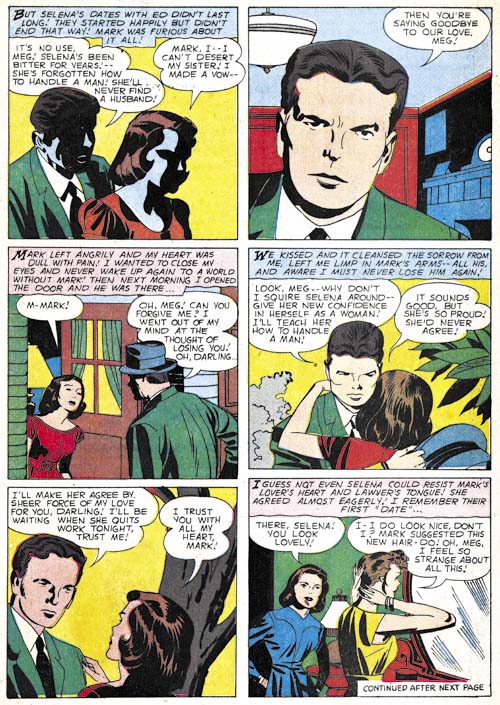
Young Romance #98 (February 1959) “A Husband for My Sister” page 3, pencils by Jack Kirby, inks by Marvin Stein
While I believe the splash page for “A Husband for My Sister” was inked by Kirby himself, the rest of the story does not look like his inking. Perhaps the most obvious difference is the shadow inking found in the first panel of page three. The inker obviously had a poor understanding of the shape of the head. Particularly grievous is the shadow around the eye of the woman. Nor would one expect the man’s lips to catch the light as it does here. I have never seen Kirby do this sort of thing but I have seen Marvin Stein do similar unnatural handling of shadows (“Tragic Circle, JTTG #75, Criminal Artists, Marvin Stein).

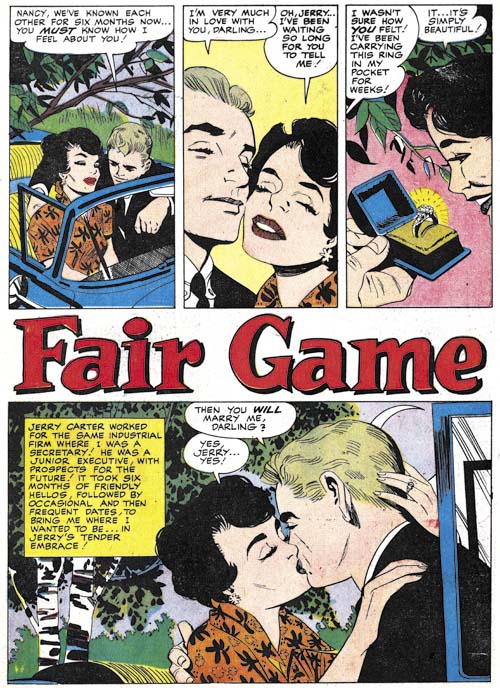
Young Romance #99 (April 1959) “Fair Game”, art by Paul Reinman
Paul Reinman was used often during this period, providing five stories for Young Romance. His abundant appearance in Young Romance and absence from All For Love and Personal Love is another indication that they titles were produced by different editors.

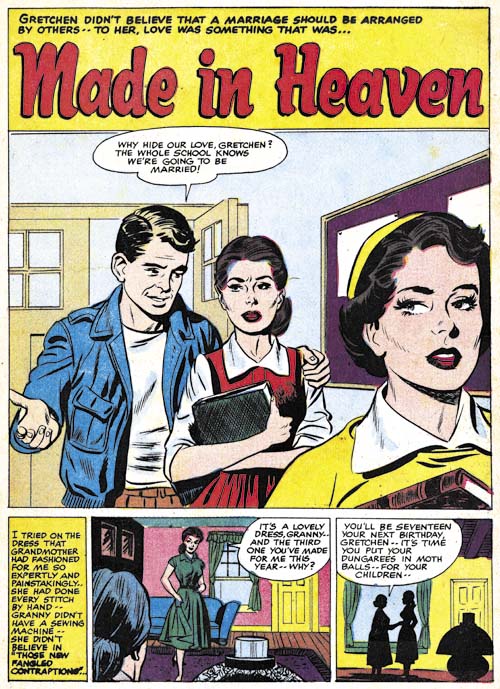
Young Romance #98 (February 1959) “Made in Heaven”, art by John Prentice?
I am not sure what to make of “Made in Heaven”. The art superficially resembles that by John Prentice but is no where nearly nicely drawn as was typical for John. At this time Prentice was primarily working on the syndication strip Rip Kirby but he may also have been doing some work for DC. Was this Prentice quickly dashing something off or was it some other artists copying John’s style? Like I said, I am not sure but I will deffer my opinion until the next chapter when I will have further examples to examine.

All For Love #14 (June 1959) “Lost Paradise” page 4, pencils and inks by Marvin Stein
Marvin Stein only did a single story during this period. Stein had begun working for Cellomatic in 1958 so presumably his comic book work was done during his spare time. Perhaps this explains his the increasingly looser style that Marvin was using. Still “Lost Paradise” is a graphically well told story.
In the previous chapter I mentioned an unidentified artist who, like Stein, used a rather blunt brush. I wrote that this unknown artist liked to provide very thick outlines in parts. Well it looks like Stein has adopted that style as well. I still believe they are different artists because of the very different manners they drew woman.

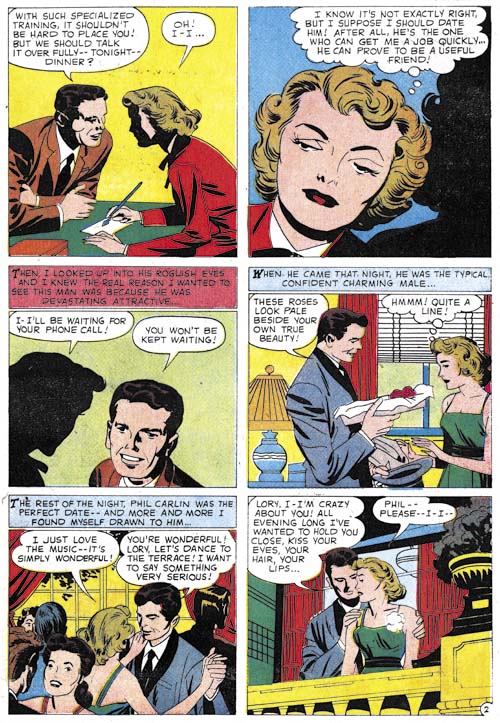
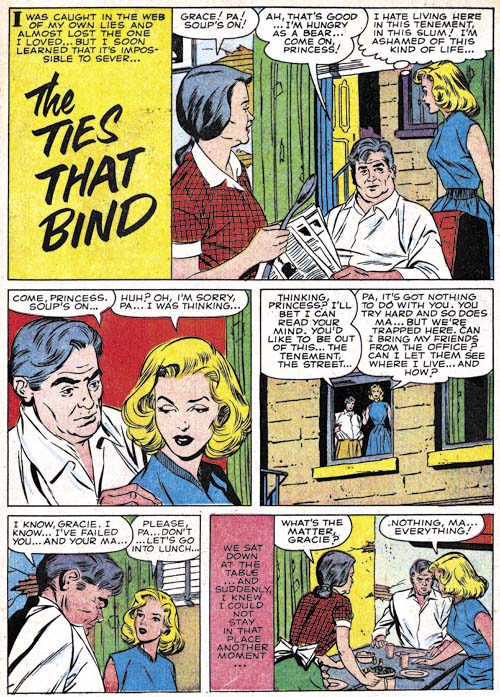
Personal Love #10 (March 1959) “The Ties That Bind”, art by Ted Galindo
Ted Galindo’s attractive work continues to show up frequently in All For Love and Personal Love. Would you call this a splashless story or one with just a reduced size splash? An unusual panel layout for Galindo or any other artist doing work for the Prize romance titles.

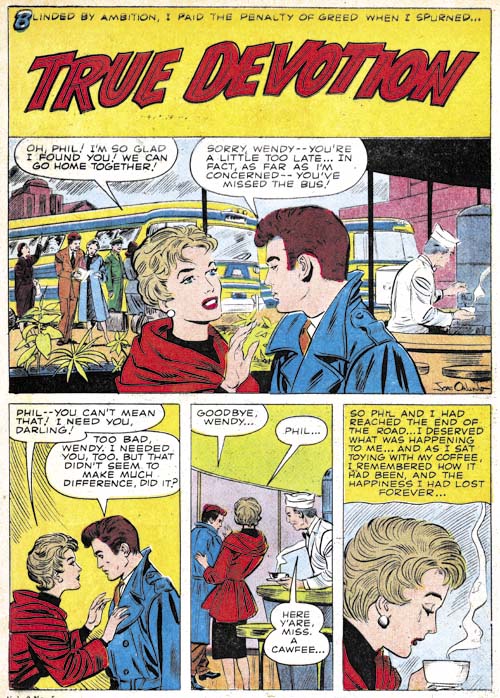
Personal Love #11 (May 1959) “True Devotion”, art by Joe Orlando
I would have saved myself much effort had I noticed before the signature on the splash for “True Devotion”. There as clear as day is Joe Orlando’s full signature. Even the letters J and O are executed in the same manner that he used on cover art for All For Love, Personal Love and Justice Traps the Guilty. No question about it all that cover art was done by Joe. Orlando was no longer providing covers but he was now drawing full stories. Besides “True Devotion” there are two other unsigned stories from this period. Considering the quality of the covers Orlando did, it is not surprising how excellent the story art was.

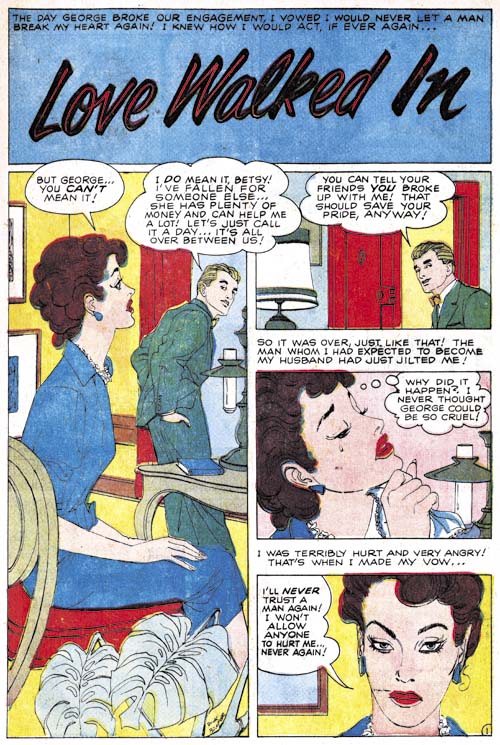
All For Love #14 (June 1959) “Love Walked In”, art by Dick Briefer
Unlike Orlando’s “True Devotion”, I had previously seen the signature on “Love Walked In” but I had misread it. So I was rather surprised when I reviewed it for this post to find the correct reading was clearly Dick Briefer. What a pleasant but unexpected find. A fortunate one as well, I doubt I would have identified Briefer as the artist without the signature. I have never seen romance art by Dick before and he does it surprisingly well. Once you know it was done by Briefer you can pick out some of his traits, particularly Briefer’s love of asymmetry. But the style on a whole is a lot more conservative and realistic than typical Briefer art especially compared to his Frankenstein.

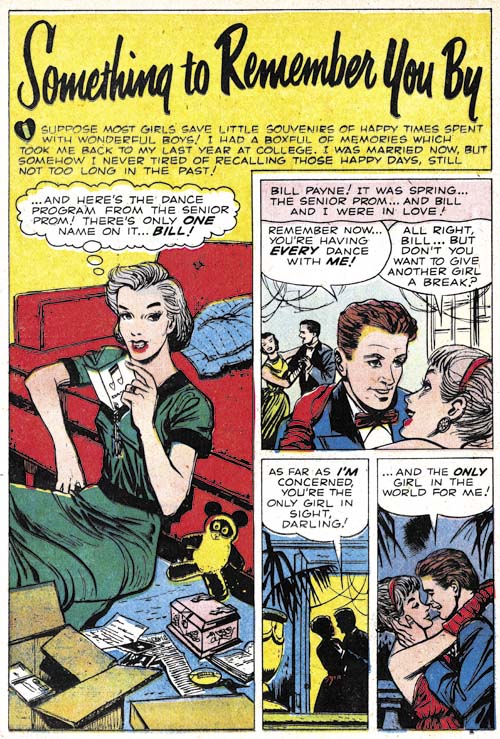
Personal Love #11 (May 1959) “Something To Remember You By” , art by Dick Briefer
Briefer also did two unsigned pieces during the period so I could not resist including another example. I really love what he does with these stories.
I thought Dick had pretty much given up work as a comic book artist after Prize’s Frankenstein was cancelled in 1954 (a casualty of the Comic Code). The GCD only lists reprints for him after that date. “Who’s Who” has him as a non-comics freelancer from 1956 to 1960, followed by advertisement art (1960 – 1972) and fine arts (1962 – 1972). But now we know he did not completely abandon comics.
Chapter 1, A New Genre (YR #1 – #4)
Chapter 2, Early Artists (YR #1 – #4)
Chapter 3, The Field No Longer Their’s Alone (YR #5 – #8)
Chapter 4, An Explosion of Romance (YR #9 – #12, YL #1 – #4)
Chapter 5, New Talent (YR #9 – 12, YL #1 – #4)
Chapter 6, Love on the Range (RWR #1 – #7, WL #1 – #6)
Chapter 7, More Love on the Range (RWR #1 – #7, WL #1 – #6)
Chapter 8, Kirby on the Range? (RWR #1 – #7, WL #1 – #6)
Chapter 9, More Romance (YR #13 – #16, YL #5 – #6)
Chapter 10, The Peak of the Love Glut (YR #17 – #20, YL #7 – #8)
Chapter 11, After the Glut (YR #21 – #23, YL #9 – #10)
Chapter 12, A Smaller Studio (YR #24 – #26, YL #12 – #14)
Chapter 13, Romance Bottoms Out (YR #27 – #29, YL #15 – #17)
Chapter 14, The Third Suspect (YR #30 – #32, YL #18 – #20)
Chapter 15, The Action of Romance (YR #33 – #35, YL #21 – #23)
Chapter 16, Someone Old and Someone New (YR #36 – #38, YL #24 – #26)
Chapter 17, The Assistant (YR #39 – #41, YL #27 – #29)
Chapter 18, Meskin Takes Over (YR #42 – #44, YL #30 – #32)
Chapter 19, More Artists (YR #45 – #47, YL #33 – #35)
Chapter 20, Romance Still Matters (YR #48 – #50, YL #36 – #38, YB #1)
Chapter 21, Roussos Messes Up (YR #51 – #53, YL #39 – #41, YB #2 – 3)
Chapter 22, He’s the Man (YR #54 – #56, YL #42 – #44, YB #4)
Chapter 23, New Ways of Doing Things (YR #57 – #59, YL #45 – #47, YB #5 – #6)
Chapter 24, A New Artist (YR #60 – #62, YL #48 – #50, YB #7 – #8)
Chapter 25, More New Faces (YR #63 – #65, YLe #51 – #53, YB #9 – #11)
Chapter 26, Goodbye Jack (YR #66 – #68, YL #54 – #56, YB #12 – #14)
Chapter 27, The Return of Mort (YR #69 – #71, YL #57 – #59, YB #15 – #17)
Chapter 28, A Glut of Artists (YR #72 – #74, YL #60 – #62, YB #18 & #19, IL #1 & #2)
Chapter 29, Trouble Begins (YR #75 – #77, YL #63 – #65, YB #20 – #22, IL #3 – #5)
Chapter 30, Transition (YR #78 – #80, YL #66 – #68, YBs #23 – #25, IL #6, ILY #7)
Chapter 30, Appendix (YB #23)
Chapter 31, Kirby, Kirby and More Kirby (YR #81 – #82, YL #69 – #70, YB #26 – #27)
Chapter 32, The Kirby Beat Goes On (YR #83 – #84, YL #71 – #72, YB #28 – #29)
Chapter 33, End of an Era (YR #85 – #87, YL #73, YB #30, AFL #1)
Chapter 34, A New Prize Title (YR #88 – #91, AFL #2 – #5, PL #1 – #2)
Chapter 35, Settling In ( YR #92 – #94, AFL #6 – #8, PL #3 – #5)
Appendix, J.O. Is Joe Orlando
Chapter 36, More Kirby (YR #95 – #97, AFL #9 – #11, PL #6 – #8)
Chapter 37, Some Surprises (YR #98 – #100, AFL #12 – #14, PL #9 – #11)
Chapter 38, All Things Must End (YR #101 – #103, AFL #15 – #17, PL #12 – #14)

Posted in 2010/08, 7 Freelance, Art of Romance, Artists, Breifer, Dick, Kirby, Jack, Periods, Prize, Serial Posts, Stein, Marvin, z Archive
Tagged Art of Romance, dick briefer, Jack Kirby, joe orlando, marvin stein, paul reinman, ted galindo
6 Comments
Art of Romance, Chapter 36, More Kirby
(July – December 1958: Young Romance #95 – #97, All For Love #9 – #11, Personal Love #6 – #8)

Young Romance #97 (December 1958), pencils by Jack Kirby, inks by Jack and Rosalind? Kirby
Kirby drew two of the Young Romance covers during this period (he also did Young Romance #95). Both appeared to be inked by Jack as well. But note the unusual hand belonging to the contestant wearing the blue dress. When Kirby drew covers those hands found in the periphery often were just crudely sketched. Inkers were generally artists as well and they would ink Jack’s quickly drawn hands in a way to provide them with some semblance of normality. But this example from the YR #97 cover could only be described as quite amateurish. I find it hard to believe that any professional artist would have inked such a hand. That is why I suspect that Jack’s wife Rosalind provided the outline inking. It has been reported that Rosalind did help Jack with the inking at this time, most notably for DC’s Green Arrow. Some have said that her help amounted to nothing more than filling in the black areas but other believe she did some of the outline inking as well using a pen. YR #97 convinces me that the latter proposition is correct. Rosalind Kirby may have outline inked some of Jack’s other romance art from this period but I have not noticed other such obvious examples.

Young Romance #95 (August 1958) “Listening To Love” page 2, pencils and inks by Jack Kirby
The above page is a nice example of Kirby’s Austere inking. This style provided art that normally had a lighter overall look to it compared to earlier Simon and Kirby work. Yes panels 3 and 6 are filled with black but the figures are still light. Some characteristics of earlier inking remain. For example the arched shadow in panel 5 was often found in previous work. While I am a great admirer of the earlier style (which I call the Studio style), I find the Austere style rather beautiful as well.

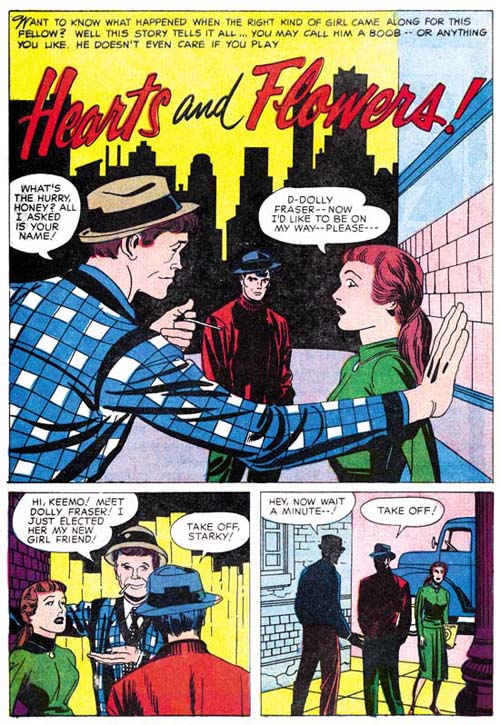
Young Romance #97 (December 1958) “Hearts and Flowers”, pencils and inks by Jack Kirby
I personally find Kirby’s romance splashes from 1957 as among Kirby’s poorer pieces. But the splashes he did in 1958 are just great. The fact that Jack inked so many of them himself in 1958 provides part of the explanation about why they are so much better. However even pieces inked by others (such as the one from “Jealousy” from the last chapter) seem more interesting. It seems Kirby got his creative juices flowing again and began provided interesting compositions. The man in the foreground of “Hearts and Flowers” seems to block the reader’s viewpoint as well as the ladies. Her straight back pose seems to shout her feelings of being trapped. The man in the background occupies only a small part of the image but his presence at the focal point makes certain that the reader sees his disapproval of the other man’s actions. Great art, great story telling, great Kirby!

Young Romance #97 (December 1958) “Uninvited Guest” page 4, pencils and inks by Jack Kirby
I love the final romance art that Jack Kirby did for Young Romance. Most fans focus on Kirby superhero features but it is his romance work that Jack truly showed his genius. This page is a great example. While there is no action this is by no means a collection of panels of standing figures. Expression, body language and view points are all manipulated to advance the story and keep the reader interested.

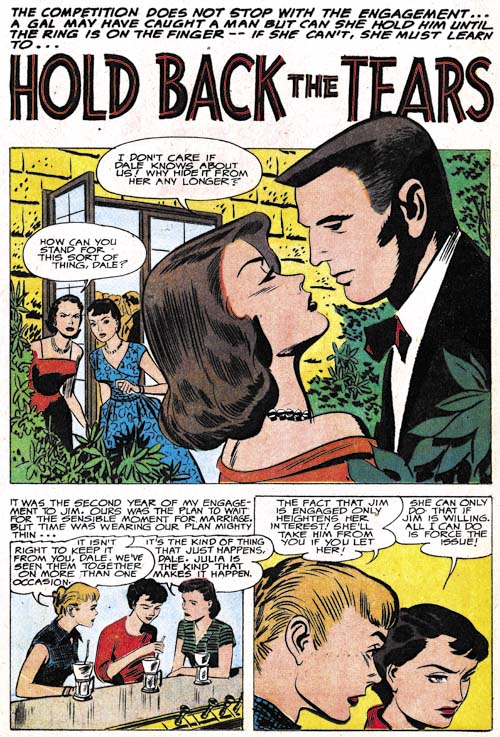
Young Romance #95 (August 1958) “Hold Back The Tears”, pencils and inks by Marvin Stein
Marvin Stein is one artist that I have reevaluated over the years. Initially I was not impressed. My earlier low opinion was largely due to his early romance art which even now I do not think that all that great. It was his crime work in particular that changed my opinion (Criminal Artist, Marvin Stein). While in some ways I find his style not as conducive for the romance genre, Stein’s romance art is still very interesting.
Note the long eyebrows found on the woman in the last panel. Such exaggerated eyebrows sometimes appear in the inking of Kirby’s pencils from 1956 and 1957. That is one of the reasons I sometimes believe Stein was the inker for much of Kirby’s work during that period.

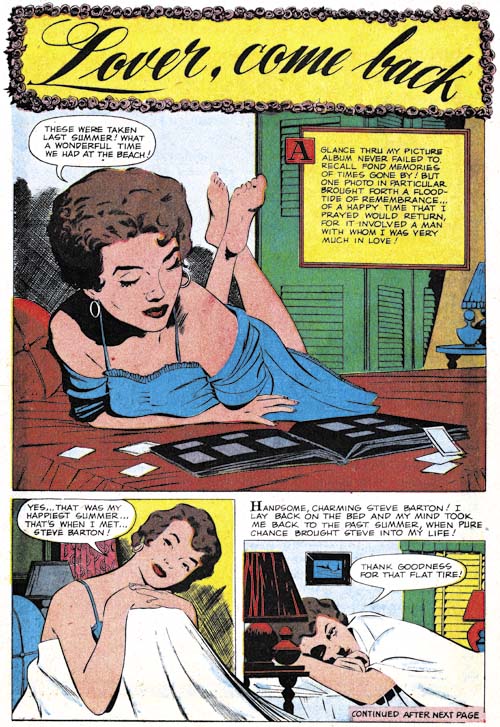
Young Romance #95 (August 1958) “Lover, Come Back”, art by unidentified artist
Some of the yet unidentified artist doing romance for Prize during this period were frankly not as good compared to those used previously. There are, however, exceptions. I particularly like the work for “Lover, Come Back”. The art appears to be based on photographic reference material and not all panels are quite as successful as those from the first page. But all the art is nicely integrated so that the swiped parts are not so noticeable. There is another story from the same issue (“A Young Man’s Fancy”) that I believe was done by the same artist. While that story also appeared to be in parts based on photographs it was not so successfully integrated. In fact the results was pretty much a disaster.

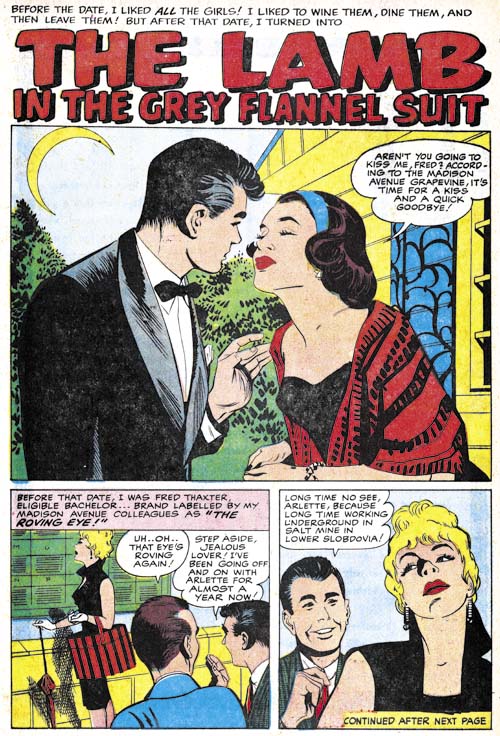
Young Romance #97 (December 1958) “The Lamb In The Grey Flannel Suit”, art by unidentified artist Paul Reinman
Another interesting but unidentified artist appearing in Young Romance. I have not noticed any other work by the same artist. Reinman did two other stories during this period and would play an important roll in futher issues of Young Romance.

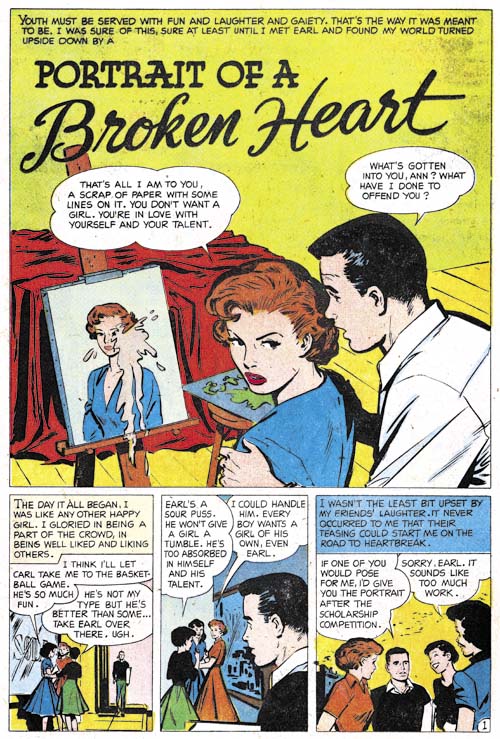
All For Love #9 (August 1958) “Portrait of a Broken Heart”, art by unidentified artist
This artist appears fairly frequently in All For Love and Personal Love. Like Marvin Stein, he uses a rather blunt brush for his inking. However his woman are very different from Stein’s so there should be no problems confusing the two. Unlike Stein, this artist likes to use very thick outlines in places such as in the above splash on the woman’s hair and the man’s back.

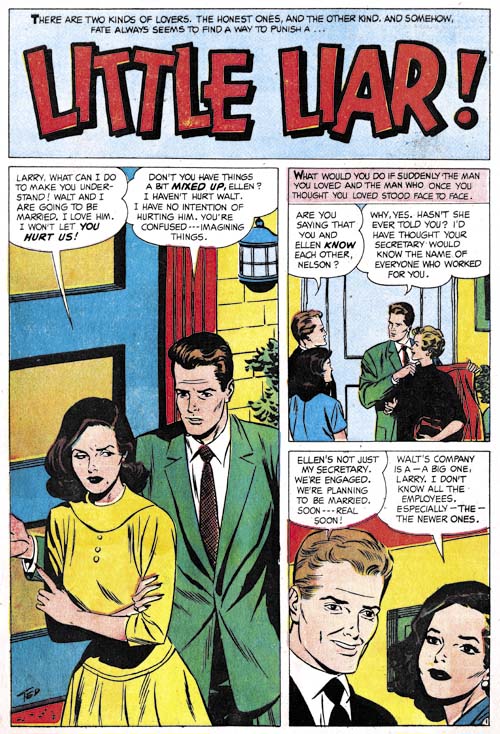
All For Love #10 (October 1958) “Little Liar”, art by Ted Galindo
Ted Galindo continues to frequently appear in All For Love and Personal Love but not in Young Romance (the title still produced by Simon and Kirby). Ted provides 6 stories with most issues having one of his stories. It does not work out perfectly since Galindo appeared twice in All For Love #10 (October 1958) but not at all in Personal Love #7 (September 1958). The above page shows Ted using a tall narrow splash. While Galindo did not use such a splash panels often, tall and narrow panels do appear fairly frequently in the story pages.
Chapter 1, A New Genre (YR #1 – #4)
Chapter 2, Early Artists (YR #1 – #4)
Chapter 3, The Field No Longer Their’s Alone (YR #5 – #8)
Chapter 4, An Explosion of Romance (YR #9 – #12, YL #1 – #4)
Chapter 5, New Talent (YR #9 – 12, YL #1 – #4)
Chapter 6, Love on the Range (RWR #1 – #7, WL #1 – #6)
Chapter 7, More Love on the Range (RWR #1 – #7, WL #1 – #6)
Chapter 8, Kirby on the Range? (RWR #1 – #7, WL #1 – #6)
Chapter 9, More Romance (YR #13 – #16, YL #5 – #6)
Chapter 10, The Peak of the Love Glut (YR #17 – #20, YL #7 – #8)
Chapter 11, After the Glut (YR #21 – #23, YL #9 – #10)
Chapter 12, A Smaller Studio (YR #24 – #26, YL #12 – #14)
Chapter 13, Romance Bottoms Out (YR #27 – #29, YL #15 – #17)
Chapter 14, The Third Suspect (YR #30 – #32, YL #18 – #20)
Chapter 15, The Action of Romance (YR #33 – #35, YL #21 – #23)
Chapter 16, Someone Old and Someone New (YR #36 – #38, YL #24 – #26)
Chapter 17, The Assistant (YR #39 – #41, YL #27 – #29)
Chapter 18, Meskin Takes Over (YR #42 – #44, YL #30 – #32)
Chapter 19, More Artists (YR #45 – #47, YL #33 – #35)
Chapter 20, Romance Still Matters (YR #48 – #50, YL #36 – #38, YB #1)
Chapter 21, Roussos Messes Up (YR #51 – #53, YL #39 – #41, YB #2 – 3)
Chapter 22, He’s the Man (YR #54 – #56, YL #42 – #44, YB #4)
Chapter 23, New Ways of Doing Things (YR #57 – #59, YL #45 – #47, YB #5 – #6)
Chapter 24, A New Artist (YR #60 – #62, YL #48 – #50, YB #7 – #8)
Chapter 25, More New Faces (YR #63 – #65, YLe #51 – #53, YB #9 – #11)
Chapter 26, Goodbye Jack (YR #66 – #68, YL #54 – #56, YB #12 – #14)
Chapter 27, The Return of Mort (YR #69 – #71, YL #57 – #59, YB #15 – #17)
Chapter 28, A Glut of Artists (YR #72 – #74, YL #60 – #62, YB #18 & #19, IL #1 & #2)
Chapter 29, Trouble Begins (YR #75 – #77, YL #63 – #65, YB #20 – #22, IL #3 – #5)
Chapter 30, Transition (YR #78 – #80, YL #66 – #68, YBs #23 – #25, IL #6, ILY #7)
Chapter 30, Appendix (YB #23)
Chapter 31, Kirby, Kirby and More Kirby (YR #81 – #82, YL #69 – #70, YB #26 – #27)
Chapter 32, The Kirby Beat Goes On (YR #83 – #84, YL #71 – #72, YB #28 – #29)
Chapter 33, End of an Era (YR #85 – #87, YL #73, YB #30, AFL #1)
Chapter 34, A New Prize Title (YR #88 – #91, AFL #2 – #5, PL #1 – #2)
Chapter 35, Settling In ( YR #92 – #94, AFL #6 – #8, PL #3 – #5)
Appendix, J.O. Is Joe Orlando
Chapter 36, More Kirby (YR #95 – #97, AFL #9 – #11, PL #6 – #8)
Chapter 37, Some Surprises (YR #98 – #100, AFL #12 – #14, PL #9 – #11)
Chapter 38, All Things Must End (YR #101 – #103, AFL #15 – #17, PL #12 – #14)
Posted in 2010/08, 7 Freelance, Art of Romance, Artists, Kirby, Jack, Periods, Prize, Serial Posts, Stein, Marvin, z Archive
Tagged Art of Romance, Jack Kirby, marvin stein, ted galindo
13 Comments
Art of Romance, Chapter 35, Settling In
(January – June 1958: Young Romance #92 – #94, All For Love #6 – #8, Personal Love #3 – #5)
I was mistaken when in my last chapter I wrote that the postal statement for All For Love listed Joe Genalo as the editor. That was true for all such statements except the first which listed Joe Simon and Jack Kirby as the editors. Where Simon and Kirby really the editors or was this just an error caused by cutting and pasting from a statement in Young Romance to the one for All For Love? I believe it was just an error because in this chapter as in the last one, different artists appeared in the different publications. Jack Kirby and Bill Benulis only appeared in Young Romance while Ted Galindo only appeared in All For Love and Personal Love. Marvin Stein appeared to be the only artist appearing in both Young Romance and All For Love, although oddly not in Personal Love.

Young Romance #92 (February 1958), pencils and inks by Jack Kirby
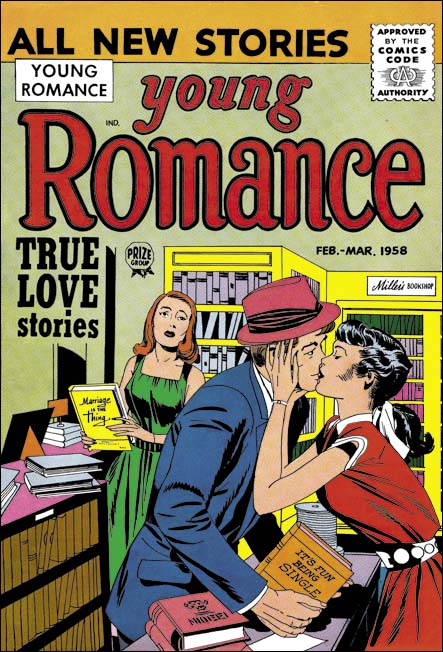
The cover for Young Romance #92 (February 1958) was the first one that Kirby did since his run of all-Kirby Prize romance issues of 1956. The preceding six covers done by other artists is a clear indication of the very different nature of Young Romance from 1957 on. Previously Kirby was the artist for all drawn covers except during the period when he and Joe were busy with Mainline Comics (there own publishing venture). This cover was inked by Kirby as well in the manner I call the Austere style (Jack Kirby’s Austere Inking). Older techniques like picket fence crosshatching (Inking Glossary) are absent although drop strings continue to be used but in an overlapping manner. Inking is sparser giving the art a lighter look. When a black region is called for it is executed by flooding the area with ink. The Austere style appears to have been adopted as a means to speed the inking process but not by sacrificing the aesthetics of the final result.

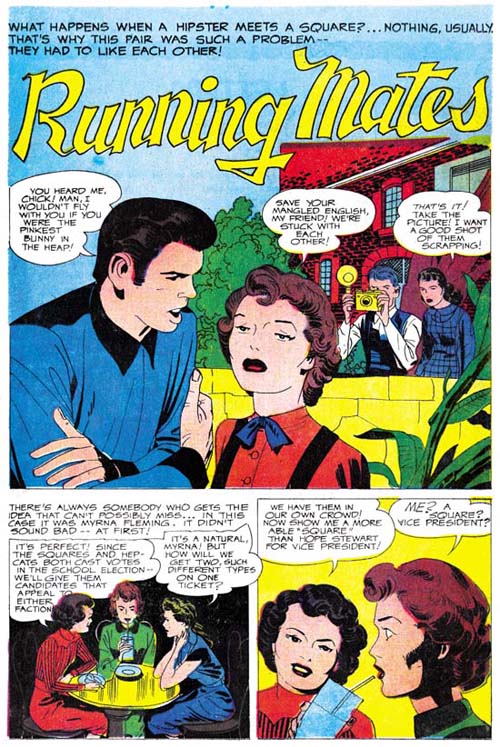
Young Romance #92 (February 1958) “Running Mates”, pencils and inks by Jack Kirby
“Running Mates” marks the beginning of Kirby inking his stories as well. An inker working on his own pencils always has an advantage, but when the artists is as talented inker as Jack was the difference can be astonishing. Jack’s drawing style has changed as well compared to his earlier work. His lines take on a more abstract quality. Look at the woman in the splash; particularly here nose and eyelids. This is far from realism but provides the figure with an expressive quality that realistic art generally fails to achieve.

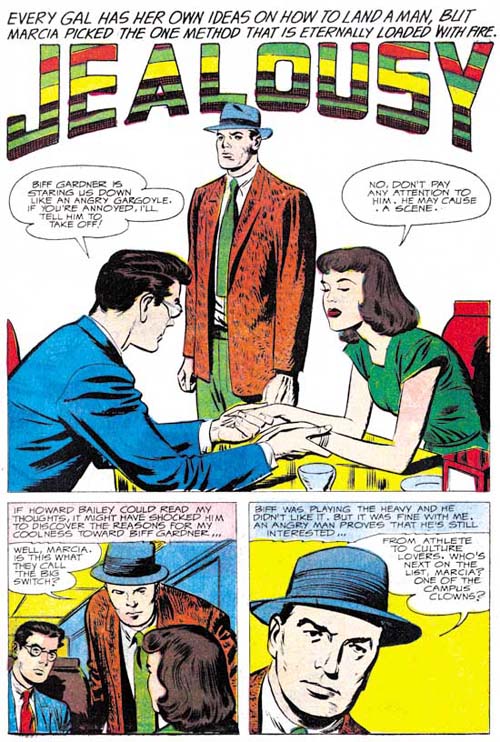
Young Romance #93 (April 1958) “Jealousy”, pencils by Jack Kirby, inks by Marvin Stein
Kirby would not inked all his pencils during the period covered by this chapter, or even most. There are a number of Kirby stories that seemed to be inked by the same artist but I am generally not willing to commit myself to say who that artist was. However I have little doubt when it comes to the inker of “Jealousy”. Marvin Stein inks this piece in exactly the same manner that he would ink his own. When looking at the details it is easy to forget about Kirby’s involvement because Stein’s touch so permeates the piece. Only when one steps back to look at the forest instead of the trees does Jack’s hand become obvious. It is in my opinion a beautiful combination. This is one of my favorite Kirby pieces inked by someone other than Jack himself.

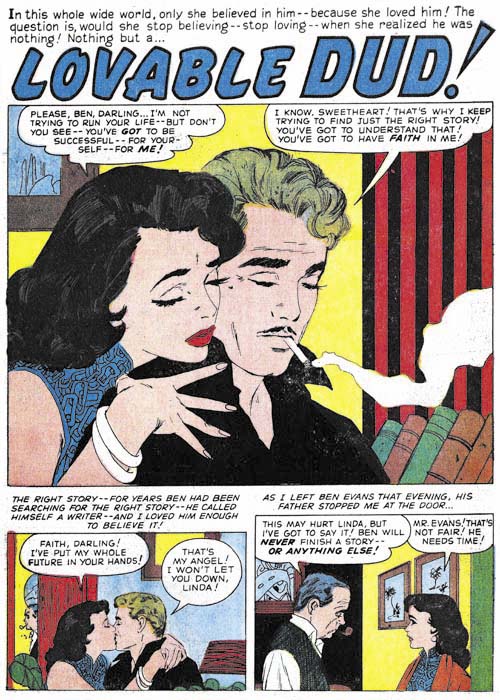
Young Romance #92 (February 1958) “Lovable Dud”, pencils by Bill Benulis unidentified artist, inks by Vince Colletta
None of the stories from this period that I attribute to Bill Benulis are signed but the style does look like his. Benulis did some signed work for Simon and Kirby published in January 1954 (Young Brides #11 and Young Love #53) but I also credit to him an unsigned work from October 1955 (Young Love #67). Benulis is one of the younger artists who did romance in a more modern style and gave his characters more modern clothing and hair styles. Bill had a penchant for patterned clothing as for examples seen worn by the woman in the splash page above.
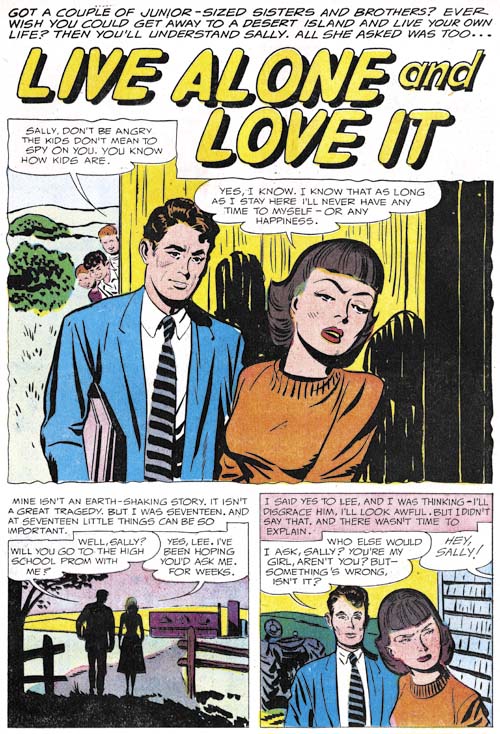
8/8/10 – Based on observations made by some commentors I went back and compared this and three other stories with “Live Alone And Love It” from Young Romance #91 (December 1957) a piece signed by Vince Colletta. All appeared to be inked by the same artist, Vince Colletta. I also compared these four stories with work from 1954 and 1955 that can confidently be credited to Bill Benulis. I no longer feel they all were done by the same penciller. I still feel that “Loveable Dud” and the other three stories were pencilled by a different artist than the Colletta signed piece. Therefore I have removed the Benulis attribution and left the penciller as unknown while crediting the inking for all to Vince Colletta.

All For Love #6 (February 1958), pencils by Joe Orlando?
The cover for All For Love #6 is unsigned but appears to be by the same artist who initials J. O. appear on other All For Love, Personal Love and Justice Traps the Guilty covers. There have been some comments (both supportive and not) to the last chapter about my tentative suggestion that these covers may have been done by Joe Orlando. Frankly I have not real evidence to back up my suggestion. The artist is quite talented and he almost certainly has done work in comic books before. There really are not a lot of candidates from this period with these particular initials. None of the candidates seems more appropriate than Joe Orlando and so I am now questionably attributing this material to him. My practice in this blog is to use provide credit based on my own observations but this in no way should be interpreted as a disagreement with those who are more knowledgeable about certain artists than I am. Once I have had a chance to familiarize myself with the work Orlando did for other publishers, I am sure either the question mark will be removed or the attribution dropped.

All For Love #6 (February 1958) “To Love is to Trust” page 6, pencils by Ted Galindo
Ted Galindo was perhaps the most used artist for All For Love and Personal Love during this period. He certainly is one of my favorites. The above page is a good example of why I like him. The floating hearts are, in my opinion, a little hokey (but very much in fashion for the period) but otherwise this is a well designed and executed sequence.

All For Love #7 (April 1958) “Love For Granted” page 5], pencils by Marvin Stein
As in the last chapter, Marvin Stein appears in Young Romance (produced by Simon and Kirby) and All For Love. In some ways this is the better romance work compared to what Stein had been doing earlier in his career. In general I feel that Marvin’s style was more appropriate for the crime and western features he was doing for Prize. But now his woman are more lively and attractive. But I do feel Stein’s art now looks a bit rushed.
Chapter 1, A New Genre (YR #1 – #4)
Chapter 2, Early Artists (YR #1 – #4)
Chapter 3, The Field No Longer Their’s Alone (YR #5 – #8)
Chapter 4, An Explosion of Romance (YR #9 – #12, YL #1 – #4)
Chapter 5, New Talent (YR #9 – 12, YL #1 – #4)
Chapter 6, Love on the Range (RWR #1 – #7, WL #1 – #6)
Chapter 7, More Love on the Range (RWR #1 – #7, WL #1 – #6)
Chapter 8, Kirby on the Range? (RWR #1 – #7, WL #1 – #6)
Chapter 9, More Romance (YR #13 – #16, YL #5 – #6)
Chapter 10, The Peak of the Love Glut (YR #17 – #20, YL #7 – #8)
Chapter 11, After the Glut (YR #21 – #23, YL #9 – #10)
Chapter 12, A Smaller Studio (YR #24 – #26, YL #12 – #14)
Chapter 13, Romance Bottoms Out (YR #27 – #29, YL #15 – #17)
Chapter 14, The Third Suspect (YR #30 – #32, YL #18 – #20)
Chapter 15, The Action of Romance (YR #33 – #35, YL #21 – #23)
Chapter 16, Someone Old and Someone New (YR #36 – #38, YL #24 – #26)
Chapter 17, The Assistant (YR #39 – #41, YL #27 – #29)
Chapter 18, Meskin Takes Over (YR #42 – #44, YL #30 – #32)
Chapter 19, More Artists (YR #45 – #47, YL #33 – #35)
Chapter 20, Romance Still Matters (YR #48 – #50, YL #36 – #38, YB #1)
Chapter 21, Roussos Messes Up (YR #51 – #53, YL #39 – #41, YB #2 – 3)
Chapter 22, He’s the Man (YR #54 – #56, YL #42 – #44, YB #4)
Chapter 23, New Ways of Doing Things (YR #57 – #59, YL #45 – #47, YB #5 – #6)
Chapter 24, A New Artist (YR #60 – #62, YL #48 – #50, YB #7 – #8)
Chapter 25, More New Faces (YR #63 – #65, YLe #51 – #53, YB #9 – #11)
Chapter 26, Goodbye Jack (YR #66 – #68, YL #54 – #56, YB #12 – #14)
Chapter 27, The Return of Mort (YR #69 – #71, YL #57 – #59, YB #15 – #17)
Chapter 28, A Glut of Artists (YR #72 – #74, YL #60 – #62, YB #18 & #19, IL #1 & #2)
Chapter 29, Trouble Begins (YR #75 – #77, YL #63 – #65, YB #20 – #22, IL #3 – #5)
Chapter 30, Transition (YR #78 – #80, YL #66 – #68, YBs #23 – #25, IL #6, ILY #7)
Chapter 30, Appendix (YB #23)
Chapter 31, Kirby, Kirby and More Kirby (YR #81 – #82, YL #69 – #70, YB #26 – #27)
Chapter 32, The Kirby Beat Goes On (YR #83 – #84, YL #71 – #72, YB #28 – #29)
Chapter 33, End of an Era (YR #85 – #87, YL #73, YB #30, AFL #1)
Chapter 34, A New Prize Title (YR #88 – #91, AFL #2 – #5, PL #1 – #2)
Chapter 35, Settling In ( YR #92 – #94, AFL #6 – #8, PL #3 – #5)
Appendix, J.O. Is Joe Orlando
Chapter 36, More Kirby (YR #95 – #97, AFL #9 – #11, PL #6 – #8)
Chapter 37, Some Surprises (YR #98 – #100, AFL #12 – #14, PL #9 – #11)
Chapter 38, All Things Must End (YR #101 – #103, AFL #15 – #17, PL #12 – #14)
Posted in 2010/07, 7 Freelance, Art of Romance, Artists, Kirby, Jack, Periods, Prize, Serial Posts, Stein, Marvin, z Archive
Tagged bill benulis, Jack Kirby, joe orlando, marvin stein, ted galindo
6 Comments