
Please donate!
The Jack Kirby Museum is raising funds to open a "Pop-Up" Museum on the Lower East Side, near where Kirby was born and raised. Learn more here.About this Blog:
© 2006, 2007, 2008, 2009, 2010 & 2011 Harry Mendryk. Unless otherwise marked, all images are my own restorations. Further some of the images have copyrights by Joe Simon and Jack Kirby or Joe Simon alone. I am fortunate that Joe Simon has allowed me to also include some previously unpublished material. Please do not copy from this blog without permission.Pages
Categories
- 9/11 (6)
- Artists (261)
- Albistur, Jo (7)
- Avison, Al (8)
- Belfi, John (4)
- Breifer, Dick (9)
- Brewster, Ann (7)
- Burgos, Carl (1)
- Ditko, Steve (2)
- Donahue, Vic (12)
- Draut, Bill (50)
- Eadeh, Al (16)
- Gregg, George (5)
- Infantino, Carmine (6)
- Kirby, Jack (152)
- McCarty, Bob (9)
- Meskin, Mort (68)
- Morrow, Gray (1)
- Oda, Ben (1)
- Oleck, Jack (2)
- Powell, Bob (1)
- Premiani, Bruno (9)
- Prentice, John (29)
- Riley, Ken (2)
- Robinson, Jerry (10)
- Severin, John (7)
- Simon, Joe (54)
- Stallman, Manny (7)
- Starr, Leonard (13)
- Stein, Marvin (20)
- Walton, Bill (5)
- Checklist (19)
- Albistur, Joe (1)
- Brewster, Ann (1)
- Briefer, Dick (1)
- Donahue, Vic (1)
- Draut, Bill (1)
- Eadeh (1)
- Gregg, George (1)
- Infantino, Carmine (1)
- Kirby, Jack (1)
- McCarty, Bob (1)
- Premiani?, Bruno (1)
- Prentice, John (1)
- Riley, Ken (1)
- Robinson & Meskin (1)
- Severin, John (1)
- Simon, Joe (1)
- Stallman, Manny (1)
- Starr, Leonard (1)
- Stein, Marvin (1)
- Comic Checklists (20)
- All For Love (1)
- Black Magic, DC (1)
- Black Magic, Prize (1)
- Boys' Ranch (1)
- Charlie Chan (1)
- Clue (1)
- Fighting American (1)
- Foxhole (1)
- Headline (1)
- In Love (1)
- Justice Traps the Guilty (1)
- My Date (1)
- Personal Love (1)
- Prize Comics Western (1)
- Real West Romance (1)
- Western Love (1)
- Young Brides (1)
- Young Love (1)
- Young Romance (1)
- Your Dreams (1)
- Ink Checklist (1)
- Kirby, Jack (1)
- Periods (392)
- 1 Early (22)
- 2 Fox (14)
- 3 Timely (44)
- 4 DC (early) (46)
- 5 Studio (135)
- 6 Mainline (68)
- Assorted (10)
- Bullseye (8)
- Fighting American (6)
- Foxhole (13)
- In Love (16)
- Police Trap (7)
- Prize (15)
- 7 Freelance (71)
- Archie (13)
- Atlas Kirby (14)
- DC Kirby (4)
- Harvey (24)
- Prize (17)
- 8 Marvel (12)
- Assorted (6)
- Marvel Kirby (6)
- 9 DC (late) (5)
- Late (3)
- Serial Posts (136)
- Art of J. Simon (1)
- Art of Romance (41)
- Criminal Artists (4)
- Early Jack Kirby (9)
- End of S & K (1)
- It's a Crime (1)
- Kirby Austere Inking (1)
- Kirby Inkers (4)
- Little Shop of Horrors (1)
- Margin Notes (5)
- Replacing S&K (4)
- S&K Colorists (3)
- Start of S&K (12)
- Wide Angle Scream (15)
- Topic (330)
- Alternate Takes (16)
- Anthologies (6)
- Art Editing (4)
- Best of Simon & Kirby (2)
- Captain America (5)
- Comicscope (3)
- Experts (3)
- Featured Work (64)
- First Romance (1)
- Ghosting (7)
- Harvey Covers (24)
- Kirby Inking Kirby (4)
- Kirby Krackle (3)
- Kirby Or Not (28)
- Lettering (13)
- My Two Cents (4)
- Odds & Ends (122)
- Publications (22)
- Quote (4)
- Restoration (3)
- Robots (3)
- S&K Superheroes (2)
- Swiping (8)
- Wertham & Censoring (5)
- Why Comics Declined (1)
- Uncategorized (50)
- z Archive (576)
- 2006/03 (16)
- 2006/04 (14)
- 2006/05 (15)
- 2006/06 (16)
- 2006/07 (10)
- 2006/08 (24)
- 2006/09 (11)
- 2006/10 (19)
- 2006/11 (20)
- 2006/12 (14)
- 2007/01 (16)
- 2007/02 (17)
- 2007/03 (14)
- 2007/04 (10)
- 2007/05 (12)
- 2007/06 (8)
- 2007/07 (7)
- 2007/08 (8)
- 2007/09 (6)
- 2007/10 (10)
- 2007/11 (7)
- 2007/12 (4)
- 2008/01 (4)
- 2008/02 (7)
- 2008/03 (12)
- 2008/04 (8)
- 2008/05 (8)
- 2008/06 (11)
- 2008/07 (6)
- 2008/08 (12)
- 2008/09 (7)
- 2008/10 (8)
- 2008/11 (4)
- 2008/12 (6)
- 2009/01 (10)
- 2009/02 (4)
- 2009/03 (5)
- 2009/04 (8)
- 2009/05 (6)
- 2009/06 (5)
- 2009/07 (8)
- 2009/08 (6)
- 2009/09 (5)
- 2009/10 (6)
- 2009/11 (4)
- 2009/12 (3)
- 2010/01 (6)
- 2010/02 (7)
- 2010/03 (5)
- 2010/04 (4)
- 2010/05 (7)
- 2010/06 (5)
- 2010/07 (8)
- 2010/08 (4)
- 2010/09 (5)
- 2010/10 (9)
- 2010/11 (5)
- 2010/12 (5)
- 2011/01 (4)
- 2011/02 (2)
- 2011/03 (4)
- 2011/04 (6)
- 2011/05 (3)
- 2011/06 (5)
- 2011/07 (7)
- 2011/08 (5)
- 2011/09 (4)
- 2011/10 (10)
- 2011/11 (6)
- 2011/12 (5)
- 2012/01 (3)
Comic related blogs
Groups (membership required)
Web pages
Tag Archives: Hillman
It’s A Crime, Chapter 3, Competing Against Themselves
(Clue Comics vol. 2 num. 1 – 3)
The same month that the first crime version of Prize Comic’s Headline was released, Simon and Kirby also appeared in Hillman’s Clue Comics (v. 2, n. 1, March 1947). Over the rest of the year Joe and Jack would do a wide variety of work for Hillman Publications; a Caniff style adventure (“The Flying Fool” in Airboy Comics), funny animals (“Lockjaw the Alligator” and “Earl the Rich Rabbit” in Punch and Judy Comics), teenage humor (My Date Comics) and crime (Clue Comics and Real Clue Crime Comics).
Clue Comics had started out in January 1943 as a hero genre anthology. The covers featured the costumed hero, the Boy King, and the interior included features such as Nightmare and Micro Face. It must not have been very successful because it began as a monthly, switched to a being a bimonthly with issue #4 and then quarterly with issue #8 before being put on hold after issue #9 (Winter 1944). Hillman rebooted Clue Comics after the war (cover date October 1946) and introduced Gun Master as the cover feature. Gun Master gave a more crime genre feel to Clue Comics but it remained as essentially a hero anthology with Nightmare and Micro Face continuing to be included. The revamped Clue must have been successful because it started as a bimonthly but switch to being a monthly with the March 1947 issue.

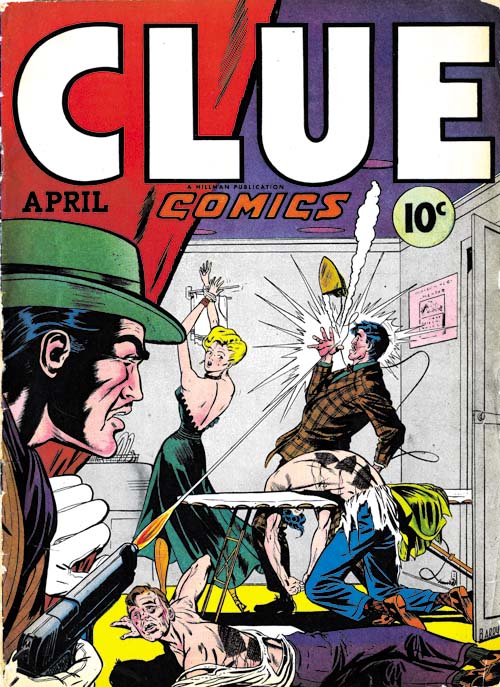
Clue Comics (volume 2, number 2, April 1947), art by Dan Barry
Since the Gun Master did not wear a costume or have any super-powers, the covers for Clue very much had a crime genre feel to them. This can particularly be seen in the cover for the April issue shown above. This cover drew its inspiration from the more graphically brutal covers that some crime comics then used. The depiction of torture by electric iron certainly appeals to the more prurient tastes and goes way beyond what artists like Simon and Kirby would ever produce. The April cover is a bit exploitive and misleading as it does not represent the type of stories actually included in the comic book. Hillman would not repeat such a graphic depiction again for any cover of Clue Comics or the later Real Clue Crime Comics.

Clue Comics (volume 2, number 1, March 1947) “Gun Master”
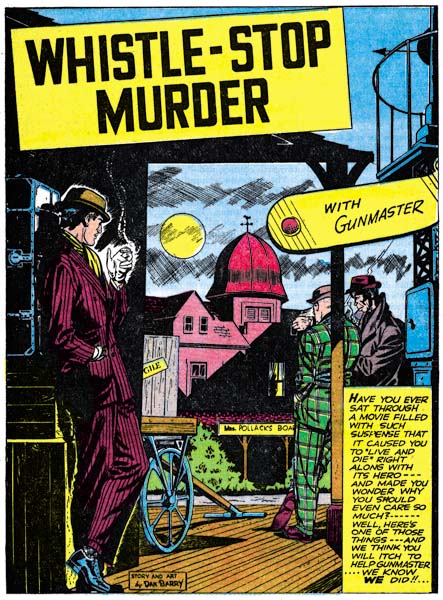
With the March and April issues, Gun Master played an even greater roll for Clue Comics as there were now two Gun Master stories in each issue. If Gun Master’s uncannily accurate ability with a pistol were not enough to convince one that he really belongs in the hero genre then perhaps the Council of Elders will. They were mysterious robed figures who directed the Gun Master. Not the sort of story device expected to be used in a typical crime story.
I do not know who the artist was for the above splash, but despite the complete lack of any real action he has managed in any case to make it interesting. Much of the effect of the splash is due to the low viewing angle and unnatural but effective perspective. From such a low view point the sides of the buildings and lamp post should converge towards the top but diverge instead, giving the scene an other-world appearance. The architectural details enhance the strangeness of the scene which I suspect is meant to be in Europe. Perhaps the weakest element of the splash is the upper of the two dead men. The way he is prompt up on his elbows seems unstable and unexpected for a corpse.

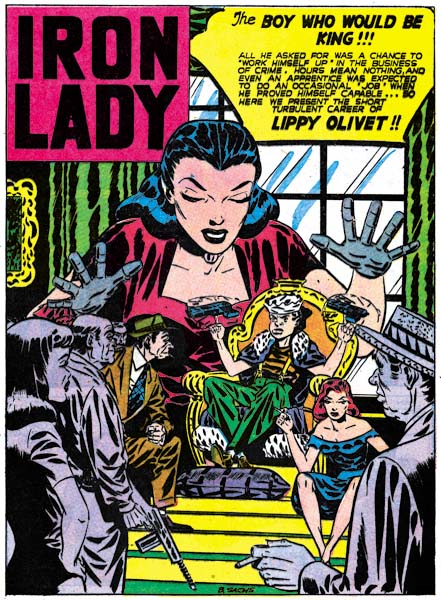
Clue Comics (volume 2, number 1, March 1947) “Iron Lady”
A new feature, “Iron Lady”, was added to Clue Comics that both gave the comic a more crime comic feel while actually making the title untypical for that genre. “Iron Lady” was a feature about a female villain. Such an anti-hero theme had been used previously (such as The Claw) and female lead characters were also not that unusual but I am not sure if the combination had ever been done before. Her use of special gloves that gave her great strength shows once more that this really is not a crime story. Iron Lady’s appearance in Clue Comics is not her debut as I believe she appeared previously in Airboy Comics.

Clue Comics (volume 2, number 2, April 1947) “Nightmare”
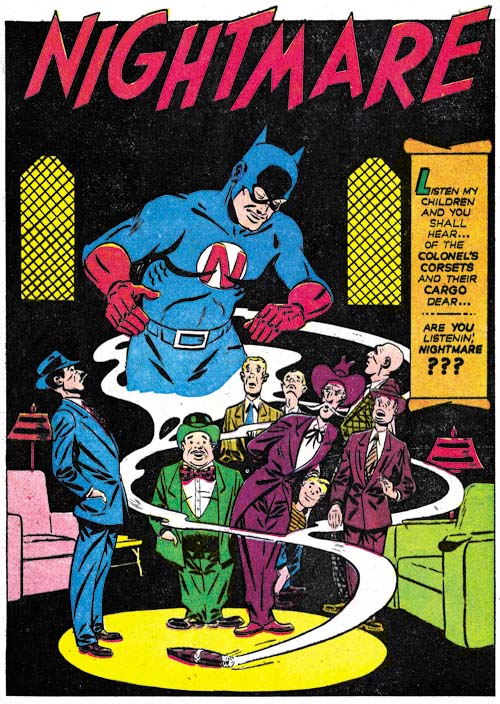
The revamped Clue Comic still retained some of its older features. Nightmare appeared in the March and April issues while Micro Face showed up in the May release. Judging solely by the covers of the early issues of Clue Comics, Nightmare originally had a young sidekick who somewhere along the line had been dropped. This hero appears from the smoke of a cigar which is reminiscent of the Flame from Fox Comics or Simon and Kirby’s Vision for Timely. Micro Face has a peculiar face gear that almost looks like a welder’s mask. These two costume heroes certainly work against the crime genre look that the revamped Clue seemed to be striving for.

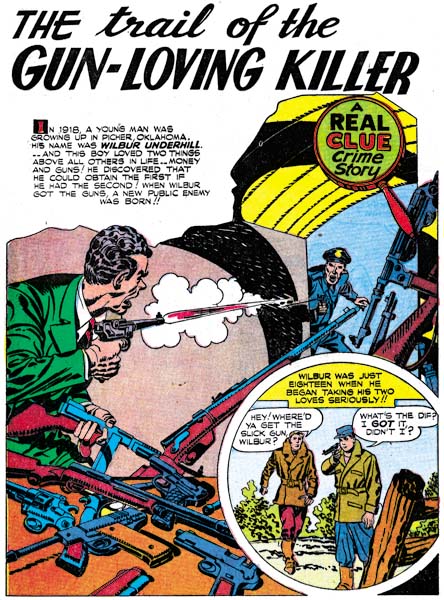
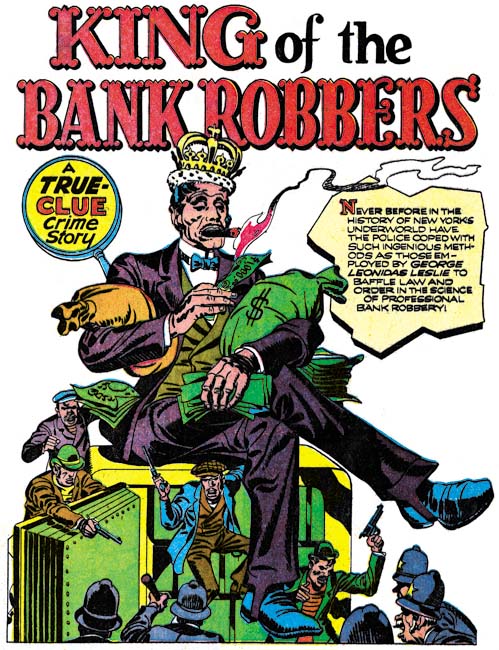
Clue Comics (volume 2, number 1, March 1947) “King of the Bank Robbers”, art by Jack Kirby
The Simon and Kirby’s contribution to the March 1947 issue of Clue was unabashedly crime genre. It was supposedly a true story and considering it was a period piece it probably was based on some real life criminal. No special powers here, just the career of a colorful criminal and his eventual downfall. Despite its short term attractions, in the end crime does not pay. The use of an oversized figure in the above splash is unusual for Jack Kirby particularly when doing crime comics. I tend to believe that when such oversized figures were used it was based in part on a Simon layout as oversized figures played a part in Joe’s art both before and after working with Jack.

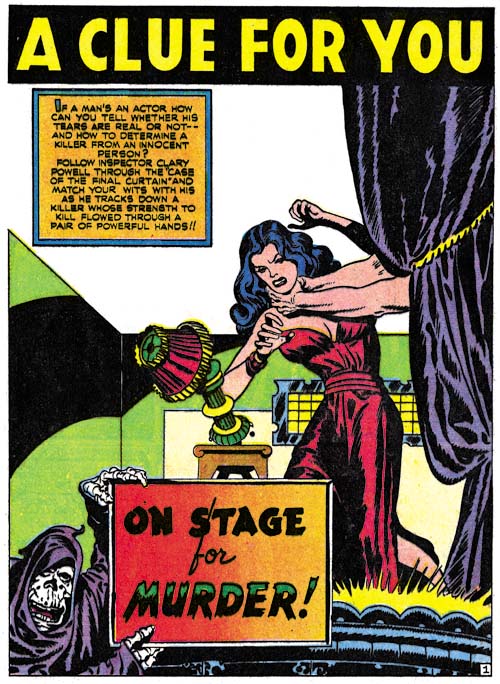
Clue Comics (volume 2, number 2, April 1947) “On Stage for Murder”, art by Jack Kirby
There was only a single Simon and Kirby piece in the March issue but their presence increased as they did two stories for the April issue and three for May. The art work done in the Clue Comics seems to be indistinguishable from that appearing concurrently in Prize’s Headline. This includes the type of inking done. In the previous chapters I have described this as part of the Sculptural style. Actually the use of style names is for convenience as inking used by Simon and Kirby was continually evolving and there really were no distinct breaks in the type of inking used. To lump it all together would mean to ignore the real changes that were made, but to divide the inking too finely into different periods would just confuse the issue. As I have been reviewing the art for this and the serial post “The Art of Romance” I have been coming to the realization that although during this period Simon and Kirby have not adopted all the characteristics of the coming Studio style of inking, they also were no longer working in quite the same manner as they had used during the war. In particular there was less emphasis on what I call form lines (see my Inking Glossary for explanation of my terms). These form lines were previously very dominantly used and were the reason I gave the name to the inking the Sculptural style. I am not going to try to answer this issue now but I am still interested in how the Studio style came into being. As with the art done for Headline, that for Clue Comics does not include the common use of picket fence crosshatching or shoulder blots. However as previously seen in Headline, abstract shadow arches, another technique of the Studio style, begins to appear more frequently. A good example is the splash shown above. Another Studio style technique is the use of drop strings and that mannerism also begins to become more common.

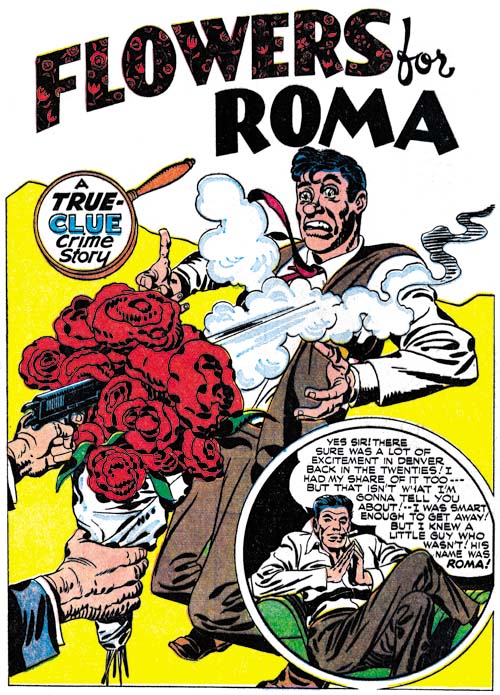
Clue Comics (volume 2, number 3, May 1947) “Flowers for Roma”, art by Jack Kirby
Although the art used for Clue and Headline comics is pretty much the same the panel layouts are not. In my previous chapters on the crime art that Simon and Kirby produced for Prize Comics I noted that circular and semi-circular panels were used at just about the same level as previously in Stuntman and Boy Explorers. On an average this would work out to be about one round panel for every story page. The round panels are completely absent on any of the story pages that Joe and Jack did for Clue. There are two occurrences of circular panels in Clue and they both are restricted to the splash page. The circular panels on the splash page are truly story panels and so must still be considered, but even so there is a clear distinction between the panel layouts for Headline and Clue. I am just not sure what to make of that distinction.

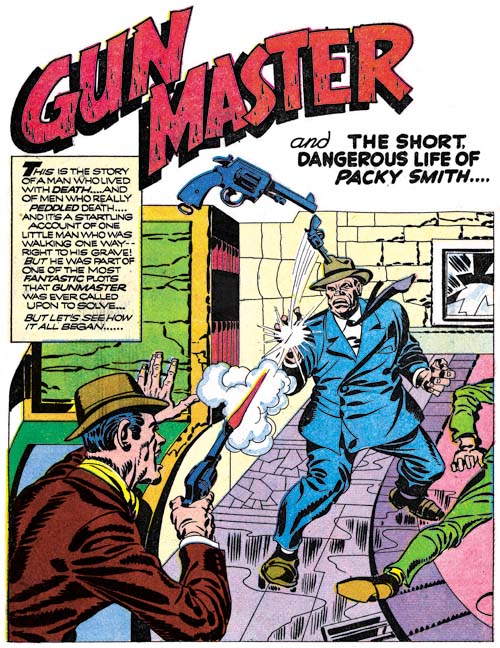
Clue Comics (volume 2, number 2, April 1947) “The Short, Dangerous Life of Packy Smith”, art by Jack Kirby
Simon and Kirby’s contribution to Clue Comics was not limited to “true” crime stories. They also had a chance to work on Gun Master as well. Because it was the key feature for Clue Comics it is not surprising that Joe and Jack did not make any serious changes to Gun Master. Gun Master remained an uncanny marksman who continued to receive his direction from the robed Council of Elders. However Simon and Kirby did make one innovation, they tried to provide the feature with a continuing story line while previously all the Gun Master stories had been stand alone units. What Simon and Kirby did was to introduce Packy Smith a man born with “element X” in his body and as the result doomed to an early death. If that were not bad enough it turns out that element X could be used to turn Packy into a human bomb. This results into a manhunt for Packy by not only Gun Master but by the criminal element as well. In the April issue the story ends with Packy Smith disappearance after haven taken a nose dive off a bridge. In the May issue Simon and Kirby continue the tale revealing that Packy had survived the plunge. Even the ending for the second tale was clearly not meant to be the finish as not only does Packy get away again but Gun Master has obtained the phone number to the criminal mastermind behind the manhunt. Unfortunately although Gun Master would make some further appearances, Simon and Kirby never returned to the feature to continue the story. Clearly Joe and Jack were not simply following someone else’s script.

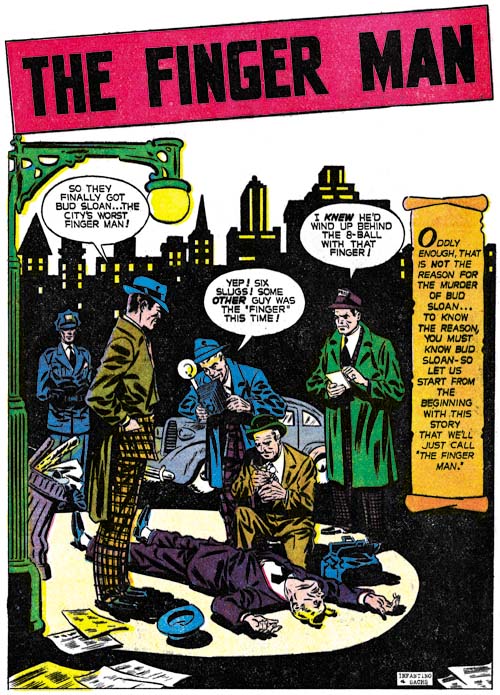
Clue Comics (volume 2, number 2, April 1947) “The Finger Man”, art by Carmine Infantino and Bernard Sachs
As previously discussed there were a number of continuing features in Clue Comics. Simon and Kirby would produce most of the remaining “true” crime stories, but not all. “The Finger Man” is one such example. Fortunately it is signed otherwise I am not sure I would have recognized Infantino’s work. Besides his silver age comics I am most familiar with the Charlie Chan Comics that Carmine drew for Simon and Kirby in 1948 and early 1949. Despite the fact that Charlie Chan was done only a little over a year later, the style Carmine used was very different then the one shown here in “The Finger Man”. It would seem that Infantino adopted a Kirby influenced style just for the work on Charlie Chan. Carmine is an excellent artist and it would be interesting how his style evolved over the years. Unfortunately Infantino only worked for Simon and Kirby that once and so my knowledge of his art is otherwise limited to occasional pieces such as this. In “The Finger Man” Carmine is inked by Bernard Sachs. Sachs was a commonly used inker at Hillman at this time and he also did some pencil work.
Like the initial Headline art that Simon and Kirby did for Prize, the duo did not provide signatures on any of the work they did on Clue. The only work for Hillman that they signed was for My Date and a single cover for Western Fighters. As I mentioned in the last chapter it was very untypical for Simon and Kirby to leave out their signature on so much work. My Date was probably their idea and nothing like it was being produced at Prize so it is not surprising that they would sign work in that title. Otherwise Joe and Jack probably did not want to make it too obvious that they were providing work for two different publishers at the same time.
My conclusion after reviewing the material is that the drifting of Clue Comics into a more truly crime comic had little, if anything, to do with Simon and Kirby. But S&K’s influence on the title seemed to increase as time went on. The May issue of Clue Comics (v. 2, n 4) was the last before the title was renamed into Real Clue Crime Comics. This was more then just a name change but that will be covered in my next chapter.
Chapter 1, Promoting Crime
Chapter 2, A Revitalized Title
Chapter 4, Crime Gets Real
Chapter 5, Making a Commitment
Chapter 6, Forgotten Artists
Chapter 7, A Studio With Many Artists
Chapter 8, The Chinese Detective
Chapter 9, Not The Same
Chapter 10, The Master and His Protege
Chapter 11, The New Team
Posted in 2008/08, Artists, Hillman, Infantino, Carmine, Kirby, Jack, Periods, z Archive
Tagged Hillman, infantino, Kirby, Simon
2 Comments
A Date Without Romance
Most of the work that Simon and Kirby did for Hillman in 1947 was for previously existing titles. The sole exception was My Date. Despite its title, My Date was not a romance comic (as I discussed previously) instead it is teenage humor and in particular an Archie-clone. Archie first appeared as a backup feature in MLJ’s Pep Comics during the war while both Joe and Jack were in military service. Archie was so successful that MLJ’s superheroes were eventually dropped and the company’s name changed to Archie Comics. 1947 found Simon and Kirby looking for a work so it is not surprising that the popular Archie would lead them to suggest teenage humor title to Hillman. Although My Date was not a romance comic it clearly was directed at teenage girls. There would be a lot of dating in My Date but no romance.

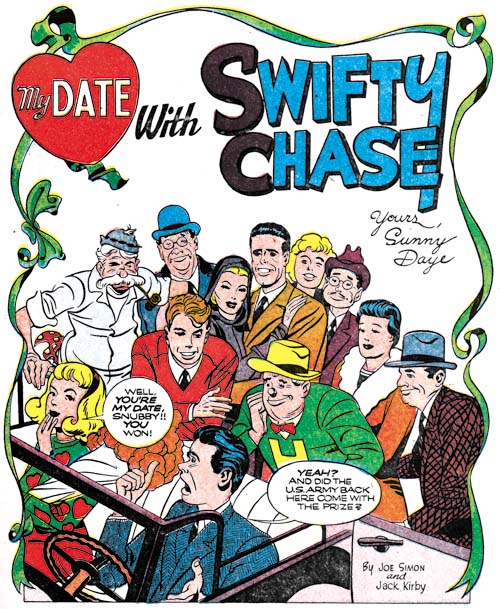
My Date #1 (July 1947) “My Date with Swifty Chase”, art by Jack Kirby
The first story in all the My Date issues would be by Simon and Kirby. Initially the feature centered on Swifty Chase a good hearted young inventor. Like Archie there is a love triangle but in this case the center of it is the beautiful Sunny Daye and Snubby Skeemer is Swifty’s rich and unscrupulous rival. The first story has quite a cast of characters as can be seen in the splash. Three of them were clearly meant for this story alone; Humphrey Hogart, his fiance actress Chandra Blake and B. O. his business manager (the three are shown in the center background of the splash). The rest seem to be meant to be re-occurring cast members. However issue #2 introduced a new character, House-Date Harry, who would quickly become the feature’s lead character while Swifty would be delegated to a supporting roll. This is the equivalent of Jughead pushing out Archie. The Swifty Chase feature would be Simon and Kirby’s only contribution to the title and only the last issue would have more then one Swifty or House-Date Harry story.
Kirby’s drawing for My Date is surprising good. I say surprising because Jack is most famous for his more realistic portrayals. Yet the Swifty Chase stories are filled with visually interesting characters all done in a more cartoony style then is typical for Kirby although not as cartoony as his work at the same time in Punch and Judy. I wish I can be as complimentary about the writing. The first story is really a masterpiece. Lots of action and funny turns of events. Having Humphrey Hobart in it also helped. Things changed with the introduction of House-Date Harry. The idea of the scheming but good hearted Harry would have been fine as one shot story line. With the recurring use of the House-Date Harry theme it becomes forced and not nearly so funny. I really cannot see Simon and Kirby being able to continue to make this feature interesting.
Incidentally, I once wrote that the first use of a pin-up by Simon and Kirby was for Boys’ Ranch. Well I was wrong. I forgot about the pin-up found in My Date #3. It depicts Harry’s new house-on-wheels. It was printed to be viewed by rotating the page but perhaps it was originally meant to be a double page pin-up.

My Date #2 (September 1947) “My Date”, art by Dan Barry
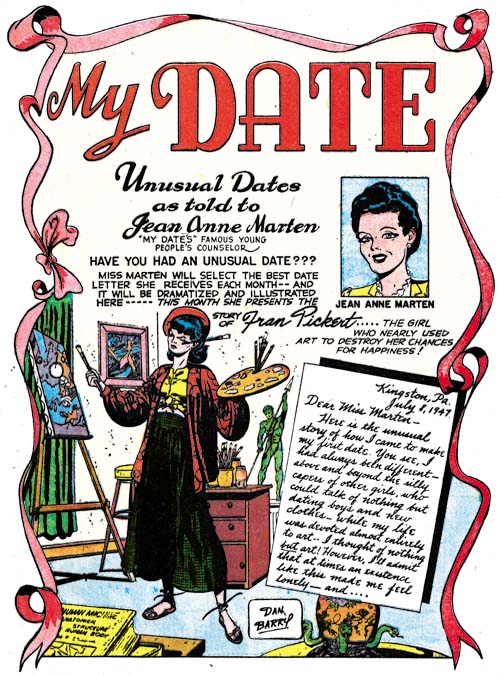
Not only was there a feature “My Date with Swifty Chase” but there was also another simply titled “My Date”. Interestingly “My Date” uses the same ribbon border on the splash page that is found in “My Date with Swifty Chase”. The premise for the feature was the supposed true stories as told to Jean Anne Marten. But after reading these stories it is clear that they are fictional. The feature “My Date” was drawn by Dan Barry in issues #1 to #3 and by an unidentified artist in the final issue. At this time Barry was doing a bit of work for Hillman including Airboy and the Heap. Besides comic books, Dan would also do syndication work on Tarzan (1947 – 1948) and Flash Gordon (1951 – 1990). Joe Simon told me that Barry did work for him during the Mainline period. Originally I thought this was on Charlie Chan but when I showed Joe that art he said it was not done by Barry. So at this point I have no idea what work Dan Barry did for Mainline. Barry seems a good enough artist but I cannot get very excited about the work he did for My Date.

My Date #1 (July 1947) “Ginny”, art by unidentified artist
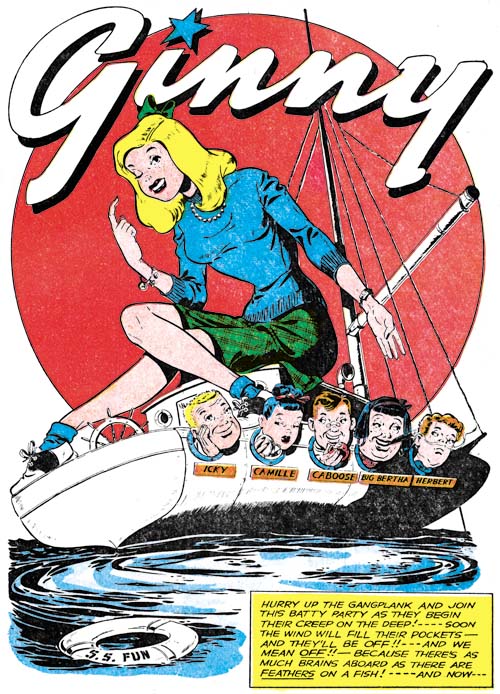
Another feature in My Date is “Ginny”. Nothing particularly outstanding about this feature, it was just another teenage group. The most unusual member was a cigar smoking girl with the name of Big Bertha. (Big Bertha was a heavy gun used by the Germans during World War 1). I have no idea who the artist was but it was the same one in all four issues. In terms of drawing skills this artist really was not more exceptional then other artists in My Date (of course excluding Kirby). What really distinguishes him is his use of panel layouts. These were much more imaginative then even those by Simon and Kirby in the “Swifty Chase” stories.

My Date #1 (July 1947) “Ultra Violet” page 2, art by Jerry Robinson? and George Roussos?
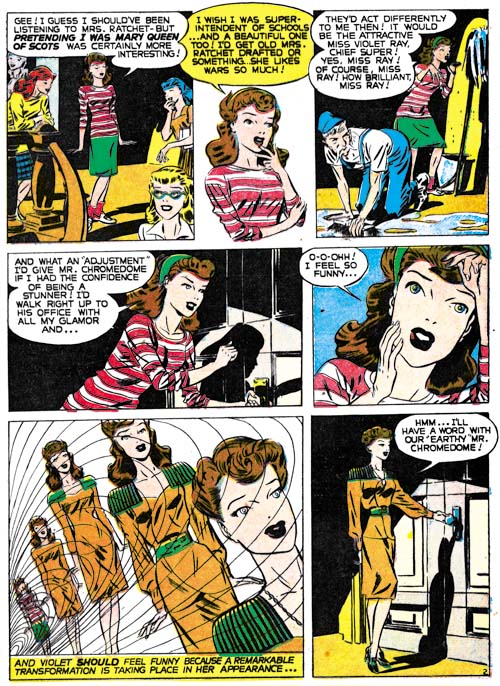
Perhaps the most unique feature in My Date was “Ultra Violet”. The lead character Violet has a very active imagination. But she is no Walter Mitty, her daydreams actually affect reality. In the sequence shown above, Violet transforms into a glamorous school superintendent (that sure sounds like an oxymoron). Her actions in that roll have repercussions even after she resumes her more ordinary existence. Another daydream reveals the truth behind a musical idol (he has false teeth and wears a toupee). I rather like the fact that no explanation is given as to how she is able to achieve such transformations.
The first Ultra Violet story is unsigned. When writing in this blog I prefer to record my current opinions even when they are very tentative and in need of further investigation. Such is the case here where I feel the art looks very much like that by Jerry Robinson. You can see some of Jerry’s work with Mort Meskin in a previous post. However the art is not so well done as to suggest that Jerry inked it himself, nor is the inking by Mort Meskin. If it is by Robinson, and that still is a big if, then it may have been inked by George Roussos.

My Date #2 (September 1947) “Ultra Violet”, art by Dan Barry
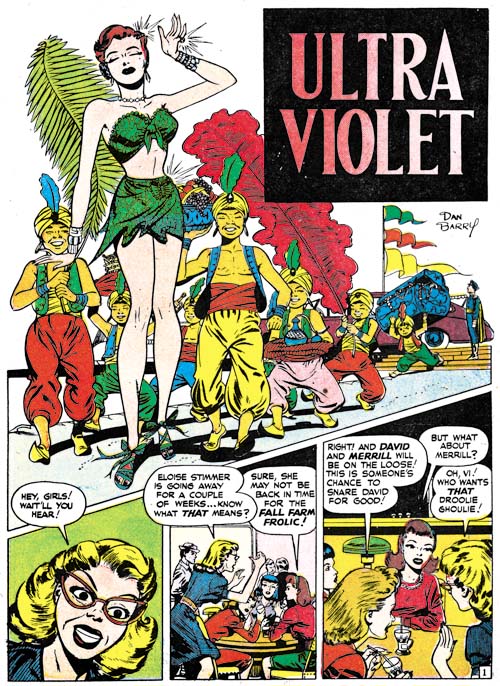
The Ultra Violet features in My Date #2 and #3 were done by Dan Barry. Barry brought to the feature a more finished and elaborate style but I rather liked the original artist.

My Date #2 (September 1947) “The Rosebud Sisters”, art by Jack Keeler
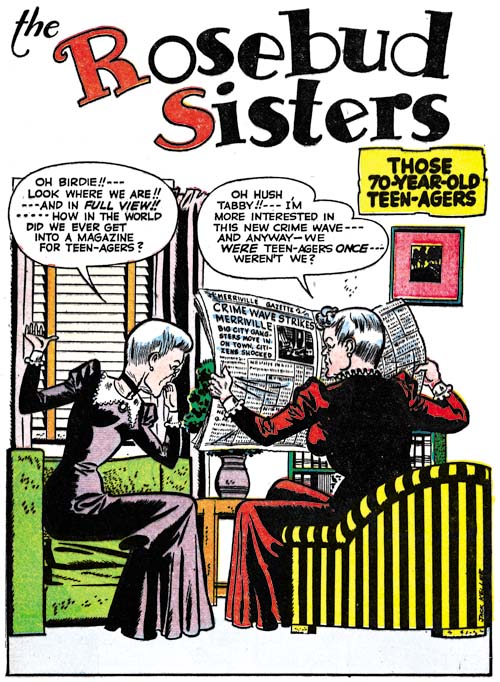
My Date included stories that only appeared once. Was that intentional or were they tryouts that were judged to be unsuccessful? One unusual story was “The Rosebud Sisters”. Since the story is about a couple of elderly woman it seems very out of place in a comic devoted to teenage humor. The oddness of including this story was obvious even then since it was subtitled “Those 70-Year-Old Teen-Agers”. Fortunately the art was signed by Jack Keeler otherwise I never would have recognized it. Keeler had worked with Simon and Kirby previously having provided some 3 page Junior Genius stories for Stuntman. The Junior Genius was one of those humor strips with rather cartoony type of drawing. Keeler drew “The Rosebud Sisters” more realistically without completely loosing the cartoon-like effect.

My Date #2 (September 1947) “Lindy Hopp Dancing Lessons”, art by unidentified artist
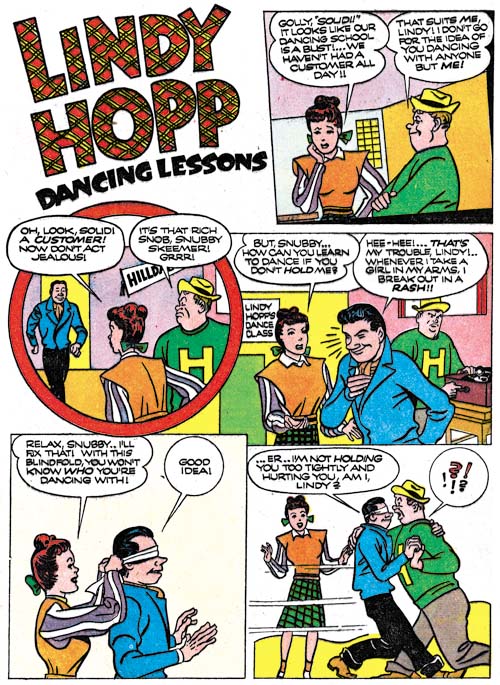
Another curious feature is “Lindy Hopp Dancing Lessons” from My Date #2. What is unusual about it is although it clearly was not drawn by either Jack Kirby or Joe Simon it includes two characters from “My Date with Swifty Chase”. The boy in the green sweater and yellow hat is clearly Bumpy although he is referred to as Soud. Snubby Skeemer is correctly named but in this strip he will not hold a girl because when he does he breaks out in a rash. This is hardly consistent with his portrayal in the Swifty Chase stories.

My Date #3 (November 1947) “Date Snatcher”, art by unidentified artist
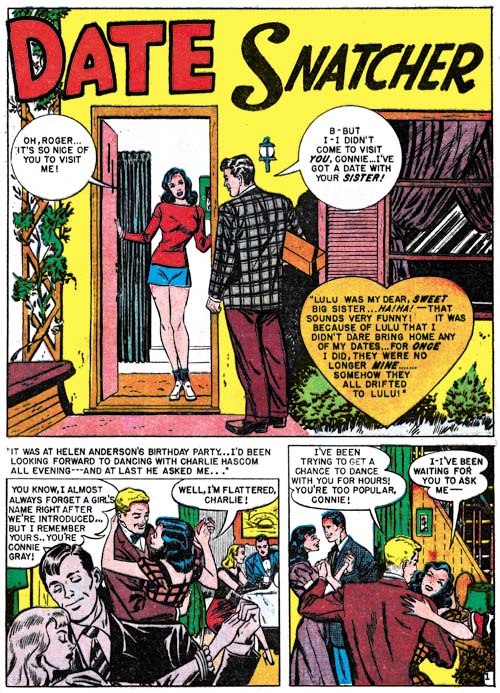
While recognizing My Date was not a romance comic, some have called it a proto-romance. The idea being that it lead the way to the first true romance comic book, Young Romance. Personally I do not buy that argument since I feel the best prototype was just what Joe Simon claimed, the romance pulps. Almost all of My Date was teenage humor albeit primarily aimed at a young female readership. There is some justification for a label of proto-romance for a couple of stories in My Date. “Date Snatcher” (My Date #3) and “Genius, That’s What” (My Date #4) are decidedly not humor. They both deal with relations between the sexes. However there are no kisses or expressions of love although the lead character’s sister in “Date Snatcher” does get married. Like the humor stories, there is lots of dating but no romance. Still very little would have to be changed to make these true romance stories so proto-romance seems appropriate for these particular features.

My Date #4 (January 1948) “Genius, That’s What”, art by unidentified artist
I am undecided about just what level of involvement did Simon and Kirby have with My Date. I am sure the title was Joe and Jack’s brain-child. Although not belonging to the romance genre, My Date was clearly aimed at teenage girls which was the same audience intended for the romance comic that Simon and Kirby were proposing at this time. All the covers were by Kirby except the last one which was by Jerry Robinson and Mort Meskin but that one also depicted Swifty Chase, Sunny Daye and House-Date Harry. Further the first story in the comic was always by Simon and Kirby. In fact the only art that Simon and Kirby signed for Hillman was for My Date and the Western Fighters #1 cover. All that would suggest that My Date was produced by Joe Simon and Jack Kirby. But not everything in the comic supports that thesis. Usually any new Simon and Kirby title would feature a lot of work drawn by Jack but My Date would only have one Kirby story per issue (except for My Date #4). S&K would usually provide a feature with a story title while Hillman generally only used the feature’s name and My Date followed the Hillman format. Like Sherlock Holmes’s barking dog, what is most surprising is what is not present in My Date and that is Bill Draut. Draut played an important part in earlier the Stuntman and Boy Explorers comics and would again in Young Romance but he is completely absent from My Date. The only artist that worked with Joe and Jack previously was Jack Keeler and he only shows up once. I am not sure what to say about Dan Barry. Barry appeared in a number of Hillman titles in about the same time. Did Simon and Kirby introduce Dan to Hillman or was it the other way around? I am unfamiliar with the rest of the My Date artists and do not believe any of them did work for Simon and Kirby later. All in all there is a least a suggestion the Simon and Kirby did not have the full creative control over My Date that they obviously had with titles that they produced for Prize.
Posted in 2008/07, 5 Studio, Artists, Featured Work, Hillman, Kirby, Jack, Periods, Topic, z Archive
Tagged Hillman, Kirby, Simon
6 Comments
Simon and Kirby Take On Kiddy Comics
After the failure of Stuntman and Boy Explorers (published by Harvey Comics) by October 1946 (cover date) Simon and Kirby had to look elsewhere to keep their partnership going. DC was not really much of an option. Simon and Kirby had pretty much burned that bridge behind them when they made the deal with Harvey. Yes they still contributed to Boy Commandos, but Sandman had been cancelled months before and the Newsboy Legion would be a few months later. Joe and Jack would eventually do work largely for two publishers, Hillman and Prize. On the face of what S&K initially produced one might predict that Hillman would be the primary source of future work. While Simon and Kirby produced a crime title for Prize (Headline) they supplied a wide variety of genre to Hillman; crime (Clue and Real Clue Crime Stories), adventure (Flying Fool in Airboy), teenage humor (My Date), and most surprising kiddy humor (Punch and Judy). Furry animal stories seem such an unlikely product for Joe and Jack. However I doubt that Simon and Kirby felt there was any genre they could not do better then most other creators.

Punch and Judy vol. 1 no. 4 (Fall 1945) “How to Make Your Own Puppets”, art by an unidentified artist
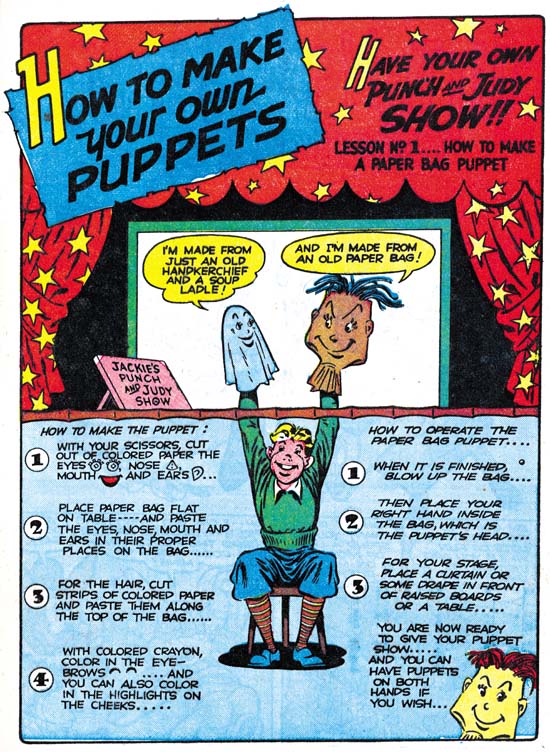
According to the Jack Kirby Checklist, the first time Kirby drew something for Hillman was for Punch and Judy in the fall of 1945. If true it would have been one of the earliest things that Jack did after the war. The earliest other post-war work was the cover for Adventure #100 (October 1945, and no I do not believe this was done before Kirby went into the Army) so the date for the early Punch and Judy piece is just possible. At this point Joe Simon was still in the Coast Guard and so any work that Jack did was done without Joe’s help. The last time I wrote about this early Punch and Judy piece I was undecided about how correct the attribution to Kirby was. Since then I come to believe that “How to Make Your Own Puppets” should be excluded from work by Kirby. The timing seems wrong. It does not seem reasonable that immediately after returning to civilian life that Jack would seek out and find a company that he had never work for previously. Instead it would have made more sense to return to DC since at that point he still had a good relationship with that company. Yes I know Kirby did work for another company Lafayette Street Corp. (Picture News #1, January 1946, “You Can’t Loose A Faithful Dog”) but that had a cover date of months later. The inking for “How to Make Your Own Puppets” was not by Kirby. And last, but certainly not least, the drawing does appear to have any distinctive Kirby traits. Now it is true that the subject matter is not typical for Jack Kirby and therefore there is less to compare with it. But it is easy to recognize Kirby’s hand in some similar work for newspapers that Kirby did early in his career as well as the later work for Punch and Judy. So the absence of Kirby traits in “How to Make Your Own Puppets” is not a good sign.

Punch and Judy volume 2, number 9 (April 1947) “Rover the Rascal”, art by Jack Kirby
So if we exclude “How to Make Your Own Puppets”, the earliest work that Simon and Kirby did for Hillman was “King of the Bank Robbers” (Clue volume 2, number 1, March 1947). The next month Joe and Jack did another crime story and their first contribution to Hillman’s Punch and Judy Comics. Punch and Judy obviously catered to a younger reader then S&K normally dealt with. The feature story was about a about a wooden puppet that was very much alive, in other words a Pinocchio clone. Other stories included talking animals. Art was very simple consisting of little more then outlines. S&K first art for Punch and Judy was “Rover the Rascal”. This was a single page humor using a humanized dog family. I am not sure whether this was the first appearance of “Rover the Rascal” but it would not appear again. The line art was a simple as that found in the rest of the comic. The humor was of the slap-stick variety, something that Kirby gravitated towards. Probably the only exceptional thing about this piece was the use of a circular panel. That was a device that was very abundantly used from Captain America to Stuntman, but in the near future would become less common. All in all “Rover the Rascal” was not a very successful piece, but it was not a failure either. It was a beginning. For the rest of the year each issue of Punch and Judy what have at least one piece by Simon and Kirby and often two.

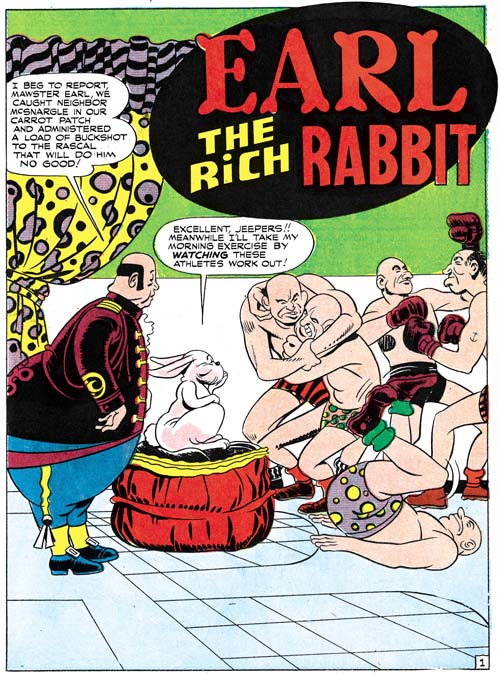
Punch and Judy volume 3, number 2 (December 1947) “Earl the Rich Rabbit”, art by Jack Kirby
One of the stories that Simon and Kirby would do for Punch and Judy was not their own creation. “Earl the Rich Rabbit” had appeared previously. I am not sure when it was created but the GCD has an entry for it for February 1947 issue (volume2, number 7). The Wikipedia says that Tony DiPreta drew it, but it is not clear if he was the creator or even when he worked on Earl. Jack Kirby did “Earl the Rich Rabbit” three times (June, October and December 1947). As generally was the case for Punch and Judy, the art for “Earl the Rich Rabbit” was very simplistic. Little more then outlines. Even so Kirby’s personal drawing style can often be recognized. There is little in the way of spotting but the spotting that was used was often drop strings (see the Inking Glossary for an explanation of inking terms). Considering their situation it is unlikely that Simon and Kirby had any studio assistants at the time. So it is likely that the inking was done by either Jack or Joe. There is little to go on, but what little there is looks like Jack’s spotting. The outline inking is just too simple to hazard a guess. The humor is often the slap-stick that Jack preferred. The “Earl the Rich Rabbit” stories that Simon and Kirby did were nicely done and funny in places. But I cannot help but feel that Joe and Jack’s hearts were not really into it. Since it was an ongoing feature I suspect that Simon and Kirby were not given any leeway to make the type of changes that would get their creative juices flowing.

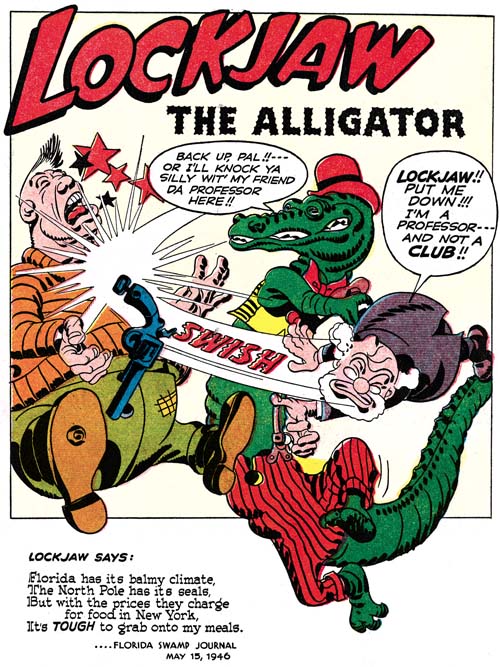
Punch and Judy volume 2, number 10 (May 1947) “Lockjaw the Alligator”, art by Jack Kirby
Simon and Kirby’s most frequent contribution to Punch and Judy was “Lockjaw the Alligator” which appeared on four occasions. Lockjaw was a S&K creation and forms an interesting contrast to “Earl the Rich Rabbit”. The art is much more substantial in Lockjaw as compared to Earl. Although still simple relative to work by Simon and Kirby in other genre, the drawing is more detailed and the inking more substantial then the other funny animal stories. Drop strings are much more evident but there are no signs of techniques such as picket fence crosshatching. Most important is that forms are given a much more three dimensional shape. As I wrote before the inking was probably done by either Joe or Jack. In the case of the above splash I suspect it was Kirby doing the spotting.

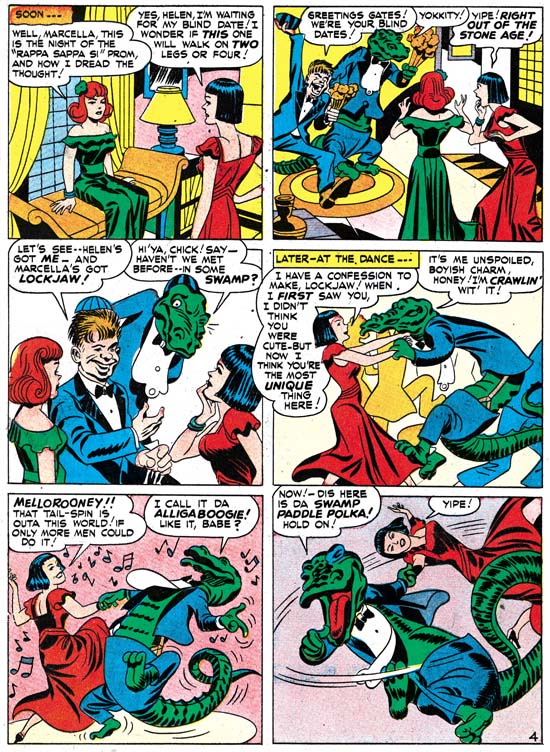
Punch and Judy volume 3, number 1 (October 1947) “Lockjaw Goes To College” page 4, art by Jack Kirby
The humor is predominately slap-stick and can get pretty ridiculous. This is not a negative criticism because you can hardly expect talking animal stories to be serious (that only changed in recent years). Lockjaw really can be a lot of fun. I could not resist including one of my favorite pages. The image of an alligator on a college date is pretty ludicrous. Lockjaw’s cloths always looked funny but never more so then this tux. The dance sequence continues onto the next page where it goes to rather extremes, but it is panel 5 that is one of my favorite pieces of Simon and Kirby humor art.
The inking of the cloth folds does not look like Kirby’s which normally would have more elongated oval (spatulate) shapes. Also the placement of the folds does not look typical for Jack. So this story was most likely inked by Joe Simon.

Punch and Judy volume 2, number 12 (July 1947) “The Mystery Crooner”, art by Jack Kirby
Simon and Kirby had one other creation used in Punch and Judy; Toby and His Band. Toby had only one appearance but the fact that it was provided with both a feature name and a story title (not done for any of the other Simon and Kirby stories in Punch and Judy) suggests a hope for it to be a continuing feature. Toby was not a funny animal story but rather belong to the teenage humor genre. The surprise is not that Simon and Kirby would try teenage humor (after all Archie was a big success) but that they would try it twice for the same publisher. My Date was a not the proto-romance that some have tried to make it but rather another teenage humor comic. The fact that the first issue of My Date and the Toby and His Band story were both released in the same month suggests that Toby may originally have been conceived for My Date.
Toby also has a more then passing resemblance to another Simon and Kirby story: “Pipsy” from Laugh #24 (September 1947) published by Archie. Only a slight change in hair style would be required to morph Toby into Pipsy. Doreen, the leading lady from “Pipsy”, even has the same ribbon in her hair as Jill does in the splash for Toby and His Band. Since “Pipsy” was published just a couple months after “The Mystery Crooner” if it was not recycled art it was at least a recycled concept.
Although Simon and Kirby started out doing a greater variety of work for Hillman then for Prize by the end of the year things were very different. It was Prize that agreed to publish Joe and Jack’s Young Romance in September. The conversion of Headline into a crime comic by S&K must have been very successful as the first Justice Traps the Guilty was released in October. The deal that Simon and Kirby made with Prize must have been very attractive, particularly the sharing of the profits for the highly successful Young Romance. Simon and Kirby’s last crime work for Hillman would appear in September, the last Fly Fool and the last work for Punch and Judy would be in December, and My Date would end in January 1948. The last Hillman work would be a cover for Western Fighters #1 (April 1948). Left over inventory?