
Kirby Inking Kirby


I have decided to examine Simon and Kirby’s most neglected superhero, Captain 3D. So set your computer to 3D viewing. What your computer does not have the 3D view feature? Oh well, I can see most of you have not upgraded to the latest Pear computer. In that case through the magic of Photoshop I will convert scans of the Captain 3D #1 comic to restore the line art. Seriously I have never been a fan of 3D comics feeling that it is largely a gimmick where too much is lost (color) with too little gained. Besides I find it an annoyance to have to wear special glasses just to read a comic.

By their very nature, superheroes require a suspension of critical judgment in order to be enjoyed. I think the barrier is even higher in the case of Captain 3D due to link between the comic’s 3D gimmick and the hero’s jumping out of a book when viewed with special glasses. Along with the ability to come out of the book when needed, Captain 3D has a power pack that allows him to fly. Otherwise Cap, and he is referred to by that nickname, does not seem to have any special powers or strengths. Captain 3D’s main adversaries are the cat people. The cat people had in the past killed the rest of Cap’s people and now want to enslave mankind as well. Normally Cat people look no different from the rest of the population but when viewed with the same 3D glasses that release Captain 3D from the book, the cat people show their feline features. However Cap also fights more everyday criminals as well. Like many superhero comics of that time, Captain 3D has a young sidekick named Danny, the guardian of the book of D.
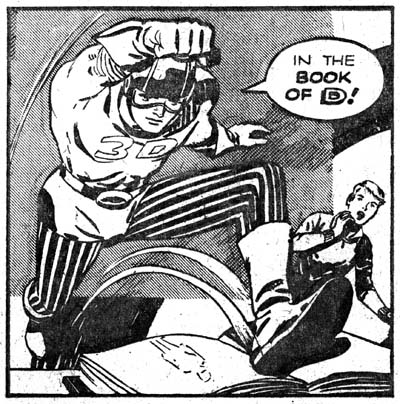
Captain 3D
Captain 3D (December 1953) “The Man from the World of D” page 11 panel 4, pencils by Jack Kirby, inks by Mort Meskin
 
There is little doubt that Jack Kirby penciled all of Captain 3D #1. Perhaps more then any other comic book artist, Kirby has worked on supplying the extra dimension to comic’s flat plane. He has done so starting perhaps from his days at Timely until the very end of his career. I am not sure how he felt about 3D comics but he came to them already knowing how the images should be composed. Joe Simon’s comments about this can be found in his book “The Comic Book Makers”. There Joe’s basic premise is that the images should project out of the comic, not into. The actual art found in Captain 3D confirms Joe’s observation; there are only a few panels that project into the page. One of them is very effective despite breaking this rule; it is a composition that would be repeated years later in the comic book Battle.  Late in life Jack would adopt a style where perspective would be exaggerated to such an extent as to appear unnatural. This style is exemplified by a pose the Kirby would use often where the hero jumps toward the user with one arm held straight and fist closed. Captain 3D has the earliest example of the pose that I am aware off, although without the extraordinary exaggerated perspective. After Captain 3D the pose would not be repeated for many years, but obviously it was not forgotten.

In his book Joe Simon describes Al Harvey requesting Simon and Kirby to produce a 3D book. Neither Joe, Jack nor any of the artists working for them had any experience with making such a comic before. An outside artist had come to Harvey saying he figured how to make 3D comics himself and offered to show Harvey’s people how. Harvey wanted the comic done quickly in order to cash in to what looked like a lucrative craze. As an incentive Harvey offered special rates but I sometimes wonder if Simon and Kirby had every turned down a job because they were too busy.

Joe says the Captain 3D book was created by him, Jack, Mort Meskin, Steve Ditko and “other key artists” working for the S&K studio. As I said above Jack Kirby was responsible for all the pencils. The inking is another question. Frequently the inking has been attributed to Steve Ditko by comic art dealers. Not long ago I saw one offering a page from Captain 3D as created by Steve Ditko, never even mentioning Jack Kirby’s involvement! Determining inking attributions for the Simon and Kirby studio is fraught with difficulties as inking credits were never provided. So comparison of inking methods with that used by different artists on their own work is the only technique that can provide help. There is the added difficulty in a case like Captain 3D when a number of different artists were involved on the same project. If that was not enough, the acetate used to create the 3D effect was a very unforgiving and unfamiliar material for the artists to ink on. Brush control that the artists normally exhibited cannot be expected to show up in the Captain 3D inking. Therefore it would be the risky, to say the least, to try to sort it all out. So naturally I cannot resist.
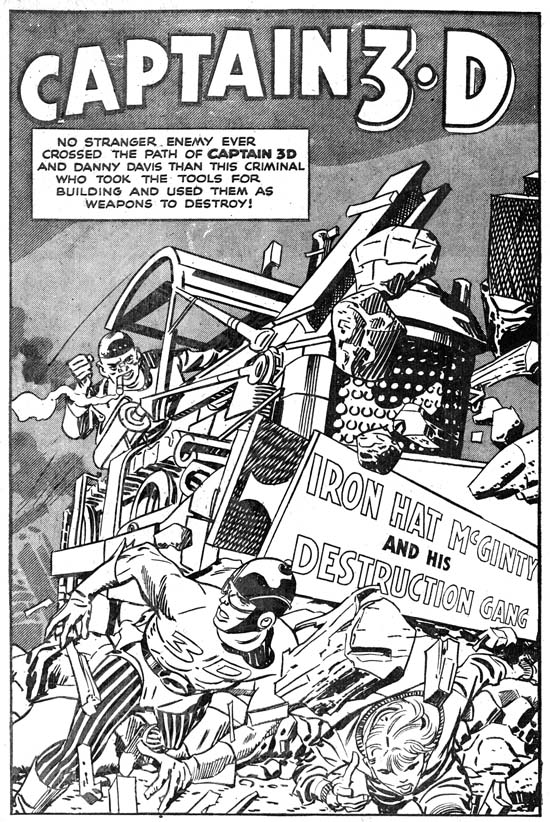
Captain 3D
Captain 3D (December 1953) “Iron Hat McGinty and His Destruction Gang”, pencils by Jack Kirby, inks by Mort Meskin

The inker easiest to spot is Mort Meskin. I have previously discussed Mort’s inking techniques.  Despite the problems acetate presented many of those techniques can be found in Captain 3D. Here the inking technique that seems to stand out the most is Meskin’s manner of doing picket fence brushwork (for explanations of some of my terms please see the Inking Glossary). Although picket fence crosshatching was part of the S&K Studio style, Mort’s can usually be distinguished by “rails” that are lines of strong but even strength, almost like wires laid down on the page. Even the “pickets” tend to be more mechanical then those by S&K. I have found picket fence brushwork in 13 pages all but 2 of which look like Meskin’s work. Mort also had a way of depicting clothing folds with multiple long parallel, sometimes overlapping, brush strokes. Perhaps because of the difficulties acetate presented, I have found this Meskin brushwork only on 4 pages. Meskin had a special way of drawing and inking eyes and eyebrows. He modified it when inking Kirby’s pencils but it sometimes still retains enough of his personal touch so that it can be recognized. In Captain 3D I found 9 pages with Meskin’s eyes. Mort occasionally would place on one side of a form a wider then normal line that also served as a sort of shadow. There is one page that has this Meskin technique. I came to notice that Meskin sometimes gave a sinuous shadow to Cap’s helmet; this can be found in 6 pages. All together I attribute 11 out of 32 pages to Mort Meskin. For those interested these are “The Man from the World of D” pages 5 and 8 to 11; “The Living Dolls” pages 2, 3 and 10; “Iron Hat McGinty and His Destruction Gang” pages 1 and 9; a figure of Captain 3D in an advertisement at the end of the book.
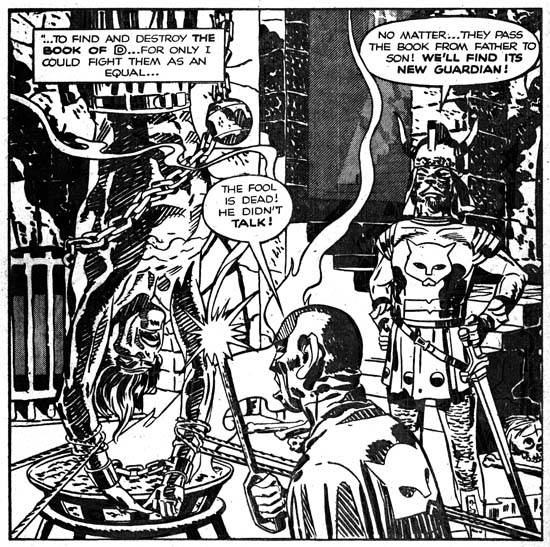
Captain 3D
Captain 3D (December 1953) “The Man from the World of D” page 10 panel 2, pencils by Jack Kirby, inks by Mort Meskin

Mort Meskin did an outstanding job on the splash page for “Iron Hat McGinty and His Destruction Gang”. However for me the tour de force of the entire book is page 10 of the “The Man from the World of D”. You can tell Mort was struggling with the acetate surface but he still managed to create a masterpiece in the bottom, almost splash-like panel. I believe there is a reason Mort put so much effort here, this is probably the most powerful image that Simon and Kirby had every produced. I am not referring here to the graphic qualities of the image but to its subject matter. Simon and Kirby never went the extremes such as could be found in EC comics. That is not to say they avoided violence; guns, knives, whips and other weapons can be found but S&K usually refrained from making the use of these devices so obvious. The only exception to this seems to be found earlier in the Captain America art where one time they even went so far as to depict the hanging of a fake Captain America and Bucky. Even then we only see a back view of their dead bodies.
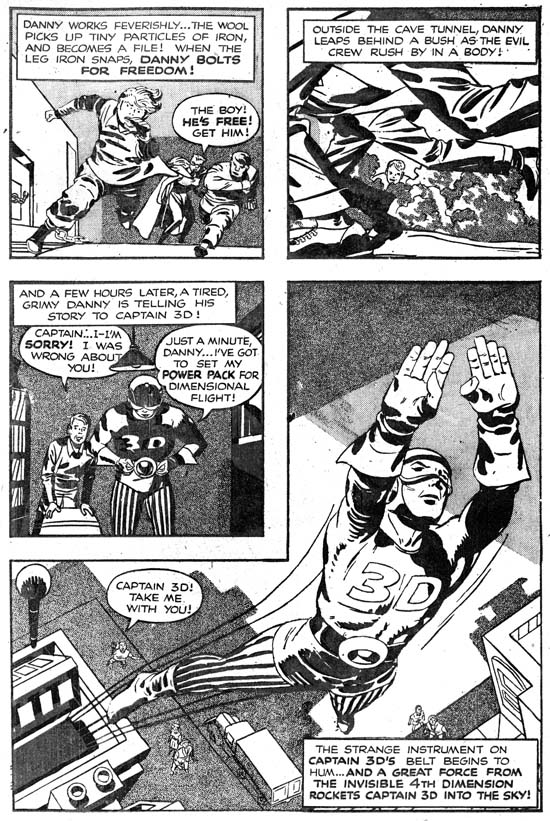
Captain 3D
Captain 3D (December 1953) “The Living Dolls” page 7, pencils and inks by Jack Kirby

The next most easy to spot inker in Captain 3D is Jack Kirby himself. Jack’s involvement to the inking should not be too much of a surprise. After all it was a rush job and Jack would finish pencils before all the inking had been completed and so would be expected to join in. What is surprising is the inking technique he adopts for Captain 3D. Kirby does not use the Studio inking brushwork that was ubiquitous of his inking at that time. Instead Jack works in a style remarkably like the Severe style that would not appear in his inking for several years hence. I think Kirby used this style because it allowed him to work more quickly and it overcame some of the difficult problems presented by inking on acetate. Missing from the Kirby inked pages are techniques like picket fence crosshatching or drop strings. Part of the Severe style is a technique of inking a clothing fold with simple elongated ovals or tapers sometimes attached to a thin line giving it the appearance of a narrow stem ending in a long leaf. This brushwork is found on two pages I attribute to Jack but only in a single panel of one of them suggesting that there Kirby was retouching another inker’s page. Kirby was an excellent inker which gave him an advantage in interpreting some of the nuances of his own pencils. The acetate undoubtedly made it difficult for Jack to achieve such subtleties. Nonetheless I feel I have detected nuances in the treatment of eyes and eyebrows that look like Kirby’s hand. Although Kirby’s brush can be confidently detected Jack did not ink much of Captain 3D. There is not much to go on but the two small heads found in the introduction look like Kirby to me. More certainly Kirby’s inking are panel 1 of page 7 of “The Man from the World of D”, page 7 of “The Living Dolls”, and page 5 of “Iron Hat McGinty and His Destruction Gang”. There are some other possible candidates that I will discuss below.
Captain 3D
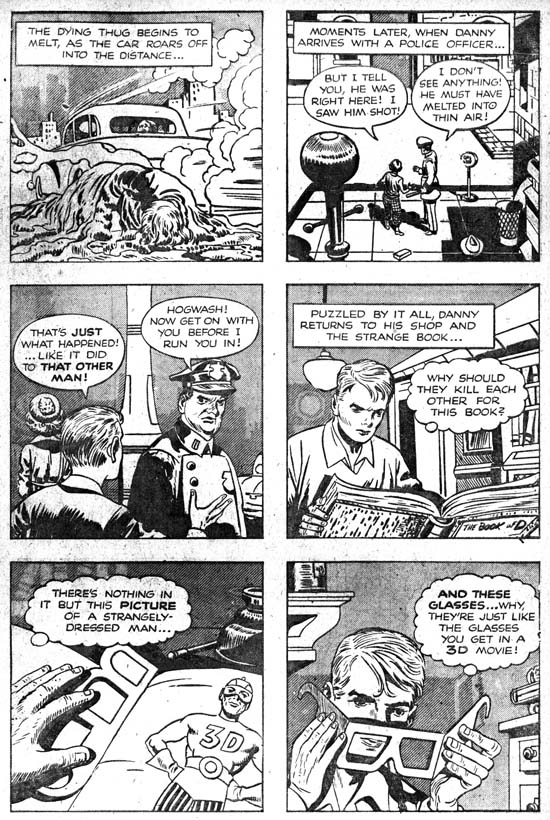
Captain 3D (December 1953) “The Man from the World of D” page 4, pencils by Jack Kirby, inks by Joe Simon

I have not yet presented to my readers a thorough examination of the inking techniques used by Joe Simon. Joe presents a particular problem in determining inking attributions. My normal methodology is to examine the inking of art penciled by the artist to find clues on how that artist might in turn ink Kirby’s pencils. Unfortunately Simon did not pencil much art during his collaboration with Kirby. Further Joe has shown himself in the past as adept at mimicking other artists’ styles. While at Fox Joe did such a great job that even experts have missed his signature on some of the covers and attributed the art to Lou Fine. Joe has also mimicked Kirby’s pencils and there is no reason to believe he would not also try to do so with Jack’s inks. Therefore what I present below should only be viewed as a preliminary assessment. Joe Simon’s brushwork was coarser then Kirby’s and in particular his clothing folds did not have the same almost puddled appearance as those Jack used in this comic. In Captain 3D 6 of the pages have a coarser brushwork that looks like Simon’s to me. Like Meskin, Simon has a way of doing eyes that can sometimes show through when inking Kirby’s pencils; 3 pages look like they have Simon’s eyes. I previously mentioned that in Captain 3D picket fence crosshatching was used by Meskin but not by Kirby. There are 2 pages that have picket fence brushwork that do not appear to be Mort’s. I feel that they were done by Simon, but it is possible that this could be misleading due to the difficulty of inking on acetate. Both Simon and Kirby used shoulder blots and these can be found among the pages I attribute to Simon. Shoulder blots do not appear on any of the pages I have credited to Meskin but they do on one that assigned to another artist to be discussed below. All total I credit Joe Simon with inking 8 pages of Captain 3D. For those interested these pages are “The Man from the World of D” pages 3 and 4; “The Living Dolls” page 2; “Iron Hat McGinty and His Destruction Gang” pages 2 to 4, 6 and 8. Keeping in mind the problems about distinguishing Simon from Kirby and the difficulties presented by working on acetate it is quite possible that some of the pages I have attributed to Simon might actually been done by Kirby. Particularly suspicious are the number of Simon pages found in the last story. Assuming that was the last story actually penciled it is just where we might expect the greatest inking contribution by Kirby.
Captain 3D
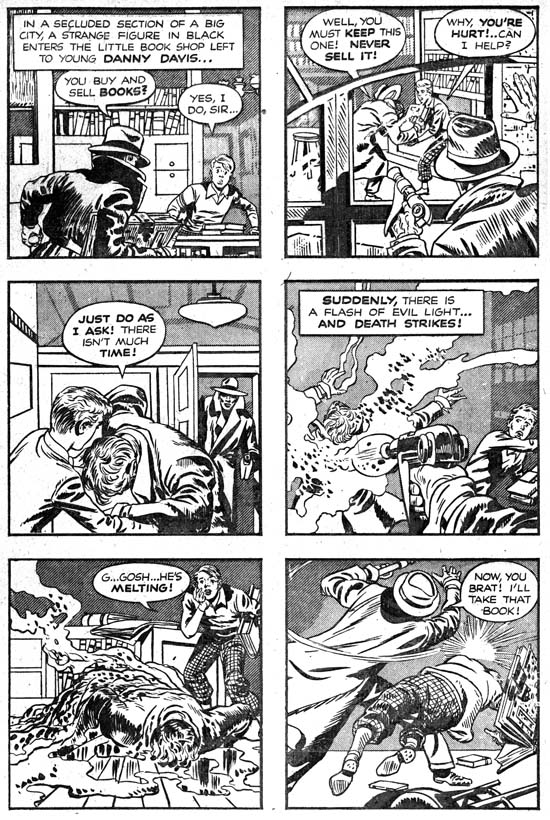
Captain 3D (December 1953) “The Man from the World of D” page 2, pencils by Jack Kirby, inks by Steve Ditko

Those keeping tally would realize that there are still a number of pages in Captain 3D that were not done by Meskin, Kirby or Simon. I believe most of them were done by the same artist. I credit them to Steve Ditko but frankly this also is very provisional. Since I have not done a careful review of Steve Ditko’s earliest efforts I really do not have a lot of inking traits to rely on. The most distinguishing feature of his inking, at least compared to Simon and Kirby studio artists, is his reliance on a pen for most of his spotting. Some fine pen work does show up in Captain 3D. However there are often brush spotting on the same pages sometimes covering over some of the pen lines. Some of this may be Ditko’s own efforts but some of it looks like Joe Simon going over and strengthening Steve’s work. The presence of a shoulder blot on one of these pages supports that suggestion. The lower part of the man’s jacket in the last panel of the page 2 of “The Man from the World of D” shows a type of feathering that I have never seen before in work produced by Simon and Kirby or artists that worked for them. Ditko also seems to have his unique touch in his way of doing eyes that shows up in Kirby’s pencils. I notice that Ditko had his own way of inking Captain 3D’s helmet. Ditko would create two simple bands or when the top band was near the peak it would be formed into a small semicircular field. All in all I assign 8 pages to Ditko; “The Man from the World of D” pages 2, 6 and 7; “The Living Dolls” pages 5, 6, 8 and 9; “Iron Hat McGinty and His Destruction Gang” page 7.
Captain 3D
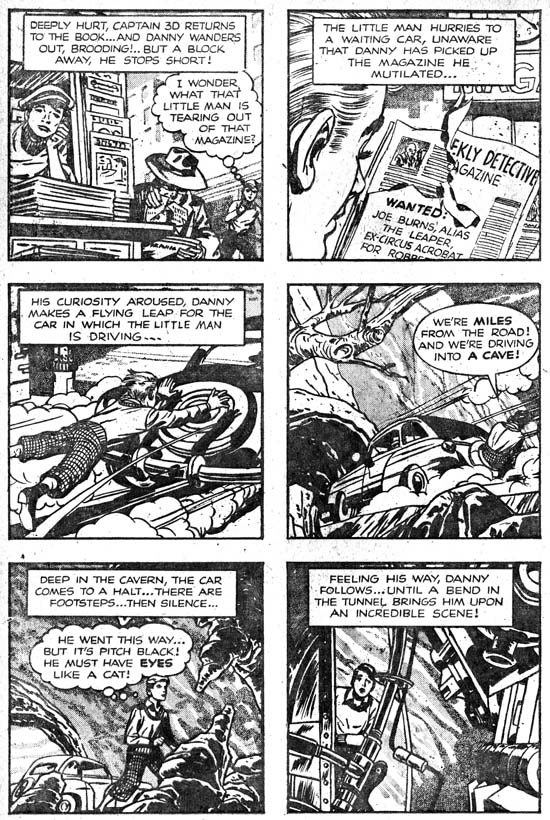
Captain 3D (December 1953) “The Living Dolls” page 4, pencils by Jack Kirby, inks by unidentified artist

I am concerned that since I do not yet have a good handle on Ditko’s inking style, especially on acetate, that perhaps some of the pages assigned to him may actually been done by some other artist. There is one page (page 4 of “The Living Dolls”) that I simple am not comfortable to assigning to any of the artists that I have discussed so far. I feel this indicates there was at least one other artist inking Captain 3D but I have no idea who he was.
Captain 3D
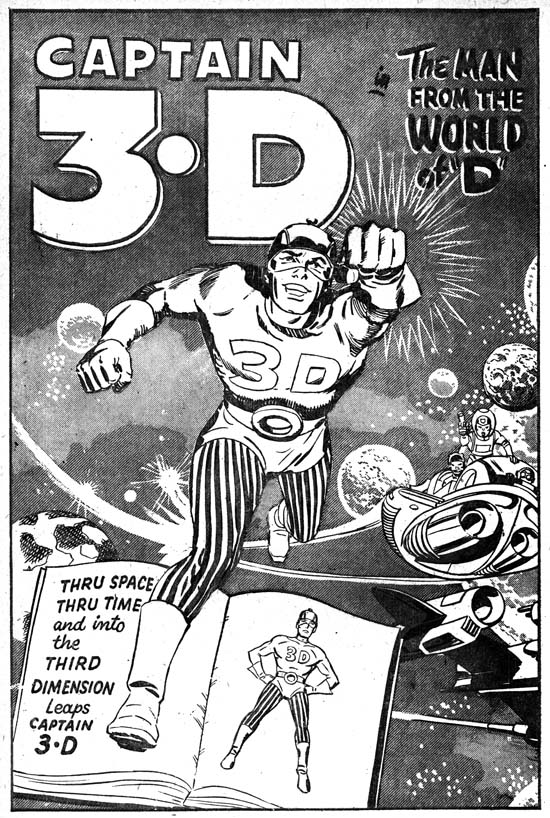
Captain 3D (December 1953) “The Man from the World of D”, pencils by Jack Kirby, inks by Mort Meskin

I have saved for last a short discussion about the cover. The art for the cover was also used as the splash page for “The Man from the World of D”. Therefore it would have been done on acetate in order to achieve the 3D effect. It must have been a difficult task to ink on acetate carefully enough so that it could also be used for the cover. Perhaps because of that spotting is very minimal. It appears to have been done with either a pen or a fine brush. This might suggest Ditko inking but I feel it was actually done by Meskin. Meskin did not do much fine inking in the other interior art but some does show up particularly on splash pages where greater effort was made as for example the first page of “Iron Hat McGinty and His Destruction Gang”. The method used to spot the muscular forms on the cover does appear similar that used in the splash. Captain 3D on the cover also has eyes that suggest Meskin’s personal style. There are not much clothing folds but some on the upper torso are made using close parallel lines like those Meskin prefers. Finally Captain 3D’s helmet has a sinuous curve to the shadow; a device similar to what Mort used in the interior art.

The final breakdown is 12 pages inked by Meskin, 8 pages by Simon, 7 2/3 pages by Ditko, 3 1/3 pages by Kirby, and 1 by an unidentified inker. This is a little misleading because one of the pages attributed to Kirby consists only of two small heads and one of the pages credited to Meskin is an advertisement with only a single figure of Captain 3D.

In my next post I hope to discuss Captain 3D #2.
Battleground #14
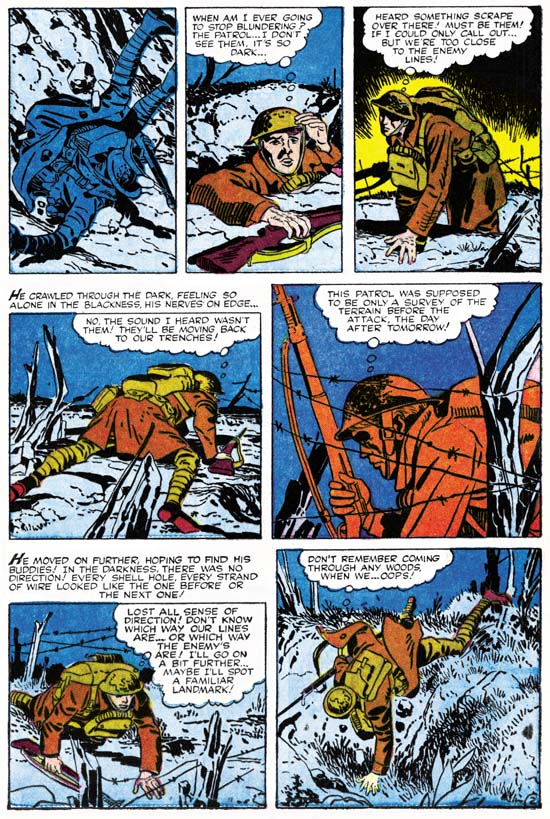
Battleground #14 (November, 1956) “Mine Field” page 2 pencils and inks by Jack Kirby

Jack Kirby turned to freelancing when the Simon and Kirby studio failed. Battleground #14 (November 1956) was the first of his freelance jobs to be published. It also marked Kirby’s return to a company that he left almost 15 years before. Jack probably still remembered Goodman’s unfulfilled promise of royalties for Captain America, but Kirby had a family to support and so had to swallow his pride. His reentry job was a short five page war story called “Mine Field”. The job should have been easy for Jack, only a couple of years before Kirby drew, wrote and edited for Foxhole, a war comic for Simon and Kirby’s own publishing company called Mainline. One story for that title, “Hot Box”, was only two pages long and Jack still managed to make it a masterpiece.

“Mine Field” is a simple tale. A somewhat bumbler of a soldier gets separated from his outfit during a night patrol. He becomes lost in the dark and by daybreak finds himself close to the enemy’s position. From his observations he realizes the Germans plans to lure the Americans into a mine field. Upon dark the soldier rearranges the German marker and finds the way back with the outfit. The table has turned and the enemy falls into their own trap. It is a good story, just not one that plays on what would normally be considered Kirby’s strengths. Jack likes his war action up close and personal and that is not what this story is about, although Jack does manage to sneak in some typical Kirby action in the last panel. But it is because the story does not have a lot of action that it provides a showcase for how good an artist Kirby was. I provide an example page above. Note that there really is not a lot happening on this page. We find the hapless soldier fall into a shell hole and his unsuccessful attempt to find his comrades. Yet by altering the view point and careful use of the landscape Jack manages to make it all interesting. Kirby is able to do this throughout the story. This sort of low action story may not have been the best vehicle for Jack, but he still managed to make it look easy.

Jack’s pencils are always at their best when inked by his greatest inker, Kirby himself. For this story Jack’s inked in a manner which I referred to as the S&K Studio style. That style is categorized by bold brushwork and some unusual techniques. In the image I provide above, note the use of the picket fence pattern (see inking glossary) in the second and fifth panels. By itself there is nothing unusual about Jack’s inking in the Studio style, he had often used it in the past. What is surprising is that this style appeared in a work at this late date. At this time Jack had adopted a similar style but with a finer brush for Prize romance covers or a simpler style without techniques like the picket fence brushing for romance story art. However the inking in “Mine Field” does show one important trait agreeing with both the Fine Studio and Austere styles. Spotting has been downplayed giving the entire art a lighter look. Black areas tend to be limited coverage but when used are done by filling the area with ink. The inking for this story was not as masterful as Jack would shortly do for Atlas in Yellow Claw #2 and #3. However in its own understated way it is a beautiful job without any signs of rushing and loss of control found in “Afraid To Dream” that Kirby also did in the next month.

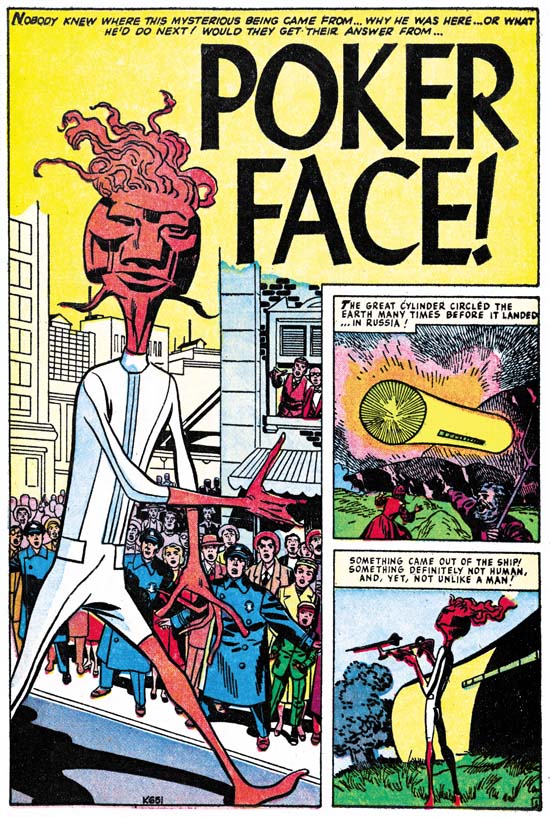
I have already remarked above how the plot for “Mine Field” was not typical for Kirby. I also find that the actual text writing does not have Kirby’s “voice”. Jack’s writing usually includes exclamations that are a little over the top. I find none of that quality in the script for “Mine Field”. Therefore I do not believe that Jack had much to do with the writing for this story and that he was working from a script supplied by Atlas. This sets this story apart from most pre-Implosion Atlas work which either Kirby seemed to have a lot of control over the writing (Yellow Claw, “Afraid to Dream”, “No Man Can Outdraw Him” and “Pokerface”) or at least some input to the plot (Black Rider Rides Again).

Battleground #14
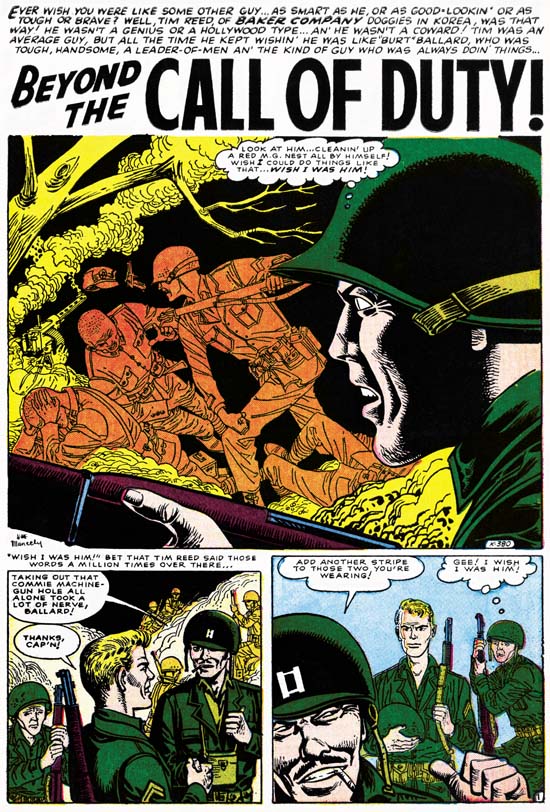
Battleground #14 (November, 1956) “Beyond the Call of Duty” art by Joe Maneely

In my posts for this blog I generally avoid comparing other artists to Jack Kirby. It really is not fair and can result in overlooking the special talents these comic book artists possessed. Effectively Atlas made just such a comparison between Jack Kirby and Joe Maneely and judged Maneely as the better artist. Presumably this judgment was made by Stan Lee and it continued as long as Joe Maneely was alive. It was Joe that was the most frequent Atlas cover artist while Jack did not even get to do the covers for comic books titles where he did all the interior story art. In Battleground #14 Joe got the most important first story while Jack’s contribution was delegated towards the back. But this does not seem to reflect the actual merits of the two stories. Maneely is working from a script with much more action then what Kirby had. For a war title this should almost insure a more interesting story, yet Kirby’s piece is a much better read. Maneely just does not seem to know how to make the action exciting. Under Joe’s hands all of the artwork seems dry and unmoving. Even today there are those who say Joe Maneely was a great artist. I just do not understand exactly what they feel Maneely did so well.

While writing the serial post “Jack Kirby’s Austere Inking” I was pretty confident about all the examples of Jack’s inking that I provided unless I specifically commented otherwise. That does not mean that I am as confident with all my attributions of Kirby’s inking. None the less I have started a Kirby inking Kirby checklist. This checklist has also been added to my sidebar. Like all my checklists, it is a work in progress. Actually since I have only recently begun to be systematic about recording the inking attributions in my database the inking checklists maybe subject to even more alterations then the rest.

Anyone who dilegently compares my inking attributions to those in the Jack Kirby Checklist will find a number of disagreements. This is to be expected as inking credits were never provided during the time of Simon and Kirby’s collaboration. Further it is clear that during this time more then one inker worked on Jack’s pencils. With multiple inkers and no documentation I think I can safely say that there will never be a Kirby inker checklist that all Simon and Kirby scholars will completely agree with. Still not all is hopeless and there is much to be gained by providing those inking attributions that we can.

I have also added to the pages sidebar a glossary for the terms that I use to describe different brush techniques. I look upon such terms only as an imperfect aid in discussions. Neither Jack Kirby nor any of his inkers followed a strickly regimented approach. There will always be spotting that does not quite fit any available term. Providing a new term for every variation would soon result in so many discriptors that nobody would be able to remember them all.

I last discussed Kirby inking for Prize in Chapter 3 (stories) and Chapter 4 (covers). Both chapters only covered 1956 with the first appearance of the Austere inking style. During that year Kirby was doing almost all the penciling for all three Prize romance titles (Young Romance, Young Love and Young Brides). At the end of 1956 Prize comics had a shake up; Young Love and Young Brides were cancelled. Young Romance remained and a new title, All For Love appeared. Simon and Kirby continued to be listed as the editors for Young Romance but All For Love was edited by Joe Genalo. Young Romance was just not the same comic. Gone were such stalwarts of the S&K studio such as Bill Draut, Mort Meskin or John Prentice. Most of the artists that did appear in YR were simply not as talented. This leads me to the conclusion that the pay scale for art had dropped and YR could not attract the same skill level.

Normally I would be picking up with Prize where I left off, that is with 1957. Although Jack provided art for Young Romance during 1957 he did not ink his own work that year. Kirby resumed inking some of his work for YR early in 1958. At this point in time Jack was no longer inking what he did for Atlas, at least as far as the work I have looked at. What inking by Jack for DC that we have examined (unfortunately an inadequate number) was done in the Austere manner, with or without pen spotting. Jack’s last job for Harvey with his own inks (Alarming Tales #3) was done just before he had resumed inking some of his Prize art. That particular piece was done in typical Austere style with some pen spotting.

Young Romance #92
Young Romance #92 (February 1958) pencils and inks by Jack Kirby

Considering the date it not surprising to find this cover as inked in the Austere manner. An overall lightness and simple cloth folds that cluster at the shoulder and the elbow. There is one hold over from the older Studio style, the drop sting near the man’s elbow. That drop string is however made from individual drops overlapping one another to produce a sort of toothed line. This sort of brush work has been observed in other Austere inking as the preferred drop string rendition. There is one type of spotting that should be noted. It has a long history of use but I have not given note of it in my previous chapters. I think of it as shingle lines; the use of parallel lines where each is offset slightly from the others. Good examples can be found on the dress of the woman on our right. In this case I want to point out the two sets of shingle spotting just above her waste. What is special about them is that they were done using a pen. All other spotting on the page was done using a brush although some of the simple folds are done with a pen as well. Still there is nothing like the pen work we have seen on some of Jack’s inking for DC or Atlas.

Young Romance #92
Young Romance #92 (February 1958) “Running Mates” page 1, pencils and inks by Jack Kirby

This story from the same issue is also done in the Austere manner. Is that a shoulder blot on the young man or a special feature to his shirt? I am not sure but it is certainly unusual. The man in the splash provides a better example then the cover of simple folds inked with a pen. It would appear that Kirby (or assistant) inked the outlines and folds with a pen. Those that Jack wanted to augment would be gone over with a brush. Kirby would sometimes skip brushing over some lines and so leave the penned lined unchanged.

Generally Jack would use simple spatulate shapes for some of the cloth folds. But not always as sometimes longer and narrower folds are called for as in this splash. However other pages from this story provide examples of simple spatulate folds.

Young Romance #92
Young Romance #92 (February 1958) “The Happy Bachelor” page 4, pencils by Jack Kirby, inks by unidentified artist

I can understand some mistaking the inker for this story to be Jack himself. There are things that resemble shoulder blots. Here however they seem restricted to one side and denote a shadow. There are also some brush work that look like picket fences. I am less bothered about that lower rails are not provided then by the form of the pickets in the second panel. These pickets are bowed as well as having ends that are narrower then the middle parts. These are traits I have not found in Kirby. Of course picket fences were abandoned when the full Austere style was adopted. The thing that really bothers me about this inking are the very narrow and long folds such as found in the last panel. We saw examples of narrow folds in “Running Mates” but that story also included panels with typical spatulate shaped folds. The rest of the pages in “The Happy Bachelor” continue with the same sharp folds.

Young Romance #95
Young Romance #95 (August 1958) “Listening To Love” page 1, pencils and inks by Jack Kirby

Another good example of Kirby’s Austere inking. Spatulate shapes for folds, some folds left as simple penned lines, some black areas flooded with ink, and negative folds on the lady’s arms. One unusual feature is the use of pen crosshatching to make a transition from the upper black area to the lower light zone. I have not commented about this before but one of the unique characteristics of these late Prize version of the Austere inking is how rarely a pen is used for any spotting. But we know Jack’s inking for DC at this time has examples similar examples of pen use so we should not be too surprise of the pen use here.

Young Romance #97
Young Romance #97 (December 1958) “Hearts And Flowers” page 1, pencils and inks by Jack Kirby

Note how abstract Kirby has become in features such as the eyes. Jack has even done away with fingernails on the man in the splash panel. The way that Jack inks seems to have affected his drawing as well.

Young Romance #97
Young Romance #97 (December 1958) “Uninvited Guest” page 1, pencils and inks by Jack Kirby

At this point there is not a lot to add in terms of the Austere style. So I just want to provide some further examples from Young Romance. But do note in all these images how Jack’s Austere brushwork almost looks like it was done without a brush. This was not always true. For example in the Studio style Kirby would often make use of dry brush, where the brush does not have much ink so that as it goes across the paper the ink is left in discontinuous streaks and spots. You pretty much never see dry brush in the Austere style. You also see a limited use of the brush tip in the Austere style. You will see it in some of the long and sharp cloth folds. But most other brushwork looks like the ink was poured on. I am not sure whether Jack was using a blunt brush for much of the work or using techniques like the Chinese painters used where they “hide” the tip by starting a stroke in one direction for a short distance before reversing back over itself.

Young Romance #99
Young Romance #99 (April 1959) “Man Wanted” page 1, pencils and inks by Jack Kirby

Another example of the stylized eyes and eyelids that Kirby was doing during his Austere period.

I realize Kirby was famous for all the action he used for his superhero genre work. But look what a dynamic splash this is! Neither punches nor incredible superpowers but still an exciting page.

Young Romance #103
Young Romance #103 (December 1959) pencils and inks by Jack Kirby

Jack was no longer inking his own Atlas work since early 1957. The last inking for Harvey was early 1958. His last DC work was in June of 1959. So the work Jack did for Young Romance was the last that he would more or less regularly ink. Kirby did a great inking jobs right up to the end of 1959.

Young Romance #103
Young Romance #103 (December 1959) “Liars In Love” page 1, pencils and inks by Jack Kirby

Although I name Jack’s “late” inking style Austere that should not interpreted that all Jack’s inking at that time was simple and light. More effort would be used if the occasion called for it. This splash is a case in point. But even with all the spotting done you still get the overall feel of something done simpler then with the S&K Studio style.

EPILOG

One of the things that originally drew me to Simon and Kirby’s art was their Studio inking style. Bold yet sensitive. However Kirby would discard some of the things that made the Style so bold, in particularly picket fence brush work, when he evolved the Studio into the Austere style. Despite the loss of so much of what I love, the later inking is every bit as beautiful in its own way. It was no accident that the Austere style came into being during 1956. That was the year that Jack was doing pretty much all the art for the three Prize romance titles. With all that work it is not surprising that Jack would look for ways to speed up the process of producing his art. Many artists when faced with difficult schedules will cut corners to the determent of their final product. Not Jack Kirby. Jack did not just discard time consuming brush work, he modified what the inking he continued to use to make up for what he discarded. The Austere style may have been quicker, but Jack would not let his art deteriorate to achieve that.

This is the final chapter to this serial post. Next week I will provide a checklist of Kirby inking Kirby for the period I have delt with in “Jack Kirby’s Austere Inking”. Also a glossary of the inking terminology I have used. Of course since this post dealt with the final years of the Simon and Kirby collaboration, there is a lot more to be said about Kirby’s inking in previous years. But I am not ready to tackle that yet. Before then I want to discuss some of the other inkers of Kirby’s pencils. If you want to spot Jack’s inking you have to understand how other artists would ink. I will not be posting on that right away but look forward to (or dread) it in the future.

In Chapter 8, More Harvey of Jack Kirby’s Austere Inking I briefly examined “This World Is Ours” from Alarming Tales #3. Some have suggested Steve Ditko as the inker but when I wrote that chapter I had not seen any Ditko inking from that period. Well Dave Sim reviews some Ditko comics from this period and links to images are included. If this material is any indication it looks like Ditko was inking mainly with a pen and it does not look like what is done in “This World Is Ours”. So as far as I am concerned this story was inked solely by Jack Kirby.

Next Page »