Please donate!
The Jack Kirby Museum is raising funds to open a "Pop-Up" Museum on the Lower East Side, near where Kirby was born and raised. Learn more here.About this Blog:
© 2006, 2007, 2008, 2009, 2010 & 2011 Harry Mendryk. Unless otherwise marked, all images are my own restorations. Further some of the images have copyrights by Joe Simon and Jack Kirby or Joe Simon alone. I am fortunate that Joe Simon has allowed me to also include some previously unpublished material. Please do not copy from this blog without permission.Pages
Categories
- 9/11 (6)
- Artists (268)
- Albistur, Jo (7)
- Avison, Al (8)
- Belfi, John (4)
- Breifer, Dick (9)
- Brewster, Ann (7)
- Burgos, Carl (1)
- Ditko, Steve (2)
- Donahue, Vic (12)
- Draut, Bill (50)
- Eadeh, Al (16)
- Gregg, George (5)
- Infantino, Carmine (6)
- Kirby, Jack (157)
- McCarty, Bob (9)
- Meskin, Mort (69)
- Morrow, Gray (1)
- Oda, Ben (1)
- Oleck, Jack (2)
- Powell, Bob (1)
- Premiani, Bruno (9)
- Prentice, John (29)
- Riley, Ken (2)
- Robinson, Jerry (10)
- Severin, John (7)
- Simon, Joe (57)
- Stallman, Manny (7)
- Starr, Leonard (13)
- Stein, Marvin (20)
- Walton, Bill (5)
- Checklist (19)
- Albistur, Joe (1)
- Brewster, Ann (1)
- Briefer, Dick (1)
- Donahue, Vic (1)
- Draut, Bill (1)
- Eadeh (1)
- Gregg, George (1)
- Infantino, Carmine (1)
- Kirby, Jack (1)
- McCarty, Bob (1)
- Premiani?, Bruno (1)
- Prentice, John (1)
- Riley, Ken (1)
- Robinson & Meskin (1)
- Severin, John (1)
- Simon, Joe (1)
- Stallman, Manny (1)
- Starr, Leonard (1)
- Stein, Marvin (1)
- Comic Checklists (20)
- All For Love (1)
- Black Magic, DC (1)
- Black Magic, Prize (1)
- Boys' Ranch (1)
- Charlie Chan (1)
- Clue (1)
- Fighting American (1)
- Foxhole (1)
- Headline (1)
- In Love (1)
- Justice Traps the Guilty (1)
- My Date (1)
- Personal Love (1)
- Prize Comics Western (1)
- Real West Romance (1)
- Western Love (1)
- Young Brides (1)
- Young Love (1)
- Young Romance (1)
- Your Dreams (1)
- Ink Checklist (1)
- Kirby, Jack (1)
- Periods (396)
- 1 Early (22)
- 2 Fox (14)
- 3 Timely (44)
- 4 DC (early) (46)
- 5 Studio (135)
- 6 Mainline (68)
- Assorted (10)
- Bullseye (8)
- Fighting American (6)
- Foxhole (13)
- In Love (16)
- Police Trap (7)
- Prize (15)
- 7 Freelance (74)
- Archie (13)
- Atlas Kirby (14)
- DC Kirby (4)
- Harvey (27)
- Prize (17)
- 8 Marvel (12)
- Assorted (6)
- Marvel Kirby (6)
- 9 DC (late) (6)
- Late (3)
- Serial Posts (139)
- Art of J. Simon (1)
- Art of Romance (41)
- Criminal Artists (4)
- Early Jack Kirby (9)
- End of S & K (1)
- Harvey Horror (3)
- It's a Crime (1)
- Kirby Austere Inking (1)
- Kirby Inkers (4)
- Little Shop of Horrors (1)
- Margin Notes (5)
- Replacing S&K (4)
- S&K Colorists (3)
- Start of S&K (12)
- Wide Angle Scream (15)
- Topic (341)
- Alternate Takes (16)
- Anthologies (6)
- Art Editing (4)
- Best of Simon & Kirby (2)
- Captain America (5)
- Comicscope (3)
- Experts (3)
- Featured Work (64)
- First Romance (1)
- Ghosting (7)
- Harvey Covers (24)
- Kirby Inking Kirby (4)
- Kirby Krackle (3)
- Kirby Or Not (28)
- Lettering (13)
- My Two Cents (7)
- Odds & Ends (128)
- Publications (24)
- Quote (4)
- Restoration (3)
- Robots (3)
- S&K Superheroes (2)
- Swiping (8)
- Wertham & Censoring (5)
- Why Comics Declined (1)
- Uncategorized (51)
- z Archive (595)
- 2006/03 (16)
- 2006/04 (14)
- 2006/05 (15)
- 2006/06 (16)
- 2006/07 (10)
- 2006/08 (24)
- 2006/09 (11)
- 2006/10 (19)
- 2006/11 (20)
- 2006/12 (14)
- 2007/01 (16)
- 2007/02 (17)
- 2007/03 (14)
- 2007/04 (10)
- 2007/05 (12)
- 2007/06 (8)
- 2007/07 (7)
- 2007/08 (8)
- 2007/09 (6)
- 2007/10 (10)
- 2007/11 (7)
- 2007/12 (4)
- 2008/01 (4)
- 2008/02 (7)
- 2008/03 (12)
- 2008/04 (8)
- 2008/05 (8)
- 2008/06 (11)
- 2008/07 (6)
- 2008/08 (12)
- 2008/09 (7)
- 2008/10 (8)
- 2008/11 (4)
- 2008/12 (6)
- 2009/01 (10)
- 2009/02 (4)
- 2009/03 (5)
- 2009/04 (8)
- 2009/05 (6)
- 2009/06 (5)
- 2009/07 (8)
- 2009/08 (6)
- 2009/09 (5)
- 2009/10 (6)
- 2009/11 (4)
- 2009/12 (3)
- 2010/01 (6)
- 2010/02 (7)
- 2010/03 (7)
- 2010/04 (4)
- 2010/05 (7)
- 2010/06 (5)
- 2010/07 (8)
- 2010/08 (4)
- 2010/09 (6)
- 2010/10 (9)
- 2010/11 (5)
- 2010/12 (5)
- 2011/01 (4)
- 2011/02 (2)
- 2011/03 (5)
- 2011/04 (6)
- 2011/05 (3)
- 2011/06 (5)
- 2011/07 (7)
- 2011/08 (5)
- 2011/09 (4)
- 2011/10 (10)
- 2011/11 (6)
- 2011/12 (5)
- 2012/01 (3)
- 2012/02 (2)
- 2012/03 (8)
- 2012/04 (3)
- 2012/05 (2)
Comic related blogs
Groups (membership required)
Web pages
Category Archives: In Love
Artist Loves Model, the Editing of Strips into a Comic
I recently posted on the “Artist Loves Model” story from In Love #3 (December 1954). I appended a note to my blog entry where I admitted forgetting about a post by Bob on the Jack Kirby Weblog about the syndicated strip version of the story. Recently I received a copy of Buried Treasures v1 #2 which includes strips of this syndicate strip proposal. I have compared, panel by panel, the strips to the comic book story. I wrote out all the difference as an aid to my understanding what was done. Just in case anyone wants a blow by blow description I have posted the details. Here I will summarize what was done to convert the syndication strips into the comic book story.
The strips opens with Mayor La Flower. We will never see again, he is just one of Cobb’s fans reading his “Old Man Spry” to his juvenile radio audience. This beginning leaves little doubt that there were no earlier strips. The strips end abruptly with Inky going off to confront Donna Dreame about her illicit dealings. Only the comic book version of the story provides the confrontation. But the book story includes a romance angle between Donna and Inky that was not a part of the syndication strips. Had it been drawn, the confrontation scene for the syndication strips would have been very different. Personally I doubt that Simon and Kirby produced any more strips, as a syndication proposal it would have been better for the story to be open ended.
The most significant difference between the strip and the comic book versions is the number of art panels that never made it into the comic book story. 43 out of 142 strip panels failed this transition. The first panel from the strip that made it into the comic book was the first one on the sixth strip. This means that 20 earlier panels were discarded. Before the first story page of the comic book was completed a further 4 syndicate panels would be dropped. Thus most of the ignored strip panels come from the start of the story. The remaining unused strip panels do not seem randomly distributed among the comic book pages. One group is associated with the first and second meeting between Inky and Donna Dreame (8 skipped panels for pages 8 to 10). The next story arc with a number of unused panels concerns Donna Dreame’s hatching her scheme with Half-tone (page 12 with 5 unused panels). The next dropped set of panels combines Half-tone arriving at Donna’s place with his first meeting with Inky (page 13 with 4 unused panels). More importantly the section dropped off concerns Half-tone and Donna coming back from a night on the town. Considering the love angle between Inky and Donna that was part of the comic book story this strip was particularly inappropriate. There are a few single skipped strip panels in other parts of the comic book story.
Why so many unused strip panels? At 18 pages “Artist Loves Model” is the shortest of the In Love “novel length” feature stories. “Bride of the Star” had 20 pages and “Marilyn’s Men” had 19. It is possible that the length of these stories was dictated by the number of pages that the backup stories would require and not the other way around. However it seems more likely that strip panels were not used simply because they were not necessary. Even without the extra panels, the comic book version of the story reads just as well as the syndication strips. The only negative effect of the dropping of strip panels is the lengthy caption found on the splash page of the comic book. Even Joe Simon criticized it when he recently viewed the splash page. However the wordy caption probably was considered preferable to the 20 art panels it replaces. That would have added over 2 pages without significantly helping the story.
It does seem that the initial intent was to include more of the early syndicate strips in the comic book story. In my earlier post I mentioned an used page of art in Joe Simon’s collection. This page was made from some of the panels from the third strip. I was incorrect with my original suggestion that this art page was discarded because it was taking the story into a different direction. I erred due to my misidentifying one of the characters as Jack Hill (because I was working from memory). Now it seems to me that this page was abandoned in order to condensed the story’s beginning even further.

In Love #3 (December 1954) “Artist Loves Model” page 14, pencils by Jack Kirby inks by Joe Simon
Art that did not seem to exist in the syndication strips was added to the comic book. The new art is found in two sections. One is the story arc where Donna Dreame finds out that Inky has used her as a model for one of the characters in the strip they are collaborating on (page 14). A more substantial addition occurs at the very end of the story starting from when Inky confronts Donna Dreame about her dishonest dealings (page 16 through 18). What is significant about these additions is that they concern the romance between Inky and Donna. This romance played no part of the original syndication strip and was added to convert the story for inclusion in a romance comic book title.

Syndication strip 13 panel 4, art by Jack Kirby from Buried Treasures v1 n2
In Love #3 (December 1954) “Artist Loves Model” page 5 panel 5, art by Jack Kirby

Syndication strip 11 panel 4, art by Jack Kirby from Buried Treasures v1 n2
In Love #3 (December 1954) “Artist Loves Model” page 4 panel 6, art by Jack Kirby
Not all the syndicate panels that did make it into the comic book did so unmodified. The overwhelming majority of strip panels were square. When inserting strip panels into the story 41 of them had their shape altered. 30 panels where horizontally truncated, 10 horizontally extended, and 3 vertically truncated. One of the horizontally expanded panels was used to make a splash panel. This splash was overlaid with another panel so that its shape was no longer rectangular. The new art that was added to expanded panels was kept pretty simple and consisted mostly of backgrounds. Much of the horizontal truncations were done simply by clipping the art. In 2 panels this resulted in the complete elimination of one of two original figures. In 7 occasions where the panel was narrowed horizontally, a character was shifted so as not to be significantly truncated. This explains the unusual cut up nature that I found on Joe’s unused art page. Cutting a strip panel into pieces allowed adjustments to the final shape of the panel for the comic book. It appears that this was done even in cases where in the end the square panel was retained.

Syndication strip 22 panel 2, art by Jack Kirby from Buried Treasures v1 n2
In Love #3 (December 1954) “Artist Loves Model” page 9 panel 3, art by Jack Kirby and Joe Simon
I was not completely accurate above about all the syndicate strip panels that made it into the comic book. Actually I found 14 panels where the art was redrawn either wholly or in part. None of these alterations changed who was portrayed or significantly modified the pose. Most of the time Donna Dreame was redrawn (12 panels), Inky was the only other character to be modified (4 panels). In the syndicate story Inky was portrayed as shorter then most of the other characters. With his short stature and pugnacious nature, I cannot help but feel that Jack Kirby made Inky into a sort of alter ego. The size difference between Inky and Donna may have been fine for the syndicate strips. But this created a problem when romance between the two was added for the comic book, it just would not do to have love between a tall woman and a short man. So in 4 panels Inky was redrawn to be taller. That the romance angle was the reason for this adjustment is shown by the fact that Inky is still shown as shorter then Jack Hill.

Syndication strip 22 panel 3, art by Jack Kirby from Buried Treasures v1 n2
In Love #3 (December 1954) “Artist Loves Model” page 9 panel 4, art by Joe Simon
Donna Dreame was altered in a couple of panels as part of the change to reduce her height relative to Inky. That does not explain most of the times that Donna was redrawn. I believe it that these other alterations were done to make Donna more conventionally attractive. Joe Simon once remarked to me that Kirby’s women were not very beautiful, but who cared since Jack drew such great stories. That is a view shared by many others, including Kirby fans. Some have even described Kirby’s woman as ugly. (I hasten to add that I do not share these views and someday I will write a post on why that is.) Joe Simon redrew many of Jack’s women when DC republished some of the old Black Magic stories. Thankfully not all of Jack’s drawings of Donna were redone. This is particular fortunate in the case of a panel which is one of the most sensuous images Kirby ever drew (see image below). Sometimes only Donna’s hair was redone, in these cases the hair was simplified. Kirby used “wild hair” as an indication of a “wild woman”, the hair changes seemed to be done to “tame” Donna a bit.

In Love #3 (December 1954) “Artist Loves Model” page 10 panel 3, art by Jack Kirby
All Simon and Kirby signatures were removed. Other art differences between the syndication strips and the comic book are rarer. Four panels have additions to the background. In two further cases a black band with featuring was added to the top of the panel. All occurrences of Donna’s use of a cigarette holder were removed. Most surprising is a name change, Inky Spotts of the syndication strips became Inky Wells for the comic book. Both names are the sort of appropriate naming that Simon and Kirby often used. It is hard to understand why in the end Wells was considered so much better as to warrant the re-lettering needed to alter the story.
Script changes were not at all extensive. I have noted only two word balloon whose text was modified. One caption from the syndicate strips was deleted and another one rewritten. A caption was added to one comic book panel and most significantly 6 caption panels were added to the book version. None of these affected the plot. All caption additions or alterations seem to have been done just to improve the reading.
Since I have explained the what and the why of the changes made to transform the syndication strips into the comic book story, the question remaining is who was responsible? The syndicate strips had all been drawn by Jack Kirby and much, if not all, of the inking looks like his as well. As for the original syndication scripting, although other writers may have contributed, some of it seems written by Jack. The pencils for the new splash page for the comic book was by Kirby but I believe it was inked by Joe Simon. The same very coarse picket fence inking also shows up in the second splash (page 10) where extending the original syndicate panel resulted in the addition of some art. The art added to the other expanded panels also appears to be inked by Joe. The redrawing of Donna and Inky for the comic also looks like it was done by Joe. Some of the writing for the new or altered captions read like Simon’s effort. However some of the other writing is more “flowery” then typical for Joe, so either he was purposely pushing himself in that direction, or another writer was also involved in the re-scripting. The new art was clearly penciled by Jack but looks different from the rest of the story because Joe did the inking. All in all it would appear that Simon was responsible for editing the syndication strips into the final comic book form with Jack providing newly required art.
Simon and Kirby did a surprisingly number of syndication proposals. Almost all of them consisted of a relatively small number of strips with un-inked pencils. Yet the syndicate “Artists and Models” consists of 36 strips all of which were inked. More significantly, samples were made by George Matthew Adams Syndicate. It is hard to escape the conclusion that “Artists and Models” was considered as the S&K syndication proposal most likely to succeed. The strips do tell a great story and it is one of Simon and Kirby’s best efforts. But I have to agree with Bob of the Jack Kirby Weblog, that it is hard to believe that a comic strip artist could be the basis of enough good stories to keep a syndication strip going for years.
Posted in 2007/09, 6 Mainline, Art Editing, In Love, Periods, Topic, z Archive
Tagged Jack Kirby, Joe Simon
Leave a comment
In Love #3

In Love #3 (December 1954) “Artist Loves Model”, art by Jack Kirby
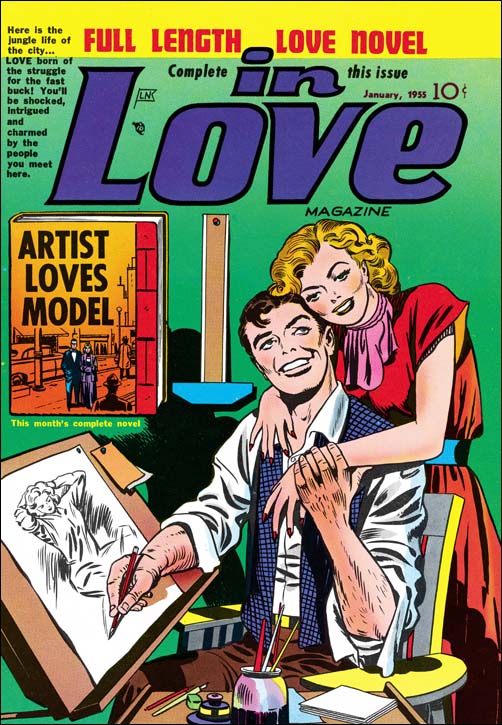
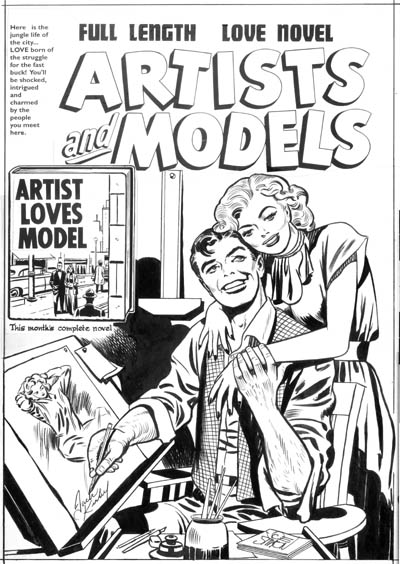
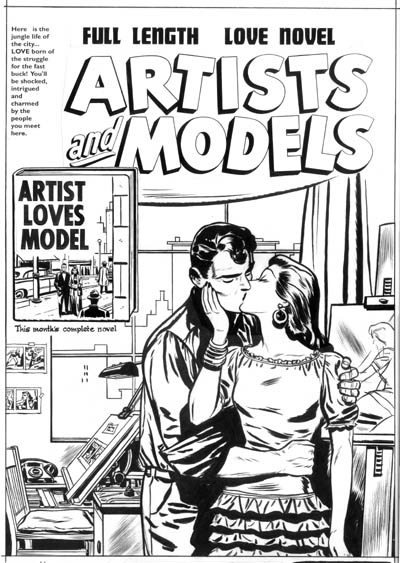
The artist and model theme was one that obviously resonated well with Simon and Kirby. They launched the whole romance comic book genre using the theme on a cover The theme became the basis of a syndication strip proposal most likely from the late ’40s or early ’50s. Later Simon and Kirby then tried to use it as a basis for a new comic book title. Kirby and Bill Draut both made cover proposals for the “Artist And Models” book. Kirby’s version of the cover and the original syndication proposals were used as a basis for the “Artist Loves Model” story for In Love #3. Theakston’s Jack Kirby Treasury vol 2 has one of the syndication strips. 2 panels made it into the comic version of the story, while 2 panels did not. The panels that made it were used in their entirety. Joe Simon’s collection has the original art for what was going to be the first page of the story. Two of the original three rows of panels remain on this page. Everything was cut and pasted, nothing was drawn on the board itself. Unlike the art from the Treasury strip example, this page did not use whole panels, instead these are pieces of panels cut to fit together. I am not sure why this page was abandoned, but it does seem to tell a story that deviates from the published version.

In Love #3 (December 1954) “Artist Loves Model” page 1, pencils by Jack Kirby inks by Joe Simon
We can be certain that the published first page was newly created for the comic book version of the story, a syndication strip would not require a full page splash. I am not certain, but I believe Simon did the inking. It is even blunter then what Kirby was doing at the time without the type of control Jack usually provided. When I showed Joe this page he commented that he felt there was too many words in the caption. It is an unusually wordy introduction for a Simon and Kirby comic. This was probably due to the need to cover the part of the story which had been on the abandoned first page that I talked about above. Although I have attributed the pencils to Jack, he may not have done the rows of buildings at the top and bottom of the page. In any case the tenements on the bottom are a particularly nice touch.
Of all the stories published for the In Love title, or any other Simon and Kirby romance productions, the inclusion of “Artists Loves Model” in the romance genre is the greatest stretch. Although love plays and important part of the story it really is not the central theme. The real theme for this story concerns artistic creativity. The story follows the lead character Inky from the end of his gig as an assistant to a famous and successful syndication strip artist. We see Inky’s failed attempt at creating his own strip. Eventually our hero does accomplish his goal, but only as an unwitting accomplice to intellectual property theft. When Inky realizes what has happen he abandons his new found success and sets things right. But he has not only proved his moral integrity, but his artistic value as well. Inky ends up with a new assignment and there is little doubt that he will be very successful with it.

In Love #3 (December 1954) “Artist Loves Model” page 5, pencils by Jack Kirby
“Artist Loves Model” has significance beyond the fact that it is a great story. Both Jack and Joe gave a number of interviews later in their lives. Jack’s interviews in particular give insight into his opinions about the creative process. The prestige of comic book artists is very different from the Silver Age on. I doubt very much if anyone bothered to interviewed Kirby or Simon during their time of collaboration. Therefore “Artist Loves Model” provides a rare opportunity into what Simon and Kirby thought about creativity in comic art at that time. When syndication manager Jack Hill rejects Inky’s initial strip proposal Hill’s explanation is:
BECAUSE YOUR CHARACTERS ARE ARTIFICIAL, INKY … THEY LACK LIFE!
Later Hill makes it clear that he is not just talking about how good the drawing is:
NO EDITOR IN HIS RIGHT MIND WILL ACCEPT THAT LIFELESS CREATION, INKY! IT’S JUST A GOOD-LOOKING CORPSE!
To help Inky understand what he is saying, Hill shows two popular syndication artists at work. One, a small and skinny man, draws a Superman clone (Vita-Man), using his inner most desires as an inspiration. Another artist is a typical family man and therefore can make his comic strip family real for his readers. One particularly interesting comment is made by Mr. Hill:
A MAN DOESN’T SEARCH FOR AN INSPIRATION … IT EXPLODES IN HIS MIND!
The way this particular comment is phrased sounds so like Kirby to me. It is just the sort of thing that Jack might have said thirty years later.
Inky’s love interest is his new found manager, Donna Dreame. Donna is a very beautiful woman with a larcenous heart. Unfortunately Inky is the only one in the story who does not recognize her true nature. Donna is surprised to find that Inky has used her as a model for one of the characters in the strip they are collaborating on. However as Donna remarks:
BUT THIS GIRL … SHE’S A SWEET YOUNG THING … INNOCENT … WHOLESOME … EVERYONE’S KID SISTER …
This is the way the love blind Inky sees Miss Dreame. Donna is so taken by Inky’s idolized version of herself that she resolves to be more like the woman that the artist has portrayed. Real life has inspired art which in turn becomes a source of inspiration. I believe this is a rare presentation of a core, if unspoken, Simon and Kirby philosophy. I can think of no more capable comic book creators at that time then Simon and Kirby. Yet Joe and Jack never went to the extremes found in comics produced by companies like EC. Even before the Comic Code there was a self imposed barrier of good taste that Simon and Kirby would never extend beyond. As businessmen money was very important to them, but never to the point that Joe and Jack would compromise their product. Simon and Kirby wanted their stories to be sources of inspiration for their readers and not just a vehicle for cheap thrills.
“Artist Loves Model” is unique among the numerous Simon and Kirby productions. Unfortunately In Love #3 is probably the rarest of all the Mainline/Charlton Simon and Kirby issues. Further this story has never been reprinted. The story has no superheroes or blazing guns yet I think it is a most important story that every Simon and Kirby fan should read. Perhaps someday that will once again be possible.
The format of the In Love would change after issue #3. Never again would the title include a “book length love novel”. Nor would the stories have the unique flavor that previously even many of the backup stories had. The stories from In Love became indistinguishable from those concurrently being produced by Simon and Kirby for Young Romance, Young Love and Young Brides. I will continue scanning and restoring the remaining issues of In Love but I doubt I will be posting about them at this time. First I need to write about Simon and Kirby’s long and fruitful career in the romance genre.
Addendum:
When I wrote the above I had completely forgotten that Bob on the Jack Kirby Comics Weblog had once posted on the syndicate version of this story. I am in the process of getting a copy of Buried Treasure v1 #2 which Bob reports has 36 strips. When I do I will post on what portion of the original strip made it into the comic book story.
Posted in 2007/09, 6 Mainline, In Love, Periods, z Archive
Tagged Jack Kirby, Joe Simon
Leave a comment
In Love #2

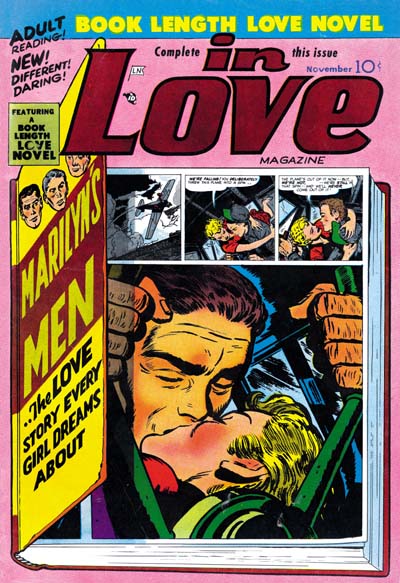
In Love #2 (November 1954) “Marilyn’s Men”, art by Bill Draut
The second issue of In Love kept to the concept of a long story broken up into three chapters. “Marilyn’s Men” is about Marilyn Morgan, her brother Jim, Lawyer Bob (he is actually called that), and Dave an airplane pilot. Jim is a constant source of scandals due to his numerous fights over girls, usually someone else’s. Lawyer Bob loves Marilyn, but unfortunately for him she does not return that affection. Marilyn heart still smolders for her high school flame Dave. Always on the look out for a big money making scheme, Jim entices Marilyn’s interest in a new project because this time it involves a deal with Dave for a new airport. This not only leads to a business partnership, but also to the renewal of love between Marilyn and Dave. All is not well because an attempt by Marilyn to prevent Jim from causing another scandal backfires with Jim leaving the partnership. But another scheme of Marilyn’s brings him back.

In Love #2 (November 1954) “Marilyn’s Men” page 6, art by Bill Draut
Most of the art in this story was done by Bill Draut, and he does a great job. There are a lot of examples I could provide. There is a nice fight scene that starts the story, a great splash page, some interesting flying sequences, and more. Instead I have selected a page with no real action because it shows how well Bill could choreograph a page. I suspect some of the credit should go to the writer for so nicely directing the whole thing. But it was probably Draut who figured how to visually make it all work. We see Marilyn and Lawyer Bob enter the park. As they sit there is a flying pigeon in the foreground. Next a close-up of a pigeon and the couple’s legs. Marilyn cites the pigeon as a metaphor for freedom. Then the pigeon is startled and flies away with the shadow of a plane showing the source of that disturbance. It is Dave’s plane that the couple look up at as if flies away. Finally it is back to focusing on the couple as we learn the depths of Marilyn’s feeling for and about Dave and Bob. All very cinematic.

In Love #2 (November 1954) “Marilyn’s Men” page 4 panel 3, art by Bill Draut and Jack Kirby
That page and others do not have a Kirby feel to them so I once again doubt that Draut was working from Kirby layouts. There is one exception, a panel with Jim taking a drag from a cigarette while talking to Marilyn. Marilyn’s pose seems pure Draut, but Jim is so Kirby-like that I suspect Jack has stepped in to redraw the brother.

In Love #2 (November 1954) “Marilyn’s Men” page 18, art by Jack Kirby
Kirby did not draw any of the pages for the first two chapters of the story, but Jack did four of the seven pages of the last chapter. The first three pages are by Jack, followed by three pages by Bill and ending with another page by Kirby. I find it surprising that Jack’s contribution came so late in the story. Draut is a good artist but lets face it, Kirby is a better one, and also the boss. Normally I would expect that if Kirby only worked on part of a story it would be the splash pages and the start. An advertisement in In Love #1 shows that at least some of the art for “Marilyn’s Men” was already completed at the time issue #1 went to the printers. So perhaps Jacks significant involvement in In Love #1 precluded initially working on issue #2 until the last chapter. If chapter 3 is thought of as a story in itself, Jack’s involvement with the starting pages and the end is just what would be expected. Jack did a beautiful job on the splash page, I believe he inked it as well. I will discuss the second page of the chapter below but I do not believe Jack was the primary inker. The third page (shown above) is a bit of a surprise, although clearly drawn by Jack it looks like the inker tried to make it looked like it was done by Draut. I do not think it was Draut who did this inking. Previously I wrote on Kirby imitating Draut and other artists in the content pages of Harvey romances. What was done here was just as unsuccessful. I suspect the attempt was made to provide a transition from the Kirby page to those done solely by Draut. It does provide a transition but at the cost of a truly ugly page of art. The same sort of Kirby transformed into Draut occurs on the last page as well, and it is just as unsuccessful.

In Love #2 (November 1954) “Marilyn’s Men” page 17, art by Jack Kirby
I supply the image for the second page of the third chapter above (page 17 of the entire story). The sequence actually starts with two panels on the splash page showing Marilyn as she passes through the park alone. The first five panels on page 17 is a sequence of two of Marilyn and the man, followed by one of the man meeting another women and then another two of Marilyn and the couple. Except for one panel where the man is up close, Jack generally puts Marilyn in the foreground with the background used for the man or couple, who are the actual focus of the panels. The next two panels show only the couple and the last has the couple again with Marilyn retreating in the background. The whole sequence is just a marvelous example of obtaining drama and tension just by the way the art is laid out. Kirby is justly famous for how he portrays action in a story, action-less drama on the other hand is not something that Jack did not do very often. Although rare, pages like this one or the one I wrote about from Foxhole #2 show that Kirby was a master of pure drama as well.
The writing for this story is truly superior. All the pieces of the plot fit well together. Marilyn’s interference with her brother Jim in the last chapter makes no sense without Jim’s fight and scandal in the first chapter. The plot moves not just to provide an interesting tale, but as a means of presenting the cast of characters and providing their motivations. The character of Marilyn is a particular surprise. Generally a businesswomen in romance comics would be expected to abandon her career and find fulfillment in love. Not Marilyn, she gets it all, love and her career. When Marilyn’s interference in Jim’s love life backfires you would expect that she would have learn her lesson. Instead Marilyn no longer tries to break up Jim and his new girlfriend, but interferes once again in his life to bring him back to business partnership. One thing sets this story apart from many Simon and Kirby romances and that is emphasis on action. Since action is so often found in romance stories that Jack drew, I believe this indicates that Kirby played a significant part in the writing of this story. There are phrases here and there that also sound like Kirby’s writing. However most of the scripting does not sound like Jack’s, so I suppose another writer was involved as well.
As I reread these issues I realize that it is not just the full length feature story that sets In Love apart. Most romance comic book stories can be summarized as boy meets girl, a problem occurs, finally love conquers all. (Do not trivialize romance comics because of this, superhero stories can be summarized into an even simpler formula). The closest that In Love stories come to that formula is “Bride of the Star” that I posted on earlier. Even there it was so much as love conquered all as that the man regained his own self confidence about pitching which allowed love to resume. The two short backup pieces in In Love #1 were both about already married woman. “Marilyn’s Men” is just as much about Marilyn’s relationship with her brother as it is about her love life. The backup in In Love #2 was more about the love of a mother for her child then it was the love between a man and a woman. It does seem that Simon and Kirby were trying to make In Love different from the rest of the romance titles just like the effort to make the rest of the Mainline titles standout from their competitors.
In Love #1

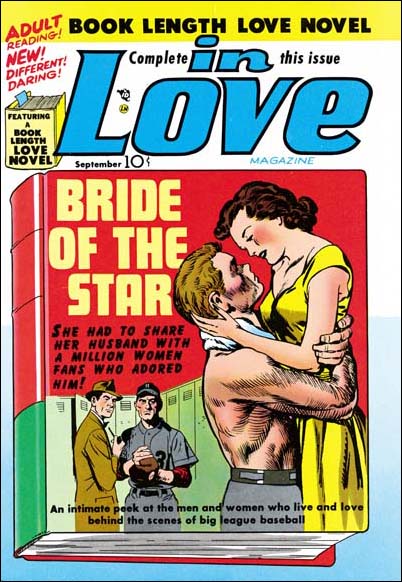
In Love #1 (September 1954) “Bride of the Star”, art by Jack Kirby
I have begun to scan and restore the Simon and Kirby title, In Love. By the time they published this title in 1954 under Mainline, their own company, Simon and Kirby had a long history of producing romance comics. In fact no one had a longer history because they had started the romance comic book genre (See my post The First Romance Comic). Joe and Jack wanted all the Mainline titles to be different and for In Love their hook was that it was a “book length love novel”. That claim was not completely accurate because besides the feature story the comic would contain a couple of short stories as well. But the feature would be, at least for the first few issues, longer then any other romance story that Simon and Kirby had ever produced. Long enough that they could divide it up into three chapters. The feature story for In Love #1 was “Bride of the Star” and was entirely drawn by Jack Kirby. I have already outlined the plot in the same First Romance post that I linked to above. But rather then ask the reader to read it from the link I have copied the appropriate paragraph:
A young lady nearly gets beaned with a baseball. This becomes the first meeting between the new rookie Warren and Patty, who just happens to be the daughter of the teams owner. Romance and then marriage follows. But having the father-in-law as the teams owner brings in difficulty. Warren insists in not getting special treatment. Betty stays home as the team travels and follows her husband’s progress, or lack thereof using newspapers. Warren is not doing well as a pitcher, wants to be sent back to the minors and resents that his special relationship with the owner is the only reason he hasn’t been. Eventually Warren leaves both baseball and Patty. Sometime later Warren returns to pick up his things. During a discussion with Patty, Warren wants to know if she still loves him. Patty says she wants to love him and it is not important that he is not a big star. But Warren has changed, before he wouldn’t accept defeat, now he was a quitter. Warren stays, the owner/father has a medical breakdown, and Warren helps Patty run the team. The team’s pitching staff all have injuries so Warren decides to step in and pitch. He declares he has kept himself in training. His pitching wins the game. Warren tells Patty that winning the game was not that important, it was winning her respect that mattered. Obviously their love has returned as the story ends with a kiss.

In Love #1 (September 1954) “Bride of the Star” page 19, art by Jack Kirby
Kirby’s romance stories generally have characteristics that make them unique from all stories by other artists that worked for the Simon and Kirby studio. Kirby emphasized action in his romance stories. This can be scene in “Bride of the Star” in the part that baseball plays. The story is a romance but on certain pages that can almost be missed because of the sport aspect.

In Love #1 (September 1954) “After the Honeymoon”, art by Mort Meskin
As mentioned above In Love would also include some short romances along with the feature story. One of these for In Love #1 was a two page tale drawn by Mort Meskin. Despite its short size it is a rather well executed story. In the first three panels (the splash is really part of the story) Meskin provides a conversation between a man and a merchant. Talking heads are always a problem in comics and particularly so for romances. Mort uses the contents of the store to keep the first and third panel interesting. For the second panel Meskin accomplishes this with the use of dramatic lighting on the merchant. Note in all three panels the main character faces us, normally in the depiction of a conversation you would expect one of the faces to be viewed from behind. This is exactly what happens in the second panel to the merchant. In the first panel Mort has the man turn about for a better light in which to view his purchase in the light. In the third panel although still conversing with the merchant, the man has already turned around to leave. In such a short story it is important to present the main character as much as possible to make a connection with the reader. Mort has done this rather well with such unobtrusive means. Because the story is so condensed, there is only a two panel bridge between the man’s dealings with the merchant and his meeting with his wife. Two panels are not much, but Mort manages to infuse them with necessary mood. After the preceding close-ups we are now presented with more distant view as the man as he walks alone. The night time is the proper setting for his troubled state. Pieces of paper blown by the wind are visual clues to the man’s unsettled thoughts. Beat up garbage pails reflect on the man’s unprosperous condition. The final panel uses a dramatic view from atop the steps, making the simple act of preparing to walk into his house as a struggle over the apprehension he has for the coming confrontation. The story, inspired by the short O’Henry tales, is one about the self sacrifice aspect of love.
Mort Meskin has manipulated the presentation of the story so well it is easy to miss what he has been doing. Mort’s drama is not the dynamic action that someone like Jack Kirby preferred. Rather Meskin works unobtrusively to set the proper emotional tone. Because it is so unassertive Mort’s efforts are often overlooked. I am not saying everything Meskin did was at this level, but it is not that unusual either. I previously examined on an even better story “The Dreaming Tower” in my post on Strange World of Your Dreams.
I like to believe that my studies of the comics produced by Simon and Kirby have given me an broad understanding of the last days of the Simon and Kirby studio. My views have not changed much from those I presented in my serial post The End of Simon and Kirby. Sure I would like to have more precise dates on some of the key events. I also admit that there is the possibility that I could be wrong in my interpretation of the data. Still I think I have an overall understanding of the relationship between Joe and Jack as well as some of the more important artists of their studio. However that understanding does not include Mort Meskin. Previously Mort played an important part in S&K productions. Mort significantly contributed to Boys’ Ranch, more then I think many realize. Yet when S&K launched Mainline that line included only three stories by Meskin, and all of those from the early issues. Bill Draut and John Prentice played much more important roles in Mainline titles, as did the newcomer Jo Albistur. Why did not Meskin show up more in Mainline? Mort’s presence in the Prize romance comics of this time did increase. But so did Draut, Prentice and Albistur due to Kirby’s absence. When Kirby returned to provide pretty much all the art for the Prize romance titles, Draut and Prentice show up in Harvey romances which at the time were being edited by Joe Simon. Why did not Meskin make that transition as well? I can think a number of possible explanations, but none that I can support with actual data. Mort Meskin’s relationship with Simon and Kirby during these times remains a bit of a mystery to me.
Posted in 2007/08, 6 Mainline, In Love, Periods, z Archive
7 Comments
The Day After
I was going to work tonight on a couple more “Not Kirby” posts. But somehow it just does not seem appropriate the day after Jack’s birthday. So I have decided to continue with progressive proofs of covers. As I said yesterday progressive proofs provide prints of the individual colors which I scan separately and combine using Photoshop. I believe this provides the most accurate idea of what the cover looked like when it was first published. No retouching or color adjustments are required. Joe Simon only had progressive proofs for five covers left. Not surprisingly they were all for Mainline Comics, the short lived comic publishing company that Joe and Jack started.

In Love #1 (September 1954) by Jack Kirby and John Prentice
I have posted a smaller image of this cover proof before although I did not mention then that it was based on progressive proofs. In Love was the romance title for Mainline. Jack did the foreground figures and John Prentice drew the background ones. This is a unique example of two S&K artists working on the same cover. I wish that the original art was still around. Perhaps it could provide evidence as to why this was done by two artists.

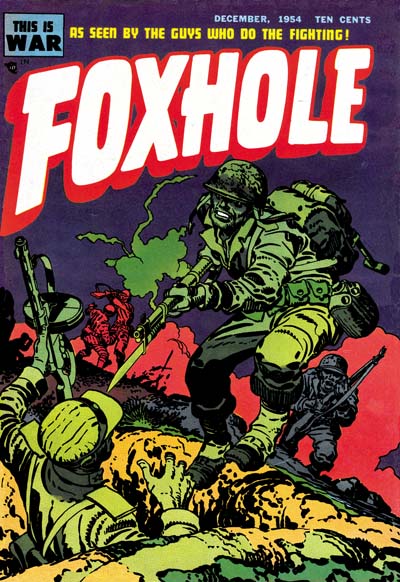
Foxhole #4 (April 1955) by Jack Kirby
Joe Simon has told me that they (the S&K shop) did not do the color guides for the comics, that was the responsibility of the publisher. Once Joe was pointing out the artists in a photograph of the S&K studio. Joe said that one of the artists, whose name I forget, was the colorist. At the time I though Joe was contradicting himself. But later Joe described the financial deal that he had for producing comics for Prize. S&K had to cover all costs for producing the comics. When a certain percentage of the printed comics were shipped, S&K would get some money back and then share the profits from the actual sales. But I believe that when the deal was made making the color guides was not part of the work that S&K would have to do. But it would not make sense for the colorist to work elsewhere, in fact Prize may not have had their own artist bullpen. So the colorist would work in the S&K studio but be paid by the publisher Prize.
However Mainline Comics were S&K’s own company and so all work in creating the comics were their responsibility. So they oversaw, if they were not actually involved, in making the color guides. It seems to me that some of the Mainline cover color work is very different from work done for Prize. In fact some of them are in my opinion the best color work ever done for Simon and Kirby comics. The cover for Foxhole #4 is certainly one of these great color jobs. In fact it would not be anywhere near as dramatic without the colors.

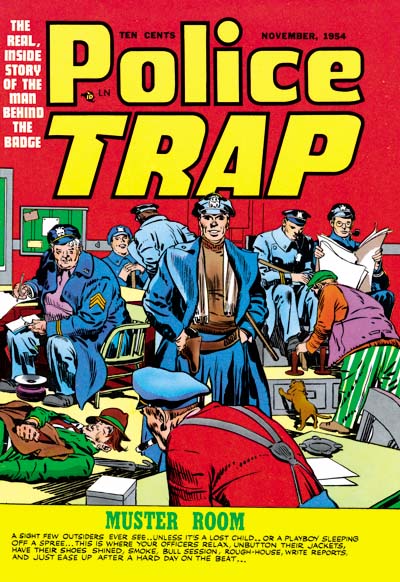
Police Trap #2 (November 1954) by Jack Kirby
The first two Police Trap covers show the interior of a police station. Even though they were swipes from some paintings, they are just great Kirby covers.

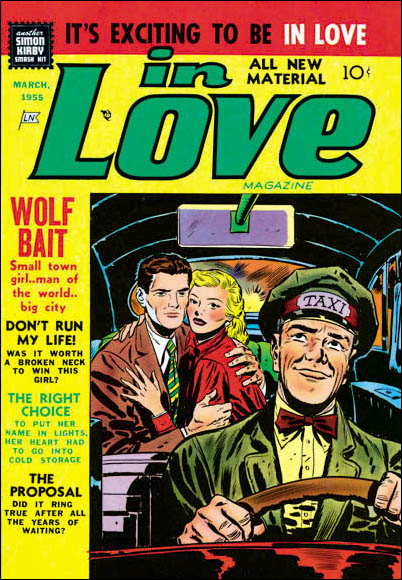
In Love #4 (March 1955) by Bill Draut
Jack Kirby did not draw most of the work in the Mainline comics despite the fact that during this period he stop drawing anything for the Prize romances. Joe Simon is said to have handled most of the business aspects of the S&K shop but I suspect running their own publishing company required more business effort which even Jack had to help with. But there were other fine artists to help such as Bill Draut who did this cover. Actually yesterday when I wrote that Jack Kirby did the cover for In Love #3 that was not technically correct. The insert of the book cover was done by Draut.
Posted in 2006/08, 6 Mainline, Featured Work, Foxhole, In Love, Periods, z Archive
2 Comments