
Please donate!
The Jack Kirby Museum is raising funds to open a "Pop-Up" Museum on the Lower East Side, near where Kirby was born and raised. Learn more here.About this Blog:
© 2006, 2007, 2008, 2009, 2010 & 2011 Harry Mendryk. Unless otherwise marked, all images are my own restorations. Further some of the images have copyrights by Joe Simon and Jack Kirby or Joe Simon alone. I am fortunate that Joe Simon has allowed me to also include some previously unpublished material. Please do not copy from this blog without permission.Pages
Categories
- 9/11 (6)
- Artists (268)
- Albistur, Jo (7)
- Avison, Al (8)
- Belfi, John (4)
- Breifer, Dick (9)
- Brewster, Ann (7)
- Burgos, Carl (1)
- Ditko, Steve (2)
- Donahue, Vic (12)
- Draut, Bill (50)
- Eadeh, Al (16)
- Gregg, George (5)
- Infantino, Carmine (6)
- Kirby, Jack (157)
- McCarty, Bob (9)
- Meskin, Mort (69)
- Morrow, Gray (1)
- Oda, Ben (1)
- Oleck, Jack (2)
- Powell, Bob (1)
- Premiani, Bruno (9)
- Prentice, John (29)
- Riley, Ken (2)
- Robinson, Jerry (10)
- Severin, John (7)
- Simon, Joe (57)
- Stallman, Manny (7)
- Starr, Leonard (13)
- Stein, Marvin (20)
- Walton, Bill (5)
- Checklist (19)
- Albistur, Joe (1)
- Brewster, Ann (1)
- Briefer, Dick (1)
- Donahue, Vic (1)
- Draut, Bill (1)
- Eadeh (1)
- Gregg, George (1)
- Infantino, Carmine (1)
- Kirby, Jack (1)
- McCarty, Bob (1)
- Premiani?, Bruno (1)
- Prentice, John (1)
- Riley, Ken (1)
- Robinson & Meskin (1)
- Severin, John (1)
- Simon, Joe (1)
- Stallman, Manny (1)
- Starr, Leonard (1)
- Stein, Marvin (1)
- Comic Checklists (20)
- All For Love (1)
- Black Magic, DC (1)
- Black Magic, Prize (1)
- Boys' Ranch (1)
- Charlie Chan (1)
- Clue (1)
- Fighting American (1)
- Foxhole (1)
- Headline (1)
- In Love (1)
- Justice Traps the Guilty (1)
- My Date (1)
- Personal Love (1)
- Prize Comics Western (1)
- Real West Romance (1)
- Western Love (1)
- Young Brides (1)
- Young Love (1)
- Young Romance (1)
- Your Dreams (1)
- Ink Checklist (1)
- Kirby, Jack (1)
- Periods (396)
- 1 Early (22)
- 2 Fox (14)
- 3 Timely (44)
- 4 DC (early) (46)
- 5 Studio (135)
- 6 Mainline (68)
- Assorted (10)
- Bullseye (8)
- Fighting American (6)
- Foxhole (13)
- In Love (16)
- Police Trap (7)
- Prize (15)
- 7 Freelance (74)
- Archie (13)
- Atlas Kirby (14)
- DC Kirby (4)
- Harvey (27)
- Prize (17)
- 8 Marvel (12)
- Assorted (6)
- Marvel Kirby (6)
- 9 DC (late) (6)
- Late (3)
- Serial Posts (139)
- Art of J. Simon (1)
- Art of Romance (41)
- Criminal Artists (4)
- Early Jack Kirby (9)
- End of S & K (1)
- Harvey Horror (3)
- It's a Crime (1)
- Kirby Austere Inking (1)
- Kirby Inkers (4)
- Little Shop of Horrors (1)
- Margin Notes (5)
- Replacing S&K (4)
- S&K Colorists (3)
- Start of S&K (12)
- Wide Angle Scream (15)
- Topic (341)
- Alternate Takes (16)
- Anthologies (6)
- Art Editing (4)
- Best of Simon & Kirby (2)
- Captain America (5)
- Comicscope (3)
- Experts (3)
- Featured Work (64)
- First Romance (1)
- Ghosting (7)
- Harvey Covers (24)
- Kirby Inking Kirby (4)
- Kirby Krackle (3)
- Kirby Or Not (28)
- Lettering (13)
- My Two Cents (7)
- Odds & Ends (128)
- Publications (24)
- Quote (4)
- Restoration (3)
- Robots (3)
- S&K Superheroes (2)
- Swiping (8)
- Wertham & Censoring (5)
- Why Comics Declined (1)
- Uncategorized (51)
- z Archive (595)
- 2006/03 (16)
- 2006/04 (14)
- 2006/05 (15)
- 2006/06 (16)
- 2006/07 (10)
- 2006/08 (24)
- 2006/09 (11)
- 2006/10 (19)
- 2006/11 (20)
- 2006/12 (14)
- 2007/01 (16)
- 2007/02 (17)
- 2007/03 (14)
- 2007/04 (10)
- 2007/05 (12)
- 2007/06 (8)
- 2007/07 (7)
- 2007/08 (8)
- 2007/09 (6)
- 2007/10 (10)
- 2007/11 (7)
- 2007/12 (4)
- 2008/01 (4)
- 2008/02 (7)
- 2008/03 (12)
- 2008/04 (8)
- 2008/05 (8)
- 2008/06 (11)
- 2008/07 (6)
- 2008/08 (12)
- 2008/09 (7)
- 2008/10 (8)
- 2008/11 (4)
- 2008/12 (6)
- 2009/01 (10)
- 2009/02 (4)
- 2009/03 (5)
- 2009/04 (8)
- 2009/05 (6)
- 2009/06 (5)
- 2009/07 (8)
- 2009/08 (6)
- 2009/09 (5)
- 2009/10 (6)
- 2009/11 (4)
- 2009/12 (3)
- 2010/01 (6)
- 2010/02 (7)
- 2010/03 (7)
- 2010/04 (4)
- 2010/05 (7)
- 2010/06 (5)
- 2010/07 (8)
- 2010/08 (4)
- 2010/09 (6)
- 2010/10 (9)
- 2010/11 (5)
- 2010/12 (5)
- 2011/01 (4)
- 2011/02 (2)
- 2011/03 (5)
- 2011/04 (6)
- 2011/05 (3)
- 2011/06 (5)
- 2011/07 (7)
- 2011/08 (5)
- 2011/09 (4)
- 2011/10 (10)
- 2011/11 (6)
- 2011/12 (5)
- 2012/01 (3)
- 2012/02 (2)
- 2012/03 (8)
- 2012/04 (3)
- 2012/05 (2)
Comic related blogs
Groups (membership required)
Web pages
Category Archives: 7 Freelance
Art of Romance, Appendix, J.O. Is Joe Orlando

Black Magic #34 (September 1957) “The Hidden Doors”, pencils by Joe Orlando
In recent entries of the serial post of The Art of Romance (Chapter 34 and Chapter 35) I discussed the cover art by an artist who used the initials JO. Although I have not yet written about him in my other serial post, Criminal Artists, the same artist also did covers for Justice Traps the Guilty. I had tentatively credited Joe Orlando as the artist in question. The main reason for uncertainty of this conclusion was that I had not had a chance to do a comparison of work from this period that can be confidently attributed to Orlando. One great thing about databases is that the remember details that the human mind sometimes forgets. I was pleased to find that my database indicated that I did in fact have something with a full signature by Joe Orlando, “The Hidden Doors” from Black Magic #34 (September 1957). This was the first issue of the re-launched Black Magic (the final issue of the earlier run was cover dated November 1954) . The new series was a very different comic from the earlier, Simon and Kirby, produced one. I am sure I will someday do a serial post on the second Black Magic run.
But let me get back to the actual subject of this post. While “The Hidden Doors” was a different genre, there are enough similarities to the romance and crime covers that I believe all were done by the same artist. Further the date for the Black Magic piece is perfectly aligned with the cover art. Therefore I am going to dispense with the question mark and just go with the Joe Orlando attribution.
Chapter 1, A New Genre (YR #1 – #4)
Chapter 2, Early Artists (YR #1 – #4)
Chapter 3, The Field No Longer Their’s Alone (YR #5 – #8)
Chapter 4, An Explosion of Romance (YR #9 – #12, YL #1 – #4)
Chapter 5, New Talent (YR #9 – 12, YL #1 – #4)
Chapter 6, Love on the Range (RWR #1 – #7, WL #1 – #6)
Chapter 7, More Love on the Range (RWR #1 – #7, WL #1 – #6)
Chapter 8, Kirby on the Range? (RWR #1 – #7, WL #1 – #6)
Chapter 9, More Romance (YR #13 – #16, YL #5 – #6)
Chapter 10, The Peak of the Love Glut (YR #17 – #20, YL #7 – #8)
Chapter 11, After the Glut (YR #21 – #23, YL #9 – #10)
Chapter 12, A Smaller Studio (YR #24 – #26, YL #12 – #14)
Chapter 13, Romance Bottoms Out (YR #27 – #29, YL #15 – #17)
Chapter 14, The Third Suspect (YR #30 – #32, YL #18 – #20)
Chapter 15, The Action of Romance (YR #33 – #35, YL #21 – #23)
Chapter 16, Someone Old and Someone New (YR #36 – #38, YL #24 – #26)
Chapter 17, The Assistant (YR #39 – #41, YL #27 – #29)
Chapter 18, Meskin Takes Over (YR #42 – #44, YL #30 – #32)
Chapter 19, More Artists (YR #45 – #47, YL #33 – #35)
Chapter 20, Romance Still Matters (YR #48 – #50, YL #36 – #38, YB #1)
Chapter 21, Roussos Messes Up (YR #51 – #53, YL #39 – #41, YB #2 – 3)
Chapter 22, He’s the Man (YR #54 – #56, YL #42 – #44, YB #4)
Chapter 23, New Ways of Doing Things (YR #57 – #59, YL #45 – #47, YB #5 – #6)
Chapter 24, A New Artist (YR #60 – #62, YL #48 – #50, YB #7 – #8)
Chapter 25, More New Faces (YR #63 – #65, YLe #51 – #53, YB #9 – #11)
Chapter 26, Goodbye Jack (YR #66 – #68, YL #54 – #56, YB #12 – #14)
Chapter 27, The Return of Mort (YR #69 – #71, YL #57 – #59, YB #15 – #17)
Chapter 28, A Glut of Artists (YR #72 – #74, YL #60 – #62, YB #18 & #19, IL #1 & #2)
Chapter 29, Trouble Begins (YR #75 – #77, YL #63 – #65, YB #20 – #22, IL #3 – #5)
Chapter 30, Transition (YR #78 – #80, YL #66 – #68, YBs #23 – #25, IL #6, ILY #7)
Chapter 30, Appendix (YB #23)
Chapter 31, Kirby, Kirby and More Kirby (YR #81 – #82, YL #69 – #70, YB #26 – #27)
Chapter 32, The Kirby Beat Goes On (YR #83 – #84, YL #71 – #72, YB #28 – #29)
Chapter 33, End of an Era (YR #85 – #87, YL #73, YB #30, AFL #1)
Chapter 34, A New Prize Title (YR #88 – #91, AFL #2 – #5, PL #1 – #2)
Chapter 35, Settling In ( YR #92 – #94, AFL #6 – #8, PL #3 – #5)
Appendix, J.O. Is Joe Orlando
Chapter 36, More Kirby (YR #95 – #97, AFL #9 – #11, PL #6 – #8)
Chapter 37, Some Surprises (YR #98 – #100, AFL #12 – #14, PL #9 – #11)
Chapter 38, All Things Must End (YR #101 – #103, AFL #15 – #17, PL #12 – #14)
Posted in 2010/08, 7 Freelance, Art of Romance, Periods, Prize, Serial Posts, z Archive
Tagged Art of Romance, joe orlando
Leave a comment
Art of Romance, Chapter 35, Settling In
(January – June 1958: Young Romance #92 – #94, All For Love #6 – #8, Personal Love #3 – #5)
I was mistaken when in my last chapter I wrote that the postal statement for All For Love listed Joe Genalo as the editor. That was true for all such statements except the first which listed Joe Simon and Jack Kirby as the editors. Where Simon and Kirby really the editors or was this just an error caused by cutting and pasting from a statement in Young Romance to the one for All For Love? I believe it was just an error because in this chapter as in the last one, different artists appeared in the different publications. Jack Kirby and Bill Benulis only appeared in Young Romance while Ted Galindo only appeared in All For Love and Personal Love. Marvin Stein appeared to be the only artist appearing in both Young Romance and All For Love, although oddly not in Personal Love.
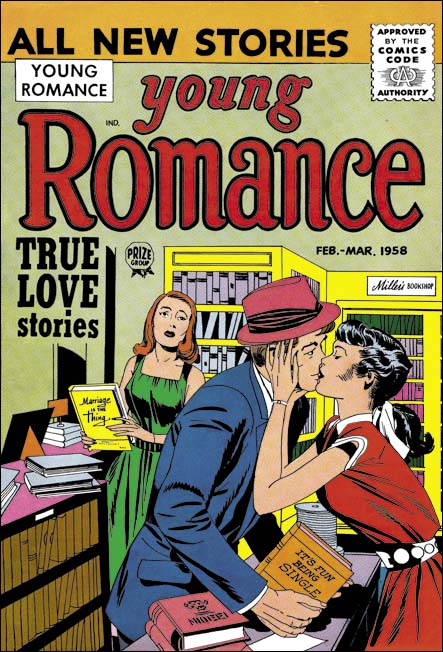
Young Romance #92 (February 1958), pencils and inks by Jack Kirby
The cover for Young Romance #92 (February 1958) was the first one that Kirby did since his run of all-Kirby Prize romance issues of 1956. The preceding six covers done by other artists is a clear indication of the very different nature of Young Romance from 1957 on. Previously Kirby was the artist for all drawn covers except during the period when he and Joe were busy with Mainline Comics (there own publishing venture). This cover was inked by Kirby as well in the manner I call the Austere style (Jack Kirby’s Austere Inking). Older techniques like picket fence crosshatching (Inking Glossary) are absent although drop strings continue to be used but in an overlapping manner. Inking is sparser giving the art a lighter look. When a black region is called for it is executed by flooding the area with ink. The Austere style appears to have been adopted as a means to speed the inking process but not by sacrificing the aesthetics of the final result.
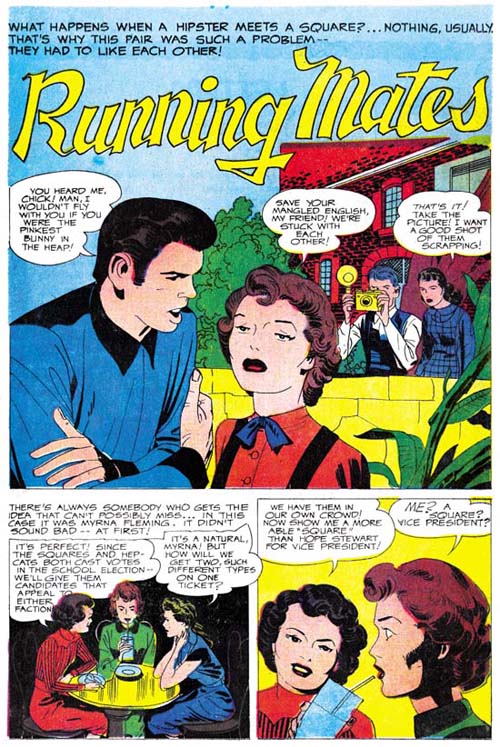
Young Romance #92 (February 1958) “Running Mates”, pencils and inks by Jack Kirby
“Running Mates” marks the beginning of Kirby inking his stories as well. An inker working on his own pencils always has an advantage, but when the artists is as talented inker as Jack was the difference can be astonishing. Jack’s drawing style has changed as well compared to his earlier work. His lines take on a more abstract quality. Look at the woman in the splash; particularly here nose and eyelids. This is far from realism but provides the figure with an expressive quality that realistic art generally fails to achieve.
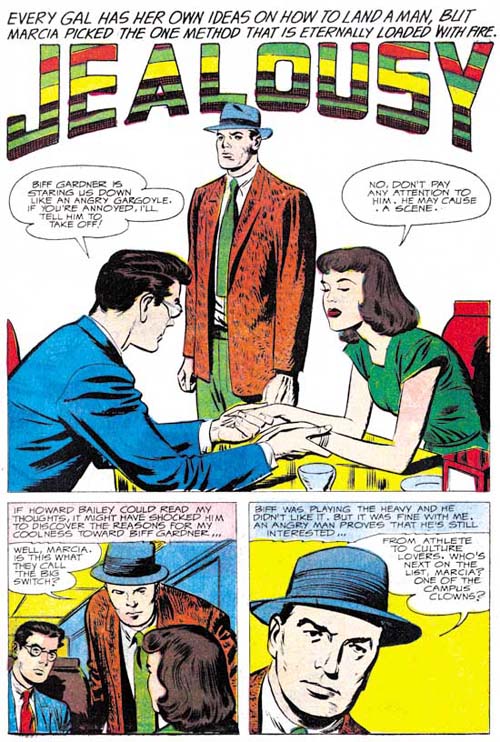
Young Romance #93 (April 1958) “Jealousy”, pencils by Jack Kirby, inks by Marvin Stein
Kirby would not inked all his pencils during the period covered by this chapter, or even most. There are a number of Kirby stories that seemed to be inked by the same artist but I am generally not willing to commit myself to say who that artist was. However I have little doubt when it comes to the inker of “Jealousy”. Marvin Stein inks this piece in exactly the same manner that he would ink his own. When looking at the details it is easy to forget about Kirby’s involvement because Stein’s touch so permeates the piece. Only when one steps back to look at the forest instead of the trees does Jack’s hand become obvious. It is in my opinion a beautiful combination. This is one of my favorite Kirby pieces inked by someone other than Jack himself.
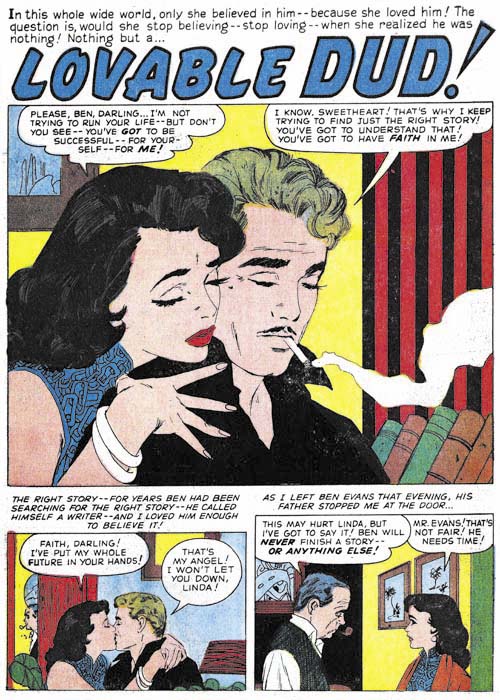
Young Romance #92 (February 1958) “Lovable Dud”, pencils by Bill Benulis unidentified artist, inks by Vince Colletta
None of the stories from this period that I attribute to Bill Benulis are signed but the style does look like his. Benulis did some signed work for Simon and Kirby published in January 1954 (Young Brides #11 and Young Love #53) but I also credit to him an unsigned work from October 1955 (Young Love #67). Benulis is one of the younger artists who did romance in a more modern style and gave his characters more modern clothing and hair styles. Bill had a penchant for patterned clothing as for examples seen worn by the woman in the splash page above.
8/8/10 – Based on observations made by some commentors I went back and compared this and three other stories with “Live Alone And Love It” from Young Romance #91 (December 1957) a piece signed by Vince Colletta. All appeared to be inked by the same artist, Vince Colletta. I also compared these four stories with work from 1954 and 1955 that can confidently be credited to Bill Benulis. I no longer feel they all were done by the same penciller. I still feel that “Loveable Dud” and the other three stories were pencilled by a different artist than the Colletta signed piece. Therefore I have removed the Benulis attribution and left the penciller as unknown while crediting the inking for all to Vince Colletta.
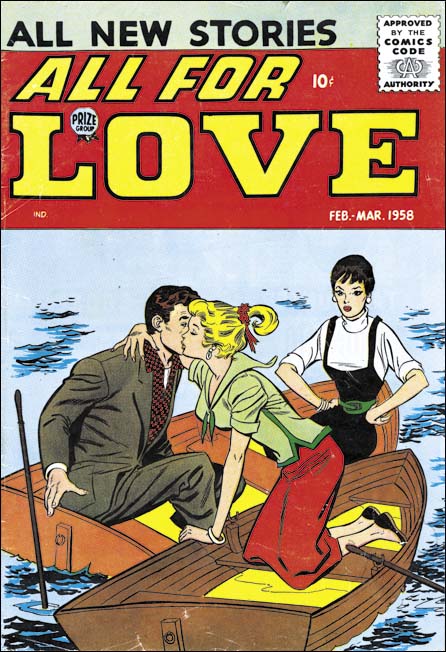
All For Love #6 (February 1958), pencils by Joe Orlando?
The cover for All For Love #6 is unsigned but appears to be by the same artist who initials J. O. appear on other All For Love, Personal Love and Justice Traps the Guilty covers. There have been some comments (both supportive and not) to the last chapter about my tentative suggestion that these covers may have been done by Joe Orlando. Frankly I have not real evidence to back up my suggestion. The artist is quite talented and he almost certainly has done work in comic books before. There really are not a lot of candidates from this period with these particular initials. None of the candidates seems more appropriate than Joe Orlando and so I am now questionably attributing this material to him. My practice in this blog is to use provide credit based on my own observations but this in no way should be interpreted as a disagreement with those who are more knowledgeable about certain artists than I am. Once I have had a chance to familiarize myself with the work Orlando did for other publishers, I am sure either the question mark will be removed or the attribution dropped.
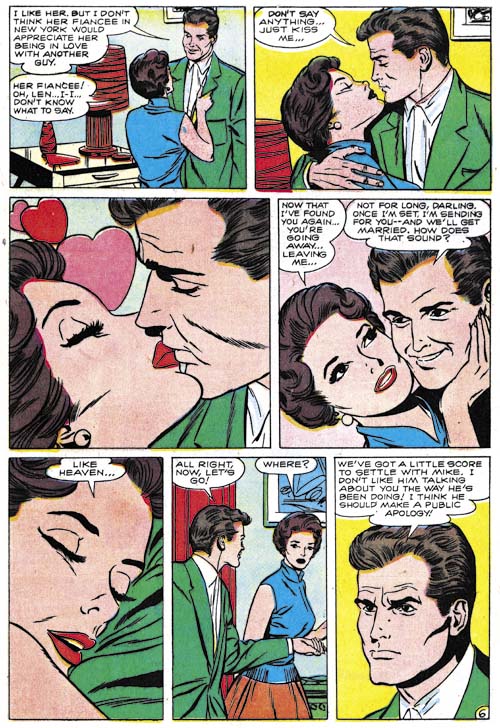
All For Love #6 (February 1958) “To Love is to Trust” page 6, pencils by Ted Galindo
Ted Galindo was perhaps the most used artist for All For Love and Personal Love during this period. He certainly is one of my favorites. The above page is a good example of why I like him. The floating hearts are, in my opinion, a little hokey (but very much in fashion for the period) but otherwise this is a well designed and executed sequence.
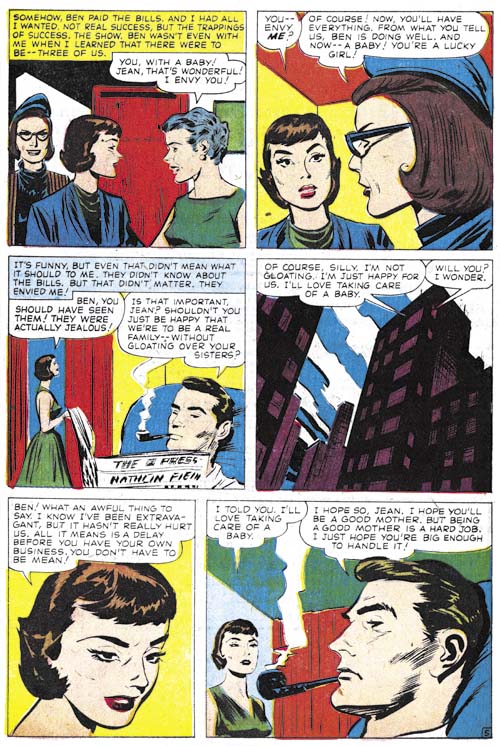
All For Love #7 (April 1958) “Love For Granted” page 5], pencils by Marvin Stein
As in the last chapter, Marvin Stein appears in Young Romance (produced by Simon and Kirby) and All For Love. In some ways this is the better romance work compared to what Stein had been doing earlier in his career. In general I feel that Marvin’s style was more appropriate for the crime and western features he was doing for Prize. But now his woman are more lively and attractive. But I do feel Stein’s art now looks a bit rushed.
Chapter 1, A New Genre (YR #1 – #4)
Chapter 2, Early Artists (YR #1 – #4)
Chapter 3, The Field No Longer Their’s Alone (YR #5 – #8)
Chapter 4, An Explosion of Romance (YR #9 – #12, YL #1 – #4)
Chapter 5, New Talent (YR #9 – 12, YL #1 – #4)
Chapter 6, Love on the Range (RWR #1 – #7, WL #1 – #6)
Chapter 7, More Love on the Range (RWR #1 – #7, WL #1 – #6)
Chapter 8, Kirby on the Range? (RWR #1 – #7, WL #1 – #6)
Chapter 9, More Romance (YR #13 – #16, YL #5 – #6)
Chapter 10, The Peak of the Love Glut (YR #17 – #20, YL #7 – #8)
Chapter 11, After the Glut (YR #21 – #23, YL #9 – #10)
Chapter 12, A Smaller Studio (YR #24 – #26, YL #12 – #14)
Chapter 13, Romance Bottoms Out (YR #27 – #29, YL #15 – #17)
Chapter 14, The Third Suspect (YR #30 – #32, YL #18 – #20)
Chapter 15, The Action of Romance (YR #33 – #35, YL #21 – #23)
Chapter 16, Someone Old and Someone New (YR #36 – #38, YL #24 – #26)
Chapter 17, The Assistant (YR #39 – #41, YL #27 – #29)
Chapter 18, Meskin Takes Over (YR #42 – #44, YL #30 – #32)
Chapter 19, More Artists (YR #45 – #47, YL #33 – #35)
Chapter 20, Romance Still Matters (YR #48 – #50, YL #36 – #38, YB #1)
Chapter 21, Roussos Messes Up (YR #51 – #53, YL #39 – #41, YB #2 – 3)
Chapter 22, He’s the Man (YR #54 – #56, YL #42 – #44, YB #4)
Chapter 23, New Ways of Doing Things (YR #57 – #59, YL #45 – #47, YB #5 – #6)
Chapter 24, A New Artist (YR #60 – #62, YL #48 – #50, YB #7 – #8)
Chapter 25, More New Faces (YR #63 – #65, YLe #51 – #53, YB #9 – #11)
Chapter 26, Goodbye Jack (YR #66 – #68, YL #54 – #56, YB #12 – #14)
Chapter 27, The Return of Mort (YR #69 – #71, YL #57 – #59, YB #15 – #17)
Chapter 28, A Glut of Artists (YR #72 – #74, YL #60 – #62, YB #18 & #19, IL #1 & #2)
Chapter 29, Trouble Begins (YR #75 – #77, YL #63 – #65, YB #20 – #22, IL #3 – #5)
Chapter 30, Transition (YR #78 – #80, YL #66 – #68, YBs #23 – #25, IL #6, ILY #7)
Chapter 30, Appendix (YB #23)
Chapter 31, Kirby, Kirby and More Kirby (YR #81 – #82, YL #69 – #70, YB #26 – #27)
Chapter 32, The Kirby Beat Goes On (YR #83 – #84, YL #71 – #72, YB #28 – #29)
Chapter 33, End of an Era (YR #85 – #87, YL #73, YB #30, AFL #1)
Chapter 34, A New Prize Title (YR #88 – #91, AFL #2 – #5, PL #1 – #2)
Chapter 35, Settling In ( YR #92 – #94, AFL #6 – #8, PL #3 – #5)
Appendix, J.O. Is Joe Orlando
Chapter 36, More Kirby (YR #95 – #97, AFL #9 – #11, PL #6 – #8)
Chapter 37, Some Surprises (YR #98 – #100, AFL #12 – #14, PL #9 – #11)
Chapter 38, All Things Must End (YR #101 – #103, AFL #15 – #17, PL #12 – #14)
Posted in 2010/07, 7 Freelance, Art of Romance, Artists, Kirby, Jack, Periods, Prize, Serial Posts, Stein, Marvin, z Archive
Tagged bill benulis, Jack Kirby, joe orlando, marvin stein, ted galindo
6 Comments
Art of Romance, Chapter 34, A New Prize Title
(May – December 1957: Young Romance #88 – #91, All For Love #2 – #5, Personal Love #1 – #2)
This serial post has now entered the period after the crash and near collapse of the comic book industry. Prize Comics was never a big publisher but these must have been particularly difficult times. At the start of this period Prize was only publishing three bi-monthly titles Justice Traps the Guilty, Young Romance and the new released All For Love. In September they would also release another new romance title, Personal Love. Like All For Love, Personal Love was not produced by Simon and Kirby. The annual postal statements list Joe Genalo as the editor and the contents seem somewhat different from that found in Young Romance. The artists used also seemed to be different as well, at least during this period. Jack Kirby appeared in three of the four issues of Young Romance covered by this post but did no work for All For Love or Personal Love. Lou Cameron played an important part in Young Romance #89 and #90 but he does not appear in the other Prize romance titles. On the other hand Ted Galindo appears frequently in All For Love and Personal Love but he does not show up in these issue of Young Romance.
Since at this time Kirby was freelancing for DC and Atlas, it is clear that he and Joe were no longer running their old studio. So the question becomes how Young Romance was actually produced. While previously there can be found examples of Jack in his roll as an art editor stepping in to fix up some parts of stories supplied by other artists or provide a splash page, I have seen no examples of that practice in the period from 1957 to 1960. On the other hand the annual postal statements still listed both Simon and Kirby as editors up to 1960. My suspicion is that Jack really was not involved in the editorial work for Young Romance and it was Joe who was really producing the title. Not that I believe this effort took much of Joe’s time; it was only a single bi-monthly title.

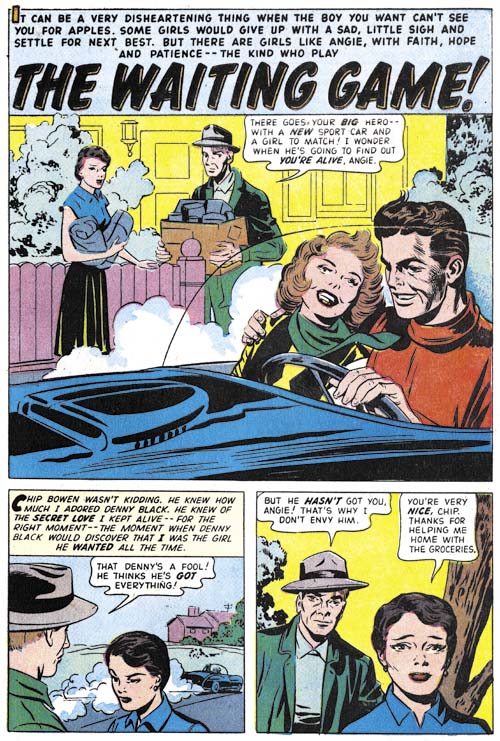
Young Romance #91 (December 1957) “The Waiting Game”, pencils by Jack Kirby, inks by Marvin Stein
Jack Kirby provided art for three of the four issues of Young Romance during this period. However all were rather short pieces (1, 4 and 5 pages) and only one of them was the lead feature (a position often reserved for Jack in the past). All were nicely done but hardly very remarkable (for Kirby). Jack did not inked any of the pieces but one of them “The Waiting Game” looks very much like it was inked by Marvin Stein. Not the blunt but still subtle handling of the face of the man in the background of the splash. Of particular significance is the handling of the lady in the first story panel. She share a rather distorted perspective that I find hard to describe but is so often seen in Stein’s own work when a head is viewed from above and to the side. I am not as confident that Stein inked the other two Kirby stories but he could have.

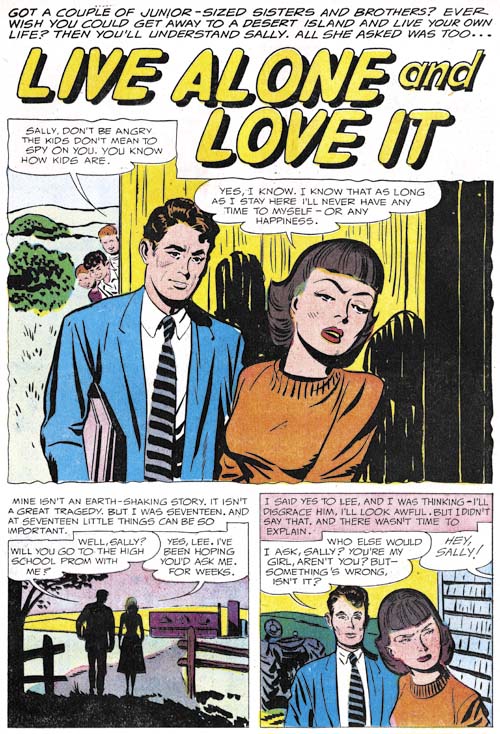
Young Romance #91 (December 1957) “Live Alone and Love It”, art by Marvin Stein
Marvin Stein not only inked a work for Jack Kirby but he penciled and inked his own story for Young Romance. I have remarked before how I find Stein’s style more appropriate for the crime genre than it was for romance. His “Live Alone and Love It” seems done in a particularly blunt manner even for Stein. Note the simplified eyebrows of the lady on this page, very reminiscent of the inking found in some of the Kirby pieces, another reason to possibly attribute to Marvin some of the more recent inking of Kirby’s art. Stein was an exception in that he appeared not only in Young Romance but also All For Love and Personal Love as well. However prior to this he also was one of the very few artists that worked on both Simon and Kirby productions along with the titles not produced by that pair.

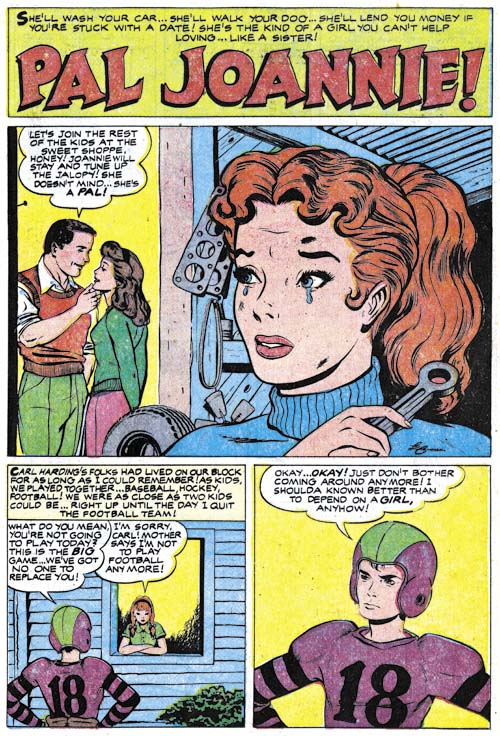
Young Romance #89 (August 1957) “Pal Joannie”, art by Lou Cameron
Lou Cameron, an artist new for Young Romance, played an important part in issues #89 and #90 supplying 5 stories. His work was really excellent; great graphic story telling and beautifully drawn women. Like some of the other younger artists new to the title, Lou drew in what I would describe as a more modern style. I am not that familiar with Cameron’s art but he also work for Atlas, DC and St. John Publishing. I am not sure what to attribute his sudden abundant appearance and just as quick disappearance in Young Romance but he is one of the artists that I wish had made a longer contribution to the title.

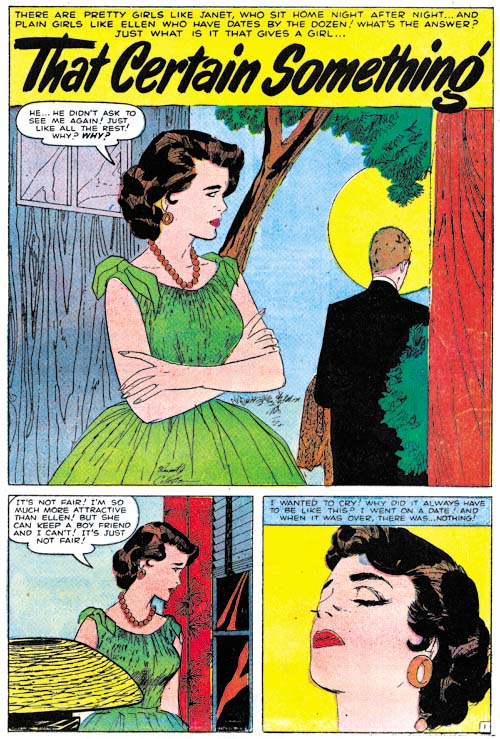
Young Romance #91 (December 1957) “That Certain Something”, art by Vince Colletta
Young Romance #91 included the only appearance of Vince Colletta in a Simon and Kirby production. Colletta did a lot of work for Atlas, much of it romance art. However he is most famous as the inker that Kirby fans love to hate. Mostly this is due to his habit of erasing some of Kirby’s pencils to speed up the inking. Oddly Colletta has a small but very vocal group of supporters who I refer to as Colletta apologists. According to the Colletta apologists, Vince was the greatest romance artist who worked in a realistic style. While I admire Colletta’s romance art, neither of these assertions are true. I have never heard anyone other than a Colletta apologists claim Vince as their favorite romance artist and as far as I can tell Colletta apologists otherwise have no interest in romance art. And while his woman are beautiful they are not truly realistic. This is fortunate because I do not believe true realism would be appropriate for comic books. For my part, while I find Colletta’s women beautiful, I also find them to lack any individuality. The only distinction found between individual examples are the hair styles and clothes. Still he is another of those artists that I wish provided more work for Young Romance.

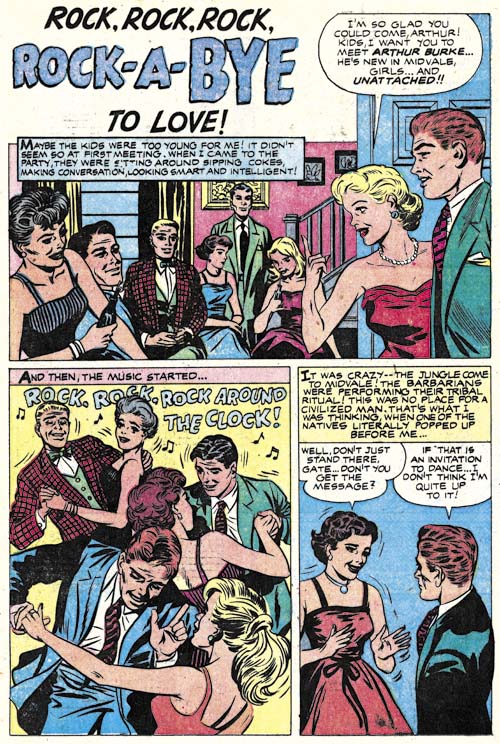
Young Romance #89 (August 1957) “Rock-A-Bye To Love”, art by unidentified artist
In these last few chapters of the Art of Romance, I do not plan to discuss all the artists that appear in the Prize titles. Frankly most of them are not that great and I am so far unable to identify them. That is not to say that they are totally uninteresting. This is a period of transition for Young Romance as the title tries to maintain its appeal with a more modern audience. Hence the inclusion of rock-and-roll in some of the stories. However there is a tendency for rock music to be judged somewhat negatively.

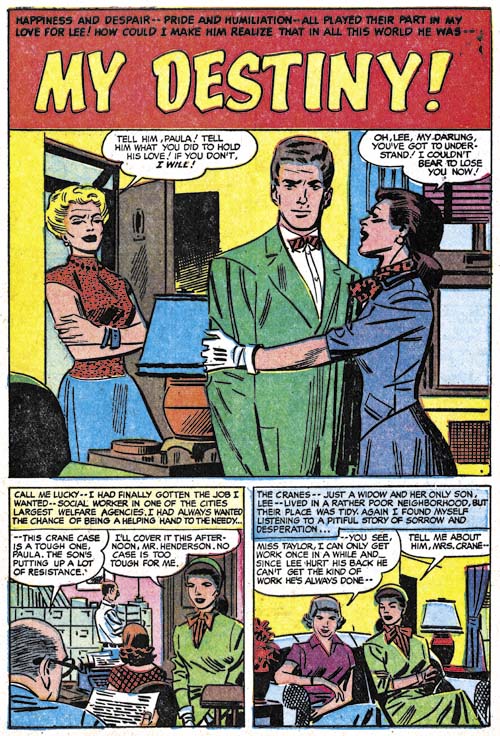
All For Love #2 (June 1957) “My Destiny”, art by Mort Meskin
Mort Meskin provides two stories for All For Love #2 (June 1957). Both works appear to have been inked by Mort as well. As far as the art is concerned the work is nicely done but does not differ much, if at all, from the romance work that Mort did up until the end of 1955. It is not the art that is a cause for a surprise but his appearance in a Prize comic. As I wrote, his romance work was about a year and a half prior to this but his art appeared in the Prize crime titles for a few months further (March 1956). His last work for Prize Comics Western was for the July 1956 issue. Then suddenly these two stories in All For Love and then Meskin disappears from further Prize comics. I suspect that Prize offered much lower page rates than what DC did which is where Meskin was doing most of his work at this time. But it is suggestive that it was in All For Love that Meskin appeared and not Young Romance which was still being produced by Simon and Kirby. In any case I believe this was the last romance comic book art that Mort Meskin would ever create.

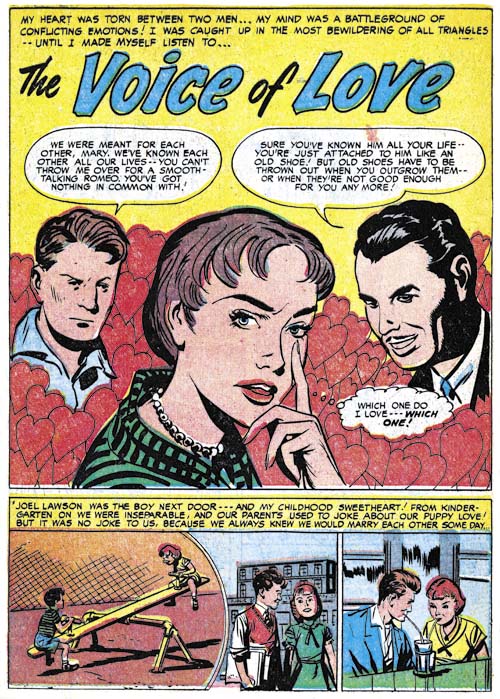
All For Love #3 (August 1957) “The Voice of Love”, art by Marvin Stein
As mentioned above, Marvin Stein was one of the few artists appearing in Young Romance as well as All For Love or Personal Love. If anything, the art for “The Voice of Love” shown above is more carefully drawn than that from Young Romance #91.

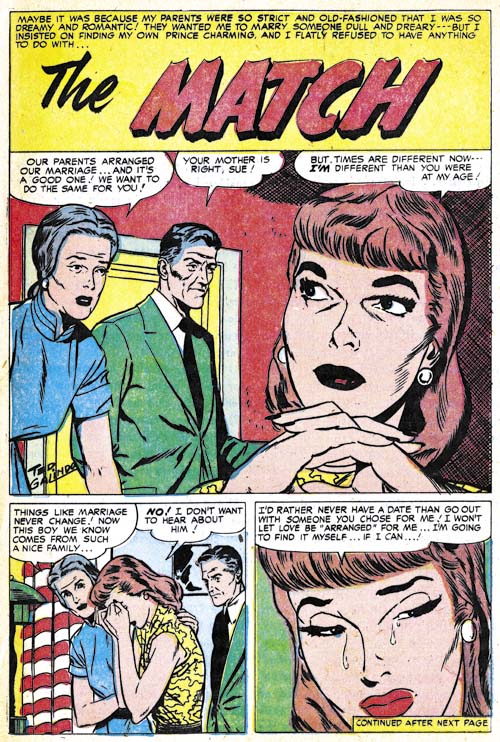
All For Love #3 (August 1957) “The Match”, art by Ted Galindo
Ted Galindo provided work for all the Prize titles at this time except for Young Romance. Ted had previously drawn a story for Foxhole which, to be frank, was really not that well done. His romance work was much better, most likely because he now was a more experienced comic book artist. I feel the best work he was doing at this time appeared in Justice Traps the Guilty which will be the subject of a future chapter to Criminal Artists.

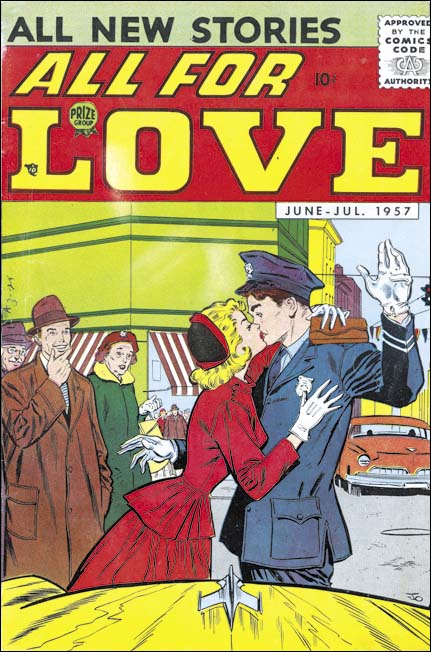
All For Love #2 (June 1957), art by J.O.
Some of the Prize titles during this period had cover art signed only as JO. No interior stories bear that signature and as far as I can seen none of the unsigned pieces were by this artist. The covers are very well done and indicate that this is a talented artist. I have only begun investigating whom this might be and have not reached any but the most tenuous conclusions. Although I have as yet no good evidence to back it up, I wonder if this might be by Joe Orlando.

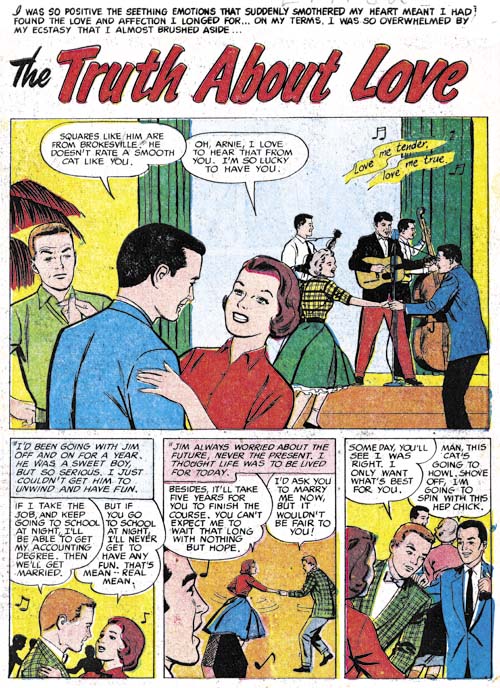
Personal Love #1 (September 1957), “The Truth About Love”, art by unidentified artist
I could not resist including another romance story from this period with a rock-n-roll reference. In the background of the splash can be seen a singer playing an acoustic guitar. That, plus the lyrics he sings, clearly were meant to be a reference to Elvis Presley who was very popular at that time (and since).
Chapter 1, A New Genre (YR #1 – #4)
Chapter 2, Early Artists (YR #1 – #4)
Chapter 3, The Field No Longer Their’s Alone (YR #5 – #8)
Chapter 4, An Explosion of Romance (YR #9 – #12, YL #1 – #4)
Chapter 5, New Talent (YR #9 – 12, YL #1 – #4)
Chapter 6, Love on the Range (RWR #1 – #7, WL #1 – #6)
Chapter 7, More Love on the Range (RWR #1 – #7, WL #1 – #6)
Chapter 8, Kirby on the Range? (RWR #1 – #7, WL #1 – #6)
Chapter 9, More Romance (YR #13 – #16, YL #5 – #6)
Chapter 10, The Peak of the Love Glut (YR #17 – #20, YL #7 – #8)
Chapter 11, After the Glut (YR #21 – #23, YL #9 – #10)
Chapter 12, A Smaller Studio (YR #24 – #26, YL #12 – #14)
Chapter 13, Romance Bottoms Out (YR #27 – #29, YL #15 – #17)
Chapter 14, The Third Suspect (YR #30 – #32, YL #18 – #20)
Chapter 15, The Action of Romance (YR #33 – #35, YL #21 – #23)
Chapter 16, Someone Old and Someone New (YR #36 – #38, YL #24 – #26)
Chapter 17, The Assistant (YR #39 – #41, YL #27 – #29)
Chapter 18, Meskin Takes Over (YR #42 – #44, YL #30 – #32)
Chapter 19, More Artists (YR #45 – #47, YL #33 – #35)
Chapter 20, Romance Still Matters (YR #48 – #50, YL #36 – #38, YB #1)
Chapter 21, Roussos Messes Up (YR #51 – #53, YL #39 – #41, YB #2 – 3)
Chapter 22, He’s the Man (YR #54 – #56, YL #42 – #44, YB #4)
Chapter 23, New Ways of Doing Things (YR #57 – #59, YL #45 – #47, YB #5 – #6)
Chapter 24, A New Artist (YR #60 – #62, YL #48 – #50, YB #7 – #8)
Chapter 25, More New Faces (YR #63 – #65, YLe #51 – #53, YB #9 – #11)
Chapter 26, Goodbye Jack (YR #66 – #68, YL #54 – #56, YB #12 – #14)
Chapter 27, The Return of Mort (YR #69 – #71, YL #57 – #59, YB #15 – #17)
Chapter 28, A Glut of Artists (YR #72 – #74, YL #60 – #62, YB #18 & #19, IL #1 & #2)
Chapter 29, Trouble Begins (YR #75 – #77, YL #63 – #65, YB #20 – #22, IL #3 – #5)
Chapter 30, Transition (YR #78 – #80, YL #66 – #68, YBs #23 – #25, IL #6, ILY #7)
Chapter 30, Appendix (YB #23)
Chapter 31, Kirby, Kirby and More Kirby (YR #81 – #82, YL #69 – #70, YB #26 – #27)
Chapter 32, The Kirby Beat Goes On (YR #83 – #84, YL #71 – #72, YB #28 – #29)
Chapter 33, End of an Era (YR #85 – #87, YL #73, YB #30, AFL #1)
Chapter 34, A New Prize Title (YR #88 – #91, AFL #2 – #5, PL #1 – #2)
Chapter 35, Settling In ( YR #92 – #94, AFL #6 – #8, PL #3 – #5)
Appendix, J.O. Is Joe Orlando
Chapter 36, More Kirby (YR #95 – #97, AFL #9 – #11, PL #6 – #8)
Chapter 37, Some Surprises (YR #98 – #100, AFL #12 – #14, PL #9 – #11)
Chapter 38, All Things Must End (YR #101 – #103, AFL #15 – #17, PL #12 – #14)
Posted in 2010/07, 7 Freelance, Art of Romance, Artists, Kirby, Jack, Periods, Prize, Serial Posts, z Archive
Tagged Art of Romance, Jack Kirby, lou cameron, marvin stein, ted galindo, vince colletta
4 Comments
Art of Romance, Chapter 33, End of an Era
(November 1956 – April 1957: Young Romance #85 – #87, Young Love #73, Young Brides #30, All For Love #1)

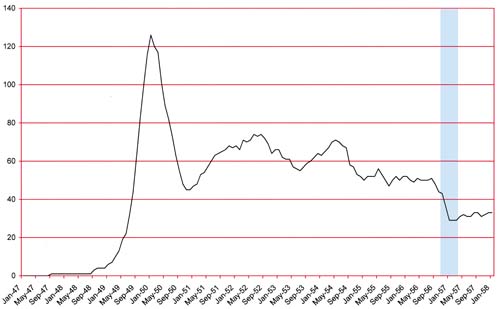
Number of Romance titles 1947 – 1958 (the period covered in this chapter is shaded in blue)
We now come to the end of the all Kirby Price romance comics and transition into a new and significantly different period of Prize Comics. Young Brides #30 (November 1956) and Young Romance #85 (December 1956) qualify as all-Kirby comics but only half of Young Love #73 (December 1956) was drawn by Kirby with the rest of the art done by Bill Draut. Unfortunately the comic book crash had finally caught up to Prize Comics. Young Love #73 and Young Brides #30 would be the final issues of those two titles although Young Love would be resurrected in 1960. At the point of cancellation Prize Comics would only be publishing three titles; Young Romance, Justice Traps the Guilty and Prize Comics Western. Since all were bi-monthlies this was a rather small line-up even for such a small company.
Starting with issue #86, Young Romance was a very changed title. The annual postal statements still listed Joe Simon and Jack Kirby as the editors but whatever working arrangement the two had it clearly was not the same as before. Kirby had started doing freelance work for DC and Atlas while Simon was doing some editorial work for Harvey Comics. Most, but not all, issues would include art drawn by Jack Kirby. Previously cover art was typically done by Kirby alone but now most covers would be done by other artists. The biggest change that came over the title was the largely complete absence of the earlier S&K Studio artists. Artists who previously played prominent rolls in the title such as Bill Draut, Mort Meskin, John Prentice and Bob McCarty would never again appear in Young Romance. The fact that some of these artists would show up in Prize romance titles not edited by Simon and Kirby suggests that there may have been some hard feelings between the artists and their former employers.
The change in Prize Comics was not a complete retreat but rather a reorganization. In April 1957 Prize came out with a new romance title, All For Love. It may seem strange to cancel two romance titles only to start up a new one. The answer is suggested by the Postal Statements which list Joe Genalo as the editor for All For Love. Prize not only wanted a new title, they particularly did not want Simon and Kirby to produce it.

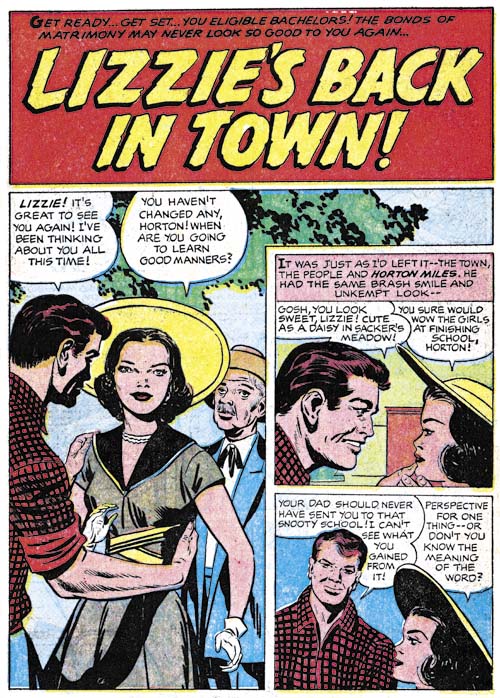
Young Romance #85 (December 1956) “Lizzie’s Back In Town”, pencils by Jack Kirby
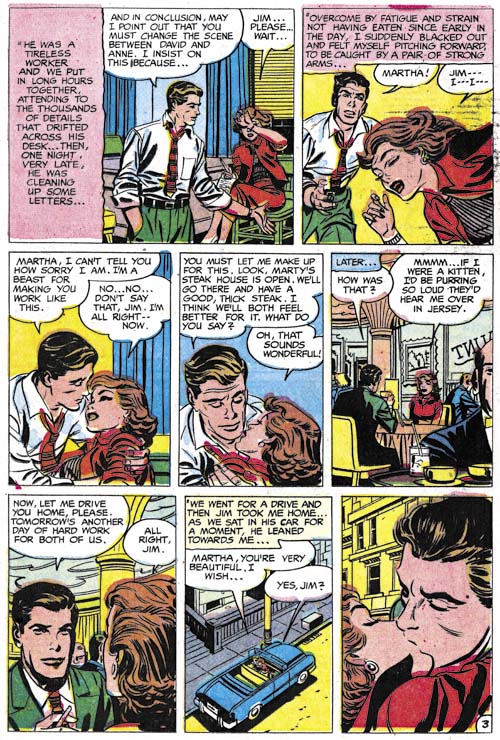
As I mentioned earlier, YR #85 was one of the issues that was drawn entirely by Jack Kirby. While the story art was often first rate, the splashes frequently left something to be desired. At least compared to the work Kirby had done in earlier years. The splash for “Lizzie’s Back In Town” is a good example of this. There is nothing wrong with the splash and granted it was probably a challenge to instill interest into some standing figures, but it was just this sort of romance splash that earlier Kirby was so good at. I suspect Kirby was just trying to do too much romance art in too little time. Some interesting splashes will be found in the future issues when Jack had returned to a more measured output of romance stories.

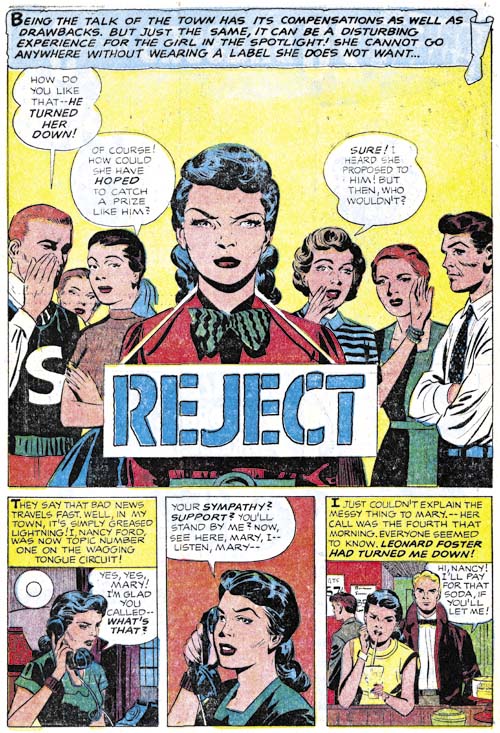
Young Romance #86 (February 1957) “Reject”, pencils by Jack Kirby
There are exceptions to lackluster splashes. I certainly like the one for “Reject”. This is not because of the subject matter because once again all there is are some standing figures. Nor is it the how well the art was handled; I suspect the original pencils were much better than what was left after the inker got finished with it. I think what appeals to me is the characterizations of the players; the stern central figure and the gossipers in the background. I also like the way the title of the story is placed on a placard worn by the lady.

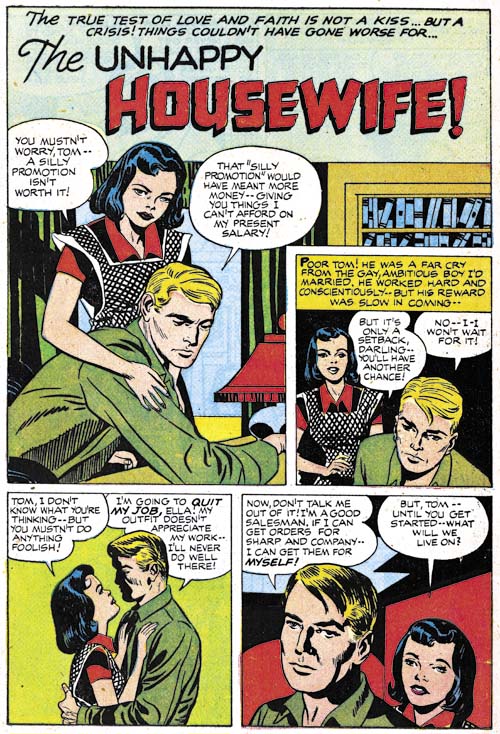
Young Brides #30 (November 1956) “The Unhappy Housewife”, pencils by Jack Kirby
There seems to have been one inker used for all the works penciled by Kirby during this period and a good portion of the art from the all-Kirby romance issues. In the past I had considered it likely that the inker was Marvin Stein. I have heard others advance Bill Draut and Joe Simon as candidates. During the review for this chapter I have come to the conclusion that I am just not sure who he was. In some places it looks like Bill Draut, other Marvin Stein or even Joe Simon. But I also feel it is quite possible that it was someone else entirely.
One interesting feature of the inking of the splash for “The Unhappy Housewife” is the presence of picket fence crosshatching (Inking Glossary). This technique was once a staple of the inking of Kirby pencils during much of the Simon and Kirby collaboration. Part of what I refer to as the Studio style inking. Picket fence crosshatching appears on some of the covers from this period but is largely absent in the stories.

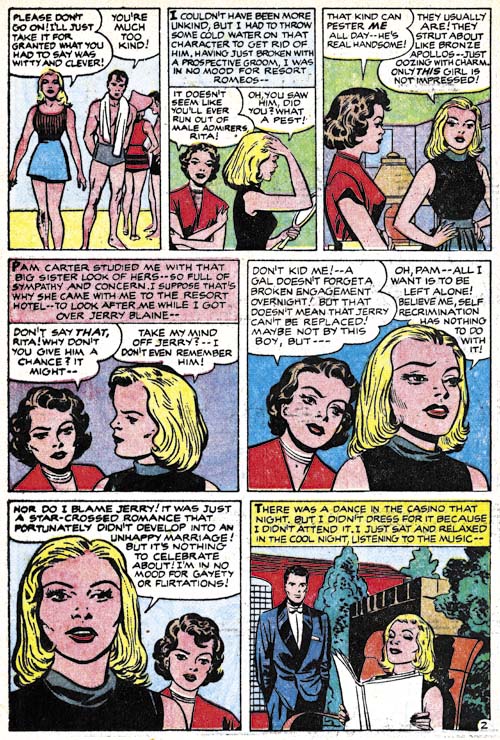
Young Romance #85 (December 1956) “Resort Romeo” page 2, pencils by Jack Kirby
The inking of eyebrows during this period were often done in a simplified but exaggerated manner. The women in panel 5 of the page shown above is a good example. There is some resemblance between these eyebrows and those used by Bill Draut which is the main reason to suggest Draut was the inker for these Kirby pencils. Unfortunately I cannot find any other evidence to support crediting Draut as Kirby’s inker during this period. But I will return to this subject below.

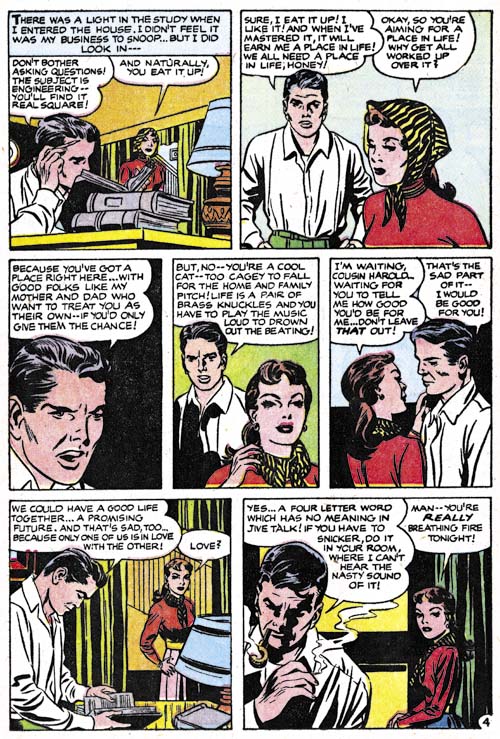
Young Romance #87 (April 1957) “Rock n’ Roll Sweetheart” page 4, pencils by Jack Kirby
Note the inking of the man’s face in the last panel from page 4 of “Rock n’ Roll Sweetheart”. The black shadow down one side of the face is what I refer to as negative highlights. I have never seen Bill Draut use negative highlights but Marvin Stein did and his looked very much like this example. Because the inking evidence does not consistantly suggest one inker, I have decided to no longer attribute the inking to Marvin Stein and for now leave it as an open question.

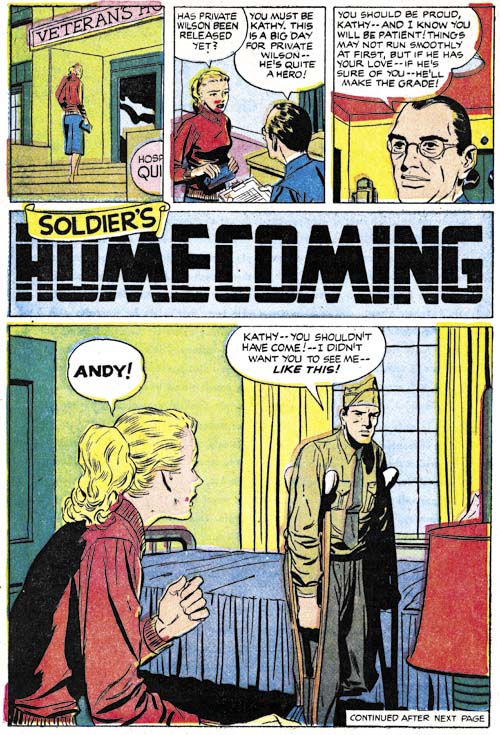
Young Love #73 (December 1956) “Soldier’s Homecoming”, pencils and inks by Bill Draut
Bill Draut provided two of the four stories from the final issue of Young Love. The style is similar to that he was using just prior to the start of the all-Kirby run. However even that was somewhat different from his earlier work. This is most notably seen in the clothing folds which earlier had been somewhat splotchy but now where cleaner and more streamlined.

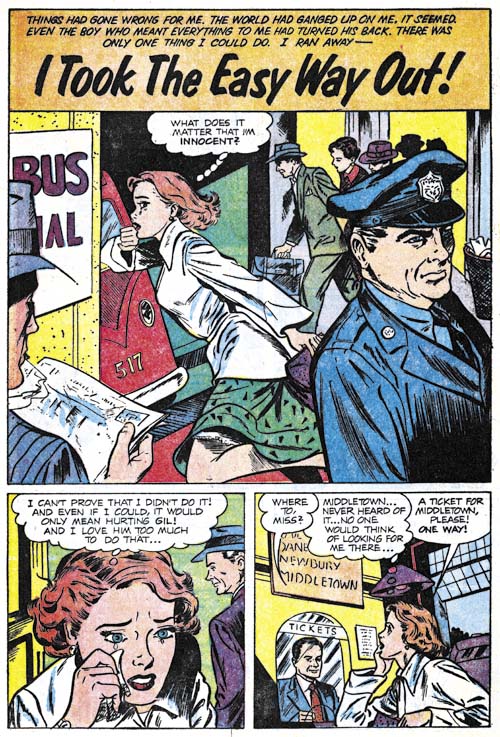
Young Romance #86 (February 1957) “I Took The Easy Way Out”, art by unidentified artist
The first issue (YR #87) of Young Romance after the cancellation of Young Love and Young Brides had only a single Kirby story. Oddly the other three stories were all done by the same artist. He is not a bad artist, but I do not believe I have seen him in a Simon and Kirby production before. It is a puzzle why he suddenly achieved such dominance in this romance title.

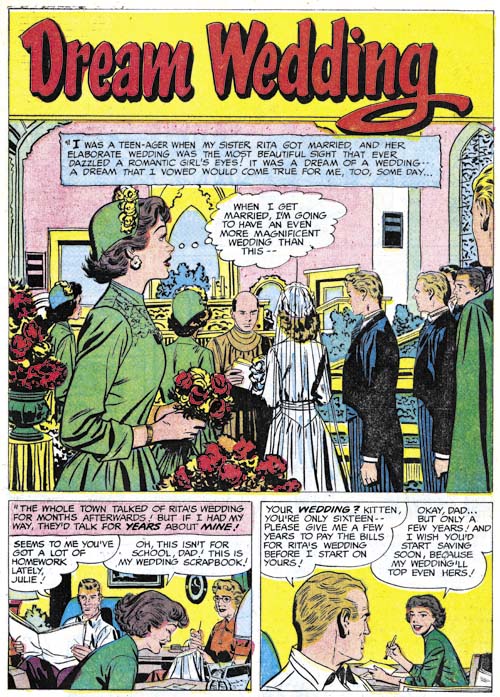
All For Love #1 (April 1957) “Dream Wedding”, art by Bill Draut
As mentioned above, the new Prize romance title All For Love, was not produced by Simon and Kirby. One of the things I will be looking for in future chapters of the Art of Romance was whether the same artists would appear in Young Romance and the Prize titles that were not produced by Simon and Kirby. One artist that shows up in the first issue is Bill Draut. Not only does Draut provide a story but he did the cover art as well. Here Bill is working in the same style we saw Young Romance #86 (February 1957).
Bill had also been appearing in some of the Harvey romance titles at this time which I believe were edited by Joe Simon. But it is unclear whether these were new stories or reprints of older material. In any case work by Draut for Harvey would end at this same time. Draut would not work with Joe Simon on comics until 1966. Bill did work on Sick but right now I am not sure when that was.

All For Love #1 (April 1957) “Hollow Triumph” page 3, art by Mort Meskin?
There are two stories in All For Love #1 that I am somewhat uncertain about. I some ways “Hollow Triumph” reminds me of the work of Mort Meskin. The way the eyebrows are inked might suggest Bill Draut but the story lacks any of Draut’s mannerisms of graphically telling the story, in particular the body language depicted and how the use of view points. Meskin is a better fit in just these graphic qualities. However if this was drawn by Mort I am certain it was not inked by him. Some of the inking reminds me of the unidentified inker for Kirby that I discussed above.

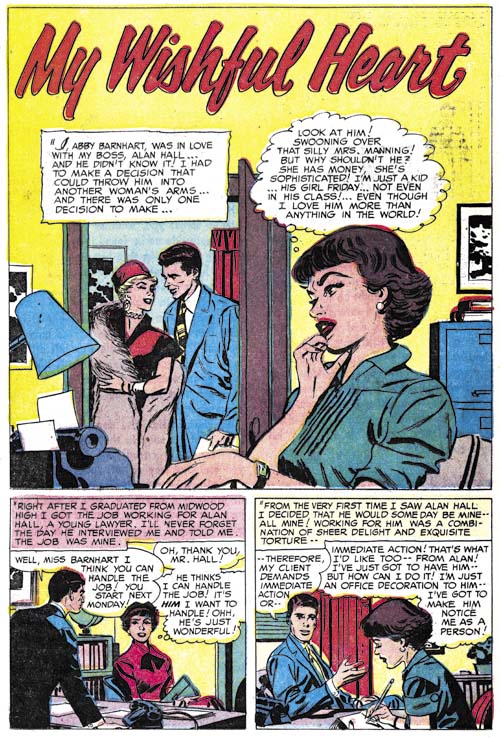
All For Love #1 (April 1957) “My Wishful Heart”, art by Bill Draut?
“My Wishful Heart” is the other story that I questionably attribute to Mort Meskin. Although not identical to “Hollow Triumph” it is close enough to suggest it was done by the same artist.

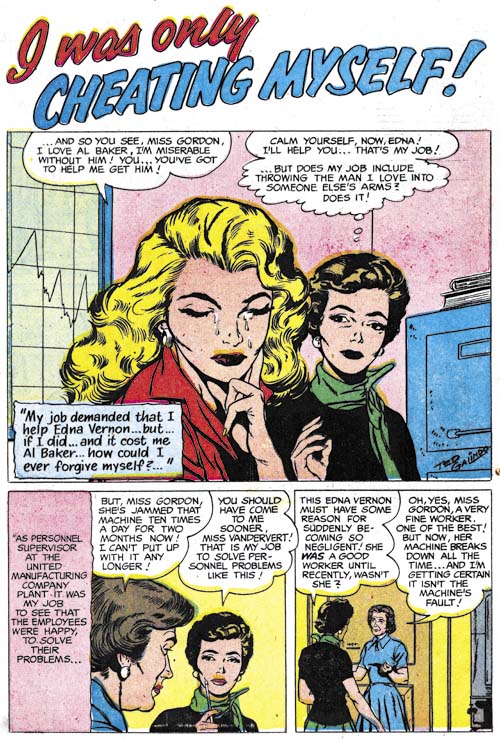
All For Love #1 (April 1957) “I Was Only Cheating Myself”, art by Ted Galindo
The only other romance artist from this period that I can identify other than Jack Kirby, Bill Draut and possibly Mort Meskin was Ted Galindo. Ted does a real nice job on his romance stories. His women are attractive and his art style more modern than most of the artists that I have discussed so far. Galindo’s use of changing viewpoints keeps his stories graphically interesting. we will be seeing more of his work
We are now coming into the final period covered by the Art of Romance. It was always my intention to take this serial post up to 1960. However I am really uncertain how many chapters remain. Frankly overall I find the Prize romance titles from this point on the least interesting of the series. If not for the presence of Jack Kirby I might be tempted to cover it in some future serial post. But there is some really great Kirby art, much of it inked by Jack himself. Plus some other interesting artists appeared from time to time.
Chapter 1, A New Genre (YR #1 – #4)
Chapter 2, Early Artists (YR #1 – #4)
Chapter 3, The Field No Longer Their’s Alone (YR #5 – #8)
Chapter 4, An Explosion of Romance (YR #9 – #12, YL #1 – #4)
Chapter 5, New Talent (YR #9 – 12, YL #1 – #4)
Chapter 6, Love on the Range (RWR #1 – #7, WL #1 – #6)
Chapter 7, More Love on the Range (RWR #1 – #7, WL #1 – #6)
Chapter 8, Kirby on the Range? (RWR #1 – #7, WL #1 – #6)
Chapter 9, More Romance (YR #13 – #16, YL #5 – #6)
Chapter 10, The Peak of the Love Glut (YR #17 – #20, YL #7 – #8)
Chapter 11, After the Glut (YR #21 – #23, YL #9 – #10)
Chapter 12, A Smaller Studio (YR #24 – #26, YL #12 – #14)
Chapter 13, Romance Bottoms Out (YR #27 – #29, YL #15 – #17)
Chapter 14, The Third Suspect (YR #30 – #32, YL #18 – #20)
Chapter 15, The Action of Romance (YR #33 – #35, YL #21 – #23)
Chapter 16, Someone Old and Someone New (YR #36 – #38, YL #24 – #26)
Chapter 17, The Assistant (YR #39 – #41, YL #27 – #29)
Chapter 18, Meskin Takes Over (YR #42 – #44, YL #30 – #32)
Chapter 19, More Artists (YR #45 – #47, YL #33 – #35)
Chapter 20, Romance Still Matters (YR #48 – #50, YL #36 – #38, YB #1)
Chapter 21, Roussos Messes Up (YR #51 – #53, YL #39 – #41, YB #2 – 3)
Chapter 22, He’s the Man (YR #54 – #56, YL #42 – #44, YB #4)
Chapter 23, New Ways of Doing Things (YR #57 – #59, YL #45 – #47, YB #5 – #6)
Chapter 24, A New Artist (YR #60 – #62, YL #48 – #50, YB #7 – #8)
Chapter 25, More New Faces (YR #63 – #65, YLe #51 – #53, YB #9 – #11)
Chapter 26, Goodbye Jack (YR #66 – #68, YL #54 – #56, YB #12 – #14)
Chapter 27, The Return of Mort (YR #69 – #71, YL #57 – #59, YB #15 – #17)
Chapter 28, A Glut of Artists (YR #72 – #74, YL #60 – #62, YB #18 & #19, IL #1 & #2)
Chapter 29, Trouble Begins (YR #75 – #77, YL #63 – #65, YB #20 – #22, IL #3 – #5)
Chapter 30, Transition (YR #78 – #80, YL #66 – #68, YBs #23 – #25, IL #6, ILY #7)
Chapter 30, Appendix (YB #23)
Chapter 31, Kirby, Kirby and More Kirby (YR #81 – #82, YL #69 – #70, YB #26 – #27)
Chapter 32, The Kirby Beat Goes On (YR #83 – #84, YL #71 – #72, YB #28 – #29)
Chapter 33, End of an Era (YR #85 – #87, YL #73, YB #30, AFL #1)
Chapter 34, A New Prize Title (YR #88 – #91, AFL #2 – #5, PL #1 – #2)
Chapter 35, Settling In ( YR #92 – #94, AFL #6 – #8, PL #3 – #5)
Appendix, J.O. Is Joe Orlando
Chapter 36, More Kirby (YR #95 – #97, AFL #9 – #11, PL #6 – #8)
Chapter 37, Some Surprises (YR #98 – #100, AFL #12 – #14, PL #9 – #11)
Chapter 38, All Things Must End (YR #101 – #103, AFL #15 – #17, PL #12 – #14)
Posted in 2010/07, 7 Freelance, Art of Romance, Artists, Draut, Bill, Kirby, Jack, Meskin, Mort, Periods, Prize, Serial Posts, z Archive
Tagged Art of Romance, bill draut, Jack Kirby, Mort Meskin, ted galindo
Leave a comment
Questions on Some Inking in Adventures of the Fly
I have recently posted on the initial issues of the Adventures of the Fly (here and here). There are still unidentified artists that penciled those issues (and more in the two Fly issues that followed). Identifying inkers is an even bigger challenged particularly because I am not that familiar with the brushwork of most of the possible inkers. However I recently noticed some inking in the Adventures of the Fly that was very familiar.

Adventures of the Fly #2 (September 1959) “Sneak Attack” page 2 (part), pencils by Jack Kirby
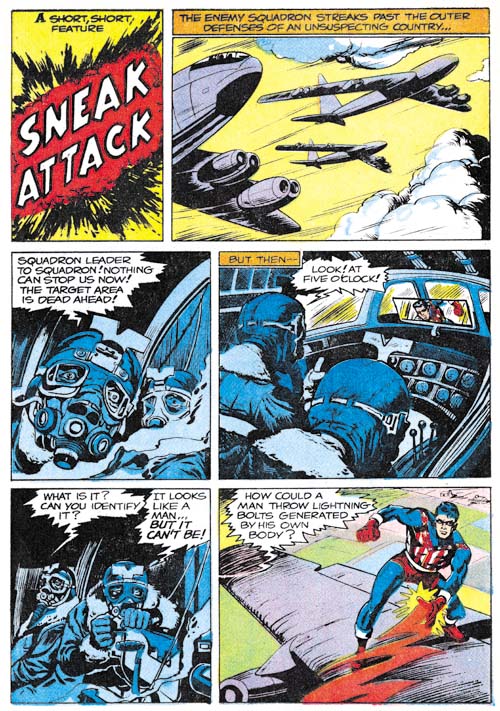
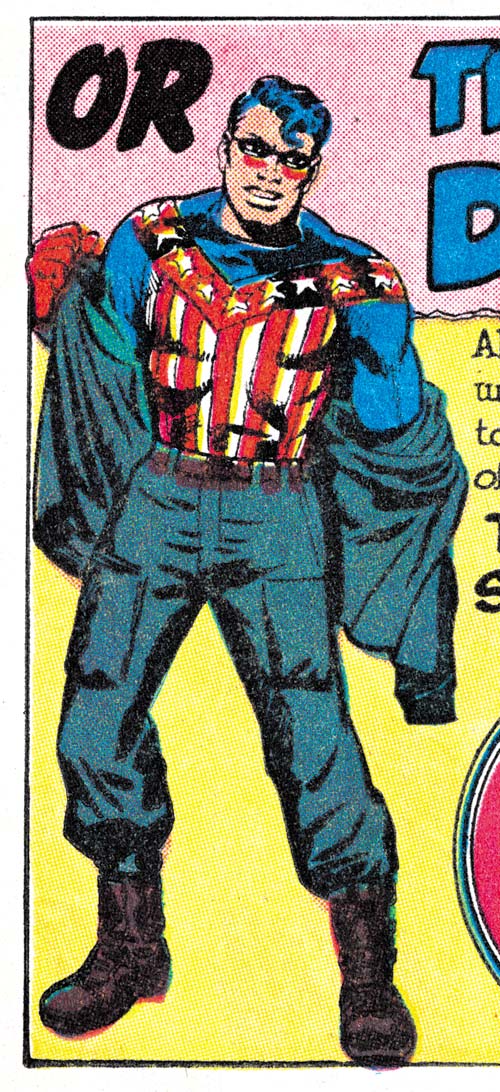
When I last wrote about “Sneak Attack” I attributed the pencils to Joe Simon. Well that was not the complete attribution. The bottom of the second page was an advertisement for the other Archie superhero comic, Double Life of Private Strong. The only art the ad contains is a standing figure of Private Strong changing into the Shield. It seems clear that the art was drawn by Jack Kirby. It is odd that the story and ad were done by different artists. I have studied the original art from Joe Simon’s collection and I can assure the reader that no cut and paste was performed to accomplish this.
The inking for the ad was really nicely done but unfortunately the details of which are obscured by rather poor printing. It is hard to see but the inner sides of both thighs were inked using picket fence crosshatching (Inking Glossary). The good news is that in the upcoming Simon and Kirby Superheroes volume from Titan “Sneak Attack” and the other stories I will be discussing here will be restored from the original art. Similarly robust picket fence brushwork was one of the characteristics of what I refer to as the Studio Style inking used during the Simon and Kirby collaboration. Not only did both Joe and Jack use this technique at that time but Mort Meskin did as well. I think, however, we can dismiss Meskin as the possible inker for the ad because he was no longer working with either Kirby or Simon and the inking here is a bit more spontaneous than was normal for Mort.

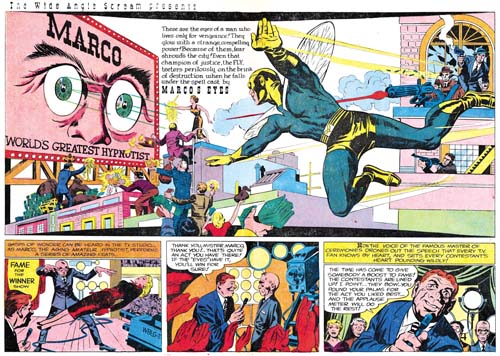
Adventures of the Fly #2 (September 1959) “Marco’s Eyes” splash (part), pencils by Jack Kirby
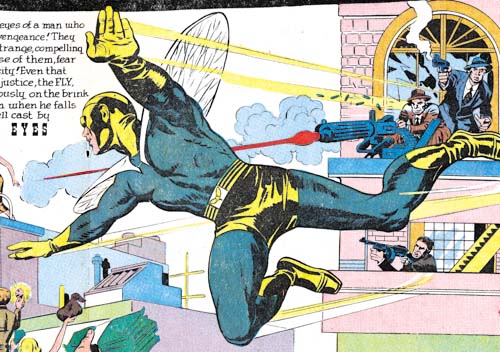
The spotting of the large figure of the Fly in the double page splash for “Marco’s Eyes is more finely worked than typical for either Simon or Kirby although either of them was certainly capable of it. Actually it is more finely worked than the inking found in any of the Fly art. So far I have not identified any brushwork in the figure that helps in determining an inking attribution.

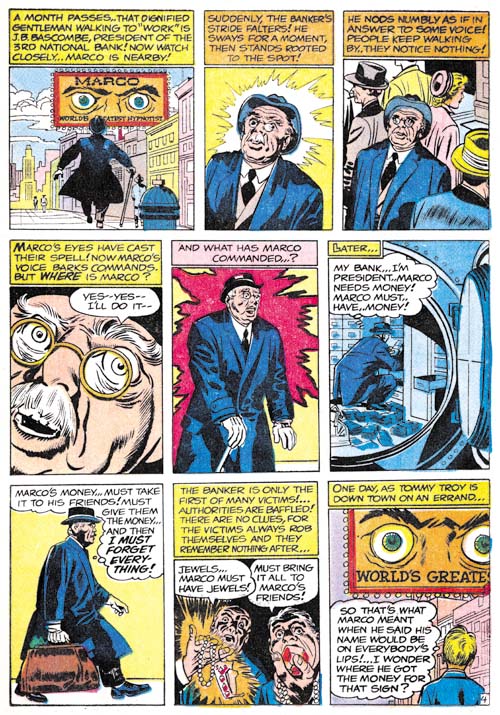
Adventures of the Fly #2 (September 1959) “Marco’s Eyes” page 4, pencils by Jack Kirby
The story art for “Marco’s Eyes” shows an important characteristic that was typical of Studio style inking, what I refer to as shoulder blots (Inking Glossary). It is prominently shown in panels 2, 3 and 5 from page 4 but occurs elsewhere in the story as well. Numerous inkers have provided their shoulders with shadows but shoulder blots are distinct in that they occur on both shoulders regardless of how a shadow would expect to be cast. So far I have only seen Joe Simon and Jack Kirby make use of shoulder blots in their inking.

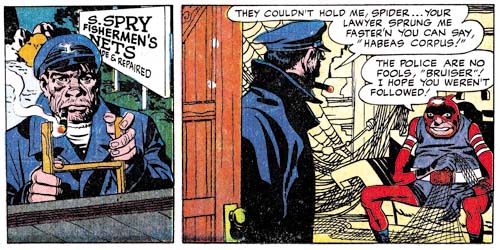
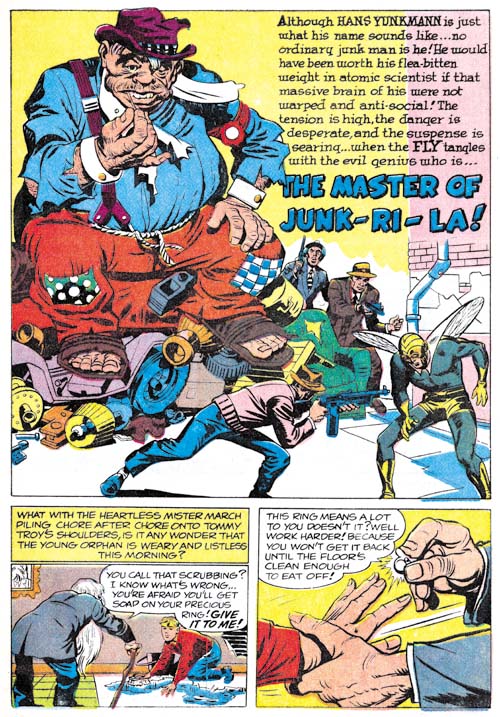
Adventures of the Fly #2 (September 1959) “The Master of Junk-Ri-La” page 2, pencils by Jack Kirby
There are no shoulder blots in “The Master of Junk-Ri-La” unless the shadow in panel 4 from page 2 is counted as one (but I am not inclined to do so). There are, however, a number of examples of course picket fence crosshatching. The first panel from page 2 shows a scallop pattern to the shadow on the boy’s arm. This scallop inking frequently showed up in Kirby’s inking. But the inking of the eyes and eyebrows of the boy look very much like the work of Simon.

Adventures of the Fly #1 (August 1959) “Come Into My Parlor” story panels 3 and 4 from the double page splash, pencils by Jack Kirby
The double page splash and accompanying story panels of “Come Into My Parlor” also contains what looks like Studio style inking. Particularly note the spotting of the sailor from story panels 3 and 4. Observe the two cloth folds on the man’s shoulder in panel 4. These cloth folds show no indication of the tip of the brush which is a technique that was typical of Kirby’s inking. I am less convinced about the inking of the rest of the story. It should be kept in mind that it was common during the Simon and Kirby collaboration for Kirby to be involved with the spotting of the splash and leave the rest of the story to other inkers.
Studio style inking techniques are not limited to the four stories that I have discussed here. But their occurrence elsewhere in the first two issues of Adventures of the Fly seems limited to what looks like touch-ups of the work by other inkers. Such touch-up were almost certainly the work of Simon since Kirby was then a freelancer working from his house.
I only become confident about inking attributions after I have “lived” with them for some time. However it is my policy to present my current views in this blog even if they are likely to be subject to change. At this time I believe “The Master of Junk-Ri-La” was inked by Joe Simon. I am also fairly certain that Jack Kirby inked the splash pages of “Come Into My Parlor”. I am less confident about the inking attributions for the ad from “Sneak Attack” or “Marco’s Eyes”. I currently am crediting Kirby for that inking but I am bother about the frequent appearance of the tip of the brush in the inking which previously was not typical for Kirby although it was for Simon.
Posted in 2010/04, 7 Freelance, Archie, Artists, Kirby, Jack, Periods, Simon, Joe, z Archive
Tagged adventures of the fly, Jack Kirby, Joe Simon
2 Comments