
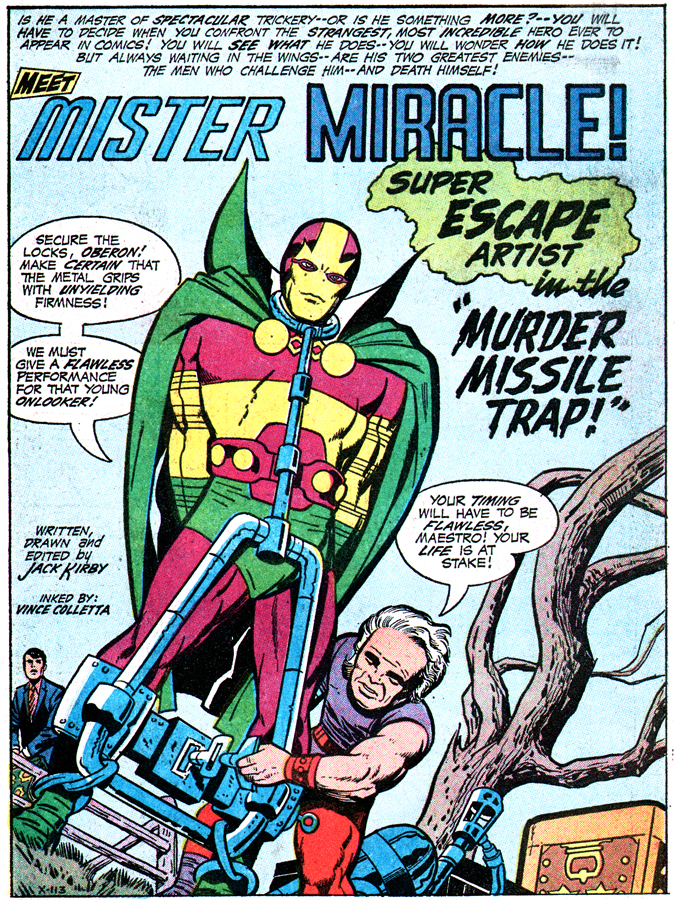
Our story opens with the original Mister Miracle being bound by a metal contraption, placed in a bolted wooden shed and then set ablaze by his assistant’s flamethrower. A young onlooker intervenes but the aging escape artist successfully defies death by bursting free of the flaming structure. And thus Thaddeus Brown meets Scott Free.
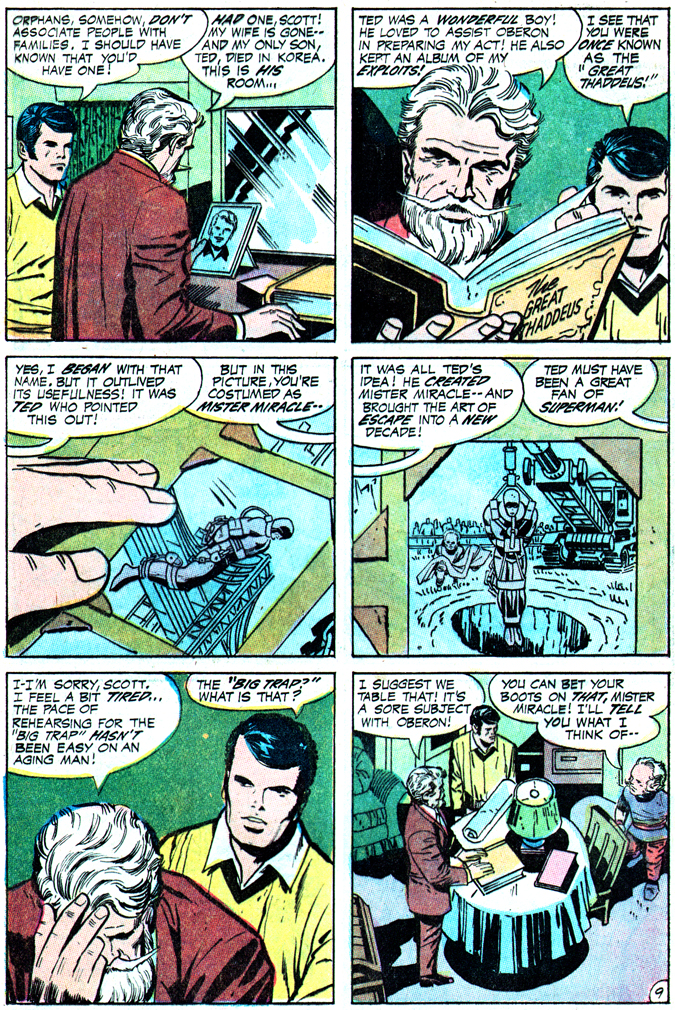
Thaddeus Brown is, of course, the original Mister Miracle, the graying, renowned escape artist formerly known as “The Great Thaddeus,” who now dreams of a return to glory by resurrecting his show business career. He lives with his faithful assistant, the diminutive Oberon, in a pleasant two-story home, which “stands serenely as it always has, in a small, quiet suburb near the city” (presumably Metropolis, where it seems many of the other Fourth World adventures take place on Earth), where he is working to get back into shape for a national campaign. We learn that Thaddeus’ wife has passed away and the escape artist tells Scott Free that his only son died in Korea (this last statement appears untrue, as public relations man Ted Brown enters the series with #10 and stays on as supporting character until #16). Thaddeus says to Scott it was Ted who urged his father to change his act. “Ted was a wonderful boy!” said Thaddeus. “He loved to assist Oberon in preparing my act! He also kept an album of my exploits!”
“I see you were once known as the ‘Great Thaddeus!’” Scott says, taking note of the scrapbook’s cover.
“Yes, I began with that name, but it outlived its usefulness! It was Ted who pointed this out!” Thaddeus explains. “It was all Ted’s idea! He created Mister Miracle — and brought the art of escape into a new decade!”
His plan to return to public performing is called “The Big Trap,” where Thaddeus is tightly bound by locked metal straps to a tree trunk situated at the bottom of an incline. At the top of the adjacent hill is secured an enormous metal sphere (“This thing weighs a ton!” yaps Oberon) and between that and the tree is a flume-like track constructed to guide the ball straight for the elderly showman. Oberon is terrified of Thaddeus’ condition and the lethal risk the escape artist is taking. In fact, the small person is a constant nag to his employer: “Don’t go through with this, maestro! I beg you — Be content with your past greatness! — During these years of inactivity — time has passed you by!” and “You were slow! Slow! Age has dimmed your senses and time has knotted your reflexes!”
Even while Thaddeus tells his friend, “Don’t scold me, Oberon! I’m doing well — soon I will do better!” Oberon does have a point. Thaddeus is likely in his mid-sixties, and despite sporting a magnificent beard and full head of hair (both snow-white), and also physically impressive and by appearances virile, he suffers from fatigue and even with the Great Thaddeus’ protestations to the contrary, his timing is off. Plus, the escape artist has the added liability of a most powerful enemy.
When Thaddeus and Scott first meet, they are interrupted by Inter-Gang goons “moving with silent, evil assurance — symbols of organized crime in the atomic age.” Not only does the head thug bandy about handguns, he is also rude, telling Thaddeus, “You creak — like one of your antique clocks!” We learn the gang’s boss is Steel Hand and a donnybrook ensues, with Scott and his carpetbag joining in. Steel Hand’s henchmen are defeated and, apparently delighted with Scott’s help during the fracas, invites the wanderer to stay in the Brown household.
Scott shows off his own impressive skills as a burgeoning escape artist and Thaddeus and Oberon are increasingly impressed with this stranger. Thaddeus alludes to an unpaid wager owed him by Steel Hand and we learn this standing debt is becoming a matter of pride with the criminal kingpin.
Tragically the Great Thaddeus, bound to the tree trunk in full-dress rehearsal for “The Big Trap,” is struck by a sniper’s bullet and while he is saved by some miraculous moves by Scott Free from being crush by the metal sphere, his life is ebbing away. “Too late — Scott — no more miracles for me,” he tells his new prodigy. Scott comforts him on the grass, as the old man says, “There’s nothing you can do, Scott! The act is finished!” Thaddeus then reveals Steel Hand was likely behind his assassination and, death coming close, he implore Scott to say by his side. Scott takes a device strapped to his upper arm and holds it next to Thaddeus’ ear. “What is it — I hear — a sound — a voice — comforting, easing — the pain is — gone –” and Thaddeus Brown, the original Mister Miracle passes this world into the great unknown.
If I may be granted some personal comments (though I’ve tried to keep things pretty descriptive with minimal opining — no easy task for me!), I still ponder over the symbolism and plot device of Thaddeus Brown in the Mister Miracle opus. I have heard, for instance, that elements of Mister Miracle are based on real-life escape artist (and comic-book legendary writer/artist/designer) Jim Steranko, a friend of Jack’s, and that leads me to speculate whether Thaddeus represents Jack and Scott symbolizes Jim, thus a dramatic “passing of the torch”… Nahhh, doesn’t ring true to me, as Jack was at the height of his game during this time. Does Scott Free seek out Thaddeus because the performer is out of the limelight, living relatively secluded in the suburbs, and thus away from the prying eyes of Darkseid’s minions in the city…? Does Scott want folks to believe he is Thaddeus Brown and that’s why he assumes the Mister Miracle identity?
It’s agonizing that I’m so far unable to get a grasp on this aspect of the Scott Free mythos, as I believe the character to be the most resonate in the Fourth World, a physical representation of life in the face of death, of happiness surrounded by misery, of hope coming through overwhelming despair… In other words, Scott Free seems to be an autobiographical character, more so than Captain America, or Scrapper, or Ben Grimm… Do you have any idea?